
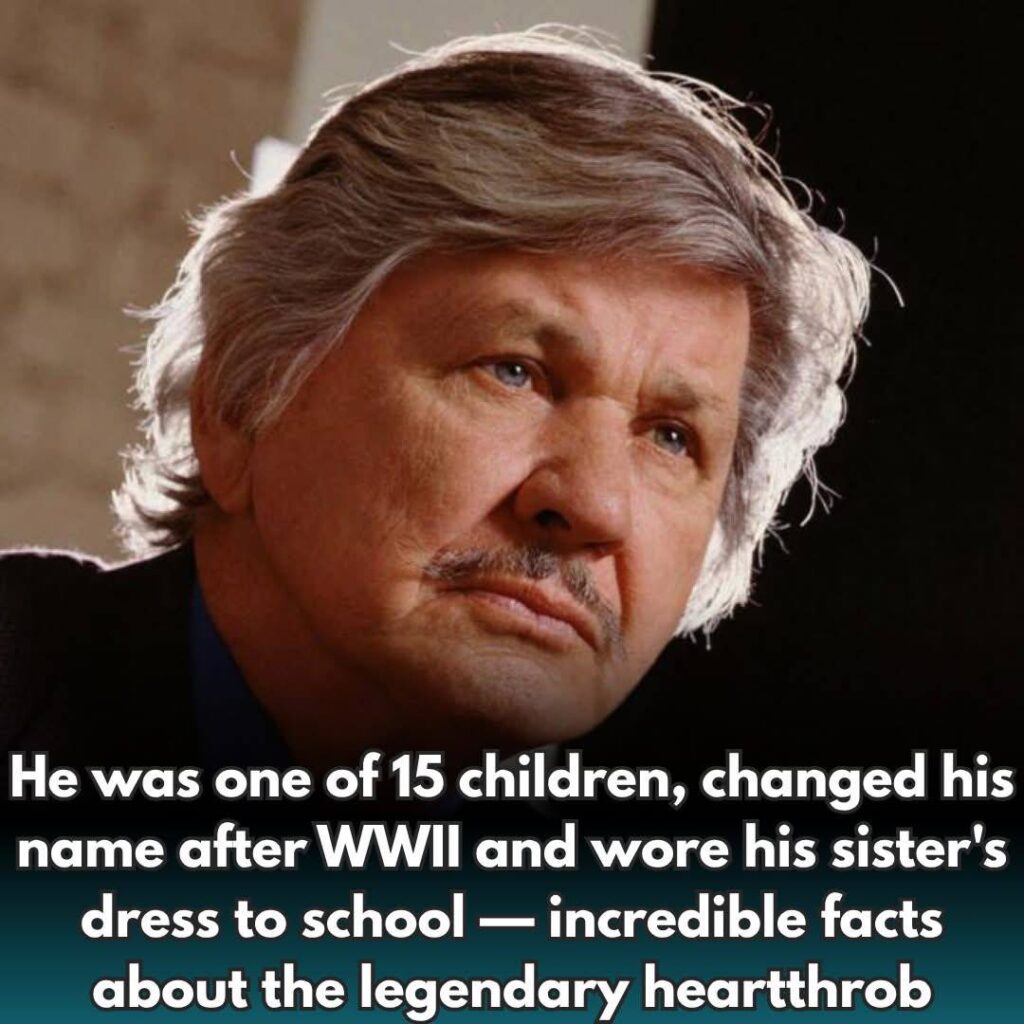
Long before Charles Bronson became one of Hollywood’s toughest action stars, he was a poor boy growing up in a Pennsylvania coal camp where survival came before dreams. Decades after finding worldwide fame, the actor admitted he never escaped the emotional scars of his childhood, once saying he felt like “the lowliest of all forms of man.”
Born on November 3, 1921, as Charles Dennis Buchinsky, Bronson entered the world in Ehrenfeld, Pennsylvania, a coal-mining community about 60 miles outside Pittsburgh. He was the 11th of 15 children born to Lithuanian immigrant parents, and from the beginning, life revolved around the mines.


5
A Childhood Defined by Poverty
Bronson’s family lived in a tiny company-owned shack just yards from the railroad tracks that carried coal from the mines. The house was so cramped that family members often slept in shifts because there simply wasn’t enough room for everyone at once.
The town itself offered little hope. There were no sidewalks, few trees, and even clean drinking water was scarce. Nearly everyone either worked in the mines or for the mining company, leaving few opportunities for children to imagine a different future.
Money was constantly tight, and Bronson later recalled the embarrassment that came with extreme poverty. At one point, he had no choice but to wear his older sister’s hand-me-down clothes—including dresses—to school because the family couldn’t afford anything else.
Those experiences stayed with him for the rest of his life.
Forced Into the Mines as a Teenager
When Bronson was still a teenager, tragedy struck after his father died.
Instead of continuing his education, he left school to help support his mother and siblings. His only real option was to join the same coal mines that had consumed so many lives in his hometown.
The work was brutal.
Bronson remembered spending long hours underground surrounded by darkness, breathing coal dust, and performing exhausting physical labor while still just a boy.
He later admitted that those years permanently shaped how he viewed himself.
“During my years as a miner, I was just a kid, but I was convinced that I was the lowliest of all forms of man.”
He recalled constant headaches from the work and remembered how coal dust filled his nose every day. Even after leaving the mines, he said he could never fully forget the smell or the feeling of working beneath the earth.
A Lasting Inferiority Complex
The emotional damage proved just as lasting as the physical hardship.
Bronson said nearly everyone who worked in the mining community developed an inferiority complex. To the miners, railroad workers and steelworkers seemed to occupy a much higher social status.
He also remembered feeling embarrassed by his rough hands.
One memory stayed with him for decades: while dancing with a girl, his calloused hand snagged on her dress and wouldn’t come loose, a painful reminder of how different his life was from everyone else’s.
Reflecting on those years, Bronson described life underground as living “on your knees,” surrounded by darkness and dust that never truly disappeared.
The Army Changed Everything
Bronson often said being drafted into the U.S. Army during World War II was the best thing that had ever happened to him.
For the first time, he had regular meals, proper clothing, and the opportunity to improve his English.
Military service also exposed him to a world beyond the mines and helped him believe he could build a different future.
When the war ended, he returned home determined not to spend the rest of his life underground.
Finding a New Life in Hollywood
After leaving the military, Bronson studied art before enrolling at the Pasadena Playhouse in California, where his acting ability quickly caught the attention of instructors.
One teacher recommended him to director Henry Hathaway, opening the door to Hollywood.
Bronson made his film debut in You’re in the Navy Now in 1951, though many of his early appearances went uncredited.
Throughout the 1950s, he slowly built his résumé with supporting roles before earning critical attention in Vera Cruz. His breakthrough continued with starring roles in Machine-Gun Kelly and eventually the film that made him an international icon—Death Wish in 1974.
The revenge thriller became one of the defining action films of its era and launched four sequels, cementing Bronson’s reputation as one of Hollywood’s toughest leading men.
Before acting fully paid the bills, however, Bronson worked wherever he could. He earned money as a bricklayer, short-order cook, onion picker, painter, and even rented benches along the Atlantic City boardwalk.
Why He Changed His Name
Bronson was born Charles Dennis Buchinsky, but during the anti-Communist atmosphere of the 1950s, he worried his Eastern European surname would hurt his career.
He eventually adopted the stage name Charles Bronson, believing it would be easier for American audiences to accept.
Although his name changed, he never forgot where he came from.
Friends and colleagues often said that despite becoming one of cinema’s biggest stars, Bronson remained guarded around strangers. Those who earned his trust, however, described him as warm, funny, and surprisingly gentle.
Love, Loss, and His Final Years
Bronson married three times.
His first marriage to Harriet Tendler lasted from 1949 to 1967, and together they had two children.
He later married British actress Jill Ireland, who appeared alongside him in several films. Their marriage lasted until Ireland died from cancer in 1990.
In 1998, Bronson married Kim Weeks, who remained by his side during his final years.
Later in life, the legendary actor developed Alzheimer’s disease. As his condition worsened, Weeks became his full-time caregiver, accompanying him everywhere and helping manage his declining health.
Family members noticed that his speech had slowed and sometimes became slurred, though they said he still recognized loved ones and treasured spending time with them.
After suffering pneumonia, Bronson’s health rapidly deteriorated.
He died on August 30, 2003, at Cedars-Sinai Medical Center in Los Angeles at the age of 81.
A Tough Man Shaped by a Tough Beginning
Charles Bronson became one of Hollywood’s most recognizable action stars, but beneath the tough exterior was a man who never forgot the hardships that shaped him.
From wearing his sister’s clothes because his family couldn’t afford his own, to spending his teenage years deep inside coal mines, Bronson carried those memories throughout his life.
Even after achieving worldwide fame, earning millions, and starring in blockbuster films, he often spoke less about Hollywood than about the poverty, pain, and determination that made him who he was. For Bronson, escaping the mines changed his future—but it never erased his past.