
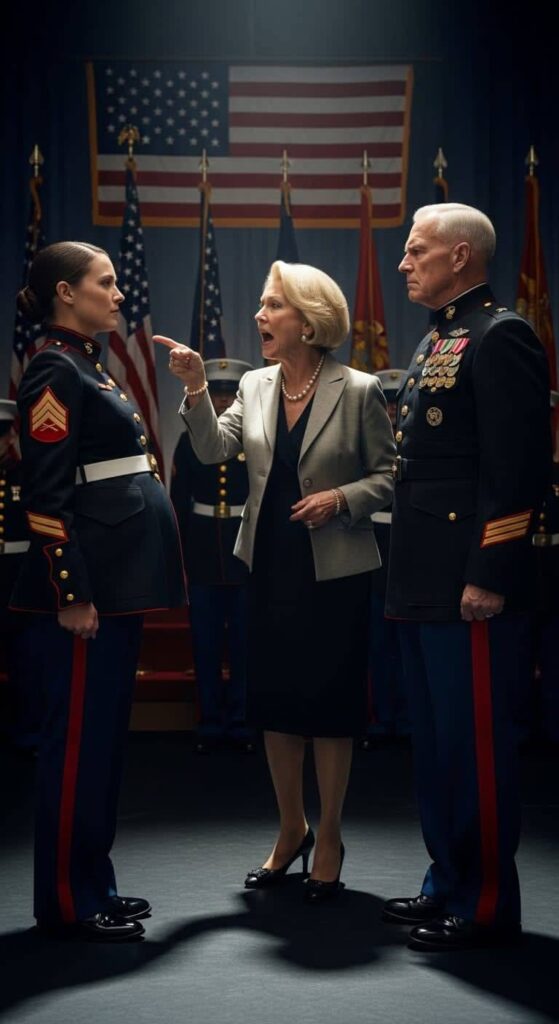
The stiff, high collar of my blouse bit into my neck, a familiar, grounding pressure. I stood before the full-length mirror in the staging room, my hands moving with practiced, rhythmic precision over the brass buttons of my Dress Blues. The fabric was immaculate, the creases sharp enough to draw blood. I was twenty-six weeks pregnant, and the subtle outward curve of my stomach beneath the tailored wool was a heavy, beautiful reminder of my dual existence. I was a protector of the nation, and I was a bringer of life. A sharp kick fluttered against my ribs. I placed a hand over the spot, taking a slow, steadying breath that smelled faintly of brass polish and starched cotton.
We were at the Quantico Marine Corps Base in Virginia, the very beating heart of military tradition. Outside these walls, high-ranking officers and dignitaries were gathering under the cavernous, vaulted ceilings of the main auditorium. They were here for me. Today, I was to be pinned as a Staff Sergeant.
Promoted Content
The door unlatched with a sharp click. Eleanor Sterling walked in.
Her designer heels struck the linoleum like a
countdown to a detonation. She brought the scent of expensive, cold
orchids and old money into the room, instantly souring the air. She
didn’t look at my face. Her pale, icy eyes immediately dropped to the
red stripes stitched onto my sleeves, her lips curling into a
microscopic sneer.
“You
look quite the part, Maya,” Eleanor said, her voice dripping with an
artificial sweetness that coated the back of my throat like syrup. “It’s
amazing what a tailor can do for… someone of your background. But let’s
not forget, when the lights go down, David still needs a wife who knows
how to run a household, not just bark orders at privates.”
My jaw tightened, the muscles ticking beneath
my skin. Through the mirror, I met her gaze. My expression was a
perfectly constructed mask of military discipline, forged over years of
grueling pressure. “I don’t bark orders, Eleanor. I lead Marines. And
today, I’m being recognized for it.”
Eleanor stepped closer, invading my space. Her
smile didn’t reach her eyes as she reached out to straighten a ribbon on
my chest. Her grip on the fabric was uncomfortably, intentionally
tight, her manicured nails digging slightly into the wool. “We’ll see
how long the ‘General’s favorite’ lasts when real life catches up to
you.”
She turned on her heel and glided out of the room. A moment later, my husband, David,
peeked in. He looked exhausted, a man perpetually caught in the
crossfire between the wife he loved and the mother whose psychological
grip he had never managed to break. He offered me a weak, apologetic
smile before retreating to follow her.
As I adjusted my white cover and walked toward
the heavy oak auditorium doors, I caught sight of them in the hallway. I
noticed Eleanor whispering something harsh and urgent into David’s ear.
Whatever she said made all the blood drain from his face. He turned
pale, his shoulders slumping, and he actively avoided my eyes as the
usher led them to their front-row seats. Just as the ceremonial music
started to swell through the speakers, I felt a sudden, sharp chill
crawl up my spine. It wasn’t the aggressive air conditioning. It was the
terrifying realization that Eleanor wasn’t just here to watch me. She
was here to destroy me.
The auditorium was a sea of navy blue, olive
drab, and gleaming gold. The floor was polished to a mirror finish,
reflecting the brilliant overhead lights. As my name echoed through the
sound system, accompanied by a recitation of my service record, a
profound sense of pride swelled in my chest. Seated on the dais was General Marcus Thorne, a legendary four-star commander whose very presence added a gravitational weight to the room.
I began my march across the stage. My posture
was flawless, my measured steps echoing in time with the deep thrum of
my own heartbeat.
As I passed the front row, a blur of beige
leather darted into my periphery. Eleanor’s designer pump extended
directly into my path.
There was no time to correct my momentum. The world tilted violently. I went down hard.
Time seemed to fracture into excruciatingly
slow, jagged pieces. The impact shuddered up my knees and hips, but my
instincts overrode the pain. I twisted mid-air, throwing my hands out to
shield my stomach, taking the brunt of the fall on my elbows and
shoulder. The thud of my body hitting the polished wood echoed through
the microphone.
The
silence that followed was deafening. It was a thick, suffocating vacuum
of collective shock from five hundred trained warfighters.
As I lay there, gasping for the breath that
had been knocked from my lungs, a shadow fell over me. Eleanor leaned
over. To the crowd behind her, it must have looked like a mother-in-law
rushing to help. But her face was twisted into a mask of pure,
unfiltered malice. Her voice was a venomous hiss, meant only for my
ears:
“A black girl in a uniform is still just a maid to me. You’ll lose that baby and my son will find a real wife.”
Before I could even process the absolute
horror of her words, the stage shook. General Thorne didn’t just step
down from the dais; he charged. He moved past the stunned Military
Police with the unstoppable momentum of a freight train, planting his
massive frame between my fallen body and Eleanor. He looked like a
mountain of granite.
“You just assaulted a United States Marine and
a federal officer!” Thorne roared. His voice vibrated in the rafters,
cracking like thunder across the silent room.
The entire auditorium froze. David sat
paralyzed in his chair just three feet away, his face a mask of absolute
horror, his mouth opening and closing without sound.
The General turned slightly, his flinty eyes
softening for a fraction of a second as he looked down at me. “Staff
Sergeant, give me the word, and she never sees the light of day again.”
My
hands trembled as I pushed myself off the floor. I ignored the
throbbing pain in my shoulder and the frantic racing of my heart. I
refused the hands offered by the approaching MPs. Standing tall, I
looked down at my Dress Blues and brushed a smudge of dust from my
sleeve with a precision that was cold and terrifying. I looked at
Eleanor, who was finally, for the first time in her life, showing a
flicker of genuine fear. Then, I shifted my gaze to David.
“General,” I said, my voice low, steady, and chillingly clear. “Let the law break her… I’ve already cut her out of the will.”
The word “will” hit the air like a physical
blow. A visible shockwave ripped through David’s posture. In that
fractured second, looking at his mother’s sudden confusion and his
wife’s unyielding stance, David finally realized the catastrophic
magnitude of what his mother had just cost them.
The sterile, fluorescent-lit walls of the
Provost Marshal’s Office holding room felt miles away from the grandeur
of the auditorium. I sat at a metal table, my hands protectively folded
over my bump, feeling the reassuring flutters of my baby. Across from
me, Eleanor was pacing like a caged, indignant peacock.
“It was a trip! A clumsy girl in heavy heels!”
she shrieked at the stoic MP guarding the door. “Do you know who I am? I
am a Sterling!”
The door opened, and David stumbled in. He
looked utterly broken, his tie askew, his eyes red-rimmed and pleading.
He bypassed his mother and fell into the chair across from me. “Maya,
please,” he begged, his voice cracking. “Please, she’s my mother. She’s
old, she’s stressed. You can’t do this. If you press charges, the
Sterling name is ruined. It will be in all the papers. Think about the
baby’s future inheritance! Think about our family.”
A cold dread had once lived in my gut whenever David invoked his mother’s legacy. Now, there was only an absolute, icy clarity.
“The Sterling name is a hollow shell, David,” I
said quietly, the calmness of my voice stark against his panic. “Did
you actually think I was marrying you for your mother’s approval? Or her
money?”
Eleanor scoffed loudly from the corner. “As if a girl from your neighborhood had a dime to her name before you trapped my son.”
I didn’t look at her. I kept my eyes locked on
David. I reached into the breast pocket of my uniform blouse and slowly
slid a folded, notarized document across the aluminum table.
“My father’s tech firm went public when I was eighteen, David,” I explained, watching his eyes dart over the legal jargon. “The Vance Family Trust
was the only thing keeping the Sterling ‘investments’ afloat this year.
Your mother’s country club memberships, the mortgage on the Charleston
estate, the cars—all subsidized by the ‘maid’ she despises.” I tapped
the paper. “I signed the restructuring papers an hour before the
ceremony. Your mother is no longer a beneficiary. The accounts are
frozen. And as for the maid she thinks I am? She’s about to find out
exactly how well a maid cleans house.”
Eleanor lunged forward, snatching the paper.
As her eyes scanned the signatures, all the color drained from her
perfectly rouged cheeks. The arrogant facade crumbled, leaving behind
the terrified face of a woman who had just realized she was standing
over an abyss.
David looked from the document to his mother,
and then finally to me. He collapsed back into his chair, burying his
face in his hands. He realized that his mother’s bigotry had not only
invited a federal prosecution but had effectively bankrupted their
family’s entire future in a single afternoon.
Just
then, the heavy steel door swung open. A sharp-looking officer from the
Judge Advocate General corps stepped into the room, holding a thick
file. “Staff Sergeant Vance?” he asked, his tone brisk and respectful.
“The General has authorized a full tribunal inquiry into the assault.
And there’s someone else here who needs to speak with you right away—the
District Attorney.”
The military courtroom was a masterpiece of
austere intimidation. Dark wood, flags bearing battle streamers, and an
atmosphere so heavy with protocol you could choke on it. The gallery,
however, was a jarring contrast. It was packed wall-to-wall with the
very East Coast socialites Eleanor had spent decades desperately trying
to impress. They whispered behind manicured hands, their eyes darting
between me, seated at the prosecution’s table, and Eleanor, who sat
rigid at the defense table, wearing a designer suit that suddenly looked
like armor that was two sizes too big.
General Thorne sat in the very front row, an immovable pillar of brass and authority.
The prosecutor, a razor-sharp Major, stood
before the judge. “Your Honor, the defense claims this was an
unfortunate stumble. We submit Exhibit A to prove premeditation and
malicious intent.”
The lights dimmed. The giant screen above the
judge’s bench flickered to life. The base archives had been recording
the ceremony in high-definition 4K. The footage played in agonizing slow
motion. It showed my approach. It showed Eleanor’s eyes tracking my
boots. It clearly showed her foot dart out, hook my ankle, and twist.
The malice in the movement was undeniable.
But the video wasn’t what broke the room.
“Your
Honor, Staff Sergeant Vance was wearing a lapel microphone,
pre-activated for her acceptance speech,” the Major announced. “We ask
the court to listen to the isolated audio track.”
The speakers hissed. And then, Eleanor’s
voice, crystal clear, unvarnished, and dripping with generational
hatred, filled the grand chamber.
“…still just a maid to me. You’ll lose that baby and my son will find a real wife.”
A collective, horrified gasp ripped through
the gallery of socialites. Eleanor flinched as if struck by a physical
blow. The Judge, a formidable woman with deep lines of experience etched
into her face and a known history of ruthlessly protecting service
members, stared down at the defense table with an expression of pure,
unadulterated disgust.
“Mrs. Sterling,” the Judge said, her voice
dropping the temperature in the room by ten degrees. “You didn’t just
trip a pregnant woman. You attacked the dignity of the United States
Armed Forces, and you did so with a level of racial vitriol that sickens
this court.”
The turning point, however, came when the prosecution called their next witness.
“The prosecution calls David Sterling to the stand.”
David
stood up from the gallery. He looked hollowed out. As he took the oath,
his mother glared at him, silently demanding his loyalty, demanding he
lie for her as he always had. But as he sat down, he looked across the
room at me. He looked at the uniform I wore, at the life growing inside
me, and the illusion of his mother’s supremacy finally shattered. Under
oath, he corroborated everything. The history of abuse, the financial
parasitism, and the threat whispered in the hallway before the ceremony.
It was a total, absolute slaughter.
As the Judge struck her gavel, preparing to
read the bail conditions and her initial ruling on the federal charges,
Eleanor lost the last shred of her sanity. She leaped to her feet,
pointing a trembling, accusing finger at me. “You’ve bewitched my son!
You’re nothing! You are nothing but trash playing dress-up!”
The MPs moved in instantly, but David stood up
from the witness stand. He didn’t walk toward his mother to defend her.
He walked purposefully across the well of the court and took an empty
seat directly behind my chair. He chose his side.
As the MPs clamped the heavy metal handcuffs
around Eleanor’s wrists, her scream of “Traitor!” echoed violently
through the marble halls, a desperate, fading sound as she was dragged
away.
Three months later, the hospital room at Walter Reed National Military Medical Center
was quiet, save for the soft, rhythmic beeping of the monitors. The air
smelled of clean linen and the distinct, powdery scent of a newborn.
I sat in the adjustable bed, holding my daughter, Sarah.
She was tiny, perfect, and blessedly healthy. Her dark eyes blinked up
at me, reflecting a world that was entirely new and unblemished.
David sat in the armchair by the window. He
looked older, heavier, but for the first time since I’d met him, he
looked like a man who had actually grown up. The past few months had
been a brutal dismantling of his past. With the Vance Family Trust
severed, the Sterling estate had collapsed like a house of cards in a
hurricane. David had spent his days liquidating assets, selling the
Charleston mansion to pay Eleanor’s massive legal fines, and moving his
mother into a small, state-assisted studio apartment on the outskirts of
the city.
The media had a field day. The “Sterling Fall”
was splashed across society pages and news networks, serving as a
vicious cautionary tale of old-money bigotry meeting modern
accountability. Eleanor had been handed a heavy suspended sentence,
crushing fines, and a permanent, ironclad restraining order that barred
her from ever coming within five hundred yards of me or my daughter.
A nurse walked in softly, carrying a small
stack of mail that had been vetted by base security. She handed me a
thick, cream-colored envelope. I recognized the embossed cursive
handwriting immediately. It was a letter from Eleanor, no doubt pleading
for a chance to see her granddaughter, begging for a lifeline back into
the world she had thrown away.
I didn’t even break the wax seal. I looked at
the envelope for a second, feeling absolutely nothing. No anger. No
triumph. Just an overwhelming sense of apathy.
I handed it back to the nurse. “This is junk mail,” I said calmly. “Please shred it.”
I looked down at Sarah. She would never know
the sting of being called a “maid” by someone who was supposed to be
family. She would never have to shrink herself to fit into the cramped,
suffocating boxes built by people like Eleanor Sterling.
Just
as the nurse wheeled the bassinet closer for my discharge, a familiar,
imposing figure appeared in the doorway. General Thorne stood there,
dressed in his everyday cammies. He wasn’t there as a superior officer
today; the warmth in his eyes said he was there as a friend.
He walked over, peered down at Sarah with a
gentle smile, and then pulled a small, velvet box from his pocket. He
placed it in my palm. I opened it. Inside rested a gleaming set of
Gunnery Sergeant stripes.
“A rank you haven’t technically reached yet,”
Thorne whispered, his voice gravelly and fond. “But one that is
officially reserved for you upon your return from maternity leave. The
Corps doesn’t forget who stood their ground, Gunny.”
He paused, a dark, amused glint appearing in his eye. “But there’s one more thing you should know about Eleanor’s legal appeal…”
Five years later, the sun was setting over the National Mall
in Washington, D.C., casting long, golden shadows across the reflection
pool. The air was crisp, carrying the scent of roasted peanuts and
autumn leaves.
I walked along the gravel path, the chevrons
of a Master Sergeant now firmly sewn onto my sleeves. Beside me,
five-year-old Sarah skipped along, wearing a miniature Marine Corps
sweatshirt, her hand tightly gripping mine. We had just finished a visit
to the monuments, a weekend tradition.
As we approached a public bus stop near the edge of the park, I slowed down.
Sitting on the graffitied bench, clutching a
tattered, reusable grocery bag, was an elderly woman. It took me a
moment to recognize her. It was Eleanor. The years had not been kind.
She looked decades older than her actual age. The tailored Chanel suits
were gone, replaced by a faded, ill-fitting wool coat. The haughty
posture had collapsed into a defeated hunch.
As we walked past, she looked up. Our eyes locked.
For a fraction of a second, I saw a flicker of
the old, familiar venom spark in her pale eyes. But it was quickly
drowned out. It died, replaced by a haunting, hollow realization of
everything she was looking at. She was looking at the thriving, powerful
legacy she had tried to abort, holding the hand of the granddaughter
she would never be allowed to touch.
I didn’t stop. I didn’t smile. I didn’t gloat.
I felt no need to conquer an enemy who had already destroyed herself. I
simply adjusted my grip on Sarah’s hand and kept walking, my boots
crunching rhythmically on the gravel.
“Mommy, did you know that lady?” Sarah asked, her big eyes looking up at me with innocent curiosity.
I looked ahead, toward the towering white
spire of the Washington Monument, standing as a testament to the country
I had served with every fiber of my being.
“No,
baby,” I replied, my voice steady and light in the evening air. “She’s
just someone who forgot that a uniform is earned, but respect is a
choice. We choose to walk with the people who see us for who we are.”
As we walked away, the distance growing
between us and the ghosts of the past, my phone vibrated in my pocket. I
pulled it out. It was a secure notification from command detailing my
new assignment. I was being sent back to Quantico—the very base where
the nightmare had begun. But this time, I wasn’t returning as a junior
NCO trying to prove herself. I was returning as the Lead Coordinator for
the incoming class of female officers.
I smiled, sliding the phone back into my
pocket. The story Eleanor had tried to violently end in that auditorium
was actually just the prologue to a dynasty. I looked up at the twilight
sky, feeling the weight of the future resting comfortably on my
shoulders, and whispered to myself, “Ready for the next watch.”
If you want more stories like this, or if
you’d like to share your thoughts about what you would have done in my
situation, I’d love to hear from you. Your perspective helps these
stories reach more people, so don’t be shy about commenting or sharing.