
Chapter 1: The Weight of an Overnight Mother
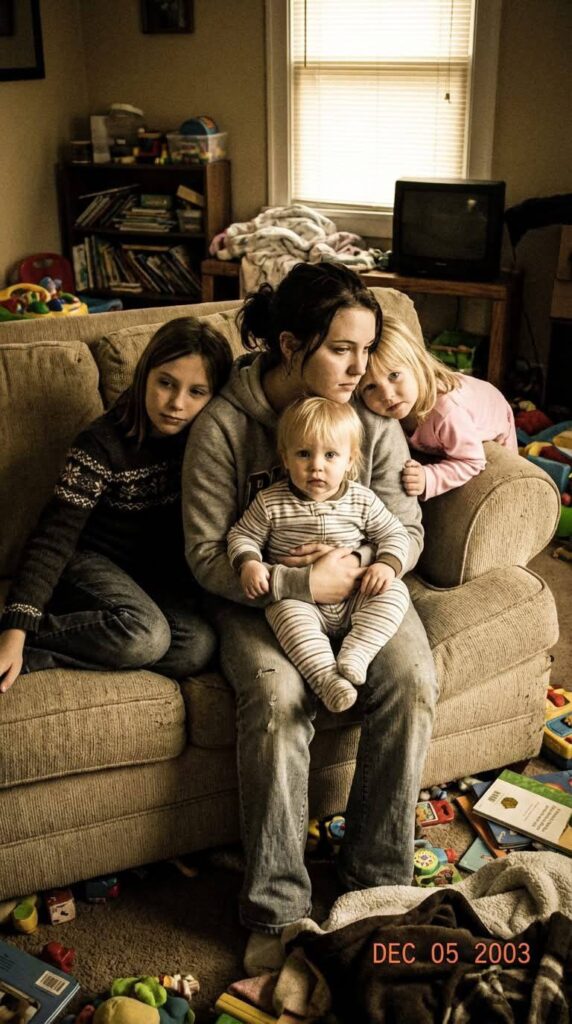
I became a mother to three grieving girls overnight, stripped of any warning and entirely devoid of a roadmap for the wreckage that lay ahead. Just when the turbulent waters of my own life had finally begun to settle into a steady, predictable rhythm, the ghosts of the past came knocking with a rhythmic persistence I could no longer ignore.
The prologue to my unexpected motherhood was written in a graveyard fifteen years ago. My older brother, Edwin, stood rigidly beside the freshly turned earth of his wife’s grave. The sky was a bruised, relentless grey, mirroring the hollow devastation in his eyes. I remember watching him stare at the polished wood of the casket, his posture screaming of a man hollowed out by sudden tragedy. And then, before the final clods of dirt had settled, before the sympathetic murmurs of the attendees had faded into the damp air, he simply vanished.
There was no tearful goodbye. There was no desperate plea for help. He evaporated like mist off a morning lake.
Without a single syllable of explanation, he left three little girls effectively orphaned in the wake of their mother’s sudden death in a catastrophic car accident. The very next evening, the doorbell of my quiet suburban home rang. I opened it to find a weary-looking social worker standing on my porch, flanked by three terrified children and a single, overstuffed floral suitcase sitting between them.
When they crossed my threshold, they were three, five, and eight years old.
I will never forget the suffocating texture of the quiet that blanketed my house that first night. It wasn’t a peaceful silence; it was a heavy, suffocating mass that sat like an anvil on my chest. I made up the spare beds, moving through the motions like a sleepwalker.
The youngest, Dora, with her wide, uncomprehending eyes, tugged at the hem of my sweater every hour, asking in a small, bird-like voice, “When is Mommy coming home, Aunt Sarah? Where did Daddy go?”
Jenny, the oldest, was a different kind of heartbreak. She didn’t shed a single tear after the first agonizing week. She simply stopped talking about her parents altogether. It was as if, at the tender age of eight, she had convened a silent, internal trial, delivered a verdict of abandonment, and made a hardened decision the rest of us hadn’t yet caught up to.
The middle child, Lyra, manifested her grief through a fierce, stubborn resistance. For six agonizing months, she absolutely refused to unpack her clothes from that floral suitcase. She would carefully pull out a shirt each morning, then meticulously refold it and put it back at night. When I gently tried to move her things into the dresser, she snatched them back, her small jaw set. “I don’t want to get too comfortable,” she had stated, her voice trembling with a precocious, defensive cynicism. “We’re leaving soon.”
For a long time, I blindly told myself that Edwin would return. He had to. I constructed elaborate, desperate fictions in my head: He was having a temporary nervous breakdown. He needed a few weeks to process the grief. He was just getting his affairs in order. Because no human being, no father, just walks away from his own flesh and blood after their world has been violently shattered. It defied the basic laws of human gravity.
So, I waited. Every time the phone rang, my pulse spiked. Every time a car slowed down on my street, I peered through the living room blinds.
But weeks bled into months, and those months calcified into years. The silence from Edwin remained absolute. No tear-stained letters. No late-night phone calls from a burner phone. Nothing.
At a certain painful juncture, I realized that waiting was a toxic holding pattern that was slowly drowning us all. So, I forced myself to stop. I boxed up the ghost of my brother and buried him in the deepest recesses of my mind.
By then, I had already seamlessly slipped into the role he vacated. I was the one packing the unevenly cut turkey sandwiches into lunchboxes at 6:00 AM. I was the one sitting on uncomfortable folding chairs in school auditoriums, cheering until my throat was raw during amateur holiday plays. I learned the precise, intricate ways each of them liked their eggs—Jenny needed hers scrambled dry, Lyra insisted on sunny-side up but panicked if the yolk broke, and Dora only ate them if they were folded into a meticulously crafted omelet.
I was the one who kept the midnight vigils, pressing cool, damp washcloths to their foreheads through raging fevers, and wrestling them free from the suffocating grip of night terrors where they screamed for a mother who would never answer. I forged my signature on mountains of permission slips, navigated the treacherous waters of middle school parent-teacher conferences, and fiercely advocated for them when the world tried to pity them.
And then came the teenage years. They started calling my name when the devastating crush of their first heartbreak stole the air from their lungs. They came to me to practice for their first job interviews, wearing my oversized blazers. They sought my guidance when they got their first real, bitter taste of adulthood.
Somewhere along that chaotic, exhausting, beautiful journey—without any grand ceremony or singular, defining moment marking the transition—they stopped being “my brother’s daughters.”
They became mine.
Which was why, when the doorbell rang on a mundane Tuesday afternoon fifteen years later, the very foundation of my reality threatened to tear itself apart.
Chapter 2: The Ghost on the Porch
It was late in the afternoon, the sky painted in the bruised, violet hues of an impending rainstorm. I was standing at the kitchen sink, rinsing out a coffee mug, while the girls—now fiercely independent young women—were scattered around the living space behind me.
The knock was hesitant. Two sharp taps, followed by a long pause, then a softer third tap.
I almost didn’t answer. We weren’t expecting any packages, and the neighborhood solicitors usually avoided our house due to the imposing oak trees that shadowed the walkway. But a strange, cold prickle of electricity crawled up the nape of my neck. I dried my hands on a dish towel, tossed it onto the counter, and walked down the hallway.
I turned the deadbolt, pulled the heavy wooden door open, and the breath was instantly, violently punched from my lungs.
I was entirely beyond shocked. Even through the heavy weathering of time, the deeply carved lines of exhaustion, and the profound weight of a decade and a half of absence, I knew his face with the visceral certainty of blood.
It was Edwin.
He was remarkably older. His frame, once broad and athletic, was significantly thinner, his shoulders bowed as if he were carrying an invisible, crushing weight. The skin of his face was drawn tight over his cheekbones, his hair heavily salted with grey and thinning at the temples. He looked like a man who had been slowly, methodically worn down to the absolute nub by the friction of life.
But it was him. The ghost had manifested on my welcome mat.
Behind me, in the warm, domestic sanctuary of the kitchen, Dora and Lyra were loudly arguing over whose turn it was to buy groceries, their voices overlapping in a familiar, comforting cadence. They had no idea that the phantom who had haunted their childhoods was standing less than twenty feet away.
Edwin looked at me with eyes that were defensive and terribly tired. He stood there as if bracing for a physical blow, entirely unsure whether I was going to scream into his face or simply slam the heavy oak door and shatter his nose.
I didn’t do either. The shock had temporarily paralyzed my vocal cords. I just stood there, my hand gripping the edge of the door so hard my knuckles burned white.
“Hi, Sarah,” he rasped. His voice was gravelly, lacking the confident resonance it once held.
A red-hot flare of fury finally ignited in my chest. Fifteen years. Fifteen years of agonizing silence, fifteen years of picking up the pieces he shattered, and that was the pathetic opening line he went with.
“You don’t get to say that as if nothing happened,” I hissed, my voice a low, vibrating wire of contained rage. “You don’t get to just stand there and say ‘hi’.”
He nodded once, a slow, heavy movement, as if he had fully expected the venom. But he didn’t offer an immediate, groveling apology. He didn’t launch into a frantic explanation of where he had been hiding. He didn’t even ask to cross the threshold into the house.
Instead, he slowly reached into the inner pocket of his worn, olive-green canvas jacket. His fingers trembled slightly as he pulled out a thick, sealed manila envelope.
He extended his arm, placing the heavy package directly into my rigid hands. He leaned in slightly, his eyes darting nervously toward the interior of the house.
“Not in front of them,” he whispered.
That was the entirety of his request. He didn’t demand to see them. He didn’t ask how tall they had grown, or what they were doing with their lives.
I stared down at the blank, unmarked envelope resting in my palms. It felt unnaturally heavy, as if it contained lead plates rather than paper. Then, I snapped my gaze back up to his weathered face.
Fifteen years of agonizing absence, fifteen years of tears I had to dry, and this… this piece of stationary was what he brought back as his offering.
I turned my head slightly over my shoulder. “Girls, I’ll be back in a few minutes. I’m just stepping outside,” I called out, fighting violently to keep the tremor out of my voice.
“Okay, Sarah!” Dora shouted back happily, completely oblivious, as the sound of the refrigerator door opening punctuated her sentence.
I stepped fully out onto the porch, pulling the front door shut behind me until the latch clicked with a terrifying finality.
I looked down at the envelope again, the rough texture of the paper scraping against my fingertips. I slid my thumbnail under the glued flap, tearing it open with a sharp, ripping sound that echoed loudly in the damp air. I reached inside and pulled out the top sheet of paper.
The very first thing my eyes locked onto was the date scrawled neatly at the top right corner.
It was dated exactly fifteen years ago. The week after his wife’s funeral.
A wave of profound, sickening vertigo washed over me.
Chapter 3: The Anatomy of a Coward’s Choice
My stomach turned over violently, the acidic burn of old grief rising in my throat. The paper itself was deeply worn at the folds, the creases softened and fraying, as if it had been opened, read, refolded, and put away hundreds, perhaps thousands of times over the years.
I unfolded it carefully, terrified it might disintegrate in my hands.
The ink was slightly faded, written in Edwin’s unmistakable, chaotic handwriting. But unlike his usual rushed scrawl, this script was meticulous. It was deliberate. It was the handwriting of a man documenting his own execution.
I leaned against the brick facade of the house, ignoring Edwin’s silent presence, and began to read. And with every single line my eyes traced, the solid, reliable ground I had built my life upon began to shift and fracture.
“Dear Sarah,
If you are reading this, I am already gone, and I am a coward. After Laura passed, things didn’t just fall apart emotionally. They fell apart financially, in ways that were catastrophic and deeply hidden. I started finding things in her desk that I didn’t know existed: predatory debts, massively overdue bills, secondary mortgages, and shadow accounts tied to desperate financial decisions she never shared with me. At first, driven by pride, I told myself I could handle it. I tried. God, Sarah, I really did. But every single time I thought I was getting ahead, every time I paid a minimum balance, something else showed up. The hole was bottomless. And it didn’t take long before I realized I was drowning in a current much deeper than I could ever understand or fight.”
I stopped reading, my chest tight. I snapped my head up and glared at him. He was staring at his boots, refusing to meet my gaze. I lowered my eyes back to the fraying page.
“The house wasn’t secure. The savings accounts were illusions. Even the life insurance policy I thought would act as our safety net… wasn’t nearly enough to cover the liens placed against our assets. Everything we owned was at immediate risk of being seized. We were going to be on the street. So, I started to panic. A blind, suffocating panic. I couldn’t see a single way out of the wreckage that didn’t involve dragging my three innocent girls through years of poverty, evictions, and collections agencies. I couldn’t bear to watch them lose what little stability they had left after losing their mother. So, I made a choice. A terrible, agonizing choice that I told myself was for them.”
My hands tightened involuntarily on the edges of the paper, crumpling the margins.
Edwin’s letter went on to reveal his deeply flawed, desperate logic. He confessed that leaving them with me—someone he knew to be financially secure, emotionally stable, and fiercely loyal—felt like the only guaranteed way to give them a real shot at a normal, unburdened life.
“Staying would have meant pulling them into a vortex of instability and shame,” the letter concluded. “I walked away, severing all ties, because I believed, in my broken state, that my absolute absence would protect them from the ruin I was inheriting. I know exactly how this looks. I know the unimaginable burden you had to carry because of my weakness. There is no version of this story, no universe, where I come out looking like a good man. I am sorry.”
I let out a long, ragged breath. The cold air burned my lungs. His words didn’t magically make the situation forgivable, nor did they erase the trauma, but they abruptly crystallized the mystery. They made the senselessness of his disappearance painfully, brutally clear.
“I meant everything in there,” Edwin whispered. It was the first time he had spoken since handing me the envelope. His voice was so quiet it was nearly swallowed by the rustling leaves of the oak tree.
I didn’t look at him. I couldn’t.
I turned the worn page over. Tucked beneath the old letter was a thick stack of different papers. These were not handwritten notes of apology. These were crisp, heavy, formal legal documents.
I flipped through them, my brow furrowing in confusion, until I suddenly stopped dead. Every single document bore recent dates—stamps from within the last three months. They were deeply complex legal ledgers tied to old bank accounts, property deeds, and corporate balances. But written across the top of every single summary page, stamped in bold, uncompromising red ink, were three distinct words:
Cleared. Settled. Reclaimed.
I looked up at him, the anger momentarily eclipsed by sheer bewilderment. “What exactly is this, Edwin?”
He finally met my eyes. They were completely devoid of pride. “I fixed it.”
“All of it?” I demanded, gesturing to the thick stack of financial miracles in my hand.
He nodded slowly. “Every penny of the debt. The liens. The mortgages. But… it took me a while.”
A while. Fifteen years. It was the ultimate understatement.
I looked back down at the final page of the legal bundle. It was a transfer of assets. And listed clearly on the beneficiary lines were three names: Jenny, Lyra, and Dora.
Every single piece of property, every reclaimed dollar, everything he had spent a decade and a half bleeding to salvage, had been legally transferred directly to the girls. It had been executed with surgical precision, completely severing the assets from his name and protecting them from any past ghosts.
“I don’t expect this to buy me redemption,” Edwin said, his voice cracking slightly.
And as I held the proof of his agonizing, misguided sacrifice, the front door behind me suddenly clicked, the brass handle beginning to turn.
Chapter 4: The Currency of Absence
I folded the heavy legal papers slowly, meticulously aligning the edges, buying myself precious seconds to control the tidal wave of conflicting emotions threatening to drown me. I slipped them back into the manila envelope and turned my body to fully face him.
“You don’t get to hand me a stack of cleared ledgers and think it makes up for almost two decades of silence,” I said, my voice shaking with a potent cocktail of grief and rage. “Money doesn’t buy back the bedtimes you missed, Edwin. It doesn’t dry the tears they cried into my shoulders.”
“I don’t,” Edwin replied instantly.
He didn’t argue. He didn’t puff out his chest and demand gratitude for his financial martyrdom. He didn’t become defensive. He just stood there, absorbing my hatred like a sponge.
And somehow, deeply and frustratingly… his total surrender made it so much worse. I wanted a fight. I needed an enemy to scream at.
I stepped heavily off the wooden porch, walking a few feet away onto the damp grass, desperately needing physical space between us. He didn’t follow. He remained rooted to the concrete step, respecting the invisible boundary I had drawn.
I turned back to him, the question that had haunted me for fifteen years finally tearing its way out of my throat.
“Why didn’t you trust me, Edwin?” I demanded, my voice cracking in the quiet afternoon air. “Why didn’t you come to me? Why didn’t you trust me to stand in the trenches with you? We could have fought the banks together. I would have supported you!”
The question hung there in the humid space between us, heavy and absolute.
He looked at me, his eyes brimming with a profound, unutterable regret, and he said absolutely nothing. That heavy, suffocating silence said more about his fractured pride and his overwhelming shame than any eloquently crafted excuse he could have offered.
I shook my head, a bitter laugh escaping my lips. “You played God. You decided the trajectory for all of us based on your own panic. You stripped me of a choice, and you stripped them of a father!”
“I know,” he whispered, his chin dropping to his chest. “I am so sorry, Sarah.”
It was his first verbal apology.
I hated the sound of it. A dark, ugly part of me wanted him to yell back, to rationalize it, to give me something tangible to push against so I could justify throwing him off my property. But he just stood there, a broken shell of a man, taking the emotional beating he knew he deserved.
Before I could launch another verbal assault, the heavy front door swung open.
“Aunt Sarah?” Dora’s voice cut through the tension like a blade.
I turned instinctively, plastering a neutral mask onto my face with practiced ease. “Coming, sweetie! Just finishing up here!”
I turned back to the ghost on my lawn. I pointed a trembling finger at his chest. “This isn’t over.”
Edwin nodded, pulling a cheap pen from his pocket. “I know. I’ll be waiting. I wrote my cell number at the bottom of the letter.”
I didn’t offer a goodbye. I didn’t nod. I simply spun on my heel, marched back up the steps, and walked back inside, the heavy envelope burning like a radioactive core in my hand.
I locked the door behind me, leaning my back against the wood. And for the very first time in fifteen incredibly long years, I had absolutely no idea what I was supposed to do next.
Chapter 5: Shattering the Silence
I stood in the kitchen for a full minute longer than was strictly necessary after helping Dora check the temperature on the oven. The sweet, comforting aroma of vanilla extract and melting chocolate chips filled the room—a stark, absurd contrast to the emotional grenade currently resting in my hands.
Jenny was leaning against the marble island, idly scrolling through social media on her phone. Lyra was perched on a barstool, nursing a mug of herbal tea. Dora was carefully placing dollops of cookie dough onto a baking sheet.
It was a perfectly normal, beautiful domestic scene. And I was about to destroy it.
I walked over to the dining table and set the manila envelope down with a soft, authoritative smack.
“We need to talk,” I said.
All three of them instantly looked up. I didn’t use that tone often. It was the voice I reserved for medical emergencies and serious transgressions. Something in the heavy cadence of my words must’ve alerted them to the severe gravity of the moment, because Jenny locked her phone screen, Lyra set her mug down, and no one offered a sarcastic joke to brush me off.
Jenny crossed her arms defensively over her chest. “What’s going on, Sarah? You look pale.”
I glanced briefly toward the front hallway, as if the door were transparent. “Your father was just here.”
Lyra blinked, her brow furrowing in genuine confusion. “Who?”
I didn’t soften the blow. There was no padding for a drop this steep.
“Your dad. Edwin.”
Dora let out a short, breathy laugh, the kind of sound you make when someone tells a joke that doesn’t quite make sense. “Yeah, okay. Very funny.”
“I am entirely serious, Dora.”
The terrifying lack of humor in my eyes wiped the tentative smile right off her face. The baking sheet rattled slightly as she set it down on the stove.
Jenny straightened up, her posture instantly rigid. “He’s the man you were just talking to outside? The guy on the porch?”
“Yes.”
Lyra spoke next, her voice remarkably calm, though her fingers gripped the edge of the counter until the knuckles turned white. “Why now? After all this time?”
I picked up the envelope, feeling the weight of their combined, terrified focus. “He brought this. I need you guys to sit down at the table.”
They moved like automatons, pulling out chairs and taking their seats.
They didn’t interrupt me while I talked. That surprised me the most. I expected shouting, or tears, but they sat in a stunned, paralyzed silence.
I explained the contents of the fifteen-year-old letter first. I laid out the hidden debts, the crushing financial pressure, and the desperate, flawed decisions my brother had made in the wake of their mother’s death. I spoke of the panic that consumed him, and the incredibly warped reasoning that led him to believe abandoning them to my care was the ultimate form of protection.
Jenny looked away halfway through my explanation, staring fiercely out the kitchen window, her jaw clenched tight. Lyra leaned forward, resting her elbows on the table, absorbing the data like a detective analyzing a crime scene. Dora simply kept her eyes fixed firmly on the wooden grain of the table, entirely motionless.
When I finished the summary of the letter, I pulled out the heavy legal documents and spread them across the center of the table.
“This is everything your father spent the last fifteen years rebuilding,” I explained softly. “Every predatory debt, every lost account, the mortgages—it’s all cleared. He bought it all back.”
Lyra reached out with a trembling hand, picked up a summary page, and scanned the dense legal jargon. “Is this… is this actually real?”
“Yes,” I confirmed. “I checked the notary stamps. It’s legitimate.”
“And it’s all transferred into our names?” Lyra asked, her voice barely a whisper.
I nodded.
Dora finally looked up, her eyes bright with unshed tears. “So… he just walked out on us… spent fifteen years fixing his financial mess… and then just came back to hand over some paperwork?”
I sighed, running a hand through my hair. “That seems to be the reality of it, yes.”
Jenny pushed her chair back violently, the wooden legs screeching horribly against the linoleum floor. “I don’t give a damn about the money!” she practically spat, her voice thick with venom. “Why didn’t he come back sooner? If he fixed it five years ago, why didn’t he come then?”
That was the ultimate, devastating question. The exact one I had been asking myself on a relentless loop for the past twenty minutes.
I shook my head helplessly. “I don’t have a better answer for you than what he wrote in that letter, Jen.”
She let out a harsh, bitter breath and looked back down at her lap, her hands balled into tight fists.
Lyra, ever the pragmatist, slowly gathered the legal papers and stacked them back into a neat, controlled pile. She tapped her fingers against the top sheet.
“We should talk to him,” Lyra declared, her tone leaving no room for argument.
Dora’s head snapped up. “What? Right now?!”
“Yeah,” Lyra said, her eyes burning with a sudden, fierce intensity. “We’ve waited in the dark for fifteen years, haven’t we? I’m not waiting another night to look him in the eye.”
I nodded slowly, feeling the shift in power. This was their narrative now. “Okay. He left his cell phone number at the bottom of the letter. I can call him.”
Lyra reached across the table, sliding the old letter toward herself. “No. I’ll do it.”
She punched the numbers into her phone with remarkably steady hands, though I could see a slight tremor in her wrist. She put the phone to her ear.
“Dad?” she said. Hearing that word in my kitchen sent a shockwave through my chest. “Can you come back over here?” She listened for a few seconds, her expression unreadable. “Okay. Goodbye.”
She lowered the phone, looking at her sisters, then at me. “He said he’s parked down at the local convenience store. He will be here in about fifteen minutes.”
The countdown had officially begun.
Chapter 6: The Dinner of Strangers
While we waited for the man who had authored our collective trauma to return, the house fell into a profound, suffocating silence. No one paced. No one spoke. I suppose none of us possessed the vocabulary required for the moment. We simply existed in the heavy, pressurized atmosphere of anticipation.
Before the fifteen minutes had even fully expired, the soft, hesitant knock returned to the front door.
I stood up from the kitchen table. I looked at my girls, who had migrated into the living room, forming a unified, defensive front near the sofa. I took a deep breath, walked to the foyer, and pulled the door open.
Edwin stood there, looking even smaller than he had an hour ago.
I stepped back, silently granting him entry. He crossed the threshold with the agonizingly slow steps of a man walking to the gallows. He stopped at the edge of the living room carpet, his hands stuffed deep into his jacket pockets.
For a long, agonizing second, no one moved. No one spoke.
Then, Lyra shattered the silence.
“You really stayed away this entire time?” she asked, her voice clipped and devoid of any warmth. “You never once drove past the house? Never checked in?”
Edwin looked down at the floorboards, the shame radiating from him in palpable waves. “I… I thought if I saw you, I wouldn’t have the strength to leave again. And I had to leave to fix it.”
Dora took a brave step forward, her hands on her hips, channeling an anger I rarely saw in her. “Did you honestly think we wouldn’t notice? Did you convince yourself that your absence wouldn’t matter as long as the bank accounts were full?”
Edwin’s expression shifted slightly, a flicker of deep, internal agony crossing his weathered face. “I thought… in my sick mind, I thought you would be better off with Sarah. She was everything I wasn’t. I also didn’t want to tarnish your mother’s memory by dragging you through my financial failures.”
“You don’t get to decide what we can handle,” Lyra snapped, her analytical demeanor cracking. “You don’t get to decide our reality for us.”
“I know that now,” Edwin pleaded, his voice cracking. “God, I know that. And I am so profoundly sorry.”
For the first time since he had arrived on my porch, I saw the glassy sheen of genuine tears building up in his hollow eyes.
Lyra reached to the coffee table and held up the thick stack of legal documents. “Is all of this actually real? You truly did all this?”
“Yes,” he whispered. “I worked on oil rigs. I took double shifts in factories. I worked as hard and as long as my body would allow to buy it all back. To buy your futures back.”
But Jenny, who had been completely silent, suddenly shook her head. Her voice, when it came, was not angry. It was utterly, devastatingly hollow.
“You missed everything, Dad,” Jenny said, the word Dad dropping like a stone.
“I know.”
“I graduated high school. I graduated college. I moved into my first apartment. I had my heart broken. Sarah taught me how to drive. Sarah taught me how to be a woman. You weren’t there for a single second of it.”
Absolute silence descended upon the room.
Jenny looked as if she wanted to scream, to violently tear the remaining pages of his letter to shreds, but instead, she just looked away. The sheer, overwhelming pain of all those lost, irrecoverable years seemed to physically envelop her, draining the fight from her posture.
Dora stepped closer to him, bridging the physical gap until there was barely any distance left between the ghost and his youngest daughter. She looked up into his face.
“Are you staying this time?” Dora asked, her voice trembling with a vulnerable, terrifying hope.
For a heart-stopping second, I thought Edwin might hesitate. I feared his cowardice would win, and he would say “no,” citing that he didn’t deserve them.
But he didn’t run. He held her gaze.
“If you will let me,” Edwin said, his voice firming with a desperate resolve. “I’m not going anywhere ever again.”
We didn’t hug. There was no cinematic, tearful embrace where all was instantly forgiven. The wounds were far too deep, the scar tissue too thick for such a sudden miracle.
Instead, Dora took a step back, wiped a stray tear from her cheek, and looked toward the kitchen.
“We should start preparing dinner, then,” Dora said softly.
Just like that. Like it was simply… the logical next step in surviving the impossible.
And so, surreal as it was, we did.
Chapter 7: What Comes Next (Epilogue)
Dinner that night felt entirely alien. It wasn’t explicitly tense, nor was it hostile; it was simply profoundly unfamiliar.
Edwin sat at the far end of the long dining table, keeping his elbows tucked in tightly, as if he were actively trying not to consume too much oxygen or take up too much physical space in a house that was no longer his.
Dora, ever the peacemaker, asked him a small, polite question about what state he had driven in from. He answered quietly, his eyes focused mostly on his plate. Lyra followed up with a clinical question about the legal transfer process, interrogating his methods rather than his motives.
Jenny stayed completely silent for the first half of the meal, methodically moving food around her plate. But then, right before dessert, she looked up and asked him a brief, pointed question about a mechanic issue she was having with her car.
He offered a piece of advice. She nodded, accepting it.
Their interactions were not easy. They were definitely not warm. But they were not entirely distant, either. It was the extremely cautious probing of a wild animal deciding whether the hand offering food was a trap.
I sat near the head of the table, watching the entire bizarre symphony unfold without saying much of anything. I just let it happen. I realized in that moment that this delicate, fragile reconciliation wasn’t something I could control, orchestrate, or force. It never was mine to control in the first place.
Later that night, after the dishes were meticulously scrubbed and put away, and the house had finally settled into a cautious, exhausted quiet, I stepped outside into the cool night air.
Edwin was standing on the porch again, leaning against the wooden railing, staring out into the dark, quiet street.
I walked over and leaned against the railing beside him, leaving a foot of space between us. The rainstorm had finally broken, leaving the air smelling crisp and metallic.
“You’re not off the hook, you know,” I said softly into the darkness. “A few cleared bank accounts and one awkward dinner doesn’t erase a damn thing.”
“Yeah,” he sighed, the exhaustion heavy in his lungs. “I know.”
“They’re going to have a lot more questions. Hard questions. Angry questions. And they are going to throw them at you when you least expect it.”
Edwin turned his head, looking at me with a steady, unblinking gaze. “I’m ready for them. I have nowhere else to be.”
I looked back out at the street. That night felt undeniably quieter, and strangely lighter in my chest in a way I hadn’t anticipated.
It wasn’t because everything was magically fixed. The trauma of his abandonment would take years of agonizing work to untangle. But the air felt lighter because the heavy, suffocating secret was finally out in the open. The ghost had been dragged into the light, given a name, and forced to answer for his sins.
There was no more agonizing wondering. There were no more midnight fantasies about where he was or why he left. The ledger of the past had finally been laid bare on the kitchen table.
There was only… what came next.
And for the very first time in a decade and a half, the five of us were finally standing in the exact same place, ready to figure that out. Together.