
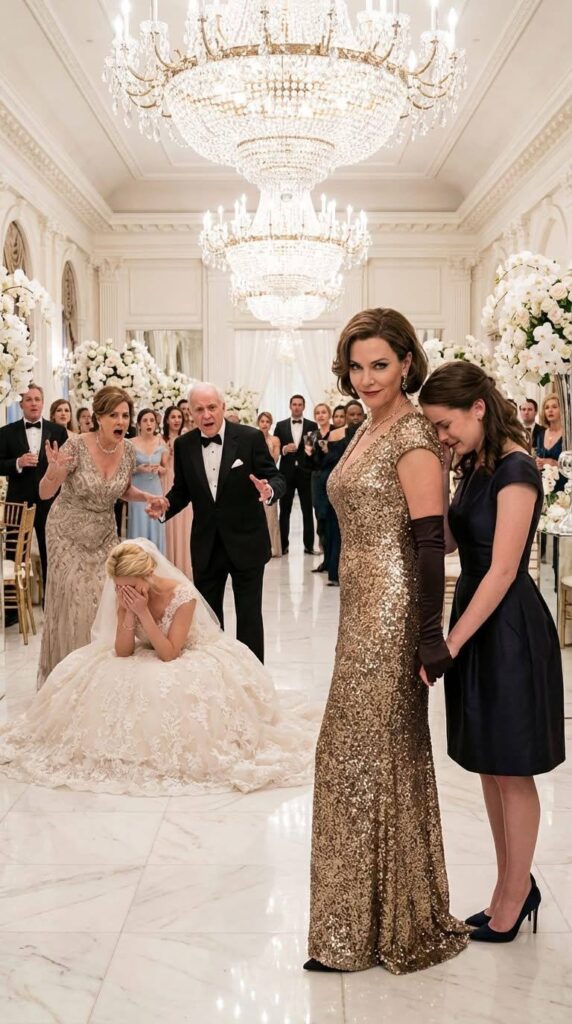
Chapter 1: The Arithmetic of a Broken Heart
The air in my workshop smelled of cedar shavings and wood oil—a scent that usually grounded me, reminding me that anything broken could be sanded down and refinished. I’m Claire Harper. I’m forty-one, a structural engineer in Raleigh, North Carolina, and a woman who has spent her entire career ensuring that things—buildings, bridges, lives—stay upright. But at 6:14 p.m. on a Tuesday, I realized the foundation of my own family had been rotting right under my feet.
I was in the garage, scraping dried North Carolina red clay off a pair of cleats, when my daughter Emma appeared in the doorway.
“Mom?”
Her voice was thin, like a wire pulled so tight it was about to snap. I didn’t look up immediately, my hands busy with the rhythm of the work. “In here, sweetie. Just a second.”
I heard the heavy, hesitant shuffle of her sneakers. When I finally looked up, my heart performed a slow, sickening roll in my chest. Emma was sixteen, a girl who usually carried herself with a quiet, stubborn grace, but now she looked like she was trying to hold her own skin together. She was sitting on the edge of my workbench, her hoodie strings wrapped so tightly around her fingers that the circulation was cutting off. Her eyes were red-rimmed but dry—that was the part that chilled me. She had already finished the loud, messy part of crying somewhere else.
“What happened?” I asked, dropping the cleats. My voice was low, steady—the same voice I used when a construction site went sideways.
She didn’t speak. She just held out her phone with hands that wouldn’t stop shaking. It was her bank app. The teen savings account I’d helped her open when she turned thirteen. She’d nicknamed it FRANCE in all caps, a digital shrine to three years of grueling babysitting for the Hendersons, missed parties, and summers spent working while her friends were at the beach.
The balance was $378.
I felt the blood drain from my face. My brain did that frantic, stupid counting thing it does when a calculation fails. $4,200. Three years of Friday nights. Every penny Emma had earned since she was thirteen.
“Did you move it, Em?” I asked, my voice sounding like it was coming from underwater. “To a different sub-account?”
She shook her head violently. “I went to the bank after school. Mrs. Daly said the first payment for the trip was due Friday, and I wanted to be early. The teller… she told me a cashier’s check had already been cut. Yesterday.”
A cold, visceral dread settled in my stomach. When we’d opened the account, the bank required an authorized adult. I had put my mother, Linda Harper, on the file. At the time, it felt like a safety net. Now, it felt like I’d handed a wolf the keys to the sheepfold.
“Grandma took it,” Emma whispered. The first sob finally broke through, a raw, ugly sound that tore through the quiet of the garage. “She took it, and now I’m never going to go. I worked so hard, Mom. I didn’t buy the homecoming dress. I didn’t go to the movies. I worked.”
I didn’t scream. I didn’t throw anything. I stood up, wiped the grease from my hands, and grabbed my keys.
“Get your shoes on,” I said. My voice was a flat, dangerous line. “We’re going to your grandmother’s.”
Cliffhanger: As we pulled out of the driveway, a notification lit up the dashboard of my car. It was a text from my sister, Kelsey: “The venue is official! Best day ever! Thank God for family who actually shows up!”
Chapter 2: The Syrup and the Sword
My mother’s house was a masterpiece of suburban artifice. The lawn was perfectly manicured, and the porch light was glowing with a warm, welcoming hue that felt like a lie. Linda Harper was sixty-eight, a woman with a “church-lady” voice and a brand of cruelty that she always disguised as “just trying to help.”
She opened the door before I could knock, smiling as if we were there for a casual dinner.
“Claire! And sweet Emma! What a lovely surprise,” she said, her voice dripping with the kind of saccharine sweetness that makes your teeth ache.
Emma stayed two steps behind me, staring at the porch floorboards as if they were a cliff’s edge. I held up my phone, the bank screen still active. My mother glanced at it, her smile didn’t even falter. It just tightened at the corners, becoming more clinical.
“Oh,” she said, as if I’d shown her a coupon for a grocery store. “Yes, about that. I borrowed it for your sister’s wedding deposit.”
I felt the air leave my lungs. “You borrowed it? From a sixteen-year-old? Without asking?”
“Don’t be dramatic, Claire,” my mother sighed, stepping back to let us in, though I stayed firmly on the threshold. “Kelsey had a deadline for the Grand Oaks Pavilion. It’s non-refundable, and she was short on the cash. Emma is young. She has plenty of time to see the world. But your sister’s wedding? That’s once in a lifetime.”
Behind me, Emma made a small, choking sound.
“Once in a lifetime,” I repeated. The words felt like ash in my mouth. I looked at my mother—really looked at her—and saw the pattern I’d been ignoring for decades. My sister, Kelsey, was the “Main Character.” Her needs were emergencies; Emma’s needs were “nice-to-haves.” It was the same reason Emma had to watch Kelsey get a designer purse for her birthday while Emma got a “grateful-to-be-here” hug. It was the same reason my mother had asked for a “contribution” to Kelsey’s engagement party the day I got my senior promotion.
“It was my money,” Emma whispered from the shadows.
My mother turned that syrup-voice on her. “Honey, you’re being selfish. Family helps family. You should be happy that your hard work is helping your aunt have the day she deserves. You can go to France when you’re older. Paris isn’t going anywhere.”
Emma’s face crumpled. She looked like she’d been punched. I felt a surge of protective fury so hot it nearly blinded me, but I didn’t yell. I knew my mother. She thrived on “scenes.” If I screamed, she became the victim. If I stayed calm, I became the hunter.
“Show me the receipt,” I said.
My mother blinked. “I beg your pardon?”
“The contract. The deposit confirmation. If you used my daughter’s money, I want to see exactly where it went.”
“I will not be interrogated in my own home,” she snapped, her church-lady mask finally slipping to reveal the cold, entitled woman underneath. “Kelsey needed the money. I provided it. The matter is closed.”
I looked at Emma, then back at my mother. I smiled—a slow, terrifyingly calm smile that I’d learned in boardrooms full of men who tried to talk over me.
“You’re right, Mom,” I said. “Kelsey’s wedding is once in a lifetime. We should treat it with exactly the gravity it deserves.”
Cliffhanger: I turned and walked back to the car without another word. My mother watched us go, looking satisfied, unaware that I was already pulling up my email to find a specific PDF I had signed three months ago.
Chapter 3: The Architecture of a Coup
When we got home, Emma went straight to her room. She didn’t even turn on the light. I sat in my home office, the blue light of the monitor reflecting in my glasses.
Here was the secret that Linda and Kelsey didn’t know: Three months ago, when Kelsey was crying about her “dream wedding” being out of reach, I had done what I always did. I had stepped in to fix it. I had quietly contacted the Grand Oaks Pavilion and paid the entire thirty-one thousand dollar venue fee in full.
I hadn’t done it for Kelsey, really. I had done it to stop the incessant phone calls from my mother. I had done it to buy peace for Emma, who was tired of hearing the family bicker about money. I had signed the contract as the sole “Payee and Contract Holder,” meaning I owned the date, the space, and the legal right to walk away.
I opened the file. Clause 12: Cancellation.
Any cancellation made 120 days or more prior to the event date will be refunded in full, minus a $500 administrative fee.
I looked at the calendar. June 14th was the wedding. Today was February 3rd. That put us at 131 days. I was within the window by eleven days.
My mother thought she was being a “team player” by stealing four thousand dollars from a child. She didn’t realize I was the one who had built the stadium she was playing in.
I typed out the email to the venue manager.
Subject: Immediate Cancellation of Contract #7742 – Harper/Brent Wedding.
Body: This is Claire Harper. As the sole contract holder and financier, I am requesting an immediate cancellation of the event scheduled for June 14th. Please process the refund to the original card on file.
I didn’t hesitate. I hit send.
Then, I opened a new folder on my desktop and labeled it: THE RECKONING. I started dragging in every screenshot of Emma’s bank account, every text from my mother, and the secret recording I’d made on my phone during our driveway confrontation.
As a structural engineer, I know that when a building is unsafe, you don’t try to patch the cracks. You perform a controlled demolition.
Cliffhanger: At 10:45 p.m., my phone buzzed. It was an automated reply from the venue: “Cancellation Confirmed. Refund of $30,500 will be processed within 5-7 business days.” I forwarded the confirmation to my mother with three words: “Once in a lifetime.”
Chapter 4: The Legal Scalpel
The next morning, I didn’t take Emma to school. I took her to the offices of Marisol Grant, a woman whose legal fees were astronomical and whose heart was made of industrial-grade titanium.
“My mother is an authorized adult on my minor daughter’s savings account,” I explained, laying the documents on the mahogany desk. “She withdrew $4,200 for a non-emergency. My daughter earned this through three years of documented labor.”
Marisol scanned the babysitting logs Emma had meticulously kept in her little spiral notebook. She looked at the Venmo receipts from the Hendersons. Then she looked at Emma, who was sitting in the oversized leather chair, looking like she wanted to disappear.
“Technically,” Marisol said, her voice like a cool blade, “the bank won’t call it theft because she was an authorized user. But in the state of North Carolina, we have something called unauthorized conversion of a minor’s assets. Since the funds were clearly intended for the minor’s benefit and the adult used them for a third party’s luxury expense, we have a very strong civil case.”
“I don’t want to go to court,” Emma whispered.
“You won’t have to,” I said, looking at her. “But we are going to send a message.”
Marisol drafted a Civil Demand Letter. It was a masterpiece of legal intimidation. It stated that if $4,200 was not returned to Emma’s account within 72 hours, we would file a formal report for financial exploitation and initiate a lawsuit that would likely freeze my mother’s own assets during the discovery phase.
I thanked Marisol, paid her retainer, and took Emma to the bank. I removed my mother from every single account. I changed every password. I put a freeze on Emma’s credit. I was erecting a fortress around my daughter that not even a grandmother’s “syrup-voice” could penetrate.
As we walked out of the bank, my phone began to explode.
Kelsey was calling. My mother was calling. My aunt was calling. The group chat was a cacophony of “How could you?” and “You’ve ruined everything!”
I didn’t answer. I drove Emma to her favorite taco spot. We sat in the corner, and for the first time in forty-eight hours, she ate.
“Are they going to hate us?” she asked.
“No, honey,” I said, reaching across the table to squeeze her hand. “They’re going to fear us. And in this family, that’s much safer.”
Cliffhanger: As we left the restaurant, I saw a familiar car pull into the parking lot. It was Kelsey. She didn’t look like a bride. She looked like a woman who had just seen her entire future vanish into a cloud of “Cancelled” notifications.
Chapter 5: The Controlled Demolition
Kelsey slammed her car door and marched toward us. Her face was blotchy, her expensive highlights disheveled.
“Claire! What did you do?” she shrieked, ignoring the people staring at us. “The venue called! They said the date is gone! They said the money was refunded to you! Why did they even have your name?”
I stood my ground, shielding Emma behind me. “They had my name because I’m the one who paid for it, Kelsey. Not Mom. Not Brent. Me.”
Kelsey froze. The realization hit her like a physical blow. “You… you paid for the whole thing?”
“I did. It was going to be your wedding gift. I wanted you to have a beautiful day. But then I realized that while I was paying for your dream, you and Mom were busy stealing Emma’s.”
“It’s four thousand dollars!” Kelsey screamed. “You’re throwing away thirty thousand over a four-thousand-dollar mistake!”
“It wasn’t a mistake,” I said, my voice dropping an octave. “It was a choice. You chose to take from a child. You chose to let her cry so you could have a ballroom. I’m just making a choice, too. I’m choosing to fund my daughter’s future instead of your ego.”
“Mom said you’d understand!” Kelsey wailed. “She said you were a team player!”
“The team is disbanded, Kelsey. Tell Mom she has forty-eight hours left on that legal demand. If the money isn’t back in Emma’s account by then, I’m going to the police. And I have the recording of her admitting she took it.”
Kelsey looked at Emma, her eyes narrowing. “You’re really going to let her do this to me? Over a trip to France?”
Emma didn’t shrink this time. She stepped out from behind me, her jaw set. “It wasn’t a trip to France, Aunt Kelsey. It was three years of my life. You didn’t even ask.”
I watched my sister’s face crumble. She realized, for the first time in her life, that her “Main Character” status had no power here. I turned and led Emma back to the car.
By the time we got home, the family group chat was a graveyard. My mother had posted: “I never thought I’d live to see my own daughter choose money over blood.”
I replied with a single photo: Emma’s empty savings account.
Cliffhanger: Thursday morning arrived. 8:59 a.m. One minute before the deadline. I sat at my laptop, my finger on the shortcut to the Raleigh PD’s online reporting portal.
Chapter 6: The New Foundation
At 9:02 a.m., Emma’s phone chimed. A transfer of $4,200 had been deposited. No message. No apology. Just the return of the stolen goods.
A week later, the “Peace Offering” arrived.
I came home to find a cake on the porch. It was white, with pink frosting flowers—the kind of cake my mother bought when she wanted to pretend a wound was just a scratch. She was standing by her car, waiting for me.
“I brought dessert,” she said, her voice trying for that old syrup-tone, but it was thin and watery now.
I didn’t invite her in. I stood on the driveway, the gate between us. “We aren’t doing the cake, Linda.”
“Claire, please. I said I was sorry in the transfer notes.”
“You didn’t say you were sorry. You just sent the money because you were afraid of a lawsuit. There’s a difference.”
Emma came out of the house then. She didn’t stay in the hallway. She walked right up to the gate. My mother looked at her, her eyes filling with performative tears.
“Emma, sweetie. Grandma made a mistake. I just wanted everything to be perfect for the family.”
“A mistake is a typo,” Emma said, her voice steady and clear. “What you did was a calculation. You calculated that my feelings mattered less than Kelsey’s wedding. You were wrong.”
My mother’s face hardened. The tragedy-act was failing. “So that’s it? You’re cutting us off? Over this?”
“No,” I said. “I’m setting a boundary. You are no longer an authorized adult on any of our accounts. You are no longer an emergency contact at Emma’s school. And you aren’t coming in for cake. Trust is a structure, Mom. You demolished yours. If you want to rebuild it, you’re going to have to start at the foundation. And that starts with an actual apology to my daughter, without mentioning Kelsey once.”
My mother looked at us—two women who refused to be part of her script—and realized she had no leverage left. She turned and got into her car, leaving the cake on the porch.
We threw it away.
In April, I drove Emma to the airport. Her French teacher, Mrs. Daly, was waiting with the rest of the group. Emma had her suitcase, her beret, and a look of pure, unadulterated joy that I hadn’t seen in years.
“I’ll call you from Paris?” she asked, hugging me.
“Every day,” I said.
As I watched her walk through security, I thought about the price of it all. I had lost a sister and a mother, at least for now. But I had gained something much more important. I had shown my daughter that she was worth fighting for. I had shown her that “family” isn’t a license to steal—it’s a promise to protect.
The moral is simple, and I learned it late: If someone can hurt your child and still call themselves “family,” what they really mean is “access.” And access is something that must be earned every single day.
My daughter is in Paris. My sister is married in a community center. And I am in my workshop, the smell of cedar grounding me, knowing that the foundation of our lives is finally, truly, solid.