
The Monroe Inheritance: A Chronicle of Silence and Steel
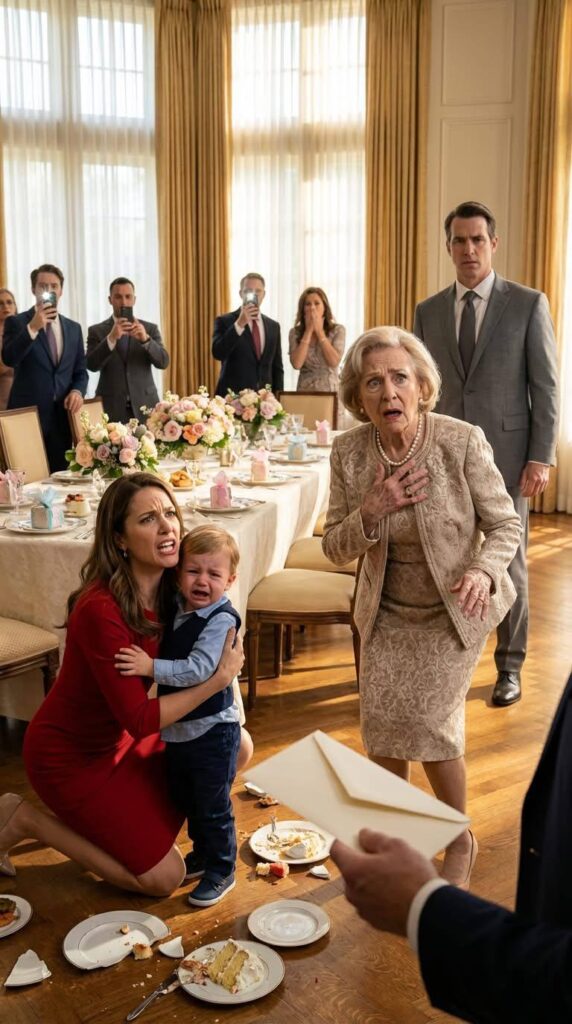
The sound of my mother-in-law’s palm connecting with my eight-year-old son’s face is a frequency I will carry to my grave. It wasn’t just a slap; it was a sharp, sudden percussion—a crack that split the festive air of the dining room like a dry branch snapping in a winter gale. Ethan gasped, his small, fragile body lurching sideways. Before I could even register the physical movement, Margaret Monroe was screaming the words that would effectively dismantle her family’s legacy forever.
“He is not real family! Get out!”
My son hit the hardwood floor with a sickening thud. The heirloom porcelain plate in his hands shattered, sending green beans and shards of ceramic scattering like shrapnel across the polished floor. Around the Easter table, fifteen adults sat like wax figures in a museum of cowardice. No one moved. No one breathed.
My husband, Daniel, stood by the bay window, his mouth agape but his throat seemingly constricted by thirty-eight years of maternal conditioning. His sister, Victoria, stared intensely at her smartphone, pretending the digital screen was a shield against the violence in the room. Their father, Robert, examined his turkey as if it held the secrets of a lost civilization. The only rhythmic sound was the grandfather clock in the hallway, ticking away the final seconds of my tolerance.
I did not scream. I did not weep. I simply crossed the room, knelt beside my shaking child, and helped him to his feet. I brushed a stray bean from his sweater and walked back to the table. From my vintage leather bag, I pulled a single, heavy cream envelope and placed it directly in front of the matriarch.
“My lawyer is already involved, Margaret.”
The six words were delivered with the chilling calm of a winter frost. Margaret’s wine glass slipped from her manicured fingers, crimson liquid blooming across the white damask cloth like a fresh wound. The room stopped breathing.
Margaret stared at the envelope as if it were a venomous snake coiled among the silverware. Her hands, glittering with diamonds on every finger, began a rhythmic tremor she couldn’t suppress. I didn’t wait for her to open it. I already knew the contents, and very soon, the weight of her sins would be common knowledge.
I looked around the room, documenting every face, filing away every betrayal. Daniel was pale, his jaw locked in a silent scream of indecision. He didn’t agree with his mother’s cruelty—he simply lacked the vocabulary to oppose it. Victoria finally looked up, her eyes narrowing in a cold, calculating gaze; she was already calculating the shift in the family hierarchy. Only Robert looked truly ashamed, but shame without action is merely a performance, and Robert had been an actor for forty years.
“This is a family matter, Jessica,” Margaret hissed, attempting to reclaim her throne through sheer vitriol. “You are making a scene.”
I almost laughed. My child was on the floor with a crimson welt blooming on his cheek, and I was the one “making a scene.” It was the classic Monroe maneuver: reframing the victim’s reaction as the primary offense.
“Daniel, control your wife,” she commanded, her voice regaining its edge.
He opened his mouth, but only a hollow silence emerged. He couldn’t even look at his son. I turned my attention back to Ethan. He stood there, his hands hanging limp, his wide brown eyes searching my face for an explanation I wasn’t ready to give. He wasn’t crying. That was the most terrifying part. At eight years old, he had already learned that in the Monroe Estate, tears were a currency that bought you nothing but further ridicule.
I knelt again, checking his hot, bruised skin. When I touched him, he flinched—not from pain, but from expectation.
“I’m sorry, Mom,” he whispered, so quietly I almost missed it. “I didn’t mean to sit in the wrong chair.”
My heart didn’t just break; it shattered into a million jagged pieces of resolve. He was apologizing for being assaulted. I stood up, lifting him into my arms, grabbing our coats and my pride.
For three years, I had swallowed the insults. I had ignored the subtle slights and smiled through the holidays where my son was treated like a guest who had overstayed his welcome. The slap wasn’t the beginning; it was the final, violent punctuation mark at the end of a long, miserable sentence.
As I walked toward the front door, their voices chased us like carrion birds.
“You can’t just leave!” Margaret shrieked. “We haven’t had dessert!”
“Jessica, don’t be dramatic,” Victoria added, her voice dripping with artificial concern.
“Think about the family, Jessica!” one of the aunts piped in.
I didn’t turn back. I felt Ethan’s small heart hammering against my chest. Daniel finally mobilized, catching up to us in the foyer. “Jess, wait. Let’s talk about this.”
I turned to face the man I had married. He was still the handsome man I loved, but in that moment, he was also a stranger who had watched his mother strike our child and done nothing.
“You had your chance to talk, Daniel,” I said, my voice a low vibration of steel. “And you had your chance to move. You chose neither.”
His face crumpled as if I had struck him, but he stayed on the threshold. He remained in the doorway, caught between the suffocating safety of his mother’s house and the uncertain freedom of his own family. That image would be burned into my retinas forever: Daniel Monroe, a man frozen on the border of his own life.
The cold November air hit us like a bucket of icy water. It was clarifying. I strapped Ethan into his car seat, my hands steady despite the adrenaline coursing through my veins.
“Are we coming back, Mom?” he asked in a small, fragile voice.
I paused, looking at his bruised cheek under the streetlamp. I didn’t lie. I didn’t soften the blow. “No, baby. We are never coming back.”
Chapter 2: The Paper Trail of Greed
The drive back to our quiet home was a symphony of silence, punctuated only by the hum of the heater. My phone was an incessant insect in the center console, buzzing with missed calls and frantic texts from the Monroe clan. I silenced it and flipped it over.
Ethan watched the streetlights dance across his face. The swelling was worse now, a purplish signature of Margaret’s malice.
“Is Dad calling?” he asked.
“Yes.”
“Are you going to answer?”
“Not tonight, Ethan.”
I thought about the envelope I had left behind. Three weeks prior, I had stumbled upon a box of Daniel’s old papers while organizing the attic. At the bottom was a letter from a law firm addressed to the beneficiaries of the Harold Monroe Educational Trust.
Harold, Daniel’s grandfather, had been the only Monroe who saw Ethan as a human being. Before he passed away fourteen months ago, he had whispered to me in the hospital, “Protect the boy, Jessica. Margaret sees people as chess pieces, not souls.”
The letter revealed that Harold had established a trust for his grandchildren’s education. The initial funding was $460,000. The beneficiaries listed were Emma, Tyler, and Ethan Wilson Monroe.
When I brought this up to Daniel months ago, he had brushed it off, saying his mother was “handling the details.” But something in the silence that followed felt wrong. I hired Emily Carter, the most ruthless estate litigation attorney in Philadelphia, to dig into the shadows.
What she found was enough to turn my stomach.
Three months after Harold’s funeral, Margaret had filed an amended trust document. Ethan’s name had been scratched out with a single, cold line of ink. The reason cited in the legal jargon was “not of direct bloodline.”
But the theft didn’t stop at exclusion. Emily had subpoenaed the bank records. Of the original $460,000, only $12,418 remained.
Margaret hadn’t just erased my son from the family; she had been systematically looting the futures of all her grandchildren. The records showed $42,000 for “tuition” that actually went toward a new kitchen renovation at the Monroe Estate. $28,000 for a “vehicle purchase” that resulted in a white Lexus SUV registered solely in Margaret’s name.
Sitting at my kitchen table that night, while Ethan finally drifted into a fitful sleep, I opened my laptop to the latest email from Emily Carter.
“We have the original signatures,” Emily had written. “Harold’s intent was clear. Your mother-in-law committed a major breach of fiduciary duty. This isn’t just a civil matter anymore, Jessica. This is fraud.”
I stared at the “before and after” photos I had taken of Ethan’s face. The bruise was an ugly, dark map of his grandmother’s heart.
My phone buzzed again. A text from Daniel: “Mom says Ethan provoked her. She says he sat in Emma’s assigned seat. Jess, if we just apologize, she might not cut us out of the will.”
I felt a coldness settle into my bones that no heater could ever warm. He was still worried about the will. He was still worried about the approval of a woman who had just robbed and assaulted his child.
I typed back: “The guest room is made up. Don’t wake Ethan when you get home.”
I spent the rest of the night reviewing the spreadsheets. $153,000. That was Ethan’s rightful share. Gone. Spent on marble countertops and designer handbags. Margaret had tried to erase my son because a child who doesn’t exist can’t sue you for his inheritance.
She thought I was a quiet, single mother she had “saved” by allowing me into her family. She thought I was grateful for the crumbs she tossed from her table. She had no idea that she hadn’t just slapped a child; she had awakened a mother who had nothing left to lose.
The battle lines were drawn in ink and blood.
Chapter 3: The Ghost of the Grandfather
The next morning, Daniel was a ghost in our kitchen. He sat with his head in his hands, the gray morning light emphasizing every wrinkle of his exhaustion.
“I stayed at the house until 2 AM,” he whispered. “She’s hysterical, Jess. She’s saying you’re trying to destroy the family name.”
“The name was destroyed the second her hand hit Ethan’s face,” I replied, setting a cup of black coffee in front of him. “Where is her apology, Daniel? Where is the check for the money she stole from our son?”
He flinched at the word stole. “She says the trust was always meant for blood relatives. She says Grandpa was confused at the end.”
I reached into my bag and pulled out a photocopy of the original trust. I slammed it on the table. “He wasn’t confused when he wrote Ethan Wilson Monroe in his own handwriting. He was deliberate. He knew exactly who Margaret was.”
Daniel looked at the document, his eyes widening. “I… I didn’t know he actually put him in the papers.”
“Because your mother ensured you never saw them,” I said. “And your sister Victoria? She witnessed the amendment. She knew, Daniel. They all knew.”
The realization hit him like a physical weight. His family wasn’t just eccentric or “old-fashioned”—they were a criminal enterprise built on the exclusion of his own child.
“I need to talk to my father,” Daniel stammered.
“Your father has been a silent partner in your mother’s crimes for forty years,” I said. “If you want to help, you’ll stand by me in court. Because I’m not just suing for the money. I’m filing for a full accounting and a restraining order.”
The doorbell rang. It was a courier. A thick stack of papers—Margaret’s opening salvo. She was suing me for “emotional distress” and attempting to challenge my custody of Ethan, claiming my “unstable behavior” at Easter was a danger to the child.
It was a declaration of total war.
I called Emily Carter. “She’s coming for Ethan.”
“Let her try,” Emily’s voice was like ice. “I just received the subpoenaed records from the contractor who did her kitchen. The invoice was paid directly from the grandchild’s trust account. We have her, Jessica. We don’t just have a civil case; we have enough to go to the District Attorney.”
I walked into Ethan’s room. He was sitting on his bed, looking at a framed photo of Grandpa Harold.
“Mom?” he asked. “Grandpa told me once that the Monroe name was a heavy thing to carry. Is that why Grandma is so mean? Is it too heavy for her?”
I sat beside him, pulling him into a hug. “Some people use their names as a shield, Ethan. Others use them as a weapon. But you? You’re going to use yours to build something better.”
That afternoon, I received a text from an unknown number.
“Meet me at the diner on 5th. 4 PM. Alone. – Robert.”
My father-in-law. The man who sat in silence while my son hit the floor. I didn’t tell Daniel. I drove to the diner, my heart hammering against my ribs.
Robert was sitting in a back booth, looking older than the last time I’d seen him. He didn’t look like a patriarch; he looked like a man who had spent his life in a cage of his own making.
“She doesn’t know I’m here,” he said, his voice trembling.
“What do you want, Robert?”
He pushed a small, old-fashioned USB drive across the table. “Harold knew. He knew she would try to erase the boy. He recorded their final arguments. He left this for me to give to the lawyers if things ever got ‘violent.’”
My hand shook as I took the drive. “Why are you giving this to me now? Why didn’t you stop her at dinner?”
Robert looked out the window, tears welling in his tired eyes. “Because I’m a coward, Jessica. But even a coward has a breaking point. When I saw my grandson on that floor… I realized that if I didn’t help you, I’d be buried in that house with her. And I don’t want to die in that house.”
I left the diner with the final piece of the puzzle.
Chapter 4: The Deposition
The conference room at Carter & Associates felt like a tomb. The air was thick with the scent of expensive stationery and the looming dread of a family’s collapse.
Margaret Monroe sat across from us, draped in black silk, her face a mask of aristocratic disdain. Beside her was a lawyer who looked like he’d been carved out of granite.
Emily Carter didn’t waste time. She played the first audio file from Harold’s USB drive.
“I want Ethan included, Margaret,” Harold’s voice crackled through the speakers, thin but resolute. “He’s Daniel’s son in every way that matters.”
“He is a distraction, Harold,” Margaret’s voice hissed in response, sharp as a razor. “A mistake from Daniel’s past. Once you’re gone, I’ll clean up the paperwork. The Monroe legacy belongs to Monroe blood.”
“If you touch that boy’s future, Margaret,” Harold coughed, the sound of a dying man’s final warning, “I’ve made sure the world will know exactly who you are.”
The recording ended. The room was so silent you could hear the ticking of Margaret’s $20,000 watch.
“My client was under immense stress during her husband’s passing,” Margaret’s lawyer began, but Emily cut him off.
“Stress doesn’t explain forging a trust amendment, Mr. Sterling. And it certainly doesn’t explain using $150,000 of a child’s education fund to buy a Lexus and Italian marble.”
Emily slid the bank statements across the table. “We are offering one chance, Margaret. Return the full amount—with interest—into a protected account for Ethan. Step down as trustee for Emma and Tyler. And you will sign a formal apology and a non-contact agreement.”
Margaret laughed—a sharp, brittle sound. “You think a few recordings and some accounting errors will break me? I built this family. I own the name. You are a waitress from a diner who got lucky with my son.”
I leaned forward then. I had stayed silent for the entire hour, but the fire in my gut was now a roar.
“I wasn’t lucky, Margaret,” I said, my voice echoing in the sterile room. “I was a mother who gave you a chance to be a grandmother. You’re the one who lost everything the moment you thought your money made you untouchable.”
“Daniel will never leave me,” she sneered. “He is a Monroe.”
“Daniel is at the courthouse right now,” I said. “He’s filing a statement in support of our lawsuit. And he’s changing his legal name, Margaret. He’s taking my maiden name. And so is Ethan.”
The mask finally shattered. Margaret’s face contorted into a mask of pure, unadulterated rage. She stood up, her chair screeching against the floor.
“You will have nothing! I will bury you!”
“You already tried to bury my son,” I said, standing up to meet her gaze. “You just forgot that he’s a seed. And I’m the storm.”
Chapter 5: The Reckoning
Six months later.
The Monroe Estate was for sale. The marble kitchen, the white Lexus, the designer handbags—all liquidated to pay back the trust and the mounting legal fees.
Robert had moved into a small apartment near the coast. He called Ethan every Sunday. They talked about baseball and books. Robert was learning how to be a grandfather without asking for permission.
Victoria had been forced to resign from her firm after the fraud investigation became public. She was working as a junior accountant in another state, the Monroe prestige gone like smoke.
And Margaret? She was living in a managed care facility, her wealth stripped by the courts, her reputation a blackened husk. She had no visitors.
Daniel sat on our new porch, watching Ethan run through the sprinkler in our backyard. The house was smaller, humbler, but the air felt light. For the first time in his life, Daniel’s shoulders weren’t hunched under the weight of his mother’s expectations.
“He looks happy,” Daniel said, taking my hand.
“He is happy,” I replied. “He knows he belongs here.”
Ethan ran over to us, dripping wet and grinning, his face clear of any bruises, his eyes bright with the future.
“Mom! Dad! Look! I found a turtle!”
He held up a small, muddy creature with the pride of a king.
“That’s great, Ethan,” Daniel said, ruffling his hair.
I looked at my son—my beautiful, resilient boy who was more than “real family.” He was a legacy of strength.
We didn’t need the Monroe name. We didn’t need the mansion or the diamonds. We had the truth. And in the end, the truth was the only inheritance that mattered.
I looked back at the house, where the ghost of a slap had once echoed. It was silent now. The cycle was broken. We were finally, truly, home.