
Chapter 1: The Calculus of Worth
I have spent the better part of my adult life in the Meadow Glenn Community Hospital, surrounded by the scent of industrial-grade bleach and the electric thrum of adrenaline. As an emergency room nurse, my reality is measured in heartbeats per minute and the terrifying clarity of a “Code Blue.” I have held the hands of strangers as their light flickered out at 4:00 a.m., and I have fought tooth and nail to pull others back from the threshold. In my world, value is found in the grit of survival.
In my mother’s world, value is found in the weight of a stone.
My mother, Vivien Reeves, is a woman who treats social standing like a military campaign. At fifty-eight, she wears her status as a “homemaker” like a badge of aristocratic honor, presiding over our suburban enclave near Richmond with the iron-fisted grace of a deposed queen. To Vivien, life is a series of rankings: the square footage of your home, the brand of your sedan, and, most crucially, the carats on your finger.
My sister, Brooke, is the crown jewel of Vivien’s collection. At thirty-three, married to a high-powered litigation partner named Tyler Langford, Brooke is the “Success.” Her wedding was a spectacle of 160 guests and string quartets, anchored by a three-carat diamond that catches the light from across a crowded ballroom. Vivien mentions that ring with the frequency of a religious litany.
Then there is me. Riley Reeves. I am the “Independent One,” which in the Reeves household is shorthand for “The Disappointment.” I pay my own student loans, my own rent, and my own car note. But on the photo wall in our living room, the hierarchy is clear: seven framed portraits of Brooke’s milestones, and two of me—one where I’m eleven years old, holding a slimy trout I caught at the lake.
Two weeks ago, Nate Hollis proposed to me. Nate is a man who breathes life into black walnut and white oak. He’s a custom furniture builder who measures success in the smoothness of a finished grain and the scent of fresh sawdust. He will never be a “Junior Partner,” and he doesn’t care. He proposed on the roof of his workshop under a string of Edison lights he hung himself.
The ring he gave me was a simple white gold band set with a deep blue sapphire. It isn’t large—maybe half a carat—but the color is haunting. It looks like the sky just as the first stars begin to puncture the twilight. I loved it because it was a piece of him. I loved it because it was everything Vivien would hate.
When we pulled into the driveway for our “engagement celebration” last Friday, I saw the cars of Linda Marsh and Margaret Bowen—Vivien’s country club lieutenants. My stomach did a slow, sickening roll. This wasn’t a family dinner; it was an inspection.
We hadn’t been in the house ten minutes before Vivien seized my left hand. She didn’t offer a hug or a “welcome home.” She pulled my fingers toward the crystal chandelier, tilting the ring until the sapphire caught the light.
She let out a laugh—a soft, pitying sound that felt like a razor blade against my skin.
“This is what he could afford, I suppose?” she murmured, her voice carrying across the silent dining room. She turned to my father, Greg, who was busying himself with a bread basket, refusing to meet my eyes. “Your father spent three months’ salary on mine, Riley. It’s a matter of respect.”
Then, she looked at my sister. “Show her yours again, sweetie. Remind Riley what a real investment looks like.”
Brooke hesitated, her eyes flickering with a momentary guilt, but she complied. The three-carat diamond threw jagged rainbows across the tablecloth, blinding and cold. I felt twelve years old again, the familiar heat of humiliation rising in my throat.
I didn’t know then that Nate was standing just past the kitchen partition. He had heard every syllable. He had heard the laugh. And in that moment, the man who shaped wood with such gentleness decided to dismantle my mother’s world.
Chapter 2: The Carpenter’s Silence
The rest of the dinner was a masterclass in passive-aggressive theater. Nate sat beside me, his hand a warm, steady weight on the small of my back. He didn’t argue. He didn’t defend himself. He simply watched Vivien with an unsettling, quiet intensity—the look of a craftsman identifying a terminal flaw in a piece of timber.
“So, Nate,” Vivien chirped, her “hostess” voice vibrating with feigned interest. “Tell Linda and Margaret about your… little business. He builds furniture,” she added to her friends, her tone suggesting he made birdhouses out of popsicle sticks.
“I build commissions,” Nate replied evenly. “Custom pieces for people who value things that last.”
Vivien waved a hand dismissively. “How creative. Anyway, I’ve already started the guest list for the party at Pinecrest Country Club. Eighty people. We’ll need a proper florist to distract from the… modesty of the occasion.”
We left as soon as dessert was cleared. The drive back to our apartment was silent for fifteen minutes. Nate’s jaw wasn’t clenched, but his hands held the steering wheel with a precision that told me he was processing something deep.
“I’m sorry, Nate,” I finally whispered. “She’s just… like that.”
“Don’t apologize for her, Riley,” he said, his voice a low rumble. “She told your sister to flaunt her ring while laughing at yours. That isn’t ‘just how she is.’ That’s cruelty.”
The next morning, Nate made coffee and set a mug in front of me. “I’m going to call her,” he said.
“Nate, don’t. It’ll just make it worse.”
He looked at me, his eyes soft but unyielding. “Riley, if a patient came into your ER and told you her mother spoke to her that way, what would you say?”
I looked into my coffee. “I’d tell her it was emotional abuse.”
“I don’t want our children growing up thinking their mother’s worth is tied to a price tag,” he said. “She needs a chance to make it right.”
I sat on the sofa as he dialed. He didn’t put it on speaker, but in our small kitchen, the sound of Vivien’s voice was unmistakable.
“Good morning, Nate!” she answered, her voice polished and bright.
“Mrs. Reeves, I’m calling about last night. I heard what you said about the ring. I heard the comparison to Brooke’s.”
The silence on the other end lasted two beats. Then, the pivot. “Nate, honey, it was a joke! Riley is so sensitive. I’ve done nothing but welcome you.”
“It wasn’t an attack, it was an observation,” Nate countered. “And for twenty-nine years, you haven’t listened to your daughter.”
Click.
She hung up on him.
Forty minutes later, my phone exploded. It wasn’t an apology. It was a declaration of war. Vivien had called Brooke, my father, and even her country club friends before she called me. The narrative was already set: Nate had “attacked” her at 8:00 a.m. on a Saturday.
“You need to control your fiancé,” Vivien hissed when I finally picked up. “He has humiliated me. If he doesn’t apologize by Sunday, the Pinecrest party is off.”
“I never asked for the party, Mom.”
“Eighty people are invited, Riley! You will not make me look like a fool!”
I hung up and looked at Nate. My hands were shaking, but for the first time in my life, it wasn’t from fear. It was the cold, focused anger I usually reserved for incompetent surgeons or negligent staff. I was done being the “Independent One” who took the hits in silence.
“What do we do now?” I asked.
Nate opened his laptop. “We tell them the truth. Not just about the ring, but about what that stone actually represents.”
Chapter 3: The Ghost in the Blue Stone
Saturday afternoon was spent in a strange, focused quiet. Nate and I sat at the oak dining table he had built for us, drafting an email. It wasn’t a rant. It wasn’t a collection of insults. It was an incident report for twenty-nine years of systemic devaluation.
We copied my father, Brooke, and Tyler.
But before we hit send, Nate told me the story he had been saving for our wedding night.
“My grandmother, Ruth Hollis, wore this sapphire on a chain for forty-one years,” Nate said, turning the ring on my finger. “My grandfather, George, was a carpenter, just like me. In 1961, he didn’t have a dime to his name, but he walked into a jeweler and asked for the smallest sapphire they had.”
“Why a sapphire?” I asked.
“Because he said it was the exact color of the sky on the morning he met her. Ruth wore it through three kids, two layoffs, and a house fire. When she died in 2002, she left me her chisels and that stone. It’s the most valuable thing I own, Riley. Not because of what it cost, but because of what it survived.”
The realization hit me like a physical blow. Vivien hadn’t just mocked a “cheap” ring; she had laughed at a forty-one-year legacy of labor and love.
We hit send at 10:47 a.m.
The fallout was instantaneous. My father called an hour later. His voice sounded older, hollower.
“Riley… did she really say those things about the salary?”
“Yes, Dad. She did.”
“I need to think,” he said, and hung up. For a man who hadn’t had an independent thought in thirty years, those four words were a seismic shift.
Then came the messages from the “Golden Child.” Brooke sent a flurry of texts, begging us to “smooth it over” for the sake of the family. I ignored them until I scrolled back through our old message history. I found a screenshot from two Christmases ago—a text Brooke had sent in a moment of rare weakness and then quickly deleted.
“Mom said Tyler’s gift to her was ‘thoughtless’ because it was a set of knives instead of jewelry. Please don’t tell him. He’s so hurt.”
I stared at the screen. Vivien didn’t have a favorite daughter. She had a favorite system. Brooke was the display case, I was the cautionary tale, and Tyler—the high-earning partner—was just another wallet to be ranked.
Wednesday evening, Vivien made her final move. She posted in the family group chat, adding Linda and Margaret to the thread for maximum visibility.
“The engagement party at Pinecrest is still on for Saturday. We’ve had a small family misunderstanding, but we Reeves always rise above. Can’t wait to celebrate Riley and her carpenter!”
She was betting on the “Social Cost.” She was banking on the idea that I would be too embarrassed to let eighty people see the cracks in our facade. She thought she could use the crowd to force me back into my box.
“She’s using the audience as a shield,” Nate said, reading over my shoulder.
“Then let’s give the audience a show,” I replied.
Chapter 4: The Pinecrest Reckoning
The Pinecrest Country Club smelled of expensive floor wax and desperation. The ballroom was draped in white lilies—Vivien’s favorite, not mine. A large banner hung behind the podium: “Congratulations Riley & Nate – Hosted by Vivien & Greg Reeves.”
Nate and I arrived together. He wore a simple, well-tailored suit; I wore a navy blue dress and no jewelry except for the sapphire. I wanted it to be the only thing they saw.
Vivien intercepted us at the door, her “hostess” mask pinned firmly in place. She hugged me—a stiff, performative embrace for the benefit of the surrounding tables. “Smile,” she whispered into my ear, her voice a poisonous thread. “Don’t you dare ruin this for me.”
For the first hour, she worked the room like a politician. Every time someone asked about the ring, she would step in. “It’s a sapphire. Very… unique. Not everyone goes traditional, and we’re just happy Riley is happy.” The subtext was clear: It’s small, but we’re being brave about it.
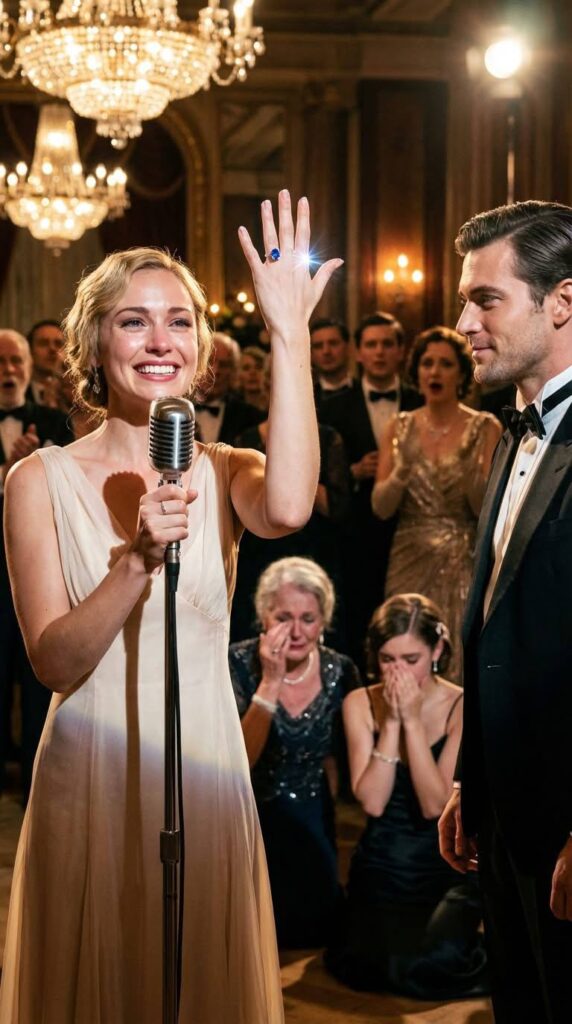
At 8:00 p.m., Vivien took the microphone. The room went silent.
“I’ve always raised my girls to aim high,” she began, her voice echoing off the high ceilings. “Brooke married a man who gave her the moon.” She gestured to Brooke, whose diamond flashed under the spotlights. “And Riley… well, Riley has always been our independent soul. She found a man who gives her handmade furniture and… creative choices.”
A few people chuckled. Linda Marsh smirked behind her champagne flute.
“But love comes in all budgets,” Vivien continued, her eyes finding mine with a glint of cold triumph. “And tonight, we celebrate that modesty.”
She raised her glass. “To Riley and Nate. May your life be as sturdy as a pine table.”
I didn’t wait for the applause to die down. I stood up. The chair scraped against the floor, a sharp, jarring sound. I walked toward the podium. I could see the panic flickering in Vivien’s eyes as I reached for the microphone.
“Thank you, Mom,” I said, my voice steady. ER training is a wonderful thing; it teaches you how to keep your heart rate down when the room is screaming. “I’d like to say a few words about this ‘modest’ ring.”
I held up my hand. Under the harsh LED lights of the podium, the sapphire didn’t sparkle like Brooke’s diamond. It glowed.
“This stone belonged to Nate’s grandmother, Ruth Hollis,” I told the eighty guests. I saw Margaret Bowen lean in, her curiosity piqued. “Her husband, George, was a carpenter. He chose this sapphire because it was the color of the sky on the morning he met her. They were married for forty-one years. They survived fires, layoffs, and a lifetime of hard labor, and she never took this stone off.”
I looked directly at my mother. “This ring isn’t about what Nate could ‘afford.’ It’s about forty-one years of a love that didn’t need a scoreboard. It’s the most valuable thing in this room, because its worth isn’t measured in carats. It’s measured in time.”
The silence that followed was absolute. It wasn’t the uncomfortable silence of a “family misunderstanding.” It was the silence of eighty people realizing they were standing on the wrong side of a very clear line.
From the back of the room, Helen Collins—the grand dame of the country club—stood up and raised her glass. “To Ruth’s sapphire,” she said, her voice ringing with authority. “And to a love that lasts.”
The room erupted. Vivien’s face didn’t just pale; it seemed to physically crumble. She had lost the room. She had lost the audience. And for a woman who lived for the applause, that was a fate worse than death.
Chapter 5: The Architecture of New Ground
The aftermath was a slow-motion collapse of the Reeves empire.
That night, my father didn’t go to the master bedroom. He stayed in the guest room. The next morning, he told Vivien she needed to see a therapist—someone “not in our social circle”—or he was filing for divorce. It was the first ultimatum he had ever issued in thirty years of marriage.
Brooke called me two days later. She didn’t ask me to “smooth things over.” She spent forty minutes crying on the phone, finally admitting that Tyler was miserable, that he felt like a bank account instead of a husband, and that she was tired of being a trophy in Vivien’s display case.
“I thought I was the favorite,” she whispered. “But I was just the one who followed the script.”
As for Vivien, the social fallout was the most brutal part. In the world of country clubs and charity galas, being called “cruel” is a temporary scandal. Being called “out of touch” is a permanent exile. Margaret and Linda stopped returning her calls. The “Engagement Party” became a cautionary tale whispered over bridge games.
Vivien reached out to me a month later. We met at Thornton’s Coffee, a neutral territory far from the lilies and chandeliers. She looked different—less polished, her hair pulled back in a simple clip.
“I’m sorry,” she said. It was the first time I had ever heard those words without a “but” attached to the end. “I realized… my own mother did the same thing to your father. She mocked his ring. She mocked his salary. I swore I wouldn’t be her, and I became her anyway.”
I didn’t offer her a quick forgiveness. I offered her a boundary.
“I love you, Mom,” I said. “But the scoreboard is gone. If you want to be in our lives, and in our children’s lives, you have to stop counting.”
Nate and I were married in October. We didn’t go back to the country club. We got married in the yard behind his workshop, under the maple tree. There were forty guests. Nate built the communal tables from white oak, and my mother brought a massive pot of her homemade red sauce—the only thing she makes that isn’t for show.
Brooke stood as my maid of honor, Tyler and Nate clinked beer bottles like brothers, and my father walked me down the aisle with a smile that finally reached his eyes.
On my hand, the sapphire caught the autumn sun. It didn’t throw rainbows. It didn’t dazzle the neighbors. It just glowed—steady, deep, and blue. A piece of the sky that had survived forty-one years of winter, and was ready for forty more.
I used to think silence was the only way to keep a family together. I was wrong. Silence is just a payment plan for a peace you can’t afford. True peace doesn’t start until you’re brave enough to say the truth out loud.
My name is Riley Reeves. I am an ER nurse, the wife of a carpenter, and I am finally, for the first time in my life, exactly where I belong.