
Chapter 1: The Test of Submission
The private dining room at L’Orangerie was suffocating. It smelled of shaved truffles, heavily decanted Bordeaux, and a potent, almost tangible aura of predatory arrogance.
I sat near the middle of the long, mahogany table, my posture impeccably straight, my hands folded neatly in my lap. I was wearing a conservative, elegant navy dress, projecting the exact image required of me: polite, unassuming, and eager to please. For the past eight months, I had been dating Marcus Vance. Tonight was the dreaded, highly anticipated “meet the family” dinner, a gauntlet I was expected to run to prove my worthiness to enter their esteemed bloodline.
At the head of the table sat Sylvia Vance, Marcus’s mother. She was a woman who seemed entirely composed of sharp angles, expensive, judgmental stares, and pearls that cost more than most people’s cars. For the last two hours, she had subjected me to a relentless, thinly veiled interrogation. She had subtly mocked my lack of a “proper pedigree,” questioned my education, and dismissed my vague description of working in “government data analysis.” In contrast, she spoke of Marcus’s mediocre career in mid-level pharmaceutical sales as if he were single-handedly curing diseases.
Marcus sat to my right, swirling his third glass of expensive Macallan scotch. He hadn’t defended me once. In fact, he seemed to inflate with every subtle insult his mother hurled my way, leaning into the role of the prized son bringing home a lesser woman who needed to be trained.
I took a slow, measured breath, maintaining my placid smile. I was exceptionally good at maintaining a facade. Marcus knew me as Elena, a quiet, organized girlfriend who liked reading and running. He had absolutely no idea that “Elena” was a carefully constructed civilian cover. He didn’t know that my actual title was Director Elena Ward, a Level 5 clearance operative for the Defense Intelligence Agency, currently overseeing domestic cyber-terrorism task forces. I had kept my profession completely classified for operational security. To Marcus and his family, I was just a civilian they could easily break.
The heavy oak doors of the private room opened, and the maitre d’ approached silently, carrying a sleek black leather checkbook. He walked directly to Marcus, the presumptive host of the evening.
But Sylvia raised a single, manicured hand, stopping the waiter in his tracks.
“Bring that here, please,” she commanded.
The waiter obliged, placing the leather book in front of her. Sylvia opened it, her eyes briefly scanning the itemized receipt. We were a party of sixteen extended relatives. They had ordered the most expensive champagne, imported caviar, and dry-aged steaks. The bill, I estimated quickly, was well over three thousand dollars.
Sylvia didn’t reach for her designer purse. Instead, she placed her hand flat on the leather book and slowly, deliberately, slid it down the long linen tablecloth until it stopped directly in front of me.
The ambient chatter of the aunts, uncles, and cousins instantly died away. The room fell into a heavy, expectant silence.
“It’s a tradition in our family, Elena,” Sylvia announced, her voice carrying an unmistakable, cruel sneer. “The newest addition always treats the family to their first dinner. It’s a gesture to prove they aren’t just after our money. It shows respect. Consider it a test of your devotion to Marcus.”
I looked at the black leather book resting inches from my water glass. Then, I looked at Marcus.
He was staring into his scotch, aggressively avoiding my eyes. A small, smug, cowardly smile played on his lips. He was complicit. He had known this was coming, and he was reveling in the power dynamic his mother was establishing. They were demanding I drain my supposed savings to buy their approval. It was an act of supreme narcissism, a financial subjugation designed to humiliate me and establish my place at the bottom of their hierarchy.
I didn’t flush with embarrassment. I didn’t reach for my purse. I kept my voice perfectly calibrated, devoid of any emotional inflection, ensuring I didn’t create a scene.
“I am a guest, Sylvia,” I said evenly, looking directly into her cold eyes. “And I don’t participate in financial loyalty tests.”
Sylvia’s triumphant smile vanished instantly. Her eyes narrowed into cold, dangerous slits. The fifteen extended relatives at the table seemed to collectively hold their breath. The silence was deafening.
Marcus suddenly leaned over, closing the distance between us. His breath was hot against my ear, the smell of alcohol sharp and incredibly unpleasant.
“Pay, or we’re finished,” Marcus whispered.
His tone had dropped the loving, charming fiancé act entirely. It was guttural, threatening, and dripping with the malice of a controlling bully whose ego had just been challenged in public.
“Don’t embarrass my mother,” he hissed, his hand gripping my thigh under the table hard enough to bruise. “Pull out your card right now, Elena. I won’t tell you again.”
Chapter 2: The Shattered Glass
I looked at Marcus’s hand gripping my leg. I looked at the red flush of anger creeping up his neck.
In a fraction of a second, my training engaged. I processed the physical threat, the psychological manipulation, and the absolute death of our relationship. There was no grief. There was only the cold, clinical realization that I had spent eight months dating a deeply insecure, dangerous sociopath.
I didn’t argue. I didn’t cry. I didn’t offer a desperate compromise.
“Then we’re finished,” I said smoothly, my voice carrying clearly across the silent table.
I reached down, smoothly prying his gripping fingers off my thigh. I picked up my small black clutch from the empty chair beside me and stood up. I intended to walk out of the private dining room, out of the restaurant, and permanently out of his life. I would call a taxi, go back to his apartment, pack my few belongings, and vanish before he even paid the bill.
I made it exactly two steps.
I didn’t see him grab the heavy, empty, dark green Bordeaux bottle from the center of the table. I was already turning toward the door, my back slightly exposed.
I only felt the explosive, white-hot, blinding agony as the thick glass shattered violently against the left side of my skull.
The sheer force of the impact knocked me completely sideways. The sound of the glass breaking was deafening, a sickening CRACK that echoed off the mahogany walls.
The room tilted violently. My vision swam in a chaotic haze of sudden, overwhelming dizziness as my brain slammed against the inside of my skull. I lost my footing, my shoulder hitting the heavy, upholstered edge of an empty chair. I dropped heavily to one knee on the thick, patterned carpet, my hands instinctively flying up to protect my head.
Warm, thick blood immediately began rushing down my temple. It poured over my eyebrow, stinging my left eye, and began soaking rapidly into the pristine white collar of my silk blouse.
A cacophony of gasps and a few muffled screams erupted from the extended family at the table.
But sickeningly, not a single person moved to help me. No one rushed forward. No one yelled for a doctor. Sylvia sat frozen at the head of the table, her hands clutching her pearls, a horrifying look of shocked, twisted satisfaction playing across her features. Her son had just physically subdued the disobedient woman.
Marcus stood towering over me. His chest was heaving with adrenaline and rage. In his right fist, he still clutched the jagged, incredibly sharp neck of the broken wine bottle, the weapon dripping with the remnants of expensive red wine and my blood.
“Who gave you permission to leave, you disrespectful brat?!” Marcus bellowed, his voice raw and echoing in the confined space. The veins in his neck were bulging prominently. He pointed the jagged glass directly at my face. “You sit down, you pay the damn bill, and you apologize to my mother right now!”
The room spun sickeningly, the nausea of a severe concussion threatening to overwhelm me.
But my training—years of surviving interrogations, combat simulations, and high-stress environments—instantly overrode the physical trauma. The civilian Elena was gone. The operative took control.
I didn’t scream. I didn’t beg for my life. I didn’t cower.
My left hand moved slowly, deliberately, dropping from my bleeding head to rest casually on my right wrist. I wore a heavy, sleek smartwatch. It looked like a high-end fitness tracker.
It wasn’t.
With my thumb, I found the discreet, encrypted, tactile button hidden on the side of the casing.
I pressed it twice. Hard.
A silent, localized, Level-1 distress beacon was just broadcast on a highly classified, encrypted military frequency. It was a signal that instantly alerted the covert, heavily armed protective security detail that tracked my movements twenty-four hours a day, seven days a week, from unmarked vehicles parked less than two blocks away.
I slowly lifted my head, looking up at Marcus through the blood dripping into my eye. He was sneering, breathing heavily, completely intoxicated by the illusion of his own power.
He thought he had just broken a weak, civilian girlfriend who had stepped out of line.
He didn’t know he had just committed a felony assault against a highly protected asset of the United States government. He didn’t know he had just declared war on a woman who could summon an army with the flick of her wrist.
Chapter 3: The Ticking Clock
“Get up!” Marcus shouted, stepping forward and viciously kicking my black clutch across the floor. It hit the wall with a dull thud. “I said, get up!”
“Marcus, calm down,” his uncle, a balding man in a cheap suit, muttered nervously from halfway down the table. He raised his hands in a placating gesture but made absolutely no move to stand up or disarm his nephew. “Just… just let her pay the bill, Marcus, and we’ll go. People are going to hear you.”
I stared at the uncle, my mind processing the sheer, breathtaking sociopathy of the room. They were actually trying to negotiate a restaurant tab over an active assault with a deadly weapon. They were enabling him, prioritizing their own comfort and avoiding a scene over my bleeding head.
I stayed on one knee. I pressed my palm firmly against the deep gash above my ear, applying direct pressure to slow the arterial bleeding. The metallic smell of copper mixed heavily with the scent of truffles in the room.
I didn’t beg. I didn’t scream for help. I didn’t cry.
I slowly shifted my weight, balancing myself, my eyes locking onto Marcus with a dead, clinical, predatory stare. It was a look completely devoid of fear, a look that operatives use when they are assessing a target for elimination.
Marcus noticed. His arrogant sneer faltered for a fraction of a second. The complete absence of panic in his victim deeply unnerved him. He expected hysterics; he was receiving absolute silence.
“You have approximately thirty seconds, Marcus,” I said. My voice was eerily calm, steady, and projecting clearly, despite the blood pooling in the corner of my mouth from biting my tongue during the fall.
Marcus blinked, thrown off balance. “Thirty seconds for what?” he scoffed, trying to regain his domineering posture, taking another threatening step toward me with the jagged, broken glass raised. “For you to stop being a stubborn bitch? Get off the floor.”
“No,” I whispered, maintaining unbroken eye contact, my voice dropping to a terrifying register. “Thirty seconds until you lose your freedom.”
“You’re crazy,” Sylvia finally spoke up from the head of the table, her voice trembling slightly, though she tried to mask it with disdain. “Marcus, just leave her there. The staff will throw her out. Let’s just pay the bill and leave.”
But before Marcus could respond, the atmosphere in the room fundamentally shifted.
The heavy, soundproofed oak doors of the private dining room were thick, but they couldn’t entirely block out the outside world. Suddenly, the ambient noise of the restaurant outside our room died completely.
The clatter of expensive silverware, the low hum of chatter from other diners, the soft piano music playing in the main hall—it all vanished in an instant. It was replaced by a heavy, unnatural, terrifying silence.
Then, the floor beneath us vibrated.
It was a low, rhythmic, heavy thudding sound echoing down the hallway outside. It sounded like the synchronized, aggressive march of heavy combat boots moving at a dead sprint.
Marcus froze, his head snapping toward the closed oak doors. The jagged bottle in his hand lowered slightly.
Sylvia stood up from her chair, her face finally paling, her hand clutching her pearls in genuine anxiety. “What… what is that noise?” she asked, her voice cracking. “Marcus, go check the door.”
Marcus took a hesitant step toward the entrance, his bravado rapidly evaporating in the face of the unknown.
“Don’t bother,” I said quietly, remaining perfectly still on one knee.
The heavy oak doors didn’t open.
They exploded inward.
With a deafening, catastrophic CRASH that shook the crystal chandeliers above the table, the double doors were violently ripped off their brass hinges by a heavy steel breaching ram. The wood splintered violently, flying into the room as the doors slammed onto the expensive carpet.
Chapter 4: The Breach
The breach was a masterclass in overwhelming, kinetic violence.
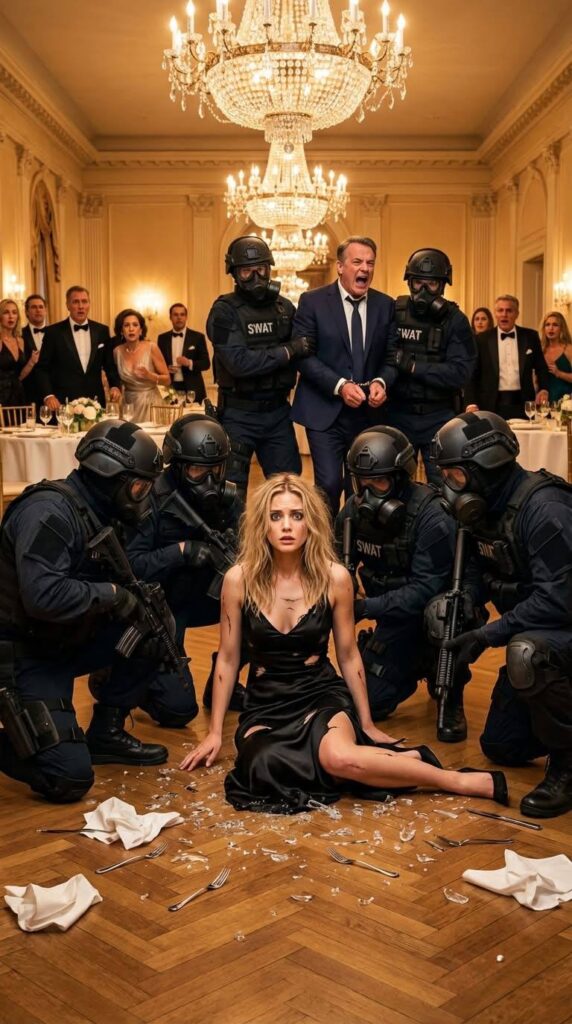
Before the splintered wood even hit the floor, eight men flooded into the private dining room. They moved with terrifying, synchronized speed, an explosive rush of dark, heavily armed tactical superiority.
They were not local police. They wore full, unmarked black tactical gear, heavy ballistic vests, and Kevlar helmets equipped with night-vision mounts. Their faces were obscured by black balaclavas, revealing only cold, hyper-focused eyes.
In less than three seconds, the room was entirely secured.
Bright, blinding weapon-mounted flashlights cut through the dim lighting of the restaurant, illuminating the terrified faces of Marcus’s family. But more terrifying than the lights were the solid red laser sights painting the chests, foreheads, and throats of every single person seated at the mahogany table.
“FEDERAL AGENTS! NOBODY MOVE! GET YOUR HANDS ON THE TABLE NOW!” the lead operator roared. His voice was a booming, deafening command that left no room for hesitation. He held a short-barreled, suppressed M4 assault rifle raised and sweeping the room, his finger hovering dangerously close to the trigger.
Absolute, hysterical chaos erupted.
Sylvia shrieked, a high-pitched wail of pure terror. She dropped her wine glass, diving under the heavy mahogany table, her expensive pearls scattering across the floor. Uncles, aunts, and cousins threw their hands over their heads, some sobbing, others screaming, completely paralyzed by the sudden, lethal force dominating their space.
“HANDS WHERE I CAN SEE THEM! DO IT NOW!” another operator shouted, stepping forward and physically shoving a slow-moving cousin’s head down onto his empty dinner plate.
Marcus stood frozen in the center of the room. He was caught in the blinding beam of a tactical flashlight. The broken, jagged neck of the wine bottle was still clutched in his right hand. His eyes were wide, bloodshot, and filled with complete, unadulterated incomprehension. The cowardly bully was entirely out of his depth.
He didn’t drop the weapon immediately. He was too stunned to process the command.
That was his second massive mistake of the night.
An operator to his left didn’t give him a warning. He didn’t negotiate.
The heavily armored man lunged forward with explosive speed. He swung the heavy, reinforced butt of his assault rifle in a tight arc, slamming it viciously into the back of Marcus’s knees.
Marcus let out a sharp cry as his legs buckled instantly. He collapsed, crashing face-first into the thick carpet with a heavy, breathless thud. The broken bottle slipped from his grasp, skittering away across the floor.
Before Marcus could even attempt to lift his head, the operator drove a heavy, steel-toed combat boot squarely into the back of Marcus’s neck, pinning his face brutally against the floor.
“Don’t move! Do not move!” the operator growled, dropping his knee onto Marcus’s spine.
He violently wrenched Marcus’s right arm backward, twisting the shoulder to the point of agonizing strain. He grabbed the left arm, pulling it to meet the right, and secured his wrists with a thick, heavy-duty plastic zip-tie. The operator pulled it so tight that the plastic cut into Marcus’s skin, causing him to scream out in sudden, sharp agony.
The lead operator, entirely ignoring the screaming, weeping family at the table, slung his rifle down to his side and immediately rushed to where I was still kneeling on the floor, pressing my hand to my bleeding head.
He didn’t call me Elena. He didn’t ask if I was Marcus’s girlfriend.
He knelt beside me, his eyes scanning my wound with rapid, clinical precision.
“Director Ward, are you secure?” the Commander asked, his voice low and urgent, entirely respectful of the hierarchy.
The room seemed to collectively gasp. The screaming from the table stopped, replaced by a stunned, horrifying realization as the title echoed in the small space. Director.
“I’m functional, Commander,” I said, my voice steady despite the throbbing pain in my skull. I accepted his gloved hand as he pulled me firmly to my feet.
A team medic, carrying a trauma bag, instantly stepped up beside me. He didn’t ask permission; he firmly pressed a thick, sterile trauma dressing to the side of my head, wrapping a pressure bandage tightly around my skull to stop the bleeding.
Marcus was thrashing on the ground, his face mashed into the carpet, spitting blood from a busted lip he sustained during the takedown. He craned his neck, looking up at me through wild, panicked eyes.
“What the hell is this?!” Marcus screamed, his voice cracking with hysteria, desperately clinging to the delusion that he still had rights. “You can’t do this! I’m a citizen! This is police brutality! She’s my fiancée! Tell them to get off me, Elena!”
I stood tall, the pressure bandage tight around my head, the blood already drying on my silk collar. I looked down at the pathetic, trembling man who had just tried to crack my skull open to impress his mother.
I stepped slowly over the trembling form of Sylvia, who was sobbing hysterically under the table, her hands covering her ears.
“I was never your fiancée, Marcus,” I said coldly, my voice ringing with absolute, crushing authority, looking down at him like he was an insect I had just stepped on. “And you just committed aggravated assault with a deadly weapon against a Level 5 intelligence officer of the United States government.”
Marcus stopped thrashing. His eyes went wide, the horrifying gravity of the situation finally, brutally penetrating his arrogance.
“I suggest you get comfortable on that floor, Marcus,” I whispered, the words carrying a lethal finality. “Because it’s the highest you’ll be for a very, very long time.”
Chapter 5: The Interrogation Room
The tactical team hauled Marcus violently to his feet.
The arrogant, domineering bully who had demanded I pay a three-thousand-dollar bill to prove my worth was entirely, thoroughly destroyed. His bespoke suit was ruined, covered in carpet lint and his own spit. He was weeping openly, tears streaming down his face, his chest heaving with panicked, gasping sobs. The reality of a federal indictment, of facing down an armed tactical team, had completely shattered his fragile ego.
“Sylvia!” Marcus sobbed as two massive operators began to drag him backward by his zip-tied arms toward the splintered doorway. “Mom! Mom, do something! Call my lawyer! Call Uncle Richard!”
Sylvia, hearing her son’s desperate, pathetic cries, slowly crawled out from under the heavy mahogany table. She looked grotesque. Her expensive, tailored dress was stained with spilled red wine. Her perfect hair was a chaotic mess, and her signature pearls were tangled around her neck.
She scrambled to her feet, holding her hands out toward me, her eyes wide with a desperate, pleading terror. The condescending matriarch was gone, replaced by a woman begging for mercy from the person she had spent two hours degrading.
“Elena, please!” Sylvia shrieked, her voice cracking. She tried to take a step toward me, but a tactical operator instantly raised a hand, physically blocking her path. “Please, Elena, tell them to stop! It was a misunderstanding! We didn’t know who you were! We didn’t know you were government! We’ll pay the bill! I swear to God, we’ll pay whatever you want! Just tell them to let my boy go!”
I stood perfectly still, letting the medic finish securing the bandage around my head. I looked at Sylvia, feeling absolutely no pity, no anger, no emotion whatsoever. She was a non-entity.
“The bill has already been paid, Sylvia,” I said, my voice eerily calm, cutting through her hysterical sobs.
I gestured toward the door, where Marcus was currently being shoved into the hallway, screaming for his mother.
“By your son,” I continued. “He just bought himself twenty years in a federal penitentiary for assaulting an intelligence officer with a deadly weapon. There is no amount of money, and no lawyer in this city, that can undo what he just did.”
Sylvia gasped, her hands flying to her mouth, her eyes rolling back slightly as if she were about to faint. The uncles and aunts at the table remained perfectly still, their hands glued to the mahogany wood, terrified to even breathe in the presence of the armed operators.
I turned to the Commander, who was standing at attention, awaiting my orders.
“Process him for aggravated assault with a deadly weapon, attempted murder of a federal official, and domestic terrorism, just to ensure he doesn’t get bail,” I instructed coldly.
“Yes, Director,” the Commander nodded sharply.
“As for the rest of them,” I said, sweeping my gaze over the terrified, trembling family members sitting at the table. “Detain the entire room. They are material witnesses to a federal crime, and potentially accessories before the fact. Confiscate their phones. I want individual, sworn statements from every single person in this room regarding what they witnessed before they are allowed to call counsel.”
A fresh wave of panicked sobbing erupted from the table as the operators moved in, pulling out zip-ties to secure the family members.
I didn’t wait to watch them be handcuffed. I didn’t need to see the conclusion of the pathetic drama.
I turned on my heel and walked out of the ruined private dining room, flanked by two armed guards, leaving the screaming, terrified Vance family behind in the wreckage of their three-thousand-dollar dinner.
I spent the rest of the night in a highly secure, undisclosed medical facility an hour outside the city. A top-tier military surgeon gave me eight neat stitches to the side of my head and diagnosed a mild concussion. I slept for four hours in a quiet, sterile room, unbothered by the chaos I had left in my wake.
The next morning, I put on a fresh, dark suit provided by my detail. I drank a cup of black coffee, got into the back of an armored SUV, and returned directly to my office in Langley.
I opened my secure terminal. The operational file on Marcus Vance, the civilian cover identity I had maintained for eight months to monitor a suspected leak in his pharmaceutical company, was officially closed. He was no longer a person of interest.
He was an inmate.
Chapter 6: The Asset’s Peace
Six months later.
The wheels of federal justice grind slowly, but when they are fueled by the assault of a high-ranking intelligence director, they grind with absolute, terrifying precision.
The trial was nothing more than a bureaucratic formality. Faced with the irrefutable, sworn testimony of a federal operative, the medical reports of my injuries, and the statements of a dozen terrified relatives who had eagerly turned state’s evidence against Marcus to save themselves from accessory charges, his high-priced defense attorney had no cards left to play.
Marcus Vance pled guilty to felony assault on a federal officer with a deadly weapon.
There was no leniency. The federal judge, citing the unprovoked, brutal nature of the attack, sentenced him to fifteen years in a maximum-security federal penitentiary, without the possibility of early parole.
His life was entirely, irrevocably destroyed.
The fallout for his family was equally catastrophic. Sylvia Vance, drowning in astronomical legal fees to defend her son, was forced to liquidate her assets and sell her sprawling suburban home. The story of the violent tactical raid at L’Orangerie had leaked into their high-society circles, becoming legendary, whispered gossip. She was formally ostracized from her country club, her charity boards, and her friend group. The family that had prided itself on dominance and pedigree was reduced to a cautionary tale of suburban arrogance.
I never saw them again. I never spoke to Marcus. I didn’t need to.
It was a Tuesday afternoon. I sat in my secure, soundproofed briefing room at headquarters in Langley. The room hummed with the quiet, intense energy of massive servers processing global data. I was reviewing classified satellite imagery for an upcoming, high-stakes extraction operation in Eastern Europe.
I reached up absentmindedly, brushing a strand of dark hair behind my left ear. My fingers grazed the scar on my temple. It had healed remarkably well, leaving only a faint, slightly raised white line hidden beneath my hairline. It didn’t ache anymore. It was just a mark, a reminder of a closed file.
I leaned back in my ergonomic chair, looking at the glowing monitors.
Marcus had demanded I pay a massive restaurant bill to prove I was worthy of entering his family. He had viewed my silence, my calm demeanor, and my refusal to escalate the argument as signs of a weak, submissive woman he could easily break into obedience. He believed that volume and physical violence equated to power.
He didn’t understand the fundamental truth of my world.
He didn’t understand that the most dangerous people on the planet are never the ones screaming in a restaurant. They are never the ones breaking bottles or demanding apologies.
The most dangerous people are the ones who can take a violent blow to the head, bleed onto a carpet, look you dead in the eye with absolute silence, and quietly, efficiently, call in an airstrike on your entire existence.
I smiled softly, a genuine, peaceful expression. I closed the briefing file on my desk, pushed the memory of Marcus Vance into the deepest, darkest vault of my mind, and got back to the only job that truly mattered.