
Chapter 1: The Arithmetic of Loss
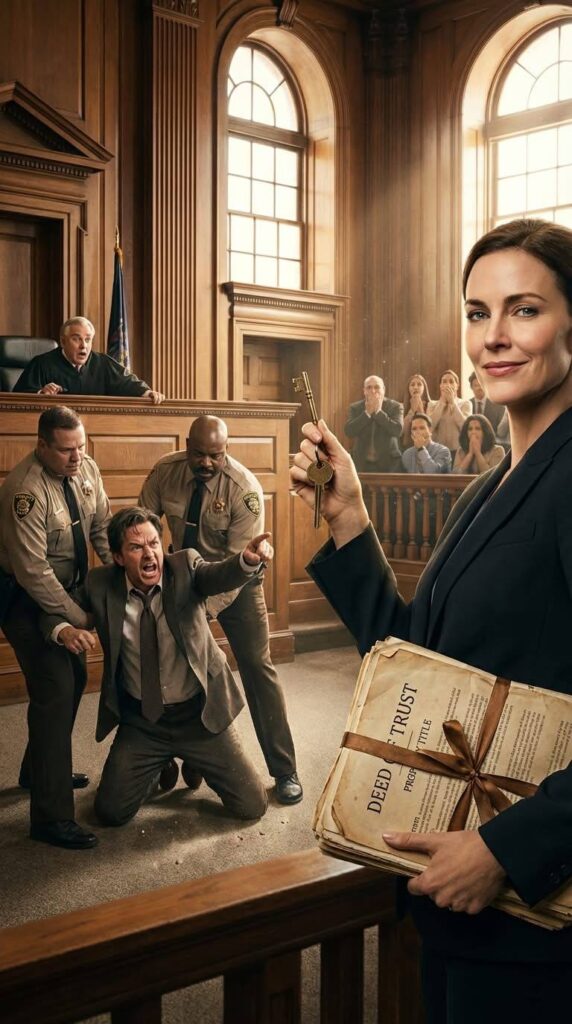
The sound of a gavel isn’t like a hammer on a nail; it’s more like a bone snapping in a quiet room. It’s final, clinical, and devoid of the sweat and blood that went into building the life it just dismantled. I sat on a hard wooden bench in Courthouse 9, watching twelve years of my life be divided like a carcass in a butcher shop.
Beside me sat a man I barely recognized. Brandon wore the charcoal pinstripe suit I had meticulously picked out for his first big promotion six years ago. He looked like the archetype of success—broad-shouldered, chin high, eyes fixed on a horizon that no longer included me. Across the aisle, his high-priced legal team straightened their silk ties and shuffled thick binders of “evidence” that proved I was a financial ghost.
Your Honor,” Brandon’s lead attorney began, his voice a smooth baritone that echoed off the high ceilings, “my client has been the sole financial engine of this union. The Ashford Residence, the luxury vehicles, the diversified investment portfolios—every brick and every cent was acquired through his professional acumen.”
I felt a phantom ache in my lower back, a memory of the double shifts I pulled as a nurse at St. Jude’s Hospital for three years so Brandon could study for his broker’s license. I remembered the broken air conditioner in our first apartment, the smell of cheap takeout, and the way I’d whispered, “We’re almost there,” when he wanted to quit. But my lawyer, a harried man from a Free Legal Aid clinic who spent most of the hearing checking his watch, had warned me to stay silent.
“The judge has seen the spreadsheets, Clare,” he’d muttered. “In the eyes of the law, Brandon is the provider. You’re the dependent. This is straightforward.”
Straightforward. That word felt like a slur.
By noon, the “straightforward” math was complete. Brandon kept the house I had painted with my own hands. He kept the cars, the retirement funds, and the savings account that still bore my name but apparently didn’t belong to my person. I was handed a settlement check for $11,000—the price of a twelve-year sacrifice—and a handshake from a judge who didn’t even look me in the eye.
But then, the final item appeared on the docket. The Lake Cabin.
“A direct inheritance from Arthur Hawkins to Clare Elizabeth Ashford,” the judge droned, glancing at the deed. “Received prior to the marriage and never commingled with marital assets. The property remains with the petitioner.”
Brandon let out a thin, performative exhale of derision. His lawyer didn’t even bother to contest it. To them, it was a liability—a rotting shack four hours north, surrounded by nothing but pine trees and silence. Brandon laughed under his breath, a sharp, jagged sound.
“Enjoy the shack, Clare,” he whispered as he stood to leave. “I hope the squirrels are good company.”
I stood there, clutching my $11,000 check and the deed to a ruin, realizing that I had walked away with nothing but what could fit into two suitcases. But as I watched Brandon walk out of that courtroom, I didn’t cry. I felt a cold, hard ember ignite in my chest.
I didn’t know then that the squirrels weren’t my only company. I didn’t know that my grandfather had been playing a much longer game than Brandon could ever conceive.
Chapter 2: The Cedar and the Rust
The padlock on the cabin door was a frozen knot of rust. I stood in the pitch-black woods of Millbrook, my breath hitching in the cold spring air. A flashlight I’d bought at a gas station forty miles back flickered in my shaking hand, illuminating the weeds that had reclaimed the gravel driveway.
I was four hours from the city, four hours from Megan’s cramped couch, and a universe away from the life I’d known. I sat on the porch steps, listening to the lake. The water lapped against the dock Grandpa Arthur had built when I was seven. He used to tell me that patience wasn’t about waiting; it was about knowing exactly what you were waiting for.
At thirty-four, standing on a porch I couldn’t enter, I finally understood the “waiting” part. The “knowing” was still a mystery.
I found a heavy stone by the woodpile and struck the padlock six times. On the seventh, it shattered. The door swung open, and the scent of the past rushed out to meet me: pine, old paper, and the sharp, medicinal tang of Cedar.
Grandpa Arthur had been obsessed with cedar blocks. He said they kept the moths away, but I suspected he just liked the smell of a forest that couldn’t be cut down. I stepped inside, the beam of my flashlight dancing over the plaid couch with its sunken middle and the bookshelves he’d built from local birch.
Everything was a museum of a man who didn’t believe in waste. His reading glasses were still on the nightstand. His fishing vest hung by the door like a molted skin. I sat on the couch, and finally, the structural integrity of my composure failed. I didn’t sob; I simply broke. I cried for three hours, a rhythmic, exhausting release that felt like scrubbing a floor until the wood bled.
The first week was a lesson in brutalist survival. This wasn’t a movie where the woman finds herself by picking wildflowers. This was the ugly reality of scrubbing black mold off bathroom tiles at 2:00 AM because my brain wouldn’t stop replaying the pinstriped derision in Brandon’s eyes.
The cabin had no central heat. The water heater was a temperamental beast that produced lukewarm water only after twenty minutes of groaning. The nearest grocery store was a thirty-minute trek down a road where cell signals went to die. I ate canned soup and stared at the walls, wondering if my mother was right. She’d called the cabin a “shack in the woods,” a consolation prize for a “favorite” grandchild who’d failed at life.
On the sixth day, I decided to clean the paintings. Grandpa Arthur wasn’t a master, but he was prolific. Landscapes mostly. The Stone Bridge, the Birch Grove, and the large winter scene above the fireplace—a frozen lake under a sky the color of a bruised plum.
“I painted that on the coldest night of my life,” he’d told me once.
As I wiped the dust from the heavy wooden frame, the painting shifted. It didn’t swing like a normal frame; it felt weighted, unbalanced. I gripped the edges to steady it and felt something thick taped to the back.
My heart hammered against my ribs—a frantic, uneven rhythm. I carefully lifted the canvas off its hook and laid it face-down on the rug. Taped to the back of the frame with yellowed packing tape was a manila envelope.
Written across the front in his elegant, disciplined script: Clare Elizabeth Ashford. If you’re reading this, it’s because I’m already gone.
I peeled the tape, my fingers fumbling with a sudden, desperate electricity. Inside was a single folded letter, a brass key, and a business card for a man named Thomas Wilder, an attorney in town.
I opened the letter.
My dear Clare, it began. If you are reading this in the cabin, then you came back to the only place I could leave something for you that no one else would ever look. I have watched you give yourself away to people who did not know your value. I watched it with your mother. I watched it with the man you married. I could not stop it. That was the hardest part of loving you—knowing that you would have to learn the hard way what you were worth.
The letter went on to describe the brass key. It opened Safety Deposit Box 1177 at First Heritage Bank.
I was not a rich man, Clare, he wrote, but I was a patient one. What is in that box is not a gift. It is a correction. The world took things from you that it should not have taken. This is my way of putting them back.
He signed it simply: A.H.
I sat on the floor, the brass key cold and heavy in my palm, and realized the silence of the woods wasn’t empty. It was expectant.
Chapter 3: The Vault of Seven Deeds
Milbrook was a town designed by time and forgotten by progress. Main Street was a four-block stretch of red brick and weathered wood. First Heritage Bank stood at the end of the line, a stone fortress that looked like it had been built to survive an apocalypse.
I walked in with the brass key tucked into the pocket of my jeans. The manager, a man named Gerald who looked like he’d been carved out of the same stone as the building, didn’t ask for my ID when I gave him my name.
“Arthur’s granddaughter,” he said, his eyes softening behind thick spectacles. “He told me you’d come eventually. I just didn’t know if I’d still be behind this desk when you did.”
He led me into the basement, a cool, subterranean vault that smelled of ozone and old paper. He turned his key, I turned mine, and Box 1177 slid open.
Inside was a thick leather journal bound by a frayed rubber band and a stack of legal folders. I took them to a small, private booth Gerald provided. My hands wouldn’t stop shaking.
I opened the top folder. The first document was a deed. Then another. Then another.
Seven deeds in total. Each one for a different parcel of land. As I read the legal descriptions, my breath hitched.
Parcel 1: North Shore Access. Parcel 3: The Ridge. Parcel 5: East Cove.
I pulled out a map my grandfather had hand-drawn in the back of the journal. The Seven Parcels weren’t just random lots. They were a ring. He had quietly, methodically, purchased every single acre of land surrounding the lake over a span of thirty-seven years.
243 acres of pristine, lakefront property.
I opened the journal. It wasn’t a diary; it was a ledger of a silent conquest.
1978: 40 acres north. $8,200. Cash from the mill. 1991: 35 acres including the ridge. Timber sale money. 2005: Finalized the Hawkins Land Trust.
Grandpa Arthur had never taken a loan. He’d lived in a one-bedroom cabin, drove a rusted truck, and wore the same fishing vest for twenty years. Every cent he’d ever made at the paper mill or from selling firewood had been funneled into the shoreline. He’d bought the land when it was “worthless,” holding onto it as the world outside began to crave exactly what he possessed.
I reached the final envelope in the box. It was a formal assessment from Thomas Wilder, dated just fourteen months ago.
I read the number. I read it again. I had to press my palms flat against the cold metal table to keep from fainting.
The assessed market value of the 243 acres, held under the Hawkins Land Trust, was $9.2 million.
Because the land was in a trust, and because Grandpa had been the sole trustee until his death, it had never appeared in public records tied to his name. To the tax assessor, it was owned by an entity. To the judge in my divorce, I was a woman with an $11,000 check and a “worthless” shack.
But there was a final note in the journal, dated the year he died.
Clare’s husband does not love her. He loves what she gives him. There is a difference, and she will learn it. When she does, she will come to the cabin. And when she finds this, she must remember: Some things can only be received when you are ready to carry them.
I walked out of that bank and stood on the sidewalk of Milbrook. I looked at my reflection in a shop window—a woman in a faded hoodie, exhausted and broke. But behind that reflection was the ghost of a man who had wrapped a lake in a fortress and handed me the keys.
My phone buzzed in my pocket. A text from Brandon.
Clare, my mother Diane mentioned you’re still at the shack. Look, I’m feeling generous. I’ll send a contractor up to quote some repairs so you can sell it and get a real apartment. Just sign the waiver I’m emailing you.
I looked at the phone, then at the bank I’d just exited. A slow, predatory smile spread across my face. I didn’t reply. I had a meeting with an attorney to attend.
Chapter 4: The Predator’s Prospectus
Thomas Wilder’s office was located above the hardware store, reachable by a set of creaking wooden stairs that smelled of linseed oil. Thomas himself was a man of silver hair and sharp, avian features. He didn’t offer me coffee; he offered me a seat and a thick stack of corporate filings.
“I’ve been waiting for you, Clare,” he said, leaning back in his leather chair. “Arthur was very specific. He said you’d find the painting when you had nothing else left to lose.”
“He knew,” I whispered. “He knew about Brandon.”
“He knew about the land,” Thomas corrected. “And he knew who was circling it.”
He slid a glossy brochure across the desk. It was for a project called The Azure Resort & Spa. It was a $120 million luxury development—golf courses, private villas, a deep-water marina.
“The Lakeview Development Group has been assembling land on the West Shore for five years,” Thomas explained. “But their project is a ‘U’ shape. They own the sides, but they don’t own the heart. Your grandfather owned the East Shore, the North Ridge, and the only viable road access for heavy construction. Without your 243 acres, their $120 million project is a dead end.”
He paused, his eyes gleaming.
“And do you know who the primary investment director for Mercer Capital, the firm funding Lakeview, is?”
I felt the blood drain from my face. I didn’t need to answer.
“Scott Kesler,” Thomas said. “Brandon’s business partner. His best friend. The man whose pinstriped coattails Brandon has been clinging to for years.”
The pieces of the puzzle slammed into place with a sickening thud. Brandon hadn’t filed for divorce because our marriage was over. He had filed because he’d done the math. He knew Grandpa Arthur was gone. He knew I had inherited the “shack.” He didn’t know about the trust, but he knew the location was the lynchpin for the biggest deal of his life.
He wanted me desperate. He wanted me broken. He wanted me to sell that “worthless” land to a shell company for pennies so he and Scott could reap the $340 million build-out.
“He tried to contest the trust,” Thomas said, pulling a fresh legal notice from his drawer. “Brandon’s lawyers filed this morning. They’re claiming the trust was a ‘hidden marital asset’ and that you acted in bad faith by not disclosing it during the divorce.”
“I didn’t know about it!” I barked, my voice cracking.
“I know that. Brandon knows that. But he doesn’t need to win, Clare. He just needs to freeze you. If the land is under litigation, you can’t sell it, you can’t lease it, and Lakeview loses their financing. He’s trying to starve you out until you agree to a ‘settlement’ that gives him a piece of the pie.”
I looked out the window at the quiet town below. My $11,000 was dwindling. I had no job, a leaking roof, and a $9 million fortune I couldn’t touch.
“What do we do?” I asked.
Thomas smiled, and it was a terrifying thing to see. He walked over to a gray filing cabinet, opened the third drawer, and pulled out a green folder labeled Protocol B.
“Your grandfather didn’t just buy land, Clare. He bought insurance. He paid for three separate legal opinions from the top firms in the country back in 2018. He had me prepare a preemptive defense that covers every possible angle of a ‘bad faith’ claim. He even left a notarized video statement explaining exactly why you were kept in the dark.”
Thomas tapped the folder.
“He called it his ‘Legal Wall.’ Brandon is about to run headfirst into it at sixty miles an hour.”
Chapter 5: The Master of the Shore
The meeting took place two weeks later in Thomas’s office. I wore a thrift-store blazer and the coldest expression I could muster.
Scott Kesler arrived first, looking every bit the high-stakes developer. But it was the man who followed him who made the air in the room turn to ice.
Brandon walked in, his charcoal suit pressed to a razor edge. He didn’t look like a man in the middle of a legal battle; he looked like a man coming to collect a debt.
“Clare,” he said, his voice dripping with faux-concern. “I’m glad you’re being reasonable. This development is good for the town. It’s a win for everyone.”
“Sit down, Brandon,” I said, not moving a muscle.
We sat across from them—Thomas and I on one side, the architects of my misery on the other. Scott Kesler laid out a contract.
“Ten million dollars,” Scott said, sliding the paper toward me. “Cash. Clean sale. We drop the litigation, you walk away a wealthy woman, and we build our resort. It’s more than the land is worth, and you know it.”
I didn’t look at the contract. I looked at Brandon.
“Did you know?” I asked quietly. “Six years ago, when you asked about Grandpa’s acreage while he was still alive. Did you already have the blueprints drawn?”
Brandon’s eyes flickered. “I don’t know what you’re talking about. I’m just trying to help you out of a legal mess.”
“The legal mess you created,” I countered.
I turned to Scott Kesler. “I’m not selling.”
Scott’s smile faltered. “Clare, ten million is—”
“I’m not selling,” I repeated, my voice gaining a rhythmic, steady power. “But I am willing to talk. My grandfather taught me that land is the only thing that doesn’t lie. He spent thirty-seven years wrapping this lake in a fortress. He didn’t do that so you could turn it into a golf course for people who don’t know the difference between a birch and a pine.”
I slid a new document across the table.
“This is a Long-Term Land Lease. Sixty years. I retain 100% ownership of the deeds. You pay an annual lease fee of $700,000, plus 2.5% of the resort’s gross revenue. I have final approval on all environmental impact studies, and the North Ridge remains a protected conservancy.”
The room went silent. Brandon let out a harsh laugh.
“A lease? You’re insane. No investor will fund a $120 million project on leased land.”
“Then don’t build it,” I said, leaning forward. “But according to your public filings, your financing for the West Shore parcels expires in ninety days. If you don’t have a signed agreement for the road access and the East Shore by then, you lose your investors, you lose your West Shore holdings, and Mercer Capital collapses.”
I looked at Scott Kesler. “You have $48 million of your own money sunk into this, Scott. Is Brandon’s ego worth $48 million?”
Scott looked at Brandon, then at the lease agreement. The friendship that had seemed so ironclad in the courtroom began to crack in the light of a bad balance sheet.
“We need to discuss this privately,” Scott muttered.
“You have ten minutes,” I said.
Chapter 6: The Final Stroke
They came back in eight minutes. Scott was pale; Brandon was vibrating with a suppressed, toxic rage.
“We accept the lease terms,” Scott said, his voice flat. “But only if Brandon remains as the project director.”
“No,” I said. “Section 14 of the lease. Conflict of Interest. No person involved in prior litigation against the Hawkins Land Trust can hold a directorial or executive position in the development. Brandon is out.”
Brandon stood up so fast his chair flipped backward. “You can’t do this! I built your life! You were nothing before me!”
“I was a nurse who paid for your degree, Brandon,” I said, standing to meet his gaze. “I was the person who believed your lies. But today, I’m the woman who owns the road you need to walk on. Get out of my office.”
Scott Kesler didn’t even look at him. He was already signing the lease. He knew that in the world of high finance, a partner who brings a personal vendetta to a $300 million deal is a liability that needs to be liquidated.
Brandon walked out of that office, not with a gavel’s snap, but with the pathetic, dragging sound of a man who had finally run out of other people’s money.
Chapter 7: The Tenth Painting
Three months later, I sat on the porch of the cabin. The weeds were gone, replaced by a modest, well-kept garden of native ferns. The roof was new. The dock was sturdy.
The construction for the resort had begun on the West Shore, but from my porch, the lake looked exactly as it had when I was seven. The water was a sheet of glass, reflecting the gold and crimson of an autumn sunset.
I had $700,000 in my bank account. I had an annual income that would grow every year. But more importantly, I had the land. Every tree, every stone, every ripple in the water belonged to the legacy of a man who knew how to wait.
I went inside and looked at the wall. Grandpa’s nine paintings were still there. But next to them, I had hung a tenth.
It was a painting of the lake at dawn. The proportions were slightly off, and the colors were perhaps a bit too vibrant, but I had signed it in the bottom corner with my own initials: C.A.
I realized then that my grandfather’s “correction” wasn’t just about the money. It was about the silence. It was about the realization that when the world tries to tell you what you’re worth, you don’t have to listen. You just have to wait.
Because the land doesn’t lie. And it never, ever leaves.
My phone buzzed. A text from Megan.
Clare, I just saw the news about the Azure Resort. It says you’re the principal lessor. Oh my god, are you okay?
I looked out at the water, at the fortress of trees that stood guard over my life. I picked up the phone and started typing.
I’m better than okay, Meg. I’m exactly where I’m supposed to be.
But as I looked at the shadow of a man standing on the far shore, watching my cabin through binoculars, I realized that some wars don’t end with a signature. They just change topography.