
My name is Fonda Marshall, and for twenty-nine years, I believed that love was a bridge that could span any distance. I thought it could connect a two-bedroom house on Birch Lane to a sprawling estate in a gated subdivision. I was a nurse practitioner, a woman trained to spot the subtle symptoms of a failing heart, yet I was utterly blind to the rot at the center of my own engagement.
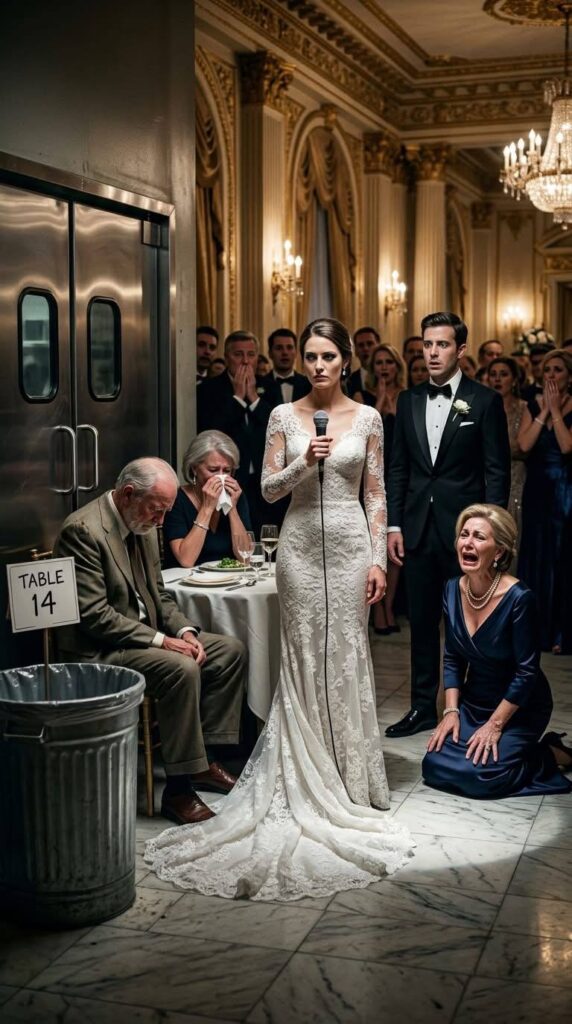
On my wedding day, I found my father, Dave Marshall, standing in a dimly lit corridor of the Whitfield Country Club. He looked like a man who had been told he was in the wrong building. There was no seat for him at the head table. Instead, nine members of my husband’s social circle occupied the chairs that had been promised to my family. Table One, front and center, was a sea of silk and smugness. My parents had been relegated to Table 14—a scarred, folding unit wedged between the clattering swinging doors of the kitchen and a industrial trash bin with a rusted foot pedal.
When I looked at Garrett Whitfield, the man I was minutes away from legally binding my soul to, and asked why, he said something about my father that didn’t just hurt—it illuminated the last two years of my life with a terrifying, clinical light. I stood there in my ivory satin gown, hearing the murmurs of two hundred guests through the drywall, and I made a choice. I chose a side. And it wasn’t his.
Chapter 1: The Orange Soap and the Gilded Cage
Milfield, Ohio, is the kind of place where your history is written in the dirt under your fingernails. Population 8,000, it’s a town of iron and grit, where people like my father, Dave, spent thirty-five years wrestling with copper pipes and septic lines. My dad wore the same pair of steel-toed boots for three decades, resoleing them four times until the leather was as thin as a prayer. He never missed a day of work. Not when his knees turned to gravel in year twenty, and not when his back started screaming in year thirty.
He would come home at dusk, his skin stained with the grey soot of the trade, and scrub his hands with that abrasive orange soap that smelled of gasoline and citrus. Only when his hands were clean would he sit at our laminate kitchen table and ask me what I’d learned about the world that day. My mother, Linda, was the heart of Milfield Elementary. She didn’t just serve lunch; she conducted a daily symphony of compassion, knowing which child needed an extra scoop of mashed potatoes because their pantry at home was empty.
We were “poor” by the standards of a ledger, perhaps. I shared a bedroom wall with the thrumming water heater. But I never lacked for the things that built a person. I reached my goals on a scholarship, earned my stripes in the ER, and eventually became a nurse practitioner at the community clinic on Route 9. By twenty-eight, I had cleared my debts. I was the architect of my own life, but Dave and Linda Marshall provided the foundation.
Then I met Garrett Whitfield.
He was the crown prince of Whitfield Acquisitions, a third-generation real estate empire. We met when his father, Richard, came into my clinic for a physical. Garrett was leaning against the reception desk, looking like he’d been sketched into existence by a high-end charcoal artist. He was charming, he was attentive, and he took me to restaurants where the menus didn’t have prices.
I was introduced to his mother, Constance Whitfield, in a room that smelled of expensive lilies and old money. She wore cream silk and pearls the size of marbles. When she found out I worked at a community clinic, she tilted her head and said, “How… quaint. Garrett usually spends his time with the Harrison girl. Her father is the Chief of Surgery at St. Luke’s.”
Garrett squeezed my hand under the table and whispered that she would “warm up.” I chose to believe him. I chose to believe that his love was a shield. When he proposed fourteen months later in a private room filled with white roses, I said yes, thinking the ring was a promise of a new family. I didn’t realize it was a shackle to an old one.
As the wedding planning commenced, the version of Garrett I had fallen for began to dissolve like sugar in a storm. Constance took over the logistics with a predatory efficiency. The ceremony moved from the little church on Maple Street to the Whitfield Country Club. My mother’s suggestion of serving fried chicken—a family staple—was met with a laugh that felt like a slap. “This is a seated gala, Linda, not a church basement potluck,” Constance had said.
I told myself to pick my battles. I told myself the wedding was just one day, and the marriage was a lifetime. I was wrong. The wedding day wasn’t the celebration; it was the final inspection of my worth.
Chapter 2: The Geography of Discarded People
June 14th arrived with a cruel, mocking brightness. By 10:00 AM, the Whitfield Country Club was a vision of ivory linens and gold-rimmed chargers. It was an $85,000 production, largely funded by the Whitfields, though my parents had handed over their entire fifteen-year savings of $12,000 to cover the catering deposit.
I walked into the reception hall before the ceremony to catch my breath. The room was breathtaking, but as I approached Table One, the air left my lungs. I began to read the place cards. Richard and Constance. Gerald and Lydia Whitfield. The Hendersons. The Porters. All business associates or country club elite.
I scanned the room, my heart hammering a frantic rhythm against my ribs. I found them at the very back. Table 14.
It was tucked behind a decorative pillar, so close to the kitchen that the swinging door nearly grazed the back of my father’s chair. The lighting was poor—a yellowed utility fixture instead of the crystal chandeliers that graced the rest of the room. Two feet away stood a service cart piled with dirty water glasses and a trash can with a foot pedal.
Dave Marshall. Linda Marshall.
I felt a cold, clinical dread. This wasn’t a mistake. This was a statement. I found Diane, the wedding coordinator, near the bar.
“Who moved the Marshalls?” I asked, my voice dangerously low.
“Mrs. Whitfield revised the seating chart this morning,” Diane said, not meeting my eyes. “She told me you had approved the change to accommodate ‘essential stakeholders.’”
I hadn’t approved a thing. I looked at the trash can next to Table 14 and thought about my father’s hands—the hands that had fixed the plumbing of half this town so his daughter could go to college. I thought about my mother’s dress, which she had spent three weekends sewing by hand, squinting at the needle until her eyes ached. Constance wanted them out of the frame. She wanted to treat the people who paid for the salmon like they were the help.
I found Garrett in the groom’s suite. He was admiring his monogrammed cufflinks in a full-length mirror.
“Who moved my parents, Garrett?”
He didn’t turn around. “Mom made some last-minute adjustments, Fonda. Don’t start. It’s just a chair.”
“It’s Table 14, Garrett. It’s next to the garbage. My parents paid twelve thousand dollars for this dinner, and you have them sitting in the kitchen?”
He sighed, a heavy, patronizing sound. “We have the Hendersons and the Porters here. These are people who can change the trajectory of my career. Your parents are tough, baby. They’ll be fine in the back. Let’s just get through the night and I’ll talk to Mom tomorrow.”
Tomorrow. The graveyard of every promise he’d ever made me.
I walked out, but I didn’t go to the bridal suite. I stopped at the welcome table and picked up a program. The ivory cardstock was cold in my hand. I flipped to the “Special Thanks” section. In the version I had edited, I had written a tribute to Dave and Linda Marshall.
The new programs, reprinted that morning, listed only the Whitfield Family Foundation and Richard and Constance. My parents’ names had been systematically erased from the record of my life.
Chapter 3: The Plumber and the Lunch Lady
I needed to hear it. I needed the final confirmation. I walked back toward the groom’s suite, my heels silent on the plush carpet. The door was ajar, and the voice of Constance Whitfield drifted out, sharp and brittle.
“Garrett, look at her father’s suit. It’s a relic from the nineties. And that woman… she actually sewed her own gown. They look absolutely destitute. We cannot have them at the front table. What would the Hendersons think?”
“I know, Mom,” Garrett replied, his voice devoid of the warmth he usually reserved for me. “You’re right. The Marshalls are fine in the back. It’s more… appropriate. A plumber and a lunch lady don’t really fit the aesthetic of Table One.”
“I’m glad you finally see sense,” Constance sighed. “I told you she didn’t belong here. She’s a community clinic nurse, Garrett. You should have married the Harrison girl.”
I felt my pulse thudding in my ears—a slow, heavy beat like a drum in a funeral procession. I pushed the door open.
Constance froze, her champagne flute halfway to her lips. Garrett turned, his face a mask of practiced neutrality that quickly crumbled into alarm.
“Fonda! We were just—”
“A plumber and a lunch lady,” I said. The words were quiet, but they cut through the room like a scalpel. “My father spent thirty-five years making sure people like you had clean water. My mother spent twenty years making sure children didn’t go hungry. And you think they’re an eyesore?”
“Fonda, sweetheart, you’re being emotional,” Constance said, stepping forward with that ceramic smile. “It’s your wedding day. Seating is a strategy, not a slight.”
“It’s a betrayal,” I said, looking directly at Garrett. “You knew. You watched them move my parents to the trash can and you said nothing because you were too busy looking at your own reflection.”
“Baby, come on,” Garrett reached for my arm. “Don’t ruin this. We’ve spent so much money—”
“My parents spent twelve thousand dollars,” I corrected him. “And you don’t even have the courage to put their names in the program.”
I turned and walked away. I didn’t cry. I had spent too many years in the ER to cry when a patient was coding. And this relationship was flatlining.
I found Margot, my maid of honor, in the hallway. She looked at my face and knew.
“Fawn? What’s the plan?”
“The marriage license,” I whispered. “Is it signed?”
Margot, who was a sharp-eyed defense attorney when she wasn’t in a bridesmaid dress, grinned. “Not yet. It’s in Diane’s folio. The plan was to sign it at the sweetheart table during dessert.”
“Then we aren’t married,” I said. “The ceremony was just a play. A performance.”
“Legally? You’re as single as you were this morning,” Margot confirmed. “What do you need?”
“Stay close,” I said. “I’m going to Table 14.”
Chapter 4: The Speech at the Sinkhole
The reception hall was a masterpiece of social posturing. The string quartet was playing something light and expensive. I ignored the sweetheart table and walked straight to the back.
My father was sitting perfectly upright, his hands flat on the white linen. He looked uncomfortable, but he was smiling for my sake. My mother was trying to tuck a loose thread into her sleeve, her eyes darting toward the kitchen door every time it banged open.
“Fonda? Honey, you shouldn’t be back here,” Mom whispered, her eyes brimming with tears. “Go back to your husband.”
“I don’t have a husband, Mom,” I said.
I looked across the room and saw Nurse Patricia, my mentor from the clinic, staring at my parents’ table in horror. I saw the Hendersons whispering and pointing toward the back. The “aesthetic” was already failing.
I walked to the stage. The MC, a fraternity brother of Garrett’s named Derek, was mid-sentence. I took the microphone from his hand. The room fell into a sudden, vacuum-sealed silence.
“Thank you all for being here,” I said. My voice was amplified, echoing off the mahogany walls. “I know you came to witness a union. But first, I need to perform a triage of the truth.”
I saw Constance stand up at Table One, her face a mask of pale fury. Garrett was right beside her, frozen.
“I’d like everyone to look at the back of the room,” I continued. “To Table 14. That’s where my parents, Dave and Linda Marshall, are sitting. They’re sitting next to a trash can because Constance Whitfield decided that a plumber and a lunch lady didn’t ‘fit the aesthetic’ of the front row.”
A collective gasp rippled through the room. It was the sound of a hundred social filters breaking at once.
“My parents saved for fifteen years to contribute twelve thousand dollars to this wedding,” I said, my voice rising. “Every plate of salmon you are eating, every glass of wine you are drinking—they paid for it. And they were thanked by being placed next to the service entrance.”
I looked at Garrett. “I was going to marry you because I thought you were a man who valued character over cufflinks. But today, I heard you agree that my family belongs in the back. You chose your mother’s approval over my parents’ dignity.”
I reached up and unpinned my veil. I folded it with the same clinical precision I used to bandage a wound and set it on the edge of the stage.
“I am Dave and Linda Marshall’s daughter,” I said, my voice finally trembling with a fierce, hot pride. “And I will never belong to a family that views my parents as an embarrassment. To the guests from Milfield—the bar is open, and the food is paid for by the people sitting at Table 14. Enjoy it. But as for the wedding? It’s over.”
I stepped off the stage. I walked to my parents, took their hands, and led them out. Behind us, the room exploded into a cacophony of shouts and breaking glass. Constance was screaming something about a “public execution,” and Garrett was calling my name, but I didn’t stop until I felt the gravel of the parking lot under my feet.
We drove home in my father’s old truck. The silence was the most beautiful thing I had ever heard.
Chapter 5: The Aftermath and the Two Lines
The fallout was a slow-motion demolition. Because the marriage license was never signed, there was no legal tie to sever. I moved back into my parents’ house that night.
Margot called me two days later. “The Whitfields are in damage control mode, Fawn. Richard is furious. Apparently, Jim Henderson pulled his investment from the Oakridge project. He told Richard he couldn’t partner with a family that lacked basic human decency.”
Constance was “asked” to resign from her position at the Hope Foundation. The optics of a woman who bullied a lunch lady at a charity gala were simply too much for the board to handle.
But then, the world shifted again.
Two weeks after the wedding-that-wasn’t, I found myself on the bathroom floor, staring at a plastic stick.
Positive.
Two pink lines. A heartbeat was forming inside me, a child who would carry the DNA of a plumber and a real estate mogul. I sat there and cried—not for the life I’d lost, but for the one I now had to protect.
I told Garrett via a formal email, through Margot. I refused to see him. I refused to let him “fix it” for the sake of the child.
His response was predictable. First came the pleas for a second chance. Then came the threats. “You have no idea the legal power my family has, Fonda. We will take that child. You’re living in a shack.”
My father, Dave, walked into the kitchen as I was reading the latest legal threat. He saw the tremor in my hands. He took the phone, read the message, and set it down.
“He thinks money makes a home, Fonda,” Dad said, his voice like weathered oak. “He forgot who built the walls of this town. We aren’t going anywhere.”
Chapter 6: The Long Game of Justice
The custody battle lasted eighteen months. The Whitfields hired a firm from Columbus that cost more per hour than my father made in a month. They tried to paint me as unstable, as a woman who “staged a public breakdown” at her own wedding.
But my lawyer, Hannah Wells, was a shark in a wool suit. She brought in Nurse Patricia. She brought in neighbors from Birch Lane. She brought in the wedding coordinator, Diane, who had kept the original seating chart.
“The court doesn’t care about ‘aesthetics’, Mr. Whitfield,” the judge had said during a preliminary hearing. “It cares about stability. And this mother has a community that would walk through fire for her.”
While the legal war raged, my life continued with a quiet, stubborn beauty. Elise Marie Marshall was born on a rainy Tuesday in March. She had my eyes and a laugh that sounded like music. She was raised in the two-bedroom house on Birch Lane, surrounded by the smell of orange soap and the warmth of a cafeteria worker’s hugs.
Garrett eventually settled. He realized that a public trial would only further erode what was left of the Whitfield reputation. He was granted supervised visitation, two weekends a month. He shows up in his luxury SUV, looking older, his jawline less sharp than I remembered. He looks at Elise with a mixture of love and haunting regret. He sees what he threw away for a seat at Table One.
Constance has never met her granddaughter. She refuses to step foot in a house on “Birch Lane,” and I refuse to let my daughter near a woman who thinks a person’s worth is determined by the cost of their suit.
Epilogue: The Proper Table
It is Sunday evening, one year after the court case closed.
The table in my parents’ kitchen is crowded. There’s Margot and her new partner. There’s Nurse Patricia. There’s Elise, sitting in a high chair, smashing a piece of my mother’s legendary fried chicken into her face.
The overhead light still buzzes. The wallpaper in the hallway is still peeling. But as I look around this room, I realize that seating charts are for people who are afraid of being forgotten.
My father reaches over and wipes a smudge of grease from my forehead with a napkin. His hands are rough, his knuckles swollen with arthritis, but his grip is the steadiest thing I have ever known.
“Good chicken, Linda,” he says.
“It’s better than salmon,” I reply, and the whole table erupts into laughter.
I am Fonda Marshall. I am a nurse, a mother, and the daughter of a plumber. I live in a world where the chairs don’t match, the floors creak, and the doors are always open. I have never been wealthier. And I have never, not for one single second, sat at a table where I didn’t belong.
This is my life. It isn’t a gala. It isn’t a strategy. It’s a home. And in this house, every seat is Table One.