
The Ledger of Betrayal: A Vow of Silence Broken
Chapter 1: The Red Engine of Ruin
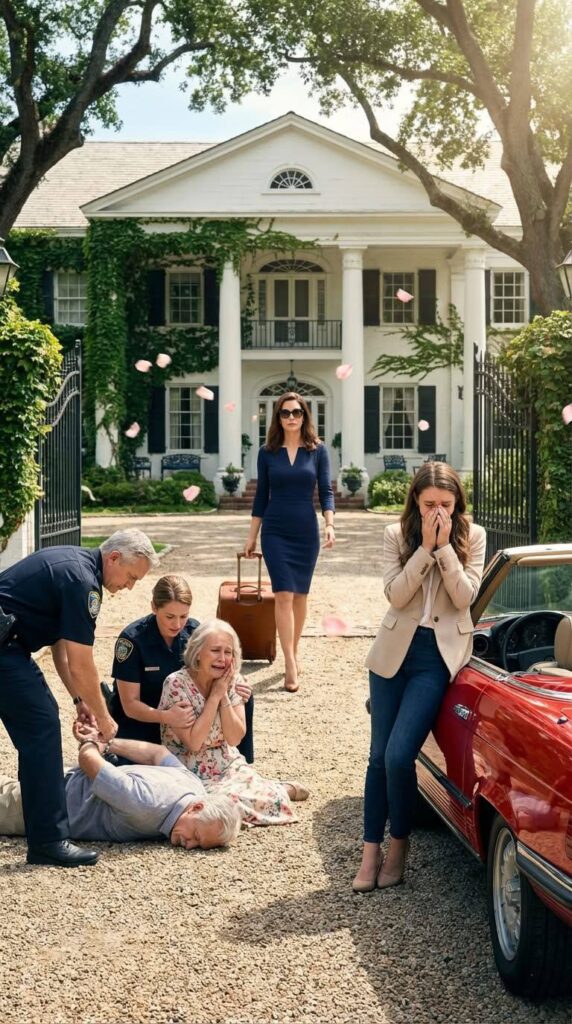
My sister, Chloe, didn’t just drive into our parents’ gravel driveway that Tuesday afternoon; she made a grand entrance into the wreckage of my future. The car was a violent, screaming shade of crimson—a high-end sports coupe that glinted under the suburban sun with an audacity that made my stomach churn. She stepped out of the driver’s side with the practiced grace of a starlet, sliding her white designer sunglasses up into her perfectly highlighted hair. She wore a smile that hadn’t been earned, but rather purchased.
From the porch, I watched the tableau of my family’s parasitic devotion unfold. My mother, Eleanor, descended the steps with a series of high-pitched shrieks, her hands fluttering like trapped birds as she applauded Chloe’s “achievement.” My father, Arthur, followed with a slow, heavy gait, whistling a low tune of masculine approval as he circled the vehicle, running a hand over the hood as if it were a prize stallion.
I stood on the cracked pavement of the sidewalk, my sensible work shoes dusty from a long shift at the dental practice where I served as the office manager. I was still clutching my insulated lunch bag, the weight of it suddenly feeling like a leaden anchor. A cold, hollow silence began to calcify in my chest.
I didn’t need to see the paperwork. I knew exactly whose sweat and overtime had paid for those leather seats and that turbocharged engine. For three years, I had lived like a ghost in my own life. I had been promoted, yes, but I hadn’t celebrated. I drove a twelve-year-old Honda with a temperamental transmission. I skipped every vacation, declined every brunch invitation, and volunteered for every grueling weekend shift available. My goal was a humble one: to excavate myself from the mountain of student debt and scrape together a down payment for a condo—a small, quiet corner of the world that would finally be mine.
But in the Holloway household, privacy was regarded as a form of treason. My mother had insisted on “assisting” with my ledgers, claiming my focus was too narrow. My father had lectured me on the sanctity of family, arguing that blood relatives should never behave like strangers when it came to resources. Somewhere between the exhaustion of sixty-hour work weeks and the relentless guilt-tripping at the dinner table, I had surrendered. I gave them access to my secondary debit card, foolishly believing their promise that it was strictly for “domestic emergencies.”
I realized then, watching Chloe buff a smudge off the side mirror with her silk scarf, that in this house, an “emergency” was simply anything my sister desired but couldn’t afford.
Chapter 2: The Architecture of Theft
The erosion of my life hadn’t happened in one tectonic shift; it was a slow, rhythmic bleeding.
At first, the charges were mundane. A surplus of groceries here, a late utility bill there. I told myself it was the price of a peaceful coexistence. But the “emergencies” began to evolve into a more luxurious species. Within months of Chloe’s whirlwind engagement to Tyler, a man whose primary trait was an eagerness to please her, my bank alerts became a chronicle of her vanity.
There were four-hundred-dollar deposits for local florists. There were “consultation fees” at bridal boutiques that specialized in imported lace. There were hair trials, organic spa packages, and what my mother termed “essential matrimonial sundries.”
Every time I attempted to raise the drawbridge, I was met with an emotional scorched-earth policy. If I questioned a three-hundred-dollar charge at a boutique, my mother would press a hand to her heart and accuse me of being “theatrically cruel” to a bride-to-be. If I demanded the return of my card, my father’s face would transform into a mask of stone.
“You sleep under this roof, eat the food your mother slaved over, and you want to play the accountant with your own flesh and blood?” he would growl, his voice vibrating with a low, practiced contempt. “You contribute, Ava. That is the tax of being a daughter.”
Chloe was the worst of them, mostly because she didn’t bother with the veneer of justification. She would sit at the breakfast nook, sipping an iced latte paid for by my labor, and smirk. “Honestly, Ava, it’s not like you were going to spend that money on anything exciting. You don’t even have a boyfriend to take you to dinner. Think of this as an investment in our family’s image.”
The day of the red sports car was the final fracture. I walked into the kitchen, the roar of that engine still vibrating in my ears, and held my hand out across the table.
“I want the card back,” I said. I didn’t yell. I didn’t even raise my voice. I spoke with the flat, dead tone of someone who had reached the end of their rope. “Now. Today. And we are going to talk about a repayment schedule for that vehicle.”
The reaction was instantaneous. My mother didn’t argue; she reacted. Her palm connected with my cheek with a sharp, sickening crack. The force of it sent my head reeling, the metallic taste of blood blooming in my mouth where my teeth had snagged my lip.
“Your money belongs to this collective!” she spat, her eyes wild with a terrifying sense of entitlement. “Everything in this house is ours!”
My father stood up, looming over me like a judge delivering a final sentence to a heretic. “Ungrateful,” he hissed, the word dripping with a venom that felt more permanent than the slap. “After the decades we spent raising you, you begrudge your sister a wedding gift?”
Chloe remained leaning against the new car outside the window, her expression one of mild, flickering amusement, as if she were watching a particularly dull reality show.
I didn’t cry. I didn’t reach for my face. I looked at the stack of ivory wedding invitations sitting on the hall table—expensive, heavy-stock paper that felt like it was made of my own skin. In that moment of crystalline clarity, I understood that they intended to spend every cent I had ever earned before Chloe ever walked down that aisle. They didn’t see me as a daughter; they saw me as an ATM with a pulse.
“Okay,” I said softly, picking up my lunch bag from the counter. “Do whatever you want.”
They mistook my compliance for a final surrender. They didn’t realize that I was no longer a participant in their family; I was a witness gathering evidence for the prosecution.
Chapter 3: The Shadow Ledger
For the next seven weeks, I became the woman they wanted me to be: the invisible, reliable drudge.
I apologized for “my outburst.” I allowed my mother to weep about my “cold heart” until she felt she had sufficiently punished me. I spent my evenings helping Chloe assemble favor boxes filled with artisanal truffles. I addressed envelopes in calligraphy until my hand cramped. I even sat through a three-hour cake tasting where Chloe rejected five different sponges before settling on a “luxury vanilla bean” that cost more per slice than my weekly grocery budget.
They were so intoxicated by their own greed that they failed to notice the subtle shift in the wind. They mistook my silence for the quiet of a broken spirit. It was their first, and most catastrophic, mistake.
My second move was surgical. During my lunch breaks, I visited a bank branch three towns over and opened a private account. I redirected my direct deposit and moved the meager remnants of my savings into a vault they couldn’t touch. Then, I went to the original bank and requested three years of comprehensive, line-item statements.
At night, while the house slept, I sat in the driver’s side of my old Honda, illuminated only by the sickly yellow glow of a streetlight, and I performed an audit of my own betrayal. I used a highlighter to mark the unauthorized charges.
Seven thousand dollars for a “resort deposit” in the Caribbean.
Twelve thousand dollars for a down payment at the European car dealership.
Eighteen hundred dollars for a designer “second dress” for the reception.
Three thousand dollars in “cash withdrawals” that occurred while I was demonstrably clocked in at the dental office.
I scanned every page. I created digital backups. I sent everything to a secure, encrypted email address they didn’t know existed. I was no longer just a victim; I was a forensic analyst of my own life’s theft.
Then, I met Denise Harper.
Denise was a lawyer who specialized in domestic litigation and financial fraud. She didn’t offer me tea or platitudes. She sat behind a desk that looked like it was made of solid iron and reviewed my highlighted statements for twenty minutes in absolute silence.
When she finally looked up, her eyes were sharp as stilettos. “Did you ever, at any point, provide written or verbal consent for these specific luxury purchases?”
“No,” I said. “I gave them the card for grocery emergencies and utility gaps. I explicitly demanded the card back two months ago in front of witnesses.”
Denise nodded, a predatory smile touching her lips. “Ava, this isn’t just a family squabble. This is systemic financial abuse. Given the amounts and the way they bypassed your verbal revocation of access, we’re looking at fraud, unauthorized use of a financial instrument, and grand larceny.”
The word larceny felt heavy in the room. It stripped away the “family” label and replaced it with something clinical and criminal.
“What do we do?” I asked.
“We let them finish the play,” Denise said. “Let them spend. Let them think they’ve won. The higher they build the tower, the more devastating the collapse will be.”
I walked out of her office feeling like a ghost. I was living in a house of thieves, counting down the days until I set the match to the fuse.
Chapter 4: The Vanishing Daughter
As the wedding approached, the atmosphere in the Holloway house reached a fever pitch of narcissistic delusion. My mother was bragging to every distant relative on Facebook that the wedding was “fully funded by the family’s hard work.” My father walked around with his chest puffed out, playing the role of the generous patriarch, shaking hands and accepting praise for a lifestyle he had stolen from his eldest daughter.
Chloe was a whirlwind of demands. She added a live string quartet for the garden ceremony. She insisted on a “champagne tower” that required three additional servers. She was living in a fantasy world constructed from my sweat and my future.
I, meanwhile, had quietly begun to vanish.
I took a small, furnished room in a short-term rental across the city. I told my parents I was staying late at the clinic for “audit week” and “emergency inventory.” They were so preoccupied with the seating charts and the floral arrangements that they barely noticed I wasn’t sleeping in my bedroom anymore. As long as the card worked, I was irrelevant to them.
The night before the ceremony, my mother called me. She didn’t ask how I was. She didn’t ask if I was coming home.
“Don’t you dare show up tomorrow with that long, miserable face, Ava,” she hissed into the phone. “This is Chloe’s day. If you do anything to embarrass us in front of Tyler’s family, I will make sure you regret it for the rest of your life.”
I looked at the cream envelope sitting on my lap in the quiet of my rented room. It was thick with the weight of police reports, bank statements, and a formal summons.
“Don’t worry, Mother,” I said, my voice as calm as a frozen lake. “I’m going to make sure tomorrow is a day no one ever forgets.”
The morning of the wedding was a masterpiece of suburban theater. The venue was a sprawling vineyard at the edge of the county. Sunlight poured over the manicured rows of grapes, and the string quartet played a delicate, airy piece as guests arrived in silk and linen.
I arrived early. I stood in the shadow of the tasting room and watched as Chloe posed for photographs beside that red sports car, which was now draped in mocking white silk ribbons. She looked beautiful—a vision of pure, unadulterated theft. My parents stood beside her, beaming for the cameras, the very image of successful, devoted parents.
If a stranger had looked at us then, they would have seen a dream. They would never have guessed that the entire production was a crime scene.
Chapter 5: The Gift in the Envelope
The ceremony was an exercise in high-stakes hypocrisy.
I sat in the third row, watching as Chloe and Tyler exchanged vows of eternal loyalty. My mother dabbed at her eyes with a lace handkerchief—likely bought with my money. My father stood tall, his hand resting on his heart as if he were a man of profound honor. Every word spoken about “trust,” “sacrifice,” and “new beginnings” felt like a jagged piece of glass being pressed into my skin.
I sat through the entire ordeal without flinching. I didn’t cry. I didn’t look away. I simply waited.
The reception was a blur of high-end catering and vintage champagne. The quartet had been replaced by a jazz ensemble. Tyler stood at the head table and gave a speech, thanking my parents for their “unbelievable generosity” in making this dream a reality. Chloe glowed under the spotlight, the center of a universe she had built from my stolen years.
The moment finally arrived during the gift-opening segment in the side lounge. This was Chloe’s favorite part—the public performance of gratitude where she could show off the tribute her guests had brought her. Family and close friends crowded around, eager to see the “luxury” items.
I stepped forward, the heavy cream envelope clutched in my hands.
“I have something for you, Chloe,” I said. My voice was steady, cutting through the chatter like a knife through silk.
Chloe smirked, her eyes darting to the envelope. “Finally. I was starting to think the ‘Office Manager’ was too cheap to get me a real gift.”
My mother shot me a warning look, her smile tight and artificial for the benefit of the surrounding guests. My father stepped closer, his voice a low, threatening rumble. “Try acting like a decent sister for once in your life, Ava.”
I didn’t back down. I stepped into their circle, leaning in so close that only the four of them—Chloe, Tyler, and my parents—could hear me over the swell of the jazz music outside the door.
“The police are waiting in the parking lot,” I whispered.
The transition was violent. Chloe’s smirk didn’t just fade; it shattered. My mother went a shade of grey that no makeup could cover. My father froze, his hand halfway to his champagne glass.
I placed the envelope in my father’s hand.
“What is this?” Tyler asked, his brow furrowing as he looked at the terrified faces of his new in-laws. “Ava, what’s going on?”
“It’s a ledger, Tyler,” I said, my voice rising so that the guests nearest us began to turn. “It’s a comprehensive record of every unauthorized dollar my parents and your new wife took from my savings to pay for this car, this dress, and the champagne you’re currently drinking.”
My father hissed my name, his face contorting into a mask of desperate rage. “You psycho! You’re doing this here? Now?”
“It’s not just a record anymore, Dad,” I said, looking him dead in the eye. “It’s a police report. The officers outside have the transaction logs showing you used my card for the down payment on the car while I was at work. They have the statements from the bridal shop. Grand larceny is a very public affair.”
Chloe grabbed my arm, her nails digging into my skin. “You wouldn’t… you’re bluffing!”
I pulled my arm free with a sharp, forceful motion. “Ask them, Chloe. Ask them whose money is in your gas tank. Ask them why the bank flagged the resort deposit as a fraudulent transfer.”
Tyler took the envelope from my father’s shaking hands and pulled out the top sheet. His eyes scanned the police report number, the highlighted bank statements, and the letter from Denise Harper. His face changed line by line—going from confusion to shock, and finally to a deep, visceral disgust.
Across the large bay windows of the lounge, the sun had begun to set. Reflected in the glass, the unmistakable blue and red strobe lights of two unmarked police vehicles flickered against the vineyard’s trellises.
The music outside didn’t just stop; it seemed to die. And for the first time in my life, no one in my family had a script to follow.
Chapter 6: The Clean Air of Autonomy
I didn’t stay to watch the handcuffs.
I didn’t stay to hear my mother’s inevitable hysterics or my father’s desperate attempts to bribe the officers. I didn’t stay to see Tyler realize that his “perfect” bride was a common thief who had used her own sister as a sacrificial lamb.
I walked out of the vineyard, the cool night air hitting my face like a benediction. The scent of damp earth and ripening grapes was intoxicatingly clean. As I reached my old Honda, I heard the muffled sound of shouting from the reception hall, but it felt like it was coming from another world—a world I no longer inhabited.
The legal process that followed was long and clinical. My parents were charged with multiple counts of financial fraud and grand larceny. Because the evidence was so overwhelming and the theft so brazen, they were forced into a restitution agreement that would see them paying me back for the next fifteen years—if they managed to stay out of prison.
The red sports car was repossessed three days later. Chloe’s “luxury” life evaporated like mist in the sun. Tyler filed for an annulment within the month, claiming he had been defrauded into the marriage.
My family tried to reach me, of course. They sent messages through cousins, left sobbing voicemails about “forgiveness” and “blood.” I deleted them all. I didn’t feel vengeful. I didn’t feel triumphant. I just felt… done.
Three months later, I sat on the floor of my new condo. It was small. The walls were a neutral cream, and the only furniture was a single armchair and a lamp. But as I looked at the deed—the real deed, with only my name on it—I felt a sense of peace that no vintage champagne could ever provide.
I am no longer the invisible daughter. I am no longer the family’s secret reserve of cash. I am Ava Holloway, and my life is finally my own.
Some endings don’t come with a sunset and a hug. Some endings come with a ledger, a lawyer, and the courage to stop being a victim.
In a world that demands you sacrifice everything for family, would you have the strength to deliver the truth in a cream envelope, or would you have kept paying the tax of being a daughter?