
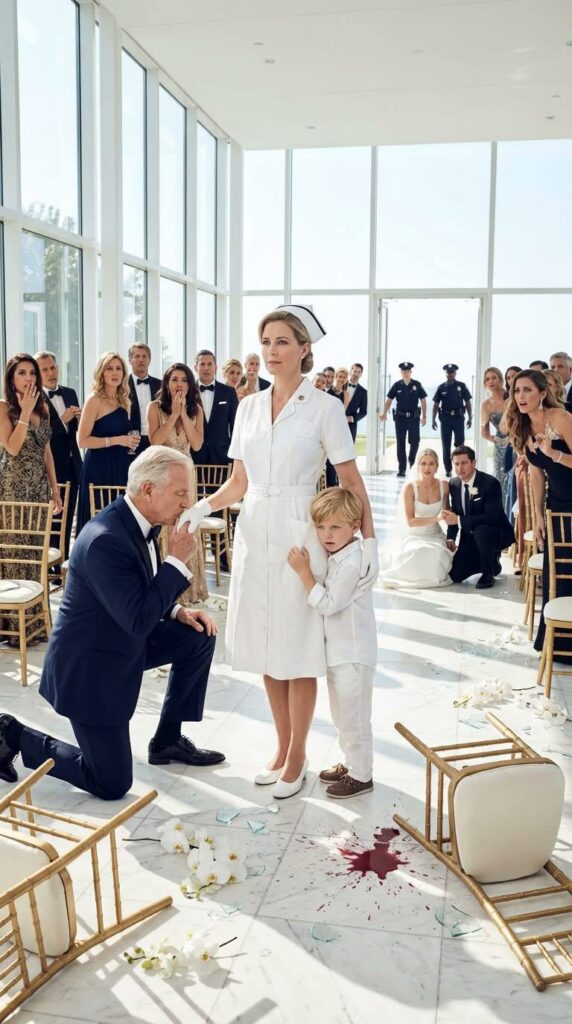
The Silent Savior: A Wedding to Remember
Chapter 1: The Shadow at the Feast
They say that silence is a virtue, but in my world, it was a necessity. For thirty-four years, I had walked through life as a background character in someone else’s vibrant, loud, and expensive movie. My name is Emily, and I am a nurse. To most, that title represents a noble profession, a life dedicated to the service of others. But to my family—specifically to my stepsister, Lily—it was a badge of mediocrity.
The invitation to Lily’s wedding dinner had arrived like a summons. It wasn’t sent out of love; it was sent so she could have an audience. I knew the drill. I would show up, blend into the wallpaper, and watch her bask in the glow of her own reflection.
The venue was the Grand Azure Ballroom, a place where the chandeliers looked like frozen explosions of diamonds and the carpet was thick enough to swallow your sins. I chose a simple, navy-blue dress—comfortable, modest, and utterly forgettable. I didn’t want to be noticed. I just wanted to get through the night, eat my dinner, and return to the quiet sanctuary of my apartment before my double shift the next morning.
As I stepped into the hall, the sheer opulence of the event hit me. The air was heavy with the scent of white roses and expensive perfume. Lily stood in the center of the room, a vision in ivory silk, her laughter ringing out like a bell that demanded attention. Beside her was Mark, her groom. From the little I had heard, he was a man of substance, the son of a wealthy real estate mogul, and remarkably grounded for someone marrying into Lily’s whirlwind of vanity.
I tried to slip toward the back, finding a seat at the far end of a long, decorated table. I watched as waiters in white gloves glided past, carrying trays of vintage champagne. I felt like a sparrow in a room full of peacocks. My mother and Lily’s father were busy playing the roles of the perfect hosts, and for a moment, I felt the familiar sting of being the outsider. We had become a “family” after my father passed away, but the seams always showed. Lily had the private schools and the designer labels; I had the night shifts and the student loans.
I didn’t mind the work. I loved being a nurse. I loved the weight of a person’s hand in mine when they were afraid. I loved the quiet triumph of a stable heart rate. But in this room, those things meant nothing. Here, value was measured in the brand of your watch and the zip code of your summer home.
As the dinner began, I focused on my plate, hoping to remain invisible. But Lily had other plans. She tapped her crystal glass with a silver spoon, the high-pitched ring cutting through the chatter like a knife.
“Everyone, if I could have your attention!” she chirped, her eyes scanning the room until they landed—with predatory precision—on me.
My stomach dropped. I knew that look. It was the look she gave right before she was about to turn someone into a punchline.
“I want to introduce a very special guest to Mark’s family,” she said, her voice dripping with a sweetness that felt like poison. “My stepsister, Emily. Please, Emily, stand up so everyone can see you!”
Reluctantly, I stood. The heat of a hundred stares pressed against my skin. Lily leaned into the microphone, a smirk playing on her lips.
“She’s a nurse,” Lily announced, pausing for effect. “Just a useless, little nurse who spends her days changing bandages while we’re out here building empires. Isn’t she adorable in her little ‘simple’ dress?”
A few people at the table chuckled. A muffled “How quaint” drifted from a woman in a heavy gold necklace. I felt the blood rush to my face, but I didn’t pull away. I didn’t argue. I just smiled—a practiced, professional mask of a smile.
But as I prepared to sit back down, I noticed something. Mark’s father, Arthur, a man with silver hair and eyes like sharpened flint, wasn’t laughing. He was staring at me. His fork was frozen halfway to his mouth, and his expression wasn’t one of amusement or pity. It was one of haunting, absolute recognition.
He leaned forward, his voice a low growl that silenced the laughter around him. “Wait… aren’t you the nurse who…?”
Chapter 2: The Ghost of a Memory
The silence that followed Arthur’s half-finished question was heavy, thick enough to suffocate the festive atmosphere. Lily’s smirk wavered, her eyes darting between her father-in-law and me.
“Oh, Arthur, you must be mistaken,” Lily said, her voice rising an octave in an attempt to reclaim the spotlight. “Emily works at a public hospital. I doubt your paths have ever crossed in the circles you move in.”
Arthur didn’t even look at her. His gaze remained locked on mine, searching, peeling back the layers of time. “St. Mary’s,” he whispered, more to himself than to the room. “Three years ago. October.”
I felt a chill race down my spine. The date hit me like a physical blow. October three years ago was a month I would never forget, but surely, this man—this pillar of high society—couldn’t be him. The man I remembered was a broken shell, covered in dust and blood, a ghost clinging to life by a literal thread.
“Dad?” Mark asked, his brow furrowed in confusion. “Is something wrong? Do you need some air?”
Arthur ignored his son. He slowly placed his fork down on the linen tablecloth with a deliberate click. The “useless nurse” comment seemed to be echoing in his mind, and I saw a flash of genuine anger spark in his gray eyes.
“Emily,” he said, my name sounding strange coming from a man of his stature. “Do you remember the night of the downtown protests? The night the main arteries of the city were paralyzed by the riots?”
I nodded slowly, my heart hammering against my ribs. “I remember. The emergency gold-codes were in effect. No one could get in or out of the medical district for hours.”
The guests at the table began to murmur. The story of the “Great Lockdown” was local legend—a night when the city’s infrastructure had failed during a massive civil unrest event.
“I was in my car,” Arthur continued, his voice growing stronger, commanding the attention of the entire ballroom. “A drunk driver hit me head-on just three blocks from the hospital. The paramedics got me to the ER, but the surgical teams were stuck on the other side of the bridge. The doctors couldn’t get through the crowds. I was bleeding out in a hallway because the trauma bays were overflowing.”
Lily looked bored, checking her manicured nails. “Really, Arthur, this is such a gloomy topic for a wedding. Let’s talk about the honeymoon! We’re going to Amalfi!”
“Be quiet, Lily,” Arthur snapped. The sharpness of his tone was like a slap. The room went dead silent again.
He turned back to me. “I was dying. I could feel the cold slipping into my bones. The machines were screaming, but there was no one to hear them. Except for one person. One nurse who refused to leave my side, even when the power flickered and the screams from the street grew louder. She stayed with me for six hours. She performed procedures she wasn’t technically supposed to do because there was no one else. She kept me talking. She kept me breathing.”
He stood up then, his tall frame casting a long shadow over the table. He walked toward me, his steps slow and rhythmic. Every eye in the room followed him.
“I never saw her face clearly that night,” Arthur said, his voice thick with emotion. “She wore a mask and a shield, and her eyes were tired—so incredibly tired. But I remember the voice. And I remember the way she held my hand when I told her I wasn’t ready to go yet.”
He stopped right in front of me. The man who owned half the city’s skyline was looking at me with a reverence usually reserved for saints.
He reached out, his hand trembling slightly as he touched my sleeve. “It was you, wasn’t it?”
Chapter 3: The Night the World Stopped
The memory rushed back over me with the force of a tidal wave. I wasn’t in the Grand Azure Ballroom anymore. I was back in the cramped, fluorescent-lit chaos of the St. Mary’s trauma ward.
It had been a Tuesday. The city was on fire—figuratively and literally. A massive protest had turned into a riot, and the streets surrounding the hospital were a labyrinth of burning barricades and chanting crowds. We were understaffed. Half our surgical team was trapped in an elevator that had lost power, and the other half was miles away, unable to navigate the gridlock.
I remembered the man they brought in. John Doe #4. He had been crushed in his vehicle, his vitals crashing. He was a VIP, the police had said, but in that moment, he was just a human being who was leaking life onto a cold linoleum floor.
I remembered the sound of the sirens outside, muffled by the thick hospital walls. I remembered the smell of ozone and antiseptic. And I remembered him—the man who was now Arthur, the father of the groom.
“You were wearing a silver watch,” I whispered, the detail suddenly surfacing. “It was shattered. The glass was cracked, but it was still ticking. You kept asking me what time it was because you didn’t want to miss your son’s graduation the next morning.”
Arthur’s eyes welled with tears. “I did. And because of you, I made it to that graduation. I made it to this wedding.”
The room was so quiet you could hear the hum of the air conditioning. Lily’s face had transitioned from a mask of smugness to a pale, ghostly white. Her hand, which had been clutching a glass of champagne, was shaking.
“Wait,” Mark said, his voice cracking as he looked at me. “You’re the ‘Angel of St. Mary’s’? Dad, you’ve told that story a thousand times. You said a nurse saved you when the surgeons couldn’t get through. You said she was a hero.”
“She is,” Arthur said firmly. He turned to face the entire room, his voice booming. “My daughter-in-law just introduced this woman as ‘just a nurse.’ She called her ‘useless.’ I want everyone here to understand something very clearly.”
He looked at Lily, and the coldness in his gaze was terrifying. “The wealth you see in this room, the empire I built, the life Mark is about to share with you—none of it would exist if it weren’t for this ‘useless’ nurse. While you were likely at home worrying about the brand of your shoes, this woman was holding my heart in her hands.”
Lily tried to speak, her mouth opening and closing like a fish out of water. “I… I didn’t know… I was just joking, Arthur. Emily knows I love her…”
“Do you?” Arthur countered. “Because I don’t think you know the meaning of the word. You value people based on what they can buy. I value them based on what they can give. And Emily gave me my life.”
He turned back to me and did something no one expected. He bowed his head. “I spent two years trying to find you to thank you properly, but the records from that night were a mess because of the riots. I thought I’d never get the chance.”
He then looked at his son. “Mark, I hope you realize the caliber of the family you’ve actually married into. It’s not the one with the bank accounts. It’s the one with the soul.”
The guests began to whisper, but the tone had shifted. The laughter was gone, replaced by a profound, awkward realization. The “simple” nurse was now the most important person in the room.
But as the tension reached its breaking point, Lily did something desperate. She grabbed the microphone again, her eyes wild. “This is my wedding!” she shrieked. “You’re ruining my wedding for a story about a hospital?!”
Chapter 4: The Price of Arrogance
The outburst from Lily was like a glass shattering at a funeral. It was ugly, jarring, and revealed the true depth of her character. The guests recoiled. Even her own parents looked down at their plates, unable to defend her.
Mark looked at his new wife as if he were seeing her for the first time. The glamor had been stripped away, leaving only a bitter, insecure woman who couldn’t stand to see anyone else respected.
“Lily, sit down,” Mark said, his voice quiet but dangerously sharp.
“No!” she yelled, her face contorting. “She’s just a nurse! She gets paid to do that! Why are we acting like she’s a queen? I’m the one in the white dress! I’m the one everyone is here for!”
Arthur stepped back, a look of profound disappointment on his face. He didn’t engage with her. He didn’t have to. The damage was done. He looked at me and offered a small, sad smile.
“I am sorry, Emily,” he said. “You came here to celebrate, and instead, you were insulted in my home—because once you marry into this family, you are under my roof. I will not have it.”
He turned to the room. “The dinner is over. I find I have lost my appetite for this particular union’s celebration.”
The gasps were audible. Ending a wedding reception mid-dinner was unheard of in these circles. It was a social death sentence.
Mark stood up. He didn’t go to Lily. He went to his father. They exchanged a look of silent understanding. Then, Mark turned to me.
“Emily,” he said sincerely. “Thank you. For my father. For everything. I’m sorry for what was said tonight. It was inexcusable.”
He then looked at Lily, who was now sobbing hysterically, though they looked more like tears of rage than regret. “We need to talk,” he told her. “Privately. Now.”
As the guests began to awkwardly filter out, the grand ballroom felt suddenly cold and cavernous. The “peacocks” were scurrying away, leaving the “sparrow” standing alone in the center of the room.
My mother approached me, her face a mask of conflict. “You should have told us, Emily. You should have said you knew them.”
“I didn’t know them, Mom,” I said softly. “I knew a patient. In my job, names don’t matter. Only pulses do.”
I walked toward the exit, my simple dress feeling more like armor than I ever imagined. I didn’t need the champagne, the diamonds, or the applause. I had something far more valuable: the knowledge that I had stood my ground, and that the truth had a way of surfacing, even in the most gilded of rooms.
As I reached the heavy oak doors, a hand touched my shoulder. It was Arthur.
“Emily,” he said, handing me a small, embossed card. “My foundation funds medical research and scholarships for nursing excellence. We’ve been looking for a Director of Clinical Outreach—someone who understands the front lines. Someone who knows that a nurse is never ‘just’ anything.”
I looked at the card, then back at him. “I just want to help people, Arthur.”
“I know,” he smiled. “That’s why you’re perfect for it.”
I walked out into the cool night air, the sound of the city humming in the distance. For the first time in my life, I wasn’t in anyone’s shadow. I was exactly where I was meant to be.
Chapter 5: The Aftermath of Truth
The weeks following the wedding were a whirlwind. The story of the “Nurse and the Mogul” became a local sensation, though I did my best to stay out of the tabloids. I didn’t want fame; I wanted to do my job.
Mark and Lily’s marriage didn’t last the year. It turns out, when you build a relationship on status and image, it tends to crumble when the light of truth hits it. Mark stayed in touch, eventually becoming a major donor to the hospital where I worked. He realized that the life he wanted wasn’t one of flash, but of substance.
As for Lily, she moved away. The social circles she once moved in had a long memory, and “the woman who insulted the nurse who saved Arthur’s life” wasn’t a title she could shake. I heard she’s still trying to find her place, still looking for value in all the wrong things.
I took the position Arthur offered. Not because of the salary, but because it allowed me to change the system from the inside. I made sure that nurses were respected, that their voices were heard, and that no one would ever feel “useless” in a hospital hallway ever again.
Sometimes, at night, I think back to that wedding. I think about the moment the room went silent. I realized then that power isn’t about who has the loudest voice or the biggest bank account. Power is about the impact you leave on another human being when they are at their lowest.
I am Emily. I am a nurse. And I am far from useless.