
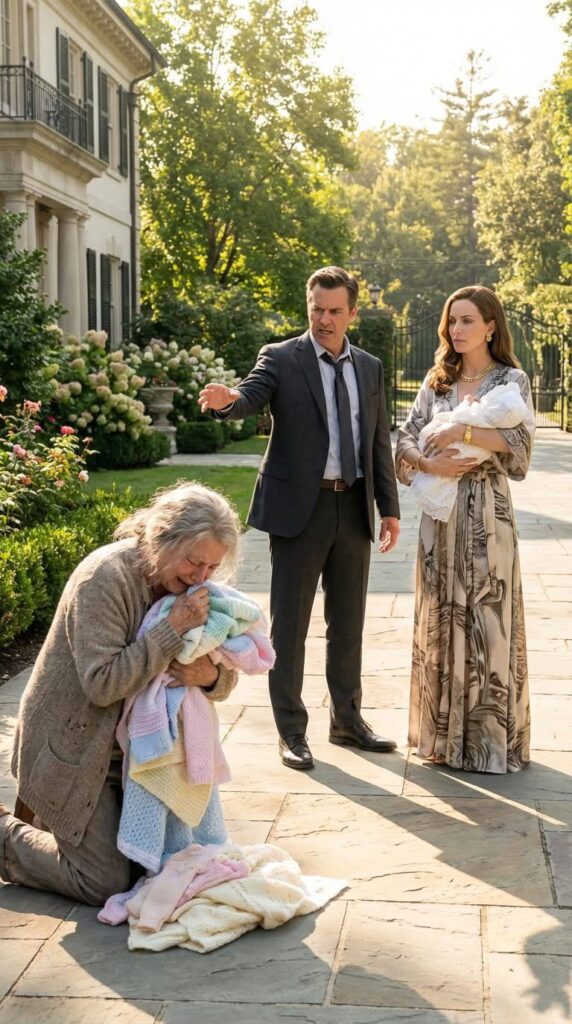
1. The Cross-Country Hope
The journey from my quiet, modest home in upstate New York to the sprawling, evergreen suburbs of Seattle had taken fourteen hours, two connecting flights, and a significant portion of my physical stamina. I am sixty-two years old. My knees ache when it rains, and my lower back protests sitting in cramped, economy-class airplane seats.
But as I stood on the pristine, perfectly swept concrete porch of my son’s massive, ultra-modern house in one of Seattle’s most exclusive zip codes, I didn’t feel the fatigue.
I felt only a soaring, overwhelming, breathless joy.
I was clutching a large, soft canvas tote bag. Inside, carefully wrapped in tissue paper, was a hand-knitted baby blanket. It was a complex, beautiful pattern of soft blues and greys, woven from the finest, softest merino wool I could find. It had taken me three agonizing months of late nights, my arthritic fingers cramping, to finish every single stitch perfectly.
My son, Nick, had just welcomed his first child into the world three days ago. A little boy named Leo.
I hadn’t been invited for the birth. Nick had called me briefly, his voice clipped and hurried, explaining that it was “going to be way too chaotic” and that Chloe, his wife, “needed her space and didn’t want overwhelming family energy around.” He told me they would let me know when it was a “good time” to visit, perhaps in a few months.
I had tried to be understanding. I had tried to respect their boundaries as new parents.
But after three days of staring at the single, watermarked photo he had texted me of my newborn grandson, the primal, undeniable ache of a grandmother’s love simply overpowered my logic. I couldn’t wait months. I needed to see him. I needed to smell that new-baby scent, to count his tiny fingers, to give him the blanket I had poured my heart into.
I hadn’t told them I was coming. I wanted to surprise them, to show up, help with the laundry, cook a few meals, and be the supportive, invisible backbone every new family needs.
I took a deep, shaky breath, smoothing my simple, sensible cardigan, and pressed the glowing, high-tech doorbell.
I heard a soft chime echo deep within the cavernous house.
A moment later, the heavy, custom-built oak front door swung open.
“Nicky!” I breathed, tears of pure, unadulterated joy instantly welling in my eyes. I took a step forward, my arms instinctively opening wide to embrace the boy I had raised as a single mother, the boy I had worked double shifts as a high school administrator to put through a prestigious out-of-state college.
But the man standing in the doorway didn’t smile.
He didn’t reach out to hug me. He didn’t even look surprised in a happy way.
Nick took a sharp, immediate step backward, his posture rigid. His face, usually handsome and carefully groomed, twisted into a mask of pure, visceral revulsion.
He actually raised a hand and pinched the bridge of his nose, physically covering his nostrils, as if the smell of the airplane cabin, my stale coffee, and my simple lavender soap was deeply offensive to his refined senses.
“Mom,” Nick demanded, his voice dropping to a harsh, panicked, furious whisper. He glanced frantically over his shoulder into the pristine, minimalist, blindingly white foyer of his home. “What the hell are you doing here?”
My arms slowly fell to my sides. The joyful tears in my eyes went cold.
“I came to see my grandson, Nicky,” I said, my smile faltering, confusion warring with the sudden, sharp sting of his rejection. “I brought him a blanket. I wanted to help you guys out for a few days.”
Nick didn’t look at the beautiful tote bag containing the blanket. He looked down at my scuffed, ten-year-old rolling suitcase sitting on the porch. He looked at my comfortable, worn-in walking shoes. He looked at me as if I were a stray dog that had wandered onto his immaculate lawn and defecated.
“You can’t be here,” Nick hissed, stepping out onto the porch and pulling the heavy oak door mostly shut behind him, as if trying to contain a contagion. “I told you we would call you when we were ready. You have exactly 15 minutes. Find somewhere else to stay.”
I stood completely frozen on the welcome mat. The chilly, damp Seattle air suddenly bit violently through my thin cardigan. The soaring joy in my chest evaporated instantly, replaced by a cold, leaden, suffocating weight that made it difficult to draw breath.
“Nick… what are you talking about?” I stammered, my brain struggling to process the sheer, breathtaking cruelty of his words. “I flew across the country. I thought I could just stay in the guest room for a few days. Just to cook and clean for Chloe. I won’t be in the way.”
“No,” Nick snapped, his eyes darting nervously up toward the second-floor windows. “You are not staying here. Chloe’s parents are flying in from Aspen this afternoon. We are hosting a massive, catered welcome-home dinner for them tonight. You cannot be here looking like… this.”
He gestured vaguely at my entire being, his face contorted with profound, unmistakable shame.
2. The 15-Minute Eviction
The words hung in the air, heavy, toxic, and utterly devastating.
“Looking like what, Nicky?” I asked, my voice cracking, the raw hurt finally bleeding through the shock. “Like your mother? Like a woman who traveled all day to see you?”
“Like you just stepped off a Greyhound bus from the rust belt, Mom,” he hissed, his face flushing with angry embarrassment. He reached out and aggressively grabbed the handle of my rolling suitcase, yanking it away from the door before I could even attempt to bring it inside. “Chloe’s parents are incredibly important people. They are accustomed to a certain standard. We have an image to maintain here. We cannot have you embarrassing us in front of them with your… your whole aesthetic.”
Before I could even formulate a response to the absolute, sociopathic vanity of his statement, a voice drifted down from the top of the grand, floating staircase inside the house.
It was bored, nasal, and dripping with an aristocratic condescension that made my skin crawl.
“Nick?”
It was Chloe, my daughter-in-law. A woman who had never worked a day in her life, whose entire existence was funded by her parents’ wealth and, supposedly, my son’s tech startup.
“Is the new housekeeper here early?” Chloe called down, her voice echoing in the marble foyer. “Tell her to use the side entrance by the garage. She’s tracking dirt on the travertine.”
Nick’s face flushed a deeper, panicked red.
“I’ll handle it, babe! It’s just a delivery!” he called back over his shoulder, his voice artificially bright and reassuring.
He turned back to me, his jaw set in a hard, unforgiving line. He wasn’t going to correct her. He was going to let his wife believe his own mother was a servant to avoid the embarrassment of claiming me.
“Please,” I whispered, the humiliation burning my throat like battery acid. The fight drained out of me, replaced by a desperate, pathetic need just to see the child I had come so far for. “Nick, please. Just let me see the baby. Five minutes. I won’t even take my coat off. Let me give him the blanket, and I’ll leave right after. I’ll go to a hotel. I just want to see his face.”
“No,” Nick said, his tone turning razor-sharp, entirely devoid of any filial affection or basic human empathy. “He’s sleeping. And frankly, you just got off a commercial airplane. You haven’t showered, you haven’t washed your hands. I am absolutely not risking my newborn’s health just to satisfy your emotional needs. We are done here. Come on.”
He didn’t let me inside to use the restroom. He didn’t offer me a glass of water after a fourteen-hour journey.
He grabbed me firmly by the upper arm, a grip that bordered on physically aggressive, and marched me roughly down the pristine, stamped-concrete driveway. He hauled my scuffed suitcase to a sleek, brand-new, top-of-the-line Tesla Model X parked in the driveway and shoved my bag unceremoniously into the trunk.
“Get in,” he ordered, opening the passenger door.
“Where are we going?” I asked, my entire body numb with a profound, terrifying shock. I felt like I was watching a movie of someone else’s life. This couldn’t be the boy I had raised. This couldn’t be the son I had sacrificed my own youth for.
“I’m taking you straight back to the airport,” Nick replied, slamming the door behind me and getting into the driver’s seat. He started the silent, electric engine. “You can catch a red-eye flight back to New York tonight, or you can find a cheap motel near the runway. I don’t care. But you are absolutely not ruining this weekend for Chloe and her family.”
We drove the forty-five minutes back to Seattle-Tacoma International Airport in absolute, agonizing silence.
I stared out the window at the passing evergreens, the tears I had been fighting finally falling silently, hot and fast, down my cheeks. Nick didn’t look at me once. He kept his eyes locked on the road, his hands gripping the steering wheel, his jaw clenched in angry annoyance at the inconvenience I had caused his perfect, curated life.
When he finally pulled up to the bustling departures curb at the airport, he didn’t get out of the car. He didn’t offer to help me with my bag.
He simply pressed a button on the massive touchscreen dashboard, popping the trunk remotely.
“Send me the bill for the motel tonight,” Nick muttered, refusing to make eye contact as he reached into his designer wallet. He pulled out a crisp, fifty-dollar bill and tossed it casually onto the leather passenger seat next to me, a gesture of profound, insulting dismissal. “I’ll cover it. Just… don’t call Chloe. Don’t post anything on Facebook. I’ll call you next month when things settle down.”
I looked at the fifty-dollar bill resting on the pristine leather.
I didn’t touch it.
I unbuckled my seatbelt, opened the door, and stepped out into the chaotic, noisy reality of the airport curb. I walked to the back of the car, hauled my own scuffed suitcase out of the trunk, and slammed the heavy trunk lid shut with a resounding thud.
I didn’t say goodbye. I didn’t look back.
I walked toward the terminal doors, feeling the cold Seattle air on my tear-stained face. Behind me, the Tesla silently, smoothly accelerated away, merging into traffic, eager to return to the ivory tower of its fake, pathetic existence.
I found a quiet, empty bench just outside the sliding glass doors of the terminal. I sat down heavily, clutching the canvas tote bag containing the hand-knitted baby blanket tightly to my chest.
For ten minutes, I allowed myself to break. I wept. I cried for the loss of the son I thought I had raised. I cried for the grandchild I was not allowed to hold. I cried for the sheer, breathtaking cruelty of a boy who looked at his mother and saw only trash to be discarded.
But the tears didn’t last long.
As I sat on that cold metal bench, the profound, agonizing grief slowly began to shift. It crystallized. The hot, messy sorrow froze into a sharp, terrifying, and absolutely brilliant clarity.
Nick had looked at my sensible shoes, my practical cardigan, and my scuffed suitcase, and he had seen a poor, embarrassing, working-class old woman who threatened his fragile illusion of wealth.
In his desperate, pathetic obsession with maintaining his status in front of his wealthy in-laws, he had conveniently, entirely forgotten exactly whose money he was spending to play pretend.
He had forgotten the paperwork he had signed five years ago.
3. The Secret Benefactor
I didn’t walk into the terminal to book a flight back to New York.
I reached into my purse, pulled out my smartphone, and opened a luxury ride-hailing app. I bypassed the standard cars and ordered a premium, black SUV service.
While I waited for the car, I opened Instagram.
I scrolled through Chloe’s public profile. It was a sickening, endless feed of performative wealth. Photos of Nick posing proudly in front of the massive Seattle house. Photos of Chloe holding designer handbags inside the Tesla. Long, gushing captions about how “blessed” they were, how Nick’s “genius tech startup” was changing the world, and how they had built their “dream life” from the ground up through hard work and determination.
They were the ultimate, self-made power couple.
What Chloe’s wealthy, aristocratic Aspen parents didn’t know—and what Nick chose to willfully, deliberately ignore every single day of his life—was that his entire existence was a carefully constructed, multi-million-dollar lie.
Five years ago, Nick’s “genius” tech startup had suffered a catastrophic failure. He had over-leveraged his assets, mismanaged his capital, and was weeks away from total, humiliating bankruptcy. He had come to me, crying, terrified of losing everything, terrified of losing Chloe, who was accustomed to a very specific standard of living.
Nick assumed, like everyone else, that I lived a modest life on a retired school administrator’s pension.
He didn’t know that my late husband, a quiet, brilliant man who worked in commercial real estate, had possessed a massive, multi-million dollar life insurance policy, and had left behind a substantial, quietly managed investment portfolio that generated astronomical dividends. I lived modestly because I valued peace and simplicity, not because I lacked funds.
To save my son from ruin, I had quietly established a blind trust through a highly discreet corporate law firm. I used the trust to inject a massive, four-million-dollar venture capital “seed loan” into his failing startup, effectively saving his company and his ego simultaneously.
Nick firmly believed he had secured funding from a faceless, silent, European angel investor. He had absolutely no idea that the “investor” who demanded quarterly reports was the mother he had just kicked out of his driveway.
But more importantly, more dangerously, was the house.
When Nick and Chloe wanted that sprawling, two-million-dollar, modern architectural masterpiece in the Seattle suburbs, their credit was garbage due to the near-bankruptcy. No bank would touch them for a jumbo mortgage.
So, I bought it.
I paid cash. The deed to the property was registered to a holding company called Lavender Holdings LLC. It was my company, named after my favorite soap. I had my lawyers draft a highly favorable, practically subsidized lease agreement, allowing Nick to rent the house from the LLC for a fraction of its actual market value, allowing him to maintain the illusion of homeownership to his wife and her wealthy family.
He thought he was dealing with a generous, hands-off corporate landlord.
He was dealing with his mother.
The black SUV pulled up to the curb. The driver stepped out, took my scuffed suitcase, and opened the door for me.
“Where to, ma’am?” the driver asked respectfully.
“The Four Seasons Hotel, downtown,” I replied, my voice cool, steady, and entirely devoid of tears.
I checked into a massive, corner suite that cost more per night than Nick’s supposedly massive monthly salary. I tipped the bellhop generously, locked the heavy wooden door of the suite, and walked over to the floor-to-ceiling windows overlooking the glittering, grey expanse of the Puget Sound.
I didn’t unpack my bag. I opened my laptop, set it on the mahogany desk, and poured myself a cup of Earl Grey tea from the room service tray.
I picked up my phone and dialed a private, direct line to a law office on the East Coast.
It rang twice.
“Arthur Sterling,” a crisp, authoritative voice answered.
Mr. Sterling was the senior partner at the firm that managed my trusts, my real estate, and my anonymity. He was a ruthless, incredibly effective attorney who treated my assets like his own children.
“Arthur, it’s Eleanor,” I said calmly, taking a sip of the hot tea.
“Eleanor! It’s wonderful to hear from you,” Sterling replied, his tone warming instantly. “How was the flight? How is the new grandson? Have you held little Leo yet?”
“I didn’t get to see him, Arthur,” I stated, my voice dead, flat, and completely devoid of emotion. “Nick informed me, in no uncertain terms, that I am a poor, embarrassing burden to his new family. He drove me back to the airport fifteen minutes after I arrived.”
There was a sudden, heavy, chilling silence on the other end of the line. Sterling was a man who understood power dynamics, and he instantly recognized the seismic shift in the wind.
“I see,” Sterling said quietly, his voice dropping into a professional, lethal register. “I am profoundly sorry to hear that, Eleanor. Truly. What are your instructions?”
I turned my chair, looking out over the Seattle skyline. I thought about the fifty-dollar bill resting on the leather seat of his Tesla.
“Initiate the default protocols on all accounts, Arthur,” I commanded, the words flowing with cold, absolute precision. “Nick has missed his last two subsidized lease payments on the residential property, assuming the ‘management company’ would just let it slide like I always do. I am done sliding. Draft a formal, legally binding thirty-day Notice to Vacate for breach of contract on the house.”
“Consider it done,” Sterling said, the furious clicking of a keyboard echoing in the background. “And regarding the commercial venture capital loan?”
“Execute the call provision,” I said, a dark, terrifying calmness settling deep into my bones. “He is in breach of several financial covenants we have ignored for years. He owes the trust four million dollars, payable immediately upon demand in full. Initiate aggressive liquidation proceedings on his company if he cannot produce the capital.”
I paused, taking another slow sip of tea.
“Let’s see exactly how much Chloe’s wealthy, aristocratic Aspen parents love their perfect son-in-law when he is utterly bankrupt, fraudulent, and entirely homeless.”
“The documents will be prepared and served locally within four hours, Eleanor,” Sterling promised. “We will execute this with extreme prejudice.”
“Thank you, Arthur,” I said, and hung up the phone.
4. The Catered Execution
I didn’t have to be in the room to know exactly how the execution played out. The process server I hired through Sterling’s local Seattle affiliate was a highly professional, expensive, and incredibly observant individual who provided a detailed, timestamped report of the delivery.
The timing was an act of surgical, malicious perfection.
At 8:00 PM, the sprawling, modern house in the suburbs was a beacon of forced, high-society elegance.
Nick and Chloe were hosting the lavish, catered “welcome home” dinner for Chloe’s parents in the formal, glass-enclosed dining room. They were drinking expensive, imported wine, eating food prepared by a private chef, and aggressively performing their roles as the successful, wealthy, perfect new parents.
They were celebrating the flawless aesthetic of their lives, completely unbothered by the fact that they had thrown a grandmother out into the cold just hours prior.
At 8:15 PM, the doorbell rang.
Nick, eager to play the gracious host, and likely assuming it was the caterers delivering a forgotten dessert course, excused himself from the table with a charming smile and walked to the grand, minimalist foyer to answer the door himself.
He pulled the heavy oak door open.
Standing on the porch was not a caterer holding a tray of pastries.
It was a man in a sharp, dark grey suit, holding a very thick, heavy, red-sealed legal envelope.
“Mr. Nick Vance?” the man asked politely, his voice carrying clearly into the quiet, echoing foyer.
“Yes, that’s me,” Nick replied, a slight frown creasing his forehead. “Can I help you?”
“You’ve been served on behalf of Lavender Holdings LLC and the Vanguard Venture Trust,” the process server stated formally. He pressed the heavy envelope directly against Nick’s chest, forcing him to take it by reflex. The server immediately turned on his heel and walked briskly down the driveway toward his waiting car.
Nick stood in the open doorway, staring down at the thick envelope in his hands.
“What is this?” Nick muttered to himself, tearing the red seal and pulling the documents out right there in the foyer.
From her seat at the dining table, Chloe, annoyed by the interruption to her perfect dinner, called out.
“Nick? Who was it?” Chloe’s nasal voice drifted out, dripping with impatience. “Is it the dessert? Daddy wants to propose a toast to the baby, and you’re holding up the evening.”
Nick didn’t answer.
He was staring at the first document.
NOTICE OF DEFAULT AND IMMEDIATE EVICTION.
The legal jargon stated clearly that due to repeated failure to remit lease payments, the tenant, Nick Vance, was in gross violation of his contract with Lavender Holdings LLC. He was required to vacate the premises entirely within thirty days, or face immediate, forcible removal by the county sheriff’s department.
The blood began to drain from Nick’s face. He was losing the house. The house he claimed he owned.
His hands began to tremble as he flipped to the second, even thicker document in the stack.
DEMAND FOR IMMEDIATE REPAYMENT OF COMMERCIAL LOAN.
The document, issued by the Vanguard Venture Trust, cited multiple, catastrophic breaches of financial covenants regarding his tech startup. It formally, legally recalled the entirety of the four-million-dollar seed loan, demanding payment in full within forty-eight hours, failing which, the trust would seize all corporate assets, intellectual property, and initiate hostile bankruptcy proceedings.
Nick’s entire, carefully constructed, fraudulent life was vaporizing before his eyes in a matter of seconds. He was bankrupt. He was homeless. His company was dead.
He was hyperventilating, his chest heaving as he flipped frantically to the final signature page of the loan recall document, desperately searching for a name, a contact, someone he could beg for an extension.
He found the signature block for the CEO and Primary Trustee of both Lavender Holdings LLC and the Vanguard Trust.
There, signed in crisp, elegant, unmistakable blue ink, was a single name.
Eleanor Vance.
“Nick?!” Chloe’s voice was sharper now, angry. She appeared in the archway of the dining room, her wealthy parents looking on with confused disapproval from the table. “What is taking so long? You are being incredibly rude to my parents!”
Nick stumbled backward, his knees practically giving out. He hit the pristine, white wall of the foyer, sliding down slightly as his legs lost their strength. He looked at the documents, the reality of the situation shattering his mind into a million jagged pieces.
The mother he had literally thrown away like garbage because she wasn’t “wealthy enough” to look at… owned the roof over his head. She owned the company he boasted about. She owned the very chair he had been sitting in.
And she had just pulled the plug on his entire existence.
5. The Eviction of Ego
At 8:30 PM, as I sat on the plush sofa of my luxury hotel suite overlooking the glittering, dark expanse of the Puget Sound, my cell phone began to vibrate violently on the glass coffee table.
I looked at the screen.
Incoming Call: Nick.
I let it ring three times, savoring the absolute, poetic justice of his desperation, before I finally reached out and tapped the green button, placing the phone on speaker.
“Hello, Nick,” I said, my voice a perfect, serene pool of tranquility.
“Mom?!”
The voice that exploded from the speaker was entirely unrecognizable. It wasn’t the arrogant, aggressive bully who had shoved my suitcase into the trunk of a Tesla. It was a high-pitched, ragged, hysterical gasp. He sounded like a man drowning, frantically clawing for a life raft he had just intentionally set on fire.
“Mom, what is this?!” Nick sobbed, the sound of his pure, unadulterated panic echoing in the absolute silence of his dining room. “The process server… the documents! The LLC! The trust! This has to be a mistake! You can’t be Lavender Holdings! You don’t have this kind of money!”
I took a slow, deliberate sip of my Earl Grey tea.
“It’s not a mistake, Nicky,” I said softly, ensuring my voice carried clearly enough that anyone standing near him—specifically Chloe’s parents—could hear me. “I just wanted to call and let you know that I successfully found somewhere else to stay tonight. Just like you asked.”
“Mom, please!” Nick wailed, the sheer terror of his situation completely breaking his fragile ego. “You can’t evict us! We have a newborn baby! Chloe is freaking out! The loan recall… my company will be liquidated by Tuesday! I have no cash reserves! You are bankrupting me! Chloe will leave me if she finds out I don’t own the house!”
“You told me I had fifteen minutes to vacate your property,” I replied, my voice completely devoid of any maternal warmth, pity, or hesitation. “I am giving you thirty entire days. I think that is exceedingly, incredibly generous for a woman you wouldn’t even allow to wash her hands in your sink before throwing her out on the street.”
In the background of the call, the chaos was escalating rapidly.
“You’re evicting us?!” Chloe shrieked, her voice a shrill, furious siren of betrayal. The realization that she had married a fraud was hitting her with the force of a freight train. “Nick, you lied to me! You said you owned this house! You said your company was booming! You’re broke?! You’re renting this house from your mother?!”
“Chloe, wait, baby, please, I can fix this!” Nick yelled frantically away from the phone, trying to placate a woman who only loved him for a bank account that didn’t exist.
Then, a deep, disgusted, aristocratic voice boomed clearly in the background. It was Chloe’s father.
“We are leaving, Chloe,” the older man barked, his tone dripping with absolute revulsion. “Go upstairs and pack a bag for you and the baby. We are going to a hotel. I am absolutely not sitting in a foreclosed house owned by a man who lies to my daughter about his finances.”
“Mr. Sterling! Please, wait!” Nick begged, his entire fabricated life collapsing around his ears in real-time.
He brought the phone back to his mouth, sobbing hysterically.
“You’re destroying my family, Mom!” Nick cried, a desperate, pathetic attempt to use guilt as a weapon one final time. “You are ruining my life over a misunderstanding!”
“No, Nick,” I said quietly, the final, fraying thread of my obligation to him snapping permanently, leaving me completely free. “I’m not destroying your family. I am simply taking back my investments. You made it very, very clear this afternoon that I am not your family. You viewed me as a disease. A burden to be hidden away.”
I paused, letting the cold, hard reality of his actions settle over him.
“You are a thirty-two-year-old man, Nicholas,” I stated with absolute finality. “It is time you learn how to pay your own rent. And I strongly suggest you find a very good bankruptcy attorney. Goodbye.”
I reached out and pressed the red button, terminating the call.
I didn’t hesitate. I opened my contacts, found his number, and hit Block Caller. I did the same for Chloe.
I set the phone down on the glass table. I looked at the beautiful, hand-knitted baby blanket resting on the sofa beside me. I gently ran my hand over the soft wool. I felt a pang of sorrow for my grandson, Leo, who would grow up in the chaotic wreckage of his parents’ profound stupidity.
But as I looked out the massive windows at the glittering, bright lights of the Seattle skyline, I didn’t feel a single, solitary shred of guilt. I felt only the immense, exhilarating relief of a woman who had finally stopped setting herself on fire to keep an ungrateful child warm.
I picked up the hotel phone on the desk, dialed the concierge, and ordered a bottle of their most expensive vintage wine. I knew the next few months would be a brutal, relentless legal massacre, but for the first time in my life, I was absolutely ready for it.
6. The Right Kind of Legacy
One year later.
The Seattle house—the sprawling, modern architectural masterpiece—was sold to a lovely, dual-income young couple who were thrilled to buy it below market value. I didn’t need the maximum profit; I just wanted the property off my ledger.
Nick’s “genius” tech startup, entirely devoid of the massive, secret financial injections I had been providing, collapsed under its own bloated weight in less than a month. He was forced into total, humiliating personal bankruptcy.
Chloe, proving that her loyalty was entirely conditional on his net worth, formally filed for divorce the very morning the eviction notice was enforced by the county sheriff. She packed her designer bags, took baby Leo, and moved back to her parents’ massive estate in Aspen, completely abandoning the sinking ship of her brief marriage.
I heard through a distant cousin that Nick was currently working as a mid-level, salaried project manager at a logistics firm. He was living alone in a cramped, noisy, one-bedroom apartment near the airport runway—ironically, the exact location he had callously suggested I sleep on the night he threw me away. He was a disgraced, broke, miserable man who had lost his company, his wife, his child, and his home, all over a fifteen-minute, arrogant power trip.
I took the recouped millions from the liquidation of his company and the sale of the house, and I did exactly what a grandmother should do.
I set up an ironclad, irrevocable, multi-million-dollar educational and living trust for my grandson, Leo. The trust was managed by Arthur Sterling’s firm, and the stipulations were brutal and absolute: neither Nick nor Chloe could ever, under any circumstances, access a single cent of the principal or the interest. The money would pay for Leo’s private schools, his college tuition, and his first home, completely bypassing the incompetent greed of his parents.
I would be a grandmother on my own terms, ensuring his future was secure, even from afar.
I sat on the wide, wooden wrap-around porch of my own modest, paid-off, beautifully quiet home in upstate New York. The afternoon sun was warm, filtering through the leaves of the old oak trees in my front yard.
I was sitting in my favorite rocking chair, a cup of Earl Grey tea resting on the small table beside me, my knitting needles clicking softly as I worked on a new, bright yellow blanket for a local children’s charity.
Nick had looked at my sensible shoes, my tired face, and my scuffed suitcase, and he had seen a filthy, embarrassing burden he needed to aggressively hide from the world.
He was so blinded by his desperate need to appear superior that he didn’t realize the woman who carried him for nine months, the woman who worked double shifts to feed him, was the only structural pillar keeping his fragile, glass castle from violently shattering.
I took a slow sip of my tea, breathing in the fresh, clean air.
I smiled at the quiet, peaceful neighborhood, knowing with absolute, unshakeable certainty that the heaviest, most exhausting burden I had ever carried in my entire life was the son I had finally put down.