
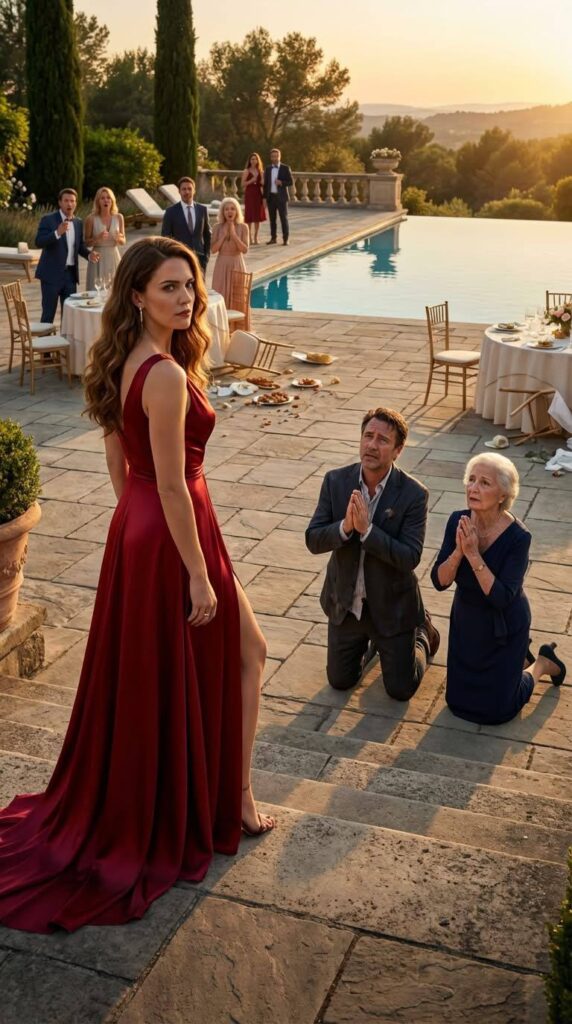
The Sovereign of Sanctuaries: A Chronicle of Reclamation
Part I: The Facade of the Thorne King
“Fresh air is truly magnificent for those on the precipice of vagrancy,” I remarked to my husband, my voice possessing the clinical chill of the Carrara marble countertops he hadn’t contributed a single copper toward.
I stood upon the emerald expanse of the Hudson Valley Villa, an eight-hundred-thousand-dollar monument to my own endurance. Before me, a private security detail, clad in tactical charcoal, methodically established a perimeter. The sun was dipping below the horizon of the river, painting the stone facade in hues of bruised purple and mocking gold. This house was meant to be my fortress, a silent testament to a decade of eighty-hour work weeks. Instead, it had been transfigured into a theater of betrayal, a place where my sweat was harvested by a clan of high-society parasites who mistook my silence for subservience.
My name is Sarah Thorne. At thirty-four, I am a senior tech consultant who specialized in rebuilding failing infrastructures. I understood systems—how they functioned, how they crumbled, and how they could be exploited. For ten years, I lived like a ghost, hoarding my earnings and bypassing the hollow lures of consumerism, all for the singular goal of owning my ground. Six months ago, I achieved it. I signed the deed in a quiet law office: Sarah Thorne, Sole Proprietor.
The rot, however, didn’t begin with a leak in the roof or a crack in the foundation. it began with the fragile, glass-spun ego of Julian Thorne.
Julian was a man composed of mid-level marketing jargon and expensive tailoring he couldn’t afford. To his mother, Eleanor Thorne, he was a titan of industry, a scion of a legacy that had long since dried up. Julian didn’t possess the spine to tell his mother that his wife’s portfolio dwarfed his own by a factor of ten. Instead, he allowed a toxic narrative to take root—a lie that portrayed him as the conqueror of the real estate market.
“You’ve restored the family honor, Julian,” Eleanor had purred during our housewarming gala, her eyes roving over the vaulted cedar ceilings with the cold hunger of a landlord. “A manor of this magnitude… it signals to the world that the Thorne men have reclaimed their rightful station. I’ve already informed the cousins in Ohio; we finally have a seat worthy of our name.”
I waited for the correction. I waited for Julian to stand tall and say, “Mother, Sarah built this. Every stone belongs to her.”
Instead, he swirled a vintage Bordeaux—a bottle I had curated—and offered a thin, self-satisfied smile. “Indeed, Mother. It’s a victory for the bloodline. We should all bask in it.”
I felt the first tremor then—not in the earth, but in the structural integrity of my marriage.
Part II: The Incursion of the Parasites
“Julian, why are you fueling this delusion?” I demanded later that evening, cornering him in the foyer. The house was finally quiet, save for the hum of the climate control I paid the utility bills for. “I liquidated a decade of stock options for this property. I handled the taxes, the closing costs, and the renovation overhead. Why are you parading it around like a Thorne family inheritance?”
Julian sighed, a weary, patronizing sound that suggested I was the one being unreasonable. “Sarah, don’t be so gauche. It’s a matter of optics. My mother is from a different era; she needs to believe her son is providing. Why are you so obsessed with ‘mine’ and ‘yours’? We’re a unit, aren’t we? Just let her have this moment. Does it truly diminish you to let her be proud of me?”
I should have recognized the red flag for what it was—a declaration of war disguised as a plea for harmony. The “moment” Julian spoke of wasn’t a fleeting lapse in judgment; it was the opening of the gates.
Three weeks later, I returned from a grueling consulting sprint in San Francisco. My mind was still buzzing with server architectures and contract negotiations. As I pulled into my driveway, I found it blocked by three bloated SUVs. The quietude of the Hudson Valley was shattered by the rhythmic thumping of bass and the shrill laughter of strangers.
Eleanor’s sister, three cousins I had met exactly once, and an aunt with a penchant for Virginia Slims had moved into the guest wing. My sanctuary had been converted into a cut-rate hotel for the entitled.
“Sarah, darling!” Eleanor called out from the living room, not bothering to rise from the Italian leather sofa. “The cousins decided to stay for the season. We found the guest rooms a bit cramped, so I took the liberty of reorganizing some of your storage. You’re always so buried in your little spreadsheets, I assumed you wouldn’t mind making space for family.”
I felt a surge of adrenaline, the kind that precedes a system crash. I marched upstairs, my boots echoing like thunder on the mahogany floors. When I reached the master suite, I found the heavy oak doors bolted from the inside.
When Julian finally emerged, looking disheveled and smelling of cheap gin, I pushed past him. My heart fractured at the sight. My designer wardrobe—pieces I had bought to mark professional milestones—had been shoved into black industrial trash bags and piled like refuse in the hallway. My custom-made bed was gone, replaced by a tangle of sleeping bags and the sticky fingerprints of toddlers.
“What is the meaning of this, Julian?” I whispered, the rage beginning to crystallize into something cold and sharp.
“Look, Sarah, the house is at capacity,” Julian said, avoiding my gaze as he balanced a tray of appetizers. “The family has had a rough fiscal year. Eleanor suggested—and after some thought, I agreed—that you’d be far more comfortable in the garden outbuilding. It’s quiet. It’s secluded. You can work on your ‘tech stuff’ without the kids bothering you. Think of it as a boutique retreat. Besides, the fresh air will do you good. Stop being so territorial; it’s incredibly unbecoming.”
The man I thought was my partner had become a squatter with a wedding band.
Part III: The Exile and the Encryption
“Fresh air?” I asked, my voice dropping to a register that should have terrified him.
“Precisely,” Julian snapped, emboldened by the presence of his clan downstairs. “Go settle in. We’re hosting a grand family banquet tonight, and Eleanor expects you to coordinate the catering arrivals. Try to be a team player for once.”
I didn’t argue. I didn’t scream. I had learned long ago that in a conflict of power, the one who makes the most noise is usually the one losing. I picked up the heavy trash bags containing my life and walked out of the back entrance, past the infinity pool, and into the ornamental garden shed.
It was a beautiful structure—cedar-shingled with large windows—but it was a potting shed nonetheless. As the sun set and the main house began to glow with the warmth of a party I wasn’t invited to, I sat on a small wooden bench in the dark. I could hear Eleanor’s triumphant toast echoing from my balcony.
I pulled out my phone. My thumb hovered over the screen. I wasn’t calling my mother or a friend. I opened a secure, encrypted messaging app and reached out to my estate attorney, a man known in the city as The Liquidator.
“IDENTIFY PROTOCOL: SCORCHED EARTH,” I typed. “INITIATE THE NUCLEAR OPTION ON THE HUDSON PROPERTY. I WANT A FAST-TRACK DISPOSAL. NO CONTINGENCIES. NO NOTIFICATIONS TO THE RESIDENTS.”
His reply came thirty seconds later: “CONFIRMED. DOCUMENTS ARRIVING FOR DIGITAL SIGNATURE WITHIN THE HOUR.”
I leaned back against the rough cedar wall. The Vances—my husband included—viewed me as a source of revenue, a silent engine that kept their fantasies running. They had forgotten that an engine can be turned off.
They thought they had exiled me to the garden. They didn’t realize they had just put me in the command center.
Part IV: The Silent Saboteur
For the next five days, I played the role of the broken woman. I moved with a deliberate slowness, my eyes downcast, a ghost haunting the edges of my own estate. I lived in the shed. I prepped the ingredients for the meals Eleanor demanded. I even endured the indignity of Julian’s “pity,” as he occasionally brought me a lukewarm cup of coffee and told me I was “handling the transition well.”
“See, Julian?” Eleanor remarked over a breakfast of poached eggs I had prepared. “She simply needed to understand the hierarchy. Some women are built to lead, and others are built to serve the lineage. She’s much more agreeable now that she’s breathing that garden air.”
Julian chuckled, spreading expensive marmalade on his toast. “I told you, Mother. I have a handle on the situation.”
They were so intoxicated by their own perceived dominance that they failed to notice the subtle changes. They didn’t notice the small, high-definition microphones hidden in the molding of the dining room. They didn’t notice that I had installed a localized jammer that prevented Julian from accessing our joint brokerage accounts.
In the quiet of the shed, I listened to the recordings. I heard Julian bragging to his cousin about how he intended to forge my signature on a quit-claim deed to put the house in his name. I heard Eleanor discussing which of my original oil paintings she would sell to fund a winter retreat in the Maldives.
“Once we have the house legally,” Eleanor whispered on the third night, “we can move her permanently into the shed or just buy her a small condo somewhere far away. She’s served her purpose.”
I felt no pain hearing these words. I felt only the satisfaction of a technician identifying a bug in the code. I had already finalized the off-market sale of the villa to a private equity firm that specialized in “distressed” luxury assets. They wanted the property for a corporate retreat and were willing to pay a premium for a seventy-two-hour closing.
On the morning of the sixth day, Eleanor announced the “Grand Thorne Rebirth Party.” She had invited the local elite, the country club set, and everyone she wanted to impress with her son’s “success.”
“Make sure the champagne is chilled to exactly forty-five degrees, Sarah,” she commanded, not even looking at me as I swept the terrace. “This is Julian’s big night. Try not to look so… bedraggled.”
I smiled, a thin, predatory expression they mistook for compliance. “Don’t worry, Eleanor. Tonight will be a night no one ever forgets.”
Part V: The Grand Finale
The evening was a masterpiece of pretension. The villa was bathed in soft, amber light. String quartets played on the lawn, and Julian stood by the wet bar, holding court. He was telling a local developer about the “struggles of historical restoration” and how he had personally sourced the reclaimed wood for the library.
He looked every bit the master of the manor. Until the front doors—the massive, custom-built oak doors—were thrown open with a violence that silenced the room.
I didn’t enter from the kitchen or the garden. I walked through the front entrance, flanked by my attorney and four stoic men from a private security firm. The guests turned, their whispers dying in their throats.
“Sarah? What is the meaning of this intrusion?” Julian demanded, his face flushing a deep, embarrassed crimson. “We are entertaining guests. Go back to your quarters.”
I walked into the center of the foyer, my heels clicking like a countdown. “Oh, Julian. I wouldn’t dream of missing this. I wanted to ensure you had a captive audience for your final performance.”
Eleanor stepped forward, her jewelry rattling with her indignation. “Get these commoners out of this house! Julian, command your wife to behave!”
“Your house, Eleanor?” I asked, my voice amplified by the perfect acoustics of the hall. “This house was bought with tech consulting fees and stock liquidations. It was bought by Sarah Thorne. Julian hasn’t even paid the cleaning lady in six months.”
I turned to the crowd, many of whom were already holding up their phones to record the spectacle. “Julian once told me that ‘fresh air is great.’ And he was right. FRESH AIR IS MAGNIFICENT FOR PEOPLE WHO ARE ABOUT TO BE HOMELESS.”
The silence that followed was absolute.
“As of six o’clock this evening,” my attorney announced, holding up the notarized transfer documents, “this property belongs to the Blackwood Equity Group. The deed is recorded. A permanent restraining order has been issued against Julian and Eleanor Thorne. You have exactly fifteen minutes to clear the premises before you are removed by force for criminal trespassing.”
“You’re bluffing!” Julian roared, his glass shattering on the floor. “You can’t sell my family home!”
“It was never your home, Julian,” I said, handing him a single black industrial trash bag. “It was mine. And since you liked the way I packed my clothes, I thought I’d return the favor. Yours and your mother’s belongings are already on the sidewalk. I suggest you hurry. The forecast calls for a heavy downpour.”
The security team stepped forward, and the “Thorne King” began to crumble.
Part VI: The Curbside Coronation
The exit was a study in public degradation.
Eleanor Thorne, the woman who had spent months lecturing me on “stature,” was escorted out of the villa by two guards while she screamed about her blood pressure and her “rightful place.” Her socialite friends, the very people she sought to impress, watched with a mixture of horror and predatory glee, their cameras capturing every second of her fall.
The cousins and the aunt, seeing the writing on the wall, didn’t stand by Julian. They immediately began bickering with Eleanor, blaming her for losing their free ride. The “Thorne Unity” vanished the moment the air conditioning was turned off.
Julian was the last to leave. He sat on the curb, perched on a suitcase that contained his vanity and very little else. He looked up as I walked toward my car, parked at the end of the driveway.
“Sarah, please,” he stammered, his voice breaking. “We can talk about this. I’ll change. I’ll tell everyone the truth. You can’t just throw family out into the street.”
I paused, the cool night air feeling like a benediction on my skin. “We weren’t a family, Julian. We were a host and a colony of parasites. I merely decided to stop the blood flow.”
I didn’t wait for a response. I climbed into my car and drove away, the headlights illuminating the “Thorne King” sitting in the dirt of the Hudson Valley.
I didn’t go to a hotel. I went to a quiet, private airport where a flight was waiting to take me to a new project in London. I had sold the villa not just for the money, but to excise the memory of their entitlement from the soil. The profit was enough to fund ten more sanctuaries.
As the plane climbed above the clouds, I looked down at the sprawling lights of New York. I realized that the greatest luxury wasn’t the house—it was the power to walk away from it.
Part VII: The Sanctuary Project
Half a year has passed since the night the Thorne dynasty collapsed.
I now reside in a penthouse in the city—a fortress of glass and steel where the security is absolute and the deed is undisputed. There is no garden shed. There are no uninvited guests. There is only the hum of a life reclaimed.
Julian is currently sharing a cramped studio with Eleanor. He works two menial jobs to satisfy the creditors who came calling once my bank account was no longer accessible to him. Eleanor spends her days complaining to anyone who will listen, but her audience has dwindled to zero. The “Thorne King” is now a servant to the very mother whose approval he destroyed his life to gain.
I used a portion of the villa’s sale to establish The Sanctuary Project. It’s a legal and financial foundation dedicated to helping women protect their assets from predatory partners and entitled in-laws. We provide the “Nuclear Option” for those who feel they have no way out.
Every morning, I sit on my terrace, forty stories above the frantic pulse of the world. I drink a cup of coffee that I earned, in a space that I own, governed by rules that I wrote. On my table sits a small, resilient succulent—the only thing I took from that garden shed in the Hudson Valley. It is thriving in the thin, high air.
“Fresh air,” I whispered to the horizon this morning as the sun began to burn through the city haze. “It really does perform miracles when you finally have the room to breathe it.”
I am no longer a tech consultant rebuilding other people’s infrastructures. I am an architect of my own destiny. And my foundation is made of something much stronger than marble.
If this story of reclamation and standing your ground resonated with you, please like and share this post. Your engagement helps these narratives of empowerment reach those who might be sitting in their own ‘sheds’ right now. What would you have done if you were in Sarah’s position? Join the conversation in the comments below!