
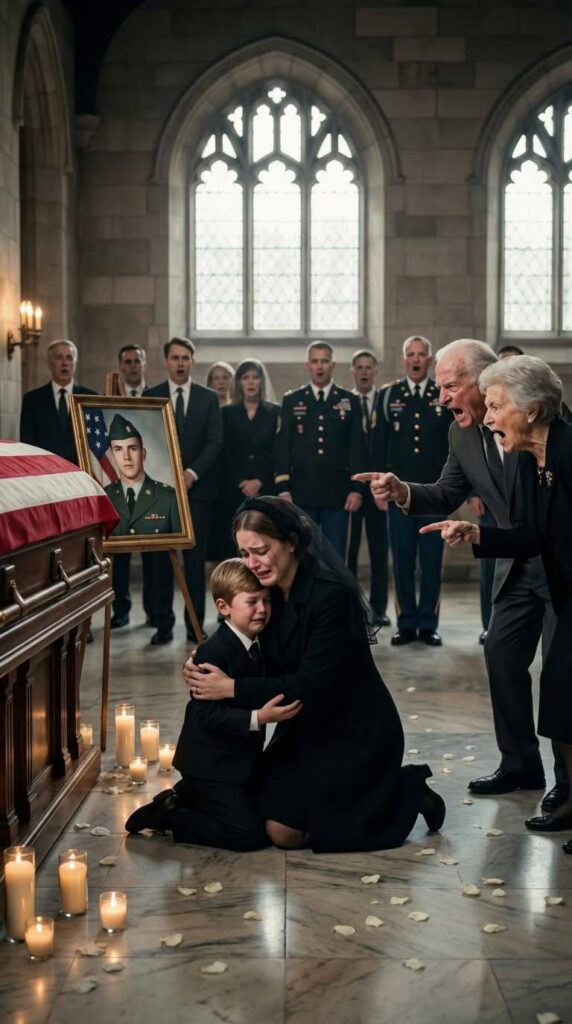
Chapter 1: The Granulated Echo
My name is Jessica Hayes, and the day I buried the center of my universe, the world did not collapse in a singular, dramatic explosion. It eroded in fragments, crumbling away like limestone under a relentless, acidic rain.
The first fragment was the hollow, percussive thud of granulated earth striking polished mahogany. The second was the voice of my six-year-old son, Noah, a sound so fragile it seemed impossible it could resonate in a world this cavernous and cold.
“Mom,” he whispered, his small hand trembling within mine, “when is the door going to open? When is Dad coming back?”
The third fragment—sharp, jagged, and delivered with a public cruelty that would haunt my marrow—was the resounding crack of my mother-in-law’s palm across my son’s face.
Most people imagine that grief arrives like a sudden summer storm. In reality, it arrives like the sound of glass shattering in a room full of strangers; everyone turns to stare at the mess, but no one offers to help you pick up the shards. We stood on the sodden grass of the Halston Avenue Cemetery, a sea of expensive black wool and calculated expressions. The air was saturated with the cloying, suffocating scent of lilies, a smell so thick it felt like it was trying to drown me.
My husband, Adrian Hayes, had been thirty-four years old when his heart stopped beating.
Only seventy-two hours prior, he had been a warm weight beside me in the quiet of our bedroom. He had been a thief of bites from my dinner plate, a builder of lopsided cardboard fortresses on the living room rug. Whenever the drawbridge of Noah’s castle collapsed, Adrian would simply laugh, pull our son close, and say, “That just means we have to build it stronger next time, buddy.”
Then came that rainy Thursday. A red light ignored on Halston Avenue. A truck that didn’t see a silver sedan.
The police used the word “instantaneous.” I have grown to loathe that word. There is nothing instant about the vacuum left behind when a soul is ripped from a family. Death may be a single moment for the departed, but for those left standing, it is a recurring nightmare that resets every time you wake up and reach for a hand that isn’t there.
As the priest’s eulogy drifted away on the biting wind, Noah tugged at the sleeve of my coat. “Mom? Why are they covering him up?”
My throat felt like it had been lined with crushed stone. Around us, the Hayes dynasty stood like pillars of salt. My mother-in-law, Eleanor Hayes, was draped in a black coat with a silver fox collar, her face a mask of regal stoicism. She stood like a grieving queen enduring a public inconvenience rather than a mother who had lost her firstborn.
“Dad’s body needs to rest, sweetheart,” I managed to whisper, stroking his blond hair. He looked so much like Adrian it was a physical ache—the same stubborn chin, the same observant, solemn eyes.
“Then why can’t we take him home?” he persisted.
Because home is now a hollow shell, I wanted to say. Because the silence there will scream your father’s name. Instead, I pulled him into the crook of my arm. “Because love has to live in our hearts for a while now.”
When the first shovel of dirt struck the casket, Noah flinched as if he’d been struck. My knees buckled, but I anchored myself. I would not fall. Not here. Not in front of them. The Hayes family had spent seven years waiting for me to shatter. I wouldn’t give them the satisfaction of seeing the dust.
Chapter 2: Wolves in Silk
If there is one thing I mastered during my tenure as a Hayes, it is this: they possess the unique ability to dress malice in silk and call it “pedigree.”
They never wanted me. I was the daughter of a public school teacher and a retired firefighter from Columbus, Ohio. To Eleanor and Charles, I was a contaminant in their pristine bloodline. They looked at my student loans and my middle-class upbringing as if they were infectious diseases. When Adrian bypassed their demands for a society wedding to marry me in a small Vermont chapel, I became a ghost in their house—tolerated only because Adrian stood between me and their cold, corporate machinery.
Now, the shield was gone.
As the funeral service dissolved, the mourners approached with rehearsed condolences. “He was so young.” “Such a tragic loss.”
I didn’t answer. I had no breath left for the performance of politeness. Across the cemetery, Eleanor stood with Charles and their daughter, Vanessa. They didn’t look at us. They didn’t offer a hand to their only grandson. A chill, sharper than the autumn wind, settled in my chest.
What happens now?
For the past two years, we had lived within the sprawling Hayes Estate. Adrian had insisted on it, claiming it was a strategic necessity while he untangled financial irregularities within the family firm. “Just until I make sure they can’t touch you or Noah,” he had told me. At the time, I thought he was being paranoid. Adrian was a man who absorbed damage quietly, only acting when he had the locks ready to be changed.
The drive back to the mansion was a heavy, suffocating silence. The Hayes Estate rose behind iron gates like a fortress of old money and older secrets. To the world, it was a landmark of success. To me, it was a gilded cage.
The circular drive was already choked with cars. Inside, the formal living room was a sea of dark suits and the clinking of crystal. Caterers moved like shadows. Every conversation dropped an octave the moment I crossed the threshold with Noah.
My son clung to my hand, then suddenly spotted the memorial table near the grand piano. It was laden with white roses and a large, framed portrait of Adrian. It was a photo I had taken—Adrian on a beach, sleeves rolled up, laughing into the wind. He looked alive. He looked like home.
Noah walked toward it, drawn like a moth to a flame. “Dad,” he whimpered.
He reached out his small, clumsy hand to touch his father’s face.
“Noah, honey, be careful—”
The frame was heavy, the marble floor slick. It slipped.
The sound of the glass shattering was violent, a sharp explosion that seemed to stop every heart in the room. Noah recoiled, his face crumpling. “I’m sorry… I didn’t mean to…”
The slap was so sudden and so loud that for a heartbeat, I thought the chandelier had fallen. Noah’s head snapped to the side.
The silence that followed was absolute. Noah began to wail—a high, piercing sound of pure shock.
I lunged forward, snatching him into my arms, my heart roaring in my ears. I turned to see Eleanor Hayes standing there, her hand still hovering in the air, her eyes burning with an incandescent, unhinged rage.
“Why would you do that?” I screamed, my voice cracking.
“He destroyed my son’s image,” Eleanor hissed.
“He is six years old! He’s grieving!”
“He’s a careless brat,” she snapped. “Just like the woman who birthed him.”
I looked around the room. Vanessa was dabbing her eyes with a dry tissue, a smirk tugging at the corner of her mouth. Charles was adjusting his watch. No one moved to help. The elite of the city watched the spectacle with the detached interest of people at a theater.
“He’s garbage,” Eleanor said, her voice dropping to a lethal, calm vibration. “He has brought nothing but ruin to this family from the moment he was conceived.”
Chapter 3: The Expulsion
The room remained frozen, a tableau of aristocratic cruelty. Noah buried his face in my neck, his small body racking with sobs. I could feel the heat radiating from the red welt on his cheek.
“What did you just say?” I whispered, the words trembling with a fury I had never known.
Vanessa stepped forward, her diamonds catching the light of the chandeliers. “Oh, Jessica, let’s stop the charade. Do you really think we were going to pretend forever? You’ve always been an interloper. A middle-class girl with a sob story who trapped my brother.”
“I loved him,” I bit out.
“You drained him,” Eleanor countered. “He had a future before he had to carry the weight of you and that… boy.”
Charles Hayes appeared beside them, looking like a judge delivering a final verdict. “This should have been handled years ago. We tolerated Adrian’s lapse in judgment because he insisted. But Adrian is gone. The protection is gone.”
He looked at me with eyes that held less warmth than a winter grave. “Pack your things, Jessica. You have two hours.”
I felt the air leave the room. “What?”
“This estate is for members of the Hayes family,” Eleanor said, smoothing her black silk dress. “Not for people who arrive with nothing and expect to inherit the world because of a funeral. You are no longer welcome on this property.”
I looked around the room—at the business partners, the cousins, the “friends.” No one spoke. The humiliation was a physical weight, pressing me down into the broken glass. I had spent seven years trying to win them over. I had sent the cards, hosted the dinners, smiled through the subtle barbs, and insisted Noah call them “Grandma” and “Grandpa.”
“I trusted you,” I said to Vanessa.
She let out a soft, melodic laugh. “That was your first mistake. You aren’t one of us, Jessica. You never were. Now, go. Before I have security remove you and the child physically.”
The laughter that rippled through the room was the final blow. They believed I was defeated. They saw a broken widow with no resources and no spine.
They had forgotten who my husband was.
I stood very still. I didn’t cry. I didn’t beg. I felt a memory surface—a conversation in our bedroom just a week ago. Adrian had looked at me, his eyes dark with a foreboding I hadn’t understood. “If anything happens, Jess, don’t look for their mercy. They don’t have any. Look for the folder in the safe. And call Martin.”
I shifted Noah on my hip. I reached into the pocket of my coat and pulled out my phone.
“Who are you calling?” Eleanor asked, her voice dripping with boredom. “Your parents? A moving company?”
I didn’t answer her. I dialed the number from memory. When the voice answered on the second ring, I said only four words:
“It’s time. Come now.”
I hung up. I looked at Charles, then at Eleanor. For the first time that day, the shaking in my hands stopped.
“I’m going upstairs to pack,” I said, my voice echoing in the sudden quiet. “But don’t hold your breath for that cab. You’re going to want to be here when the door opens again.”
Chapter 4: The Architect’s Blueprint
The east wing of the mansion was silent, a stark contrast to the predatory energy of the living room below. I carried Noah into Adrian’s private office—a room that smelled of cedar, old paper, and the faint, lingering scent of his cologne.
I sat Noah on the leather sofa and knelt before him. I used a cold cloth to gently dab at the mark on his face.
“Does it hurt?” I asked.
“Grandma is mean,” he whispered, his lip trembling. “Does she hate me because I broke the picture?”
“No, baby,” I said, my heart breaking for the millionth time. “She is mean because she doesn’t know how to be human. It has nothing to do with you. Do you trust me?”
He nodded, his eyes wide and trusting.
“Stay here. Don’t open the door for anyone but me. I need to get something Dad left for us.”
I crossed the room to the built-in bookshelves. Behind a false set of leather-bound encyclopedias lay the safe. Adrian had given me the code on our fifth anniversary. 0-6-1-2—the day Noah was born.
The lock clicked open.
Inside was a thick, cream-colored folder labeled: FOR JESSICA. IN CASE OF EMERGENCY.
I opened it, and the world shifted on its axis.
There were documents—titles, share certificates, and a letter in Adrian’s steady, architectural handwriting. I scanned the pages, my breath hitching.
Jess, the letter began. If you’re reading this, it means my family has shown you their true faces. I’m sorry I’m not there to shield you. But I didn’t leave you defenseless. Over the last two years, I didn’t just ‘untangle’ the family business. I reclaimed it.
I kept reading, the legal jargon translating into a narrative of absolute victory. Adrian had spent years quietly buying up distressed shares of Hayes Consolidated through shell corporations. He hadn’t just been an executive; he had become the majority shareholder.
And then there was the deed.
The Hayes Estate didn’t belong to Charles or Eleanor. It had been used as collateral for a loan the family business had taken out five years ago—a loan that Adrian’s private trust had bought.
But the final pages of the folder were the ones that made my blood run cold.
“The evidence,” Adrian had written. “They think they are the pillars of society. Show them what’s buried under the foundation.”
I saw the spreadsheets. The wire transfers. The proof of years of systematic embezzlement by Charles and Vanessa. They hadn’t just been cold; they had been criminal.
A sharp knock at the door startled me. “Two hours is up, Jessica!” Vanessa’s voice rang out, sharp and triumphant. “We’re coming in!”
I tucked the folder under my arm, took Noah’s hand, and opened the door.
“You didn’t pack,” Vanessa said, looking at my empty hands and the folder. She smirked. “What’s that? A scrapbook of memories to cry over?”
“Something like that,” I said, walking past her. “Let’s go downstairs. I think your guests are waiting for the finale.”
Chapter 5: The Reckoning
When we reached the bottom of the stairs, the room was still full. The vultures were waiting to see the carcass thrown out.
Eleanor was standing by the front door, a set of keys in her hand. “The taxi is outside, Jessica. Leave the house keys on the table.”
I didn’t move. I stood in the center of the room, Noah beside me, and placed the cream folder on the marble coffee table.
“I’m not leaving,” I said.
Charles laughed, a dry, grating sound. “You don’t have a choice. This is my house. These are my people.”
“Actually,” a new voice boomed from the foyer.
The front doors swung open, and Martin Feld walked in. He was the most feared estate lawyer in the state, a man who moved with the quiet authority of a predator. He was flanked by two men in dark, nondescript suits and a uniformed officer.
“Martin?” Charles stammered, his face paling. “What is this? This is a private family mourning.”
“It was,” Martin said, popping the latches on his briefcase. “Until you attempted to illegally evict the owner of this property.”
Vanessa scoffed. “We own this estate! It’s been in the Hayes name for three generations!”
“Correct,” Martin said, pulling out a stamped deed. “And as of six months ago, the Hayes name on this deed belongs to the Noah Adrian Hayes Trust, with Jessica Hayes serving as the sole executor and trustee.”
The room went so silent you could hear the snow beginning to fall against the windowpanes.
“Lies!” Eleanor shrieked. “Adrian would never do that! He was a Hayes!”
“He was a father,” I said, stepping forward. I picked up the folder and pulled out the first spreadsheet. “And he knew his family was a nest of thieves.”
I looked at Charles. “Did you think Adrian didn’t notice the twenty million dollars you funneled into the Cayman accounts? Or the way you and Vanessa were bleeding the employee pension fund to pay for your ‘aristocratic’ lifestyle?”
Charles looked like he was having a stroke. His face went from white to a mottled, dangerous red. “You have no proof.”
I turned to the two men in suits. “Charles, meet Agents Miller and Thorne from the Federal Financial Crimes Division. They’ve been reviewing Adrian’s digital trail for the last hour.”
The sound of the champagne flutes hitting the floor was the only music left in the room. The guests—the same ones who had smirked at my son’s pain—were now scrambling for the exits, terrified of being caught in the fallout of a federal investigation.
Chapter 6: Fifteen Minutes
Eleanor slumped against the piano, the very one where her grandson had dropped a picture frame two hours ago. The “Queen of Charleston” looked like a tattered rag doll.
“Jessica,” she whimpered, her voice cracking. “We are family. Think of Adrian. He wouldn’t want his father in prison. He wouldn’t want us on the street.”
“Adrian spent the last year of his life building a cage for you,” I said, my voice echoing with a coldness that surprised even me. “He knew you would turn on us the moment he was gone. He didn’t build this fortress to keep the world out; he built it to trap the wolves inside.”
I looked at Vanessa, who was sobbing hysterically, her diamonds looking like cheap glass in the harsh light of the room.
“Two hours ago,” I said, pointing to the red mark on Noah’s cheek, “you slapped my son. You called him garbage. You told us to pack because we didn’t belong.”
I leaned in, my face inches from Eleanor’s.
“I’m not as generous as Adrian was,” I whispered. “You don’t get two hours. You get fifteen minutes.”
“What?” Charles roared.
“Fifteen minutes to pack whatever you can carry in your hands,” I said. “After that, I am changing the security codes. Anything left behind will be considered abandoned property and donated to the very public schools you spent years mocking.”
“You can’t do this!” Vanessa screamed.
“The police officer is here to ensure an orderly transition,” Martin added, checking his watch. “I suggest you start with your jewelry. It’s likely the only thing of value you’ll have left once the legal fees start piling up.”
The next fifteen minutes were a blur of chaos. I watched the “Hayes Royalty” scramble through their closets, grabbing furs and handbags, their dignity discarded like the broken glass on the living room floor. They looked small. They looked pathetic.
When they finally stood on the driveway, surrounded by suitcases and the cold night air, Eleanor turned back to me.
“You’ll never be one of us,” she spat, her face twisted with hate.
“I know,” I said, holding Noah’s hand firmly. “That’s the best news I’ve had all day.”
I signaled to the security guard. The heavy iron gates of the estate groaned shut, the sound of the lock clicking into place echoing through the valley.
Chapter 7: The Stronger Foundation
The mansion was finally quiet. The catering staff had been sent home with a generous bonus. The lawyers and agents were gone, leaving behind a mountain of paperwork that would change the landscape of the city’s business world forever.
I sat on the floor of the formal living room, right where the picture frame had shattered. I had cleaned up the glass myself.
Noah came in, carrying a cardboard box he’d found in the pantry. He sat down next to me and started folding the flaps.
“What are you building, baby?” I asked.
“A castle,” he said. “For you and me. And Dad.”
He looked at the drawing of the drawbridge. “I’m going to use extra tape this time.”
I pulled him into my lap, the scent of cedar and resilience wrapping around us. Adrian was gone, and the ache of his absence would never truly leave. But he hadn’t just left us a fortune; he had left us a lesson.
He had shown me that when the world tries to break you, you don’t just pick up the pieces. You use them to build something that can never be shattered again.
“Mom?”
“Yes, Noah?”
“Can we have pizza for dinner? In the big room?”
I laughed, the sound bright and clear in the empty mansion. “We can have pizza wherever we want, sweetheart. It’s our house now.”
As we sat there, eating pepperoni pizza on the million-dollar rugs, I looked at the new frame I’d put Adrian’s picture in. He was still laughing into the wind. I felt a sense of peace settle over me—a peace that had nothing to do with the mansion or the money.
It was the peace of a soldier who had held the line and won.
The empire of the Hayes family had collapsed, and from its ashes, we were going to build a home.
Epilogue: The Long Road
One year later, the federal trials were over. Charles and Vanessa were serving sentences for their roles in the embezzlement scheme. Eleanor was living in a modest two-bedroom apartment, her name a cautionary tale in the society columns she used to dominate.
I had converted the east wing of the estate into the Adrian Hayes Foundation, a center for underprivileged children and NICU survivors.
I stood on the balcony, watching Noah run through the gardens with a golden retriever pup. He was tall, strong, and he walked with the confidence of a child who knew he was loved.
I still look at that folder sometimes. Not for the legal documents, but for the last line of Adrian’s letter.
“Build something beautiful, Jess. Build it stronger.”
And we were. One day, one brick, one memory at a time.
The End.
Final Thoughts from the Author
The journey of Jessica Hayes is a reminder that strength isn’t always found in a loud voice or a grand gesture. Sometimes, it’s found in the quiet preparation of a man who loved his family enough to plan for the worst, and the resilience of a woman who refused to let cruelty have the last word.
If you’ve ever been made to feel like an outsider, or if you’ve had to find the strength to stand your ground when the world felt like it was crumbling, this story is for you. We don’t always choose the battles we fight, but we do choose the armor we wear.
What would you have done if you were in Jessica’s shoes? Would you have stayed to fight, or would you have walked away? Let me know in the comments below. Your stories of resilience are what keep this community growing. Don’t forget to like and subscribe for more tales of justice, legacy, and the power of holding the line.