
Chapter 1: The Facade of Gratitude
There is a distinct, metallic taste to betrayal. It doesn’t arrive all at once; it seeps into your life drop by drop, disguised as minor inconveniences and passive-aggressive sighs.
For thirty years, I was Margaret Thornton, a woman who wore a black robe and wielded a wooden gavel with absolute, unyielding precision. I sat on the bench of the Virginia State Superior Court and dismantled criminal empires, mediated million-dollar corporate disputes, and separated truth from perjury. Yet, in my retirement, I had allowed myself to become entirely blind to the perjury happening at my own dining table.
I had traded the austere dignity of the courtroom for the suffocating shadow of my son Derek’s perceived success. Derek was a fiercely ambitious real estate developer, a man whose tailored suits and rehearsed charm masked a deep, ravenous insecurity. His wife, Vanessa, was a woman obsessed with the aesthetics of “old money,” despite possessing absolutely none of its inherent class or grace. To them, I was no longer a benefactor or a respected matriarch. I was a prop. A living, breathing antique that had lost its polish, useful only for free childcare and the occasional leveraging of my political connections.
We were in the final, chaotic days before their grand relocation into a newly constructed, four-million-dollar mansion in the hyper-affluent suburb of Great Falls, Virginia. The air in their current, already-too-large home was thick with the smell of packing tape and Vanessa’s suffocating floral perfume.
I was sitting in the living room, quietly building a wooden block tower with my four-year-old granddaughter, Lily, when the first real crack in the facade appeared. Derek and Vanessa were in the adjacent open-concept kitchen, loudly debating the logistics of the new property. They were discussing my “guest room.”
“I just don’t see why we have to give her the room with the southern exposure,” Vanessa complained, her voice carrying an intentional, piercing volume. “That space would make a perfect Pilates studio. The basement storage room has plenty of space. We can just throw a rug down.”
“Vanessa, keep your voice down,” Derek murmured, though there was no real reprimand in his tone.
At a pre-move dinner later that week, the disrespect shed its subtle disguise. Vanessa spent forty excruciating minutes complaining about the thread count of the linens I had purchased as a housewarming gift for the so-called “mother-in-law suite” in the basement.
“Honestly, Derek, your mother is lucky we’re taking her at all,” Vanessa sighed, swirling her Pinot Noir. “She’s so slow these days. Completely outdated. She’s like a broken grandfather clock—useless, but we have to keep her in the corner so the neighbors don’t talk and assume we abandon our elders.”
I sat at the end of the long mahogany table, my face an unreadable mask. I cut my steak with surgical precision, keeping my eyes fixed entirely on little Lily, who was quietly eating her peas. A cold ember glowed in my chest. I vividly remembered the rainy Tuesday afternoon three years ago when I sat in my judicial chambers and pushed through a highly contested special zoning bypass for Derek’s initial commercial mortgage—a favor he had begged for on his knees, with tears of desperation in his eyes. Without my signature, his empire would have died in its infancy. Now, he didn’t even have the spine to look me in the eye when his wife insulted my basic human dignity.
As the evening wound down, I stood up to help Lily into her little yellow raincoat. The hallway was quiet, save for the muffled voices coming from the study.
I paused, Lily’s small hand in mine, as I overheard Vanessa whispering to her interior decorator on speakerphone. “Don’t worry about the basement room’s ventilation,” Vanessa hissed, her tone dripping with venom. “She won’t be in our hair for long anyway. I’m already looking at state-run senior care facilities in the next county. We just need her to sign over the last of her pension trust first.”
Chapter 2: The Road of Abandonment
If you want to see the true nature of a predator, observe how they treat the vulnerable when they believe there are no consequences.
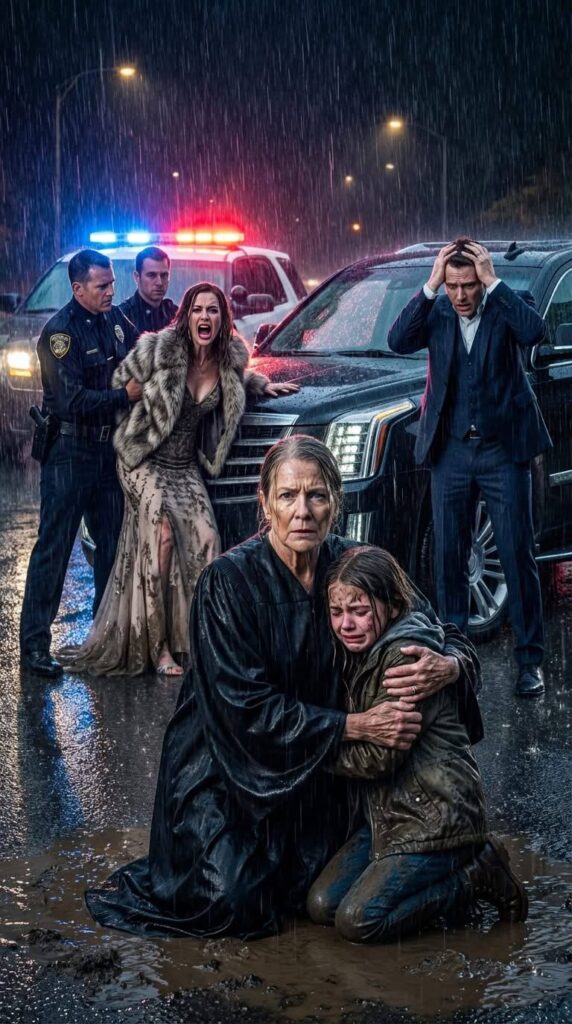
It was a torrential Tuesday evening. The Virginia sky was a bruised, violently churning purple, unleashing sheets of freezing rain. We were returning from a final site inspection of the Great Falls mansion, navigating the dark, winding, unlit curves of Route 15 in Derek’s pristine, leather-lined SUV.
The tension in the cabin was palpable. Vanessa was in the passenger seat, obsessively scrolling through catering menus for their upcoming gala, while Derek gripped the steering wheel, his jaw clenched. Lily and I sat in the back. The child was exhausted, shivering slightly in the over-air-conditioned vehicle.
As we hit a particularly deep pothole, the SUV lurched violently. Lily, startled, accidentally kicked her small, muddy rainboot forward. A singular, dark splatter of mud flew through the gap between the seats, landing directly on the heel of Vanessa’s pristine, two-thousand-dollar white designer stilettos.
The reaction was instantaneous and terrifying.
“She got mud on my shoes!” Vanessa shrieked. Her face contorted into something genuinely demonic, the veins standing out on her neck. It wasn’t just a yell; it was a guttural explosion of disproportionate rage.
“Vanessa, calm down, she’s four,” Derek said, though he immediately pulled the heavy vehicle onto the muddy, gravel-lined shoulder of the dark highway, slamming on the brakes.
Before I could even unbuckle my seatbelt, Vanessa had twisted around, unlatched Lily’s door, and grabbed the terrified child by the arm. With a violent, vicious shove, she pushed my four-year-old granddaughter out of the SUV and into the freezing, driving rain.
“Stay out there and think about what you’ve done to my property!” Vanessa screamed over the howling wind, slamming the heavy door shut.
A surge of adrenaline, cold and sharp as cracked ice, flooded my veins. “What is wrong with you?!” I yelled, scrambling across the leather seats to open the door and retrieve the sobbing, freezing child.
But before my hand could reach the handle, the heavy, mechanical thunk of the child locks echoed through the cabin.
I looked up. Derek’s hand was on the master control panel.
“Mom, sit down,” Derek ordered, his voice devoid of any warmth or humanity. “Vanessa’s right, you’re both too soft. You’re a useless hag who doesn’t understand the value of things. Lily needs to learn respect.”
I stared at my son—the boy I had raised alone, the boy whose scraped knees I had bandaged, whose debts I had cleared. I didn’t see a son anymore. I saw a stranger. A hollow, cruel man infected by greed.
I didn’t scream. Screaming is for victims. I sat perfectly still, the silence in my throat heavier than any shout.
Derek shifted the car into drive and slowly rolled forward. He drove exactly twenty yards ahead, the tires crunching on the wet gravel, leaving his weeping daughter alone in the pitch-black, freezing rain. For ten agonizing minutes, we sat there. The only sound was the rhythmic, mocking thwack of the windshield wipers and the faint, muffled sobs of a child terrified of the dark.
While I sat there, watching the red taillights of the SUV illuminate the muddy road, I slipped my hand into the deep pocket of my wool coat. My fingers wrapped around the heavy, cold brass of my retired judicial seal—a keepsake I always carried.
I gripped the metal until it cut into my palm. I looked at the back of Derek’s head and whispered, so quietly only the ghosts of my past rulings could hear, “You forgot who owns the ground you stand on, Derek.”
Chapter 3: The Silent Gavel
Grief makes you sloppy. Righteous anger, however, makes you precise.
The moment Derek finally allowed a shivering, traumatized Lily back into the vehicle, the fragile, fraying thread of my maternal obligation snapped. I was no longer a disappointed mother. I was a judge presented with undeniable evidence of endangerment and fraud.
The next morning, while Derek and Vanessa were at a luxury car dealership, I packed a single overnight bag for Lily and myself. I didn’t leave a note. I called a private car and took my granddaughter straight to a heavily secured townhouse in Alexandria. It belonged to Marcus, my former chief bailiff, a man built like a bank vault who owed me his career.
“Keep her safe, Marcus,” I said, kissing Lily’s warm forehead as she ate a bowl of oatmeal in his kitchen. “No one gets past that door.”
“Not even the Governor, Your Honor,” Marcus rumbled, locking the deadbolt.
From there, I didn’t go to the police. A simple child endangerment charge would be tied up by Derek’s expensive lawyers for months, framed as a “parenting disagreement.” I needed to obliterate the foundation of his power. I needed to go to the paperwork.
I took a cab to the Fairfax County Records Office. The air inside smelled of dust, old paper, and bureaucratic stagnation—a smell that had always felt like home to me.
I bypassed the front desk and walked straight to the back archives. My old colleague, Clerk Miller, a man with suspenders and ink-stained fingers, looked up and nearly dropped his coffee.
“Judge Thornton,” he stammered. “It’s been years.”
“Miller,” I said, pulling out a pair of tortoiseshell reading glasses. “I need the complete, unredacted financial filings for the ‘Thornton-Great Falls’ development project. Mortgages, environmental impact surveys, state subsidy applications. Everything.”
He returned an hour later, pushing a cart groaning under the weight of thick manila folders. He placed the primary file on the table, his eyes reflecting a deep hesitation. “You sure about this, Margaret? He’s your son. If I pull these out of the archive for an audit…”
I didn’t hesitate. “He was my son when he was a person, Miller. Now, he’s a defendant.”
For six hours, I sat under the flickering fluorescent lights, cross-referencing tax returns with bank statements, tracing the digital ink of their greed. Because I was the presiding judge who had blindly signed the original development permits—trusting my son’s word—I knew exactly where the structural weaknesses in the deal were hidden.
It didn’t take long to find the rot. Derek had massively falsified his income statements to secure the state-backed jumbo loan. Worse, Vanessa had blatantly forged the signatures of two county environmental inspectors on the deed to bypass wetlands protection laws—a federal offense. They had built a palace entirely on a foundation of perjury and wire fraud.
I drafted the emergency motions myself, my handwriting sharp and violent. I compiled the evidence, bound the briefs, and marched directly up to the State Auditor’s office. As the original signatory of the bypassed permits, I had the unique legal authority to unilaterally report the breach of contract and demand immediate state seizure of the assets.
I stamped the final affidavit on the Auditor’s desk with a force that echoed sharply through the quiet room. The useless, slow antique was gone. Judge Thornton had returned to her bench.
Later that evening, sitting in my idling sedan across the street from the new mansion, I watched a fleet of professional movers carrying imported Italian leather sofas into the grand foyer.
I checked my watch, watching the second hand sweep across the dial. “Forty-eight hours until the housewarming gala,” I noted aloud to the empty car. “Just enough time for them to get comfortable before the ceiling falls.”
Chapter 4: The Ten-Minute Eviction
Arrogance is a highly flammable substance. It only requires a single, well-placed spark to reduce an entire life to ash.
Saturday night arrived, bringing with it a crisp, clear chill. The Great Falls mansion was a beacon of excessive, glaring light against the dark Virginia woods. Derek and Vanessa were hosting the “Housewarming Gala of the Season,” desperate to cement their status among the local political and financial elite.
Through the massive floor-to-ceiling windows, I could see the opulent display. Waiters in crisp white tuxedos circulated with silver trays of beluga caviar. A string quartet played Vivaldi in the corner. The driveway was choked with Maseratis and Bentleys.
I did not sneak around to the servant’s entrance. I did not knock politely.
I walked up the sweeping limestone steps, flanked by two towering, unsmiling State Marshals wearing tactical vests over their dress shirts.
The heavy oak front door was locked. I nodded to the Marshal on my right. He didn’t bother with the handle; he raised a heavy, steel battering ram and kicked the door open with a splintering crash that silenced the string quartet instantly.
The music died. The clinking of crystal ceased. Two hundred of Virginia’s wealthiest citizens turned to stare in paralyzed shock.
The cork popped on a vintage bottle of Dom Pérignon somewhere in the back, the sound echoing like a gunshot in the dead silence.
Vanessa was standing near the sweeping spiral staircase, mid-laugh, showing off her unmarked, pristine designer heels to a state senator’s wife. Derek was by the fireplace, holding a glass of scotch.
I stepped into the grand foyer. I had worn a long, structured black wool coat that draped over my shoulders, mimicking the exact silhouette of my old judicial robes.
“Celebrate quickly, Vanessa,” my voice cut through the stagnant, terrified air like a serrated blade.
Derek stepped forward, his scotch sloshing over the rim of his glass, his face draining of all color. “Mom? What the hell are you doing? Who are these men?”
I looked at him with an icy, absolute indifference. “I’m doing my job. I just handed the State Attorney General the physical evidence of your mortgage fraud, the forged environmental signatures, and the falsified tax documents.”
A collective gasp rippled through the crowd of elite guests. Several politicians immediately put their drinks down and began edging toward the side exits, desperate to escape the blast radius of the scandal.
“This property was built on a lie,” I continued, my voice echoing off the vaulted ceilings. “And as the judge who mistakenly signed your original bypass papers, I have personally signed the emergency order to vacate and seize.”
Vanessa dropped her champagne flute. It shattered against the imported marble, a chaotic explosion of glass and foam. “You can’t do this! This is my house! You crazy old hag, I’ll have you committed!”
I didn’t even look at her. I kept my eyes locked on the hollow man I used to call my son.
“You have exactly ten minutes to pack your personal items before this house, and everything inside it, belongs to the State of Virginia,” I declared, pulling my watch from my pocket. “Marshals, start the clock.”
Panic erupted. Guests fled toward the coat check in scandalized, frantic silence, abandoning the hosts like rats fleeing a sinking galleon. Derek fell to his knees, clutching his chest as he hyperventilated, the reality of his total ruination finally piercing his ego.
As the seventh minute ticked by, the head Marshal emerged from the basement stairwell, holding a heavy, steel crowbar.
He walked up to me, his expression grim. “Judge Thornton, we found a hidden, unlisted wall safe behind the drywall in the basement. The one near the ventilation duct. Should we force it open now, or wait for the federal agents to arrive?”
Chapter 5: The Weight of the Law
The descent from a four-million-dollar estate to absolute destitution is a surprisingly rapid journey when the parachute has been legally severed.
The remaining three minutes of the eviction were a masterclass in pathetic desperation. Derek and Vanessa, stripped of their bravado and their staff, were reduced to frantically throwing handfuls of silk blouses and loose watches into heavy-duty black trash bags provided by the Marshals.
When the ten-minute timer on my watch beeped—a sharp, digital trill—the Marshals physically stepped between Vanessa and her walk-in closet.
“Time is up, ma’am. Step away from the property,” the Marshal ordered.
Vanessa shrieked, clawing at the man’s vest, but she was effortlessly escorted out the front door. In her panicked struggle, one of her pristine, two-thousand-dollar designer heels slipped off, abandoned to the mud tracks left by the Marshals’ boots on the front portico. I stepped carefully over it as I walked out into the cool night air.
By midnight, the fallout was absolute. Derek and Vanessa were not just homeless; they were the targets of a massive, multi-agency federal investigation. Their bank accounts were frozen. Their credit cards declined. The “friends” who had been drinking their champagne hours earlier had universally blocked their phone numbers.
They ended up in a dingy, sixty-dollar-a-night motel off the interstate. My investigator sent me the report. The walls were peeling, the air conditioning rattled like a dying asthmatic, and the room smelled of stale smoke and despair.
Sitting on the edge of a deeply stained, sagging mattress, Derek put his head in his hands.
“You just had to push her, didn’t you, Vanessa?” he sobbed, the sound pathetic and hollow. “You couldn’t just keep your mouth shut. You had to call her a hag. You had to throw Lily out of the car.”
Vanessa, her makeup smeared into dark, chaotic circles around her eyes, shrieked like a banshee. She picked up a cheap, plastic bedside lamp and hurled it at his head. “You let her do this! You gave her the access! You didn’t stop her because you’re a weak, pathetic mama’s boy!”
While they tore each other apart in a squalid room, miles away, I was in the small, warm, modest cottage I had originally intended to retire in before Derek convinced me to fund his lifestyle.
I walked into the spare bedroom and gently pulled the thick, quilted blanket up to Lily’s chin. The child was fast asleep, no longer shivering, no longer afraid of the dark.
I walked back into my small, fire-lit study and sat at my heavy oak desk. Spread out before me were the final custody filings. I wasn’t just taking their house; I was taking their future. I had secured the cloud-synced dashcam and internal cabin footage from Derek’s luxury SUV from that rainy night. The video clearly showed Vanessa violently shoving the child into the storm, and Derek manually engaging the locks to trap her out there. It was irrefutable, damning evidence of severe child endangerment.
I picked up my pen, feeling the familiar, comforting weight of the ink. I had lost a son, yes. But looking at the quiet, peaceful hallway, I knew I had saved a life. I realized that my “usefulness” was never meant to be measured by the funds in my bank account or the title before my name. My purpose was to stand as a heavy, unmoving stone wall between the innocent and the cruel.
A sharp, frantic knocking shattered the quiet of the night, rattling the glass of my cottage door.
I looked at the security monitor. It was Derek. He was standing in the freezing rain, disheveled, his suit torn, weeping openly on my porch.
“Mom! Mom, please!” he wailed, his voice cracking. “The feds are looking for me. They’re going to arrest me in the morning. I’ll do anything! I’ll tell them it was all Vanessa’s idea! I’ll sign over my parental rights! Just open the door!”
I sat at my desk, listening to his desperate pleas. I didn’t get up. I didn’t walk to the door. Instead, I reached across the mahogany desk and picked up the phone to dial the local precinct.
Chapter 6: The Bench of Peace
A year can entirely rewrite the geometry of a life. It can turn a prison into a sanctuary, and a palace into a cage.
It was a brilliant, sun-drenched Tuesday afternoon. I sat on a wrought-iron park bench beneath the sprawling branches of an ancient oak tree in Alexandria. The air smelled of cut grass and blooming jasmine.
A few yards away, Lily was sprinting across the green lawn, laughing hysterically as she chased a golden retriever puppy. She was a different child now. The quiet, unnerving stillness had melted away, replaced by a vibrant, relentless joy. She was thriving in her new kindergarten, and she had taken to introducing me to her teachers not as her grandmother, but proudly as “Judge Grandma.”
The fate of the architects of her previous misery had been predictably grim. Derek, having turned state’s evidence against his own wife in a cowardly bid for leniency, was currently serving a five-year suspended sentence, mandated to work a menial, minimum-wage job scanning inventory at a logistics warehouse to pay off his staggering restitution. Vanessa, refusing to accept a plea, had disappeared into a labyrinthine web of civil and federal lawsuits, abandoned by every lawyer who realized her accounts were permanently dry.
A young woman, a third-year law student I had recently taken on as a mentee, sat beside me on the bench, reviewing a stack of case files.
She looked up from her notes, watching Lily play. “Judge Thornton,” she asked, her voice carrying a quiet, profound respect. “How did you know when to do it? How did you know when to finally stop being a mother and start being a judge?”
I kept my eyes on my granddaughter, watching the sun catch the bright yellow of her dress.
“The law, at its absolute core, is a shield meant to protect the vulnerable from the ruthless,” I said softly, the words carrying the weight of thirty years on the bench. “When the people you love become the very monsters the vulnerable need protection from, the universe has already made the choice for you. You just have to have the spine to execute it.”
I turned to the young student, offering a gentle, absolute smile. “I didn’t destroy a family. I pruned a rotting, dead branch so the rest of the tree could finally breathe again.”
I stood up, adjusting the lapels of my crisp blazer. My posture was perfect, my heels clicking firmly and cleanly on the paved walkway—standing on solid ground that I had earned, paid for, and protected.
As we began to walk toward the park exit, my phone vibrated in my pocket. I checked the caller ID. It was the State Attorney General.
“Judge Thornton,” his voice crackled through the speaker, carrying a tone of deep satisfaction. “We’ve officially closed the audit on the Great Falls property. After liquidating the mansion and paying back the state subsidies, there is a substantial amount of recovered, clean assets left over from the original trust.”
“How much?” I asked, watching Lily run toward me.
“Since you were legally recognized as the primary victim of the initial financial fraud, the state is awarding you the remainder in restitution,” the Attorney General replied. “The transfer cleared an hour ago. What exactly do you want to do with two million dollars?”
Lily crashed into my legs, wrapping her small arms around my knees, breathless and smiling. I ran a hand through her hair, looking out over the wide, sunlit expanse of the park.
“I think,” I said, a slow, powerful smile spreading across my face, “it’s time to build a massive playground. A place where the lights stay on all night, so no one ever has to worry about being shoved into the dark again.”
If you want more stories like this, or if you’d like to share your thoughts about what you would have done in my situation, I’d love to hear from you. Your perspective helps these stories reach more people, so don’t be shy about commenting or sharing.