
Chapter 1: The Cold Threshold
They say that when you are about to undergo a revolution of the soul, the world doesn’t offer a fanfare. It offers a Tuesday. A cold, damp, nondescript Tuesday in San Antonio, where the air smells of impending rain and the exhaust of early morning commuters.
I arrived at the St. Gabriel Medical Center alone. I didn’t have a husband to lean on, nor a mother to whisper platitudes about the beauty of motherhood. I had a small, fraying overnight bag and a threadbare cardigan that had seen better winters. My heart didn’t just feel heavy; it felt like a ceramic plate that had been dropped on a marble floor—fractured into a thousand serrated pieces, held together only by the sheer, stubborn glue of necessity.
I was Clara Morales, twenty-six years old, and I was about to commit an act of solo survival.
The admitting nurse looked up from her computer, her expression a practiced blend of professional efficiency and pity. “Do we have a partner joining us today, Clara?” she asked, her fingers hovering over the keyboard.
I gave her the smile I had spent seven months perfecting—the “customer service” smile that looks polite but serves as a reinforced steel door. “He’s on his way,” I lied. The words felt like ash in my mouth.
Ethan Salazar was not on his way. He had vanished seven months ago, on the very night the two pink lines appeared on a plastic stick. He hadn’t screamed. He hadn’t thrown things. He had simply packed a duffel bag with the quiet, terrifying efficiency of a coward and walked out into the night, leaving behind a silence that was louder than any argument.
I had cried for three weeks until my eyes felt like they were filled with sand. Then, I stopped. I realized that grief was a luxury I couldn’t afford on a waitress’s tips. I moved into a studio apartment that smelled of Pine-Sol and old tobacco. I worked double shifts at a downtown diner until my ankles swelled into thick pillars of pain. Every night, I would lay a hand over the rising mound of my stomach and whisper to the life inside, “I’m staying. I’m the one who stays.”
The contractions began as a dull thrumming in my lower back, but by noon, they had transformed into a visceral, rhythmic violence. I gripped the cold metal rails of the hospital bed, my knuckles turning the color of bone. The world narrowed down to the fluorescent lights overhead and the agonizing geography of my own body.
“Please,” I gasped as a nurse wiped the cold sweat from my brow. “Please, just let him be okay. That’s all I need.”
At 3:17 p.m., the room exploded into sound. A sharp, piercing wail tore through the sterile air. It was the most beautiful noise I had ever heard—a declaration of existence. I fell back against the pillows, my lungs finally expanding after nine months of shallow breathing.
“He’s perfect,” the nurse whispered, wrapping a bundle of warmth in a striped hospital blanket.
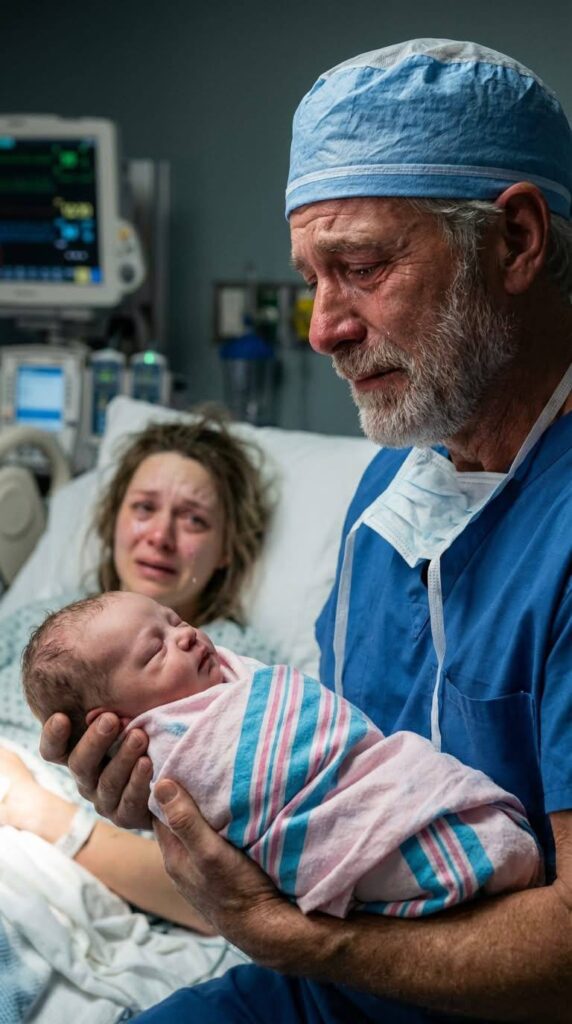
She was about to hand him to me when the door swung open. The attending physician stepped in to sign the final transition forms. He was a man in his late fifties, possessing the kind of quiet, silver-haired authority that commanded instant respect. His name tag read: Dr. Richard Salazar.
He took the chart, his movements fluid and professional. He walked toward the bassinet to perform the initial assessment. He looked down at my son.
And then, the world stopped turning.
The doctor’s hand froze mid-air. The clipboard slipped from his fingers, clattering loudly against the linoleum floor. The color drained from his face, leaving him looking like a ghost in a lab coat. His eyes—those calm, clinical eyes—suddenly welled with a grief so profound it seemed to pull the oxygen out of the room.
“Doctor?” the head nurse asked, her voice laced with sudden alarm. “Dr. Salazar, are you alright?”
He didn’t hear her. He was staring at my son’s face—the slope of the nose, the curve of the lip. And then his gaze fixed on a spot just below the baby’s left ear. A tiny birthmark, shaped like a cinnamon-colored crescent moon.
My heart hammered against my ribs. A cold, familiar dread began to coil in my stomach. “What’s wrong?” I choked out, trying to sit up. “What’s wrong with my baby?”
Dr. Salazar turned to me. His face was a mask of shattered composure.
“Where is the father?” he whispered, his voice sounding like it was being dragged over broken glass.
He saw it. He saw the ghost in the cradle.
Chapter 2: The Ghost in the Room
The air in the delivery room turned frigid. I felt a defensive fire rise in my chest, the same fire that had kept me alive in that lonely studio apartment.
“He isn’t here,” I snapped, my voice trembling with exhaustion and fear. “He hasn’t been here for months. Why does that matter? Tell me what is wrong with my son!”
Dr. Richard Salazar didn’t move. He looked at me with a sadness so ancient it felt like it belonged in a cathedral. “I need his name,” he said. “Please. I am not asking as a doctor. I am asking as a man who has been looking for something for a very long time.”
I hesitated, my hand instinctively reaching for the baby. “His name is Ethan Salazar.”
The silence that followed was absolute. It was the kind of silence that precedes an avalanche. Dr. Salazar closed his eyes, and a single, heavy tear tracked through the deep lines on his face.
“Ethan Salazar,” he repeated, the name sounding like a prayer and a curse. “He is my son.”
I felt the room tilt. The white walls seemed to pulse. No. This was a trick. A hallucination brought on by the pain. But as I looked at the man standing at the foot of my bed, I saw the impossible truth. He had Ethan’s brow. He had the same way of holding his shoulders—though the doctor carried weight where Ethan carried only the wind.
“No,” I whispered. “Ethan never mentioned a father. He never mentioned anyone.”
“Because he wanted to be a ghost,” Richard said, finally sinking into a chair as if his legs had turned to water. “We had a fight two years ago. A brutal, ego-driven collision. He felt he couldn’t live up to the ‘Salazar legacy.’ He thought I was a tyrant; I thought he was a dreamer with no spine. He walked out and erased us. He didn’t even come back when his mother passed away.”
He looked at the baby again—his grandson. “My wife, Margaret, died eight months ago. She spent her final days looking at the door, waiting for a son who never came. She had a birthmark just like that. She called it her ‘little moon.’”
I looked down at the bundle in my arms. The baby had fallen asleep, oblivious to the fact that his arrival had just detonated a landmine of family secrets. I saw the “Salazar nose” now. I saw the legacy I had unknowingly carried in my womb while I was scrubbing floors and counting pennies.
“He left me,” I said, my voice hardening. “He left me the night I told him. He didn’t care about a legacy. He cared about running.”
Richard looked at me, his gaze moving from my tired eyes to my chapped hands. He saw the reality of my last nine months without me having to say a word.
“He ran from the finest thing he ever had,” Richard said softly. “But he didn’t run far enough.”
He stood up, his professional mask slowly clicking back into place, though his eyes remained raw. “You have no one else? No family in the city?”
“I have myself,” I said firmly. “That has been enough so far.”
Richard shook his head slowly. “Not anymore. That child is a Salazar. And whether you want me there or not, I am not letting another generation of my blood vanish into the shadows.”
He walked to the door, paused, and looked back at me. “I will find him. And then, I will bring him to the only thing that might actually save his soul.”
The hunt had begun, but I didn’t know if I wanted the prey to be caught.
Chapter 3: The Price of Redemption
The three weeks following the birth were a blur of sleep deprivation and the strange, haunting presence of Dr. Richard Salazar. He didn’t intrude, but he was always there. He made sure I had the best postnatal care. He sent a car to take me home. He even had a high-end crib delivered to my cramped apartment.
I wanted to refuse. My pride was a suit of armor I wasn’t ready to take off. But every time I looked at Matthew—I had named him after my father, but gave him the middle name Salazar as a bridge I wasn’t sure I wanted to cross—I knew I couldn’t let him suffer for my ego.
Meanwhile, Richard was a man possessed. He used every resource, every contact, and every ounce of his investigative will to track his son.
He found him in a dive motel on the outskirts of Austin.
Richard told me about it later. He didn’t go with the police or a lawyer. He went as a father. He found Ethan in a room that smelled of stale beer and regret, working a dead-end job at a warehouse, hiding from the world in plain sight.
Richard didn’t yell. He didn’t throw punches. He simply sat at a plastic table and placed a photograph in front of his son.
It was a photo I had taken of Matthew. He was yawning, his tiny fists curled like rosebuds.
“His name is Matthew,” Richard had said, his voice steady. “He has your mother’s nose. And he has a mother who worked herself to the bone to keep him alive while you were hiding in this hole.”
Ethan had stared at the photo for five minutes without moving. His face, Richard said, didn’t break all at once. It cracked slowly, like ice under a heavy sun.
“I can’t go back,” Ethan had whispered. “I’m not like you, Dad. I’m not strong. I’m a coward. I’ll just fail them.”
“Being a father isn’t an innate talent, Ethan,” Richard replied. “It is a choice you make every morning when you wake up. You chose to be a coward for seven months. Now, you can choose to be something else. Or you can stay here and wait for the rest of your life to rot away.”
Richard left an address on the table. My address.
“Your mother died waiting for you,” Richard said, his voice finally breaking. “Don’t make this girl and that baby wait for a ghost that doesn’t exist.”
Two days later, there was a knock at my door.
I knew it was him. I could feel it in the air—the sudden shift in atmospheric pressure that happens when the past finally catches up to the present. I opened the door, and for the first time in nearly a year, I looked into the eyes of the man who had shattered my world.
He looked terrible. He was thin, his eyes bloodshot, his clothes wrinkled. He held a small, cheap stuffed bear in his hands as if it were a holy relic.
“Clara,” he said. The way he said my name… it didn’t sound like the charming boy I had met in a coffee shop. It sounded like a man who had just crawled out of a wreck.
“I don’t deserve to be here,” he whispered.
I looked at him, and I felt the old anger—the hot, white flame of abandonment. I wanted to scream. I wanted to slam the door and bolt every lock.
“No,” I said, my voice cold and clear. “You don’t.”
He stood there, waiting for the sentence I was about to pass.
Chapter 4: The Grip of the Innocent
Silence stretched between us in the hallway, heavy and suffocating. Ethan Salazar looked like he wanted to bolt. The “flight” instinct was written in the twitch of his jaw and the way his heels were already pivoted toward the stairs.
But then, from the crib in the corner of the room, Matthew made a sound. It wasn’t a cry. It was a soft, inquisitive coo—the sound of a life that knew nothing of debt, or shame, or the wreckage of the adults who had created him.
Ethan’s gaze shifted past me, into the room. His eyes landed on the crib.
I stepped aside. Not because I had forgiven him. Forgiveness is a long, arduous journey, and we hadn’t even left the trailhead. I stepped aside because I realized that my son was not a weapon to be used against his father. He was a human being who deserved to see the man who shared his blood.
Ethan walked in with the hesitant, trembling steps of someone walking onto a frozen lake. He approached the crib and looked down.
He didn’t touch him at first. He just stood there, his breath hitching in his chest. Then, with a hand that shook visibly, he reached out and extended two fingers.
Matthew, in the divine randomness of infancy, reached up and closed his entire fist around Ethan’s index finger.
The grip of a baby is a terrifying thing. It is unconditional. It is absolute. It is a contract signed in skin and bone.
Ethan collapsed. He didn’t fall to the floor; he just buckled at the waist, burying his face in his free hand while his other finger remained trapped in the baby’s grasp. He started to sob—not the loud, dramatic wails of someone seeking attention, but the silent, racking shudders of a man who realized exactly what he had tried to throw away.
“I’m sorry,” he choked out into the quiet room. “I’m so sorry, Clara.”
I stood by the window, watching the sun set over the San Antonio skyline. I felt a strange, hollow peace.
“Being sorry is easy, Ethan,” I said, not turning around. “Anyone can be sorry. Staying when it’s hard—that’s the only thing that counts.”
“I’m staying,” he said, his voice thick. “I don’t care if you never speak to me. I don’t care if I have to sleep on the street outside this door. I’m not leaving him. I’m not leaving you.”
Behind him, in the shadows of the doorway, I saw Dr. Richard Salazar. He had followed his son, but he remained in the hall, a silent guardian of the reconciliation he had engineered. He caught my eye and gave a single, slow nod.
He had brought the prodigal home. But I knew the real work was only just beginning.
The door was open, but the shadows were still long.
Chapter 5: The Slow Alchemy of Time
The next year was not a fairy tale. It was a construction site.
There is a common myth that love is a feeling. It’s not. Love is a discipline. It’s a series of mundane, often exhausting choices made when you’d rather be doing something else.
Ethan moved into a small apartment three blocks away. He didn’t ask to move back in with me, and I didn’t offer. We needed a buffer zone—a demilitarized space where we could learn to be parents without the toxic weight of our failed romance.
He got a job at a local print shop, working the early shift so he could come over in the afternoons to watch Matthew while I finished my degree. Dr. Richard Salazar became a fixture in our lives. He was the grandfather who brought organic squash puree and unsolicited medical advice. He was the man who taught Ethan how to change a diaper without panicking, and how to hold a child so their head was always supported.
But more than that, Richard and Ethan began the long, agonizing process of dismantling their own history. I would often sit in the kitchen, studying for my exams, while the two Salazar men sat in the living room with Matthew. They talked about things they should have said a decade ago. They talked about Margaret. They talked about the “legacy” not as a burden of excellence, but as a commitment to showing up.
One evening, Ethan was sitting on the floor, letting Matthew climb over his shoulders. He looked up at me, his face fuller now, the hollow look of the Austin motel finally gone.
“My father wants to take us to the coast this weekend,” he said. “To the house my mom loved.”
I paused, a highlighter held over my textbook. “Is that what you want?”
“I want us to be a family,” he said. He didn’t say it with the desperation of a man trying to fix a mistake. He said it with the quiet certainty of a man who had finally found his footing.
“We are a family, Ethan,” I said. “We’re just a complicated one.”
He stood up and walked toward me. He stopped just outside my personal space—a boundary he had learned to respect. “Clara, I know I broke the world once. I know you don’t need me to survive. You proved that. You’re the strongest person I’ve ever met.”
He reached into his pocket and pulled out a small, velvet box.
My heart didn’t flutter. It stayed steady. I wasn’t the girl in the coffee shop anymore.
“Don’t,” I said softly.
“Just listen,” he pleaded. He opened the box. Inside was a simple gold band. No diamond. No flash. Just a circle of honest metal. “I’m not asking you to marry the boy who ran away. I’m asking you to consider, someday, the man who stayed.”
I looked at the ring, then up at him. I saw the growth. I saw the influence of Richard’s steadiness and the softening effect of Matthew’s love. But I also saw the scars.
“I’ve been forgiving you one day at a time, Ethan,” I said. “Some days I’m at eighty percent. Some days, when I’m tired and the bills are high, I’m at ten percent.”
“I’ll take the ten percent,” he said. “I’ll work for the rest.”
I didn’t take the ring. Not that night. I closed the box and pushed it back toward him. “Keep it. Keep it as a reminder of what you’re working for. When I’m ready to say yes, it won’t be because I need a husband. It will be because I want you.”
He nodded, tears glimmering in his eyes. He didn’t argue. He just accepted it.
The revolution was almost complete.
Chapter 6: The Legacy of the Staying
Two years after that cold Tuesday morning at St. Gabriel Medical Center, I stood in the same hospital lobby.
I wasn’t there as a patient this time. I was there as the new Assistant Administrator of the clinic. I had my degree, I had my career, and I had my dignity.
I watched through the glass doors as a car pulled up. Ethan got out, followed by a toddler with a mess of dark curls and a defiant stride. Behind them, Richard Salazar climbed out, looking older but remarkably more vibrant than the day we met.
Matthew saw me through the glass and broke into a run. “Mama!”
I knelt down, catching the thirty-pound bundle of energy in my arms. I looked up to see Ethan watching me. He was wearing a clean button-down shirt, his hands no longer trembling. He looked like a man who knew exactly where he belonged.
Richard walked up and placed a hand on his son’s shoulder. It was a gesture of simple, unadorned affection—the kind that had been missing for two generations.
“Are you coming to dinner?” Richard asked me. “I’m making Margaret’s roast recipe. I’ve finally perfected the sauce.”
I looked at the three of them—the grandfather, the father, and the son. A lineage that had been on the verge of extinction, saved by a girl with a faded sweater and a broken heart.
I didn’t need them to save me. I had saved myself. I had scrubbed the floors, I had survived the labor, and I had built the life. But as I looked at Ethan, I realized that while I didn’t need him, I finally, truly, wanted him.
I reached out and took Ethan’s hand.
“Yes,” I said. “We’re coming home.”
We walked out of the hospital together. The air was warm this time, the Texas sun golden and wide.
I used to think that the most important part of a story was the ending. I was wrong. The most important part is the staying. It’s the long, quiet middle where the healing happens. It’s the choice to keep the door open just wide enough for grace to slip through.
As we walked toward the car, Matthew stopped to look at a bird on the pavement. He pointed his small finger, the one that had once trapped his father in a motel room of the soul.
“Look, Daddy!” he chirped.
Ethan knelt beside him, his eyes bright with a future he finally deserved. “I see it, Matty. I see everything.”
I looked back at the hospital one last time—the place where Dr. Richard Salazar had wept over a cinnamon birthmark. The place where my life had ended and begun in the same breath.
I wasn’t Clara Morales, the victim of abandonment. I was Clara, the architect of a new legacy. A legacy of people who don’t run. A legacy of people who stay.
And as the sun set over San Antonio, I knew that for the first time in my life, the fractures were finally, beautifully, healed.
The End