
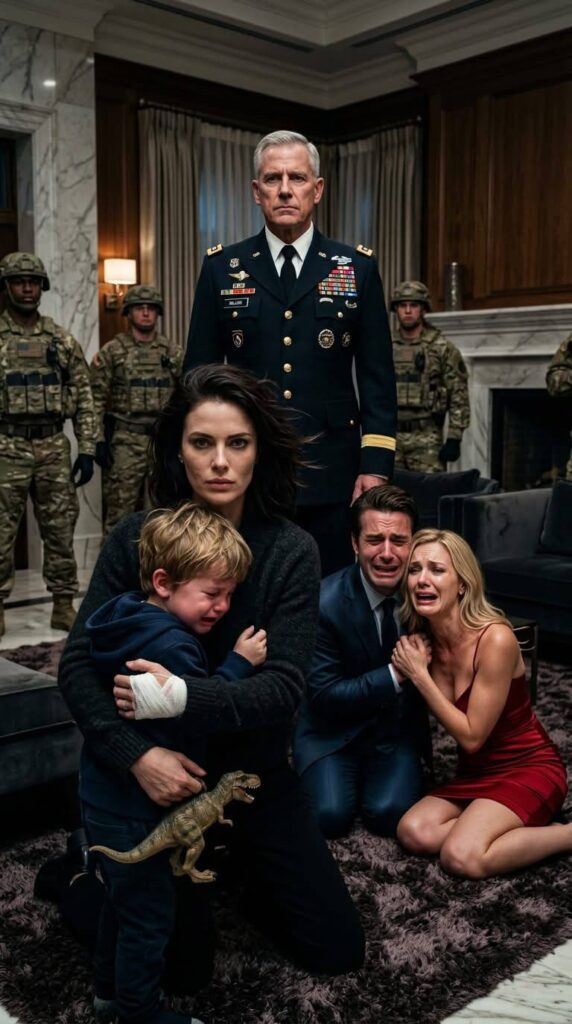
The Kevlar vest chafed against my ribs, a dull, persistent ache that I welcomed. It grounded me. It was the only real thing hidden beneath the suffocating layers of my beige, tailored trench coat. I stood in the foyer of my own home in Bethesda, Maryland, breathing in the scent of lemon Pledge and vanilla diffusers, trying to shed the psychic weight of a three-week manhunt in Eastern Europe. To the world, and to the man sitting in the living room, I was Elena Vance, a “Special Consultant” for a mid-tier logistics firm, returning from yet another soul-crushing barrage of boring corporate audits.
Mark, my soon-to-be ex-husband, didn’t even look up from the glowing screen of his smartphone. He sat slumped on the expensive linen sofa I had picked out, perfectly comfortable in the wreckage of our marriage.
Promoted Content
“Back from the spreadsheet wars?” he asked, his voice dripping with that specific brand of suburban boredom I had come to despise. He didn’t ask how the flight was. He didn’t ask if I was exhausted.
Before I could answer, a woman walked out of my kitchen. Tiffany. She was wiping her manicured hands on a floral apron that belonged to me, her blonde hair pulled into a messy bun that was carefully constructed to look effortless. Mark had moved his new girlfriend into the house the moment I filed the divorce papers, weaponizing my deployment schedule against me in family court. A boy needs a present female figure, his lawyer had argued.
“Oh, Elena! You’re back,” Tiffany chirped, her tone coated in a saccharine sweetness that made my teeth ache. “You missed Leo’s first finger-painting. It’s a shame your ‘consulting’ takes priority over his milestones. But don’t worry, I’ve got everything under control here. I’m the one he calls for now.”
I didn’t argue. I didn’t take the bait. I simply looked past her to the corner of the room. My three-year-old son, Leo, was sitting on the rug, unusually quiet. He was clutching a plastic Stegosaurus tightly against his chest, but he was only using his left hand. His favorite red fire truck, the one he normally never let out of his sight, sat untouched three feet away.
Something is wrong. The instinct wasn’t maternal panic; it was the cold, prickling sensation at the base of my skull that had kept me alive in Kandahar and Kyiv.
I dropped my overnight bag—which contained a disassembled SIG Sauer and three encrypted hard drives—and walked over to him. “Hey, bug,” I whispered, dropping to one knee.
When I reached out to ruffle his messy brown hair, he flinched.
It was just a fraction of an inch. A microscopic tightening of his shoulders. But to me, it felt like a seismic shift that cracked the foundation of my world. My son didn’t flinch. Not from me.
“He’s just tired,” Tiffany sighed dramatically, walking over to usher him away. “Come on, Leo, time for your nap. Your mother needs to unpack her briefcases.”
As Tiffany placed a hand on the back of his neck to guide him toward the hallway, the collar of his t-shirt slipped down. I froze. There, at the base of his hairline, was a small, dark, purplish smudge. It wasn’t dirt. It looked suspiciously like a thumbprint. But before I could close the distance, the heavy oak door of his bedroom slammed shut, echoing through the house like a gunshot.
Two hours later, the house was quiet. Mark had left for the gym, and Tiffany was barricaded in the master bedroom, scrolling through social media. I took the opportunity to draw a warm bath for Leo. I needed to see. I needed to know.
The bathroom filled with steam, smelling of lavender baby wash. I knelt beside the porcelain tub, my heart hammering a heavy, erratic rhythm against my ribs. “Okay, bug,” I said softly, forcing a smile I didn’t feel. “Let’s get this shirt off.”
Leo whimpered. He actively resisted raising his right arm. Gently, moving with the precision of a bomb technician, I eased the fabric over his head. As the warm water hit his right arm, he let out a sharp, high-pitched cry that shattered the silence of the house.
I stopped breathing.
I carefully turned his small arm over in my hands. The wrist was swollen to nearly twice its size, twisted at a sickening, unnatural angle. And there, blooming across his tiny, fragile shoulder like a dark rot, were four distinct, purple fingerprint bruises. A brutal, crushing grip.
A shadow fell over the bathroom doorway. Tiffany leaned against the frame, holding a glass of Pinot Noir, an amused smirk playing on her lips.
“He’s just being dramatic, Elena,” she said, taking a casual sip. “He fell off the couch yesterday because you weren’t here to watch him. He’s been faking that ‘limp’ arm all day to get attention. You’d know that if you weren’t always at ‘meetings’ in DC.”
I didn’t scream. I didn’t launch myself across the tiled floor and wrap my hands around her throat, even though my muscles screamed for violence. My internal temperature plummeted. The frightened, guilty mother evaporated, replaced instantly by the operative. I entered Intel Mode. The world slowed down. The angle of her stance, the slight dilation of her pupils, the forced nonchalance—she was lying, and she was enjoying it.
I didn’t even look at her. I pulled a heavily modified, matte-black smartphone from my pocket. It didn’t connect to commercial cell towers. It routed directly to a satellite in low Earth orbit. I dialed a secure, twelve-digit encrypted line.
“Dad?” I said. My voice wasn’t my own; it was a frozen blade. “It happened. Code Sierra. My house. Ten minutes.”
On the other end of the line, General Thomas Harrison, the former head of JSOC and current director of a clandestine intelligence apparatus that didn’t officially exist, didn’t ask a single question. He just breathed out a heavy sigh. “Units are moving. Stand by.”
I hung up. Tiffany threw her head back and laughed, the sound bouncing off the tiled walls.
“Oh, my god, you are pathetic,” she mocked, swirling her wine. “‘Code Sierra’? Are you calling Daddy to come yell at me? You really are a joke, Elena.”
She was so busy gloating that she didn’t feel the sudden, rhythmic vibration in the floorboards. She was completely unaware that the low, thrumming hum rattling the frosted glass windows wasn’t a passing summer storm. It was the synchronized rotors of a low-flying, radar-evading transport chopper, accompanied by a fleet of blacked-out SUVs tearing down our quiet suburban street.
The front door didn’t open. It was violently removed from its hinges, the reinforced steel lock snapping like brittle plastic.
Six men in pitch-black tactical gear, their faces obscured by balaclavas and panoramic night-vision goggles, flooded the living room in perfect, terrifying silence. They moved like liquid shadow. Mark, who had just walked through the back door from the gym with a protein shake in his hand, was instantly pinned against the drywall by a man twice his size. His face drained of all color, the plastic shaker cup clattering to the hardwood floor.
“What is this?!” Mark shrieked, his voice cracking in absolute terror. “Elena, what’s happening? Tell them to stop!”
I ignored him. I walked past the operators and into my “home office.” I pushed the heavy mahogany bookshelf aside, exposing a biometric scanner embedded in the wall. I pressed my thumb against the glass. The wall clicked and slid open, revealing a steel cache. I bypassed the stacks of foreign currency and passports, pulling out a sleek, black tablet and a compact 9mm sidearm, which I smoothly holstered at my hip.
When I returned to the living room, my posture was entirely different. The beige trench coat was gone. I was lethal, predatory, and totally in command.
General Harrison stepped through the ruined threshold, his four-star retired insignia pinned discreetly to his dark bomber jacket. He looked around the room with utter disgust before his eyes landed on Tiffany, who was now backed into a corner, screaming hysterically about calling the police and demanding her rights.
“Your ‘rights’ ended the millisecond you laid a hand on my grandson,” the General barked, his voice like grinding stone.
I tossed the digital dossier onto the glass coffee table. It landed with a heavy smack.
“Tiffany Miller,” I said, my voice cutting through her shrieks. “Real name: Sarah Vance. No relation to us. Born in Portland. Three counts of aggravated assault on minors in Oregon, all erased from the public record by a corrupt uncle in the District Attorney’s office.”
Tiffany stopped screaming. Her jaw dropped, her eyes darting frantically around the room, realizing she was utterly trapped.
“You thought I was away on business?” I took a slow step toward her. “I was in Langley, Sarah. I spend my entire life tracking down people who think they can hide in the dark. I hunt monsters for a living. And you just walked into the center of my spiderweb.”
A heavy silence fell over the room, broken only by Mark’s pathetic whimpering against the wall. Then, my lead tech operator, a man named Kozlov, looked up from his glowing monitor.
“Ma’am,” Kozlov said, his voice tight. “We just ripped the data off her burner phone. She wasn’t just playing ‘the girlfriend’ to get a free ride.” He turned the screen toward me. “She was sent here. Someone paid her a lot of money to get close to your family.”
The interrogation didn’t happen in a windowless room at a black site. It happened in my kitchen, beneath the warm glow of the farmhouse pendant lights I had installed two summers ago.
I sat across from Tiffany at the marble island. The floral apron was gone. Her wrists were securely bound with heavy-duty zip-ties, her hands trembling violently on the countertop. The suburban camouflage had been entirely stripped away, leaving only a terrified, broken asset.
“Who paid you?” I asked. My voice was a calm, terrifying whisper. I didn’t raise my tone. I didn’t need to.
“I don’t know what you’re talking about!” Tiffany spat, though tears of absolute panic were streaming down her cheeks. “Mark loves me! You’re a psycho! You can’t do this!”
I leaned in, slowly clicking a ballpoint pen. Click. Clack. The sound echoed in the silent kitchen.
“Mark,” I began, gesturing vaguely toward the living room where my husband was currently sitting on the floor under armed guard, crying into his hands, “is a weak, oblivious man who likes pretty things and the path of least resistance. He didn’t notice the faint needle marks between your toes. He didn’t notice the way you researched my deployment schedule on an encrypted browser. But I see everything, Sarah.”
I pulled a glossy photograph from a folder and slid it across the marble.
“I see the offshore wire transfer from a shell company in Cyprus. That company is owned by Anton Varga, a human trafficker I put in a maximum-security Belgian prison three months ago. You weren’t here for Mark. Mark was just an easy, pathetic mark. You were here to break my son’s spirit. You were here to hurt him just enough to shatter me.”
Tiffany looked at the photograph of Varga. Her eyes widened so far I thought the vessels might burst. All her bravado, her arrogant sneers, her condescending stepmother routine—it all vanished into a pool of pure, primal terror. In that exact moment, looking into my dead, unblinking eyes, she realized I wasn’t going to call the local police. I was the person the police called when they were out of their depth.
“If… if I tell you everything,” Tiffany whispered, her voice cracking, her entire body shaking like a leaf in a hurricane. “Will you keep me away from them? They told me… they told me if I failed, they’d come for me next. They’ll kill me, Elena.”
I smiled. But there was no warmth in it. It was the smile of a wolf baring its teeth.
“That depends entirely,” I said softly, leaning closer, “on how fast you talk.”
Six weeks later, the house was quiet again, but it was a different kind of quiet. A peaceful one.
The splintered, broken front door had been replaced by a custom-built, reinforced steel core door that looked like mahogany but could stop a .50 caliber round. Mark was gone. He was currently living in a damp, miserable studio apartment in a terrible part of Baltimore, crushed beneath a mounting pile of legal fees and a court-mandated, ironclad restraining order that kept him exactly five hundred yards away from the son he had utterly failed to protect.
I sat on the floor of the sunlit playroom, the warm afternoon light pouring over the rug. Leo was sitting across from me, his small brow furrowed in concentration. He reached out with his right hand—now completely healed and out of the pediatric cast—and grabbed his red fire truck. He zoomed it across the patterned carpet, making a loud, joyful “vroom” sound.
He looked up at me, flashing a wide, gap-toothed grin that reached all the way to his eyes for the first time in months. A profound, aching warmth flooded my chest, washing away the lingering ice of the past six weeks.
General Harrison stood in the doorway, a mug of black coffee in his hand. He watched Leo for a moment before looking at me.
“The Cyprus lead is dead,” my father said, his voice low, strictly professional. “Varga’s network is dismantled. The accounts are frozen, and Sarah Vance is currently sitting in a subterranean federal facility where the sun doesn’t shine and her handlers will never, ever find her. You’re clear, El. Operations wants to know… do you want back in the field? We have a situation in Bogota.”
I looked at Leo. I watched the way his small fingers gripped the plastic ladder of the truck. Then, I looked back at my father. I picked up a plastic blue sedan and rolled it toward my son.
“I think I’m going to stay home for a while, Dad,” I said quietly. “I’ve missed too many finger-paintings. But…” I paused, my eyes hardening just a fraction. “I’m keeping my clearance. And I’m keeping my access to the network. I want to be the one who sees them coming next time.”
My father nodded slowly, understanding the compromise. He turned to leave, but before he could cross the threshold, my encrypted phone on the shelf pinged with a harsh, restricted notification tone.
I stood up and grabbed the device. It was an anonymous message. Attached was a high-resolution photograph. It was a picture of me and Leo at the local park, taken just yesterday from a significant distance, likely from a telephoto lens in a parked vehicle.
Beneath the photo was a single line of text: “You can’t stay home forever, Commander.”
The Maryland sun was blindingly warm. Exactly one year later, I stood on the manicured lawn of Leo’s preschool, watching him—now an energetic four-year-old—run through the grass in a miniature graduation cap and gown.
I wore a flowy, yellow floral dress and oversized designer sunglasses. To the casual observer, I was just another affluent suburban mother attending a Tuesday morning ceremony.
A woman approached me, a new neighbor who had just moved in down the street. She balanced a toddler on her hip and offered a bright, friendly smile.
“Hi, I’m Jessica,” she said. “I heard from some of the other moms that you used to travel a lot for work. Corporate logistics, right? Do you ever miss the excitement of the road?”
I watched Leo run up to his favorite teacher and give her a massive hug, his right wrist strong, agile, and completely free of pain. As I smiled at the sight, I casually adjusted my purse on my shoulder. I felt the heavy, reassuring weight of the small, encrypted GPS transmitter and the compact Glock 43 hidden in a specialized, breakaway compartment. It was a habit I’d never break. The world was full of wolves, and I refused to be a sheep ever again.
“Not at all, Jessica,” I replied, turning my gentle smile toward her. “I realized that the most critical intelligence missions happen right here. Making sure the world is safe enough for him to just… play with his trucks. That’s the only ‘work’ that actually matters.”
Jessica beamed, completely oblivious to the layers of truth in my statement. “That’s so sweet!” she said, before wandering off to find her husband.
As the ceremony ended, I took Leo’s hand and we walked toward our car. Out of the corner of my eye, through the dark tint of my sunglasses, I noticed a black, unmarked sedan parked illegally about a block away. Its engine was idling. The windows were limo-tinted.
I didn’t panic. My pulse didn’t even elevate. I simply tapped the face of my smartwatch twice, sending a silent, encrypted, priority-one GPS ping directly to Kozlov and my father’s Overwatch team. I was a mother, yes. I was present. But I was still the highest-value target they could never, ever hit.
I strapped Leo into his car seat, kissing his forehead. As I climbed into the driver’s seat and put the car in drive, Leo looked at me in the rearview mirror, his eyes wide with innocent curiosity.
“Mommy,” he asked, kicking his little feet against the seat, “are we going on a ‘trip’ soon? Like an airplane trip?”
I winked at him in the mirror, my hands gripping the leather steering wheel. “Only the fun kind, Leo. Only the fun kind.”
As we pulled away from the curb and drove down the sunlit, tree-lined street, the black sedan threw itself into gear to follow us. But before it could clear the intersection, two massive, unmarked black SUVs roared out of a blind alley, slamming on their brakes and completely cutting the sedan off, boxing it in from both sides.
I didn’t even have to look back to know the threat had been neutralized. I just turned up the radio, and drove my son home.
If you want more stories like this, or if you’d like to share your thoughts about what you would have done in my situation, I’d love to hear from you. Your perspective helps these stories reach more people, so don’t be shy about commenting or sharing.