
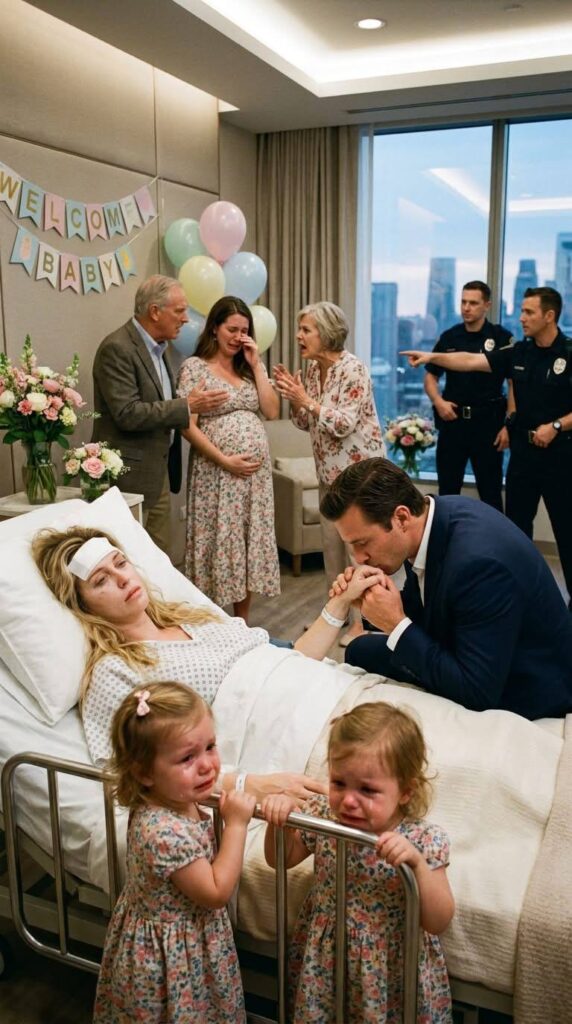
The Silent Covenant: A Chronicle of My Resurrection
My name is Holly Crawford, and at twenty-six years old, I learned that the most profound betrayal doesn’t always sound like a shout. Sometimes, it sounds like the rhythmic, hollow ringing of a phone that no one intends to answer.
They say that when you face death, your life flashes before your eyes. That’s a lie. When I was dying on a linoleum floor at 2:14 a.m. on a sweltering Thursday, I didn’t see my childhood or my first heartbreak. I saw the digital display of my smartphone—a glowing rectangular tombstone—showing seventeen unanswered calls to the people who were supposed to love me most.
This is the chronicle of my own quiet coup d’état—the moment I realized that blood is merely a biological fact, whereas family is a deliberate, sacrificial action.
Chapter 1: The Scythe of Midnight
The pain didn’t arrive with a warning. It didn’t tap me on the shoulder or whisper a threat. It struck like a rusted scythe, swinging through the dark and lodging itself firmly in my lower right side.
All evening, I had played the game of denial. It’s just indigestion, I told myself, clutching a cup of peppermint tea. Maybe I pushed too hard at the gym. But by 2:00 a.m., the denial evaporated, replaced by a primal, lizard-brained terror. I wasn’t just hurting; I was being dismantled from the inside out.
I tried to stand, but my legs were made of salt. I collapsed, my knees hitting the hardwood with a thud that echoed through the empty apartment. I began to crawl—a slow, agonizing shuffle toward the kitchen, my breath coming in shallow, ragged gasps that tasted like copper. I was sweating through my shirt, the fabric clinging to me like a cold second skin, and as I gripped the edge of the kitchen island, I caught my reflection in the oven door. I looked like a ghost that hadn’t realized it was dead yet.
With trembling fingers, I reached for my phone on the counter.
Call: Mom.
The ringing was rhythmic, mocking. One. Two. Three. Four.
“You’ve reached Eleanor Crawford. Leave a message after the beep.”
I didn’t leave a message. I called again. And again. Then I tried my father, David Crawford.
“You’ve reached David. I’m either away from my desk or on the other line…”
I was lying flat on the floor now, the cold tile pressed against my cheek. I left three voicemails. In the last one, my voice was a broken rasp, a sound I didn’t recognize as my own. “Dad… please. Something’s wrong. I’m dying. Please come.”
The silence that followed was the heaviest thing I have ever carried. It was a wall of indifference so thick that no scream could pierce it. I lay there, listening to the hum of the refrigerator, realized that for all the years I had spent trying to be the “perfect” daughter, the “low-maintenance” child, I had succeeded too well. I was so low-maintenance that I had become invisible.
I didn’t hear the ambulance. I didn’t hear Mrs. Patton, my retired neighbor, pounding on my door after hearing my body hit the floor through the thin walls. I only remember the absolute, velvet darkness that swallowed the kitchen.
Chapter 2: The Absolute Silence
They tell me I flatlined.
In the medical theater of St. Jude’s Emergency Center, as the surgeons fought the sepsis blooming in my gut from a ruptured appendix, my heart simply gave up.
There was no tunnel of light. There were no departed ancestors waiting with open arms. There was only a deep, absolute silence—the kind of silence that exists in the spaces between stars. It was peaceful, in a terrifying sort of way. For a brief window of time, I didn’t have to worry about the seventeen missed calls. I didn’t have to wonder why I wasn’t enough to wake my parents from their sleep.
Then, the world shattered.
Clear!
A jolt of lightning slammed into my chest, dragging me back into the agonizing reality of bone and blood. I heard the frantic beeping of monitors, the sharp command of voices, and the sudden, overwhelming sensation of air rushing into lungs that had forgotten how to breathe.
When I finally drifted into a fractured consciousness in the recovery room, the world was a blur of sterile white and the smell of antiseptic. A nurse was adjusting my IV drip. My throat felt like it had been scraped with sandpaper.
“My… my parents?” I croaked, the words barely a whisper.
The nurse, a woman named Clara with kind, weary eyes, paused. She looked at me with an expression that sat somewhere between pity and a simmering, professional anger.
“Someone was called, honey,” she said, her voice carefully neutral. “But let’s wait for Dr. Reeves. He wants to speak with you.”
The wait felt like an eternity. Every tick of the wall clock was a needle prick. When Dr. Reeves finally entered, he didn’t stay by the door. He pulled a chair close to my bed, his face a mask of somber intensity.
“Holly,” he began, “you are very lucky to be breathing. We almost lost you twice.”
I nodded, the weight of the flatline pressing down on me.
“However,” he continued, glancing at the chart in his hands, “there is a matter of your continued care. A woman identifying herself as your mother, Eleanor Crawford, arrived at the hospital roughly three hours ago.”
A spark of hope flickered in my chest. She came. She finally came.
“She attempted to have you discharged,” Dr. Reeves said, his voice dropping an octave.
The spark died. “Discharged? I just had surgery. I died on the table.”
“She was informed of that,” he said, his eyes never leaving mine. “She became quite argumentative with the administrative staff. She insisted that you were ‘always dramatic’ and that she needed you at home because she couldn’t be expected to manage your sister’s baby shower while worrying about you in a hospital bed.”
I felt the room tilt. The ceiling seemed to rush toward me. My mother had stood at the gates of my survival and tried to push me back into the dark because of a baby shower.
“But,” Dr. Reeves said, standing up as the door began to creak open, “the man who ensured you stayed here is waiting to see you.”
Chapter 3: The Quiet Architect
I expected my father. I expected a cousin. Perhaps a repentant aunt.
Instead, a man I had never seen before stepped into the room. He was in his mid-fifties, with a sturdy build and a gray jacket that had seen better days. He didn’t look like a savior. He looked like a man who spent his weekends fixing fences or reading the Sunday paper in a quiet armchair. He had eyes that felt like warm hearths—luminous pools of quiet, steady wisdom.
Dr. Reeves nodded to him with a level of respect usually reserved for chief surgeons and departed the room, closing the door softly behind him.
The stranger sat in the chair, his movements slow and deliberate. He folded his hands over his knees and looked at me. Not with pity, but with a profound, steady presence.
“My name is Gerald Maize,” he said. His voice was a low rumble, the kind of sound that makes you feel safe even when the world is falling apart.
“Who are you?” I whispered, clutching the hospital blanket to my chest. “Why are you here?”
“I was on the fourth floor,” Gerald began quietly. “Visiting my brother. He’s… well, he’s not doing as well as you are. I went down to the lobby to get a coffee around 4:00 a.m. when I heard a woman making a scene at the front desk.”
He paused, a shadow of distaste crossing his features. “She was shouting at a young nurse. She said she was your mother. She was demanding that they bring you down in a wheelchair immediately. She said—and I remember this clearly, Holly—that her other daughter’s ‘big day’ started at ten and she didn’t have time for this ‘crisis’.”
I closed my eyes, a single, hot tear tracking down my temple.
“The nurse told her you were in critical postoperative care,” Gerald continued. “She told her that moving you could literally kill you. Your mother asked if there was a waiver she could sign to ‘override’ the hospital’s authority. She wanted to sign a piece of paper to take you home to a house where no one was watching you, just so she wouldn’t miss a party.”
I couldn’t speak. The betrayal was so absolute it felt like another physical wound.
“I watched her walk out,” Gerald said. “She just… left. She walked out of those sliding doors and didn’t look back. I went to the desk. I asked the nurse what the situation was. She couldn’t tell me much, but she mentioned there was a ‘financial hold’ on your file—something about a gap in your insurance coverage that meant you might be moved to a less intensive facility.”
He leaned forward slightly. “I lost my daughter ten years ago, Holly. To a heart defect. I would have given every cent I had, every drop of blood in my body, for one more hour to sit by her bed. I couldn’t sit by and watch a girl be discarded like a piece of broken luggage.”
“You paid it?” I choked out, the realization hitting me like a physical blow. “You paid my bill?”
“I settled the administrative hold,” he said simply. “It wasn’t a hero’s gesture. It was just… what was right. You needed to stay in that bed. You needed to live.”
I started to cry then—not the soft, cinematic tears of a movie, but the ugly, guttural, broken sobbing of a person whose soul has been cracked open. Gerald didn’t move to hug me. He didn’t tell me to be quiet. He just sat there, a silent, immovable anchor in the storm of my grief.
Chapter 4: The Flowers on the Sill
Later that afternoon, the “Family” finally arrived.
The door swung open with a flourish, and Eleanor Crawford swept in, clutching a designer handbag and looking remarkably refreshed. My father, David, trailed behind her, his arms crossed, looking at the wall as if he were waiting for a bus.
“Oh, Holly,” my mother said, her voice a practiced lilt of motherly concern. “You gave us such a fright! I honestly didn’t hear my phone—it must have been on silent from the theater the night before. You know how it is.”
Seventeen calls. My phone had screamed into the void seventeen times while she slept through the theater of my death.
“We can’t stay long,” she continued, not even sitting down. She began to rearrange the items on my bedside table, her eyes darting around the room. “The baby shower was divine. Your sister looked like an absolute angel. Everyone was asking for you, of course. I told them you had a little ‘tummy trouble’.”
Tummy trouble. I had flatlined. I had been brought back from the absolute silence by strangers, and she called it tummy trouble.
She stopped suddenly, her gaze landing on a vibrant arrangement of lilies and snapdragons sitting on the windowsill. Gerald had left them there before returning to his brother’s room.
“Where did those come from?” she asked, her voice sharpening. “They’re quite expensive.”
“A stranger bought them,” I said. My voice was flat, devoid of the warmth I used to offer her like a tribute.
“A stranger?” She scoffed, a short, sharp sound. “That’s odd. Why on earth would a stranger be involved in your business? People are so intrusive these days.”
My father finally spoke, though he didn’t move from his spot by the door. “We should go, Eleanor. The caterers will be arriving at the house soon to pick up the linens.”
My mother nodded, patting my hand—a gesture that felt like a cold piece of plastic hitting my skin. “Rest up, dear. We’ll call you in a few days. It’s a shame you missed the morning. The mimosas were perfect.”
They stayed for exactly forty-two minutes. In that time, neither of them asked how the surgery went. Neither of them asked about the pain. They left because there was “cleanup” to do.
As the door clicked shut behind them, the fog that had obscured my life for twenty-six years finally lifted. I saw them with a terrifying, crystalline clarity. They weren’t my protectors. They weren’t my foundation. They were just people who happened to share my DNA—people who viewed my existence as a series of obligations that occasionally interfered with their social calendar.
I lay there, staring at the flowers Gerald had left, and I felt a new kind of strength beginning to knit itself together in my chest. It was a silent steel, a quiet resolution.
I was done.
Chapter 5: The Fog Lifts
Gerald visited me twice more before I was discharged. On the third day, he brought his wife, Patricia.
She was a woman who radiated a quiet, earth-mother warmth. She didn’t say much at first; she simply took my hand in hers—her palm warm and calloused—and looked at me with a gaze that said, I see you.
“You have people, Holly,” she said softly, echoing a thought I hadn’t yet dared to form. “You just haven’t met all of them yet. Some family is born in a delivery room, but the best kind is found in the trenches.”
I found out later, through a whisper from Clara the nurse, that Gerald hadn’t just paid the bill. He had gone to the Patient Advocacy Office. He had filed a formal report regarding my mother’s attempt to override medical advice for a non-medical reason. He had ensured that there was a legal paper trail of her negligence, a shield in case she ever tried to exert that kind of control over me again.
He never mentioned it to me. He wasn’t a man who traded in gratitude.
When the day of my discharge finally came, my parents didn’t come to pick me up. My father sent a text saying he was “held up at the club” and that I should call an Uber. “You’re a big girl, Holly. You can handle it.”
I didn’t call an Uber.
I walked out of the sliding glass doors of the hospital to find Gerald’s gray sedan idling at the curb. He got out, took my small bag from my hand, and opened the passenger door.
“Ready to go home?” he asked.
“I don’t think I know where home is anymore,” I admitted, my voice trembling.
He looked at me, his kind eyes steady. “Home isn’t a place you go back to, Holly. It’s the place you build with the people who would never leave you on a kitchen floor.”
As we drove away from the hospital, I looked at my phone. I had three new messages from my mother asking if I could “stop by the dry cleaners” on my way home because she was too tired from the shower weekend.
I didn’t reply. I didn’t get angry. I simply swiped the notification away and blocked the number.
The fog hadn’t just lifted; it had been burned away by the sun. I realized that for twenty-six years, I had been rearranging my worth to fit into the tiny, cramped spaces my parents provided. I had been shrinking myself so they wouldn’t feel the burden of my needs.
But I had flatlined. I had seen the absolute silence. And I was no longer interested in being small.
Chapter 6: The Found Lineage
Recovery was a slow process, but it wasn’t lonely.
Gerald and Patricia became the pillars of my new life. They didn’t replace my parents in a legal sense, but they filled the hollow spaces in my soul with the kind of love that is defined by presence. When I had a fever a week after surgery, it was Patricia who brought over homemade soup and sat with me until my breathing leveled out. When my car broke down, it was Gerald who showed up with a toolbox and a thermos of coffee, no questions asked.
My biological parents were outraged at first. They couldn’t understand why I had stopped answering their calls. They couldn’t understand why I didn’t show up for Sunday dinner to hear more stories about my sister’s “angelic” pregnancy.
“You’re being ungrateful, Holly!” my mother screamed during the one and only time I allowed her to corner me in person. “After everything we’ve done for you! We gave you life!”
“You gave me a birth certificate,” I replied, my voice as calm as the surface of a mountain lake. “But on a Thursday morning at 2:00 a.m., a stranger gave me my life. You tried to take it back for a baby shower. There is no coming back from that, Mom.”
I haven’t spoken to them in fourteen months.
People ask me if I regret it. They say, “But they’re your parents.” They use the word like it’s a magic spell that should negate a lifetime of neglect. I just smile and tell them that I’m busy. I’m busy building a life with the people who show up.
I am fully recovered now. The scar on my side is a faded silver line, a map of the night I almost disappeared. I look at it sometimes in the mirror and I don’t feel pain. I feel triumph.
If this story reached you today, I want you to look at the people in your life. Don’t look at the titles they hold—Mother, Father, Sister, Brother. Look at their hands. Are they holding you up, or are they waiting for you to fall so they don’t have to carry you?
Love isn’t a feeling. It’s not a blood type. It’s a choice made in the dark, in the silence, and in the hospital corridors at 4:00 a.m.
Sometimes, nearly losing your life is the only thing that finally shows you whose hands were never truly holding you to begin with. And sometimes, the most beautiful things in your life are the ones that arrive in a simple gray jacket, bearing a bouquet of lilies and a promise to never let go.
My name is Holly Crawford. I am twenty-seven years old. I have flatlined once, but I have never been more alive.