
Chapter 1: The Hollow Haven
The dashboard clock bled a harsh neon 0300 into the cab of my truck as I finally killed the engine. I sat there in the driveway, my hands fused to the leather steering wheel, letting the deafening silence of rural Pennsylvania sink into my bones. For the last six months, my reality had been defined by the roar of Blackhawks, the crackle of encrypted radios, and the suffocating, omnipresent hum of mortality that never fully retreats in a combat zone. But this quiet was supposed to be my sanctuary. It was supposed to mean my seventh tour was officially history. It was supposed to mean my seven-year-old daughter, Emma, was asleep just a few yards away, dreaming of Saturday morning cartoons under a roof I bled to provide.
My deployment had been abruptly severed three days early due to a sudden geopolitical shift nobody in the dirt had anticipated. I’d grabbed the first transport out of Kabul, survived sixteen sleepless hours of turbulence, pushed through demobilization at Bragg, and immediately drove nine straight hours north. Caffeine and the mental image of Emma’s missing-tooth smile were the only things keeping my nervous system from total collapse.
I was done. Twelve years in the Rangers, and I had already filed my separation papers. This driveway, this blue-shuttered house, was the final destination.
I swung the heavy door open, hauling my canvas duffel over one shoulder. My boots crushed the frosted gravel. But the moment my hand grazed the front doorknob, the primal, reptilian part of my brain—the part that kept me alive in Fallujah and Helmand—flared to life.
The deadbolt was disengaged.
The house wasn’t just quiet; it felt suffocated. Stagnant. I slipped through the foyer, my footfalls completely silent, my combat training hijacking my exhausted body. The air tasted sour, a stale cocktail of fermented grapes and neglected garbage. In the living room, the mail was scattered like dead leaves across the island counter. My wife’s purse lay discarded on the floor, spilling receipts onto the hardwood.
I took the stairs two at a time, drifting like a ghost toward the master bedroom. Brenda was sprawled diagonally across the mattress, still wearing yesterday’s denim and a stained blouse. An empty Merlot bottle lay toppled on the nightstand, a single crimson drop staining the coaster.
My jaw clamped tight. I pivoted, crossing the hall to Emma’s bedroom. The door, plastered with the princess decals we’d bought together, swung open.
My breath caught in my throat. The bed was made with military precision. Her scuffed sneakers weren’t kicked into the corner. Most damning of all, Mr. Hoppers—the threadbare stuffed rabbit she hadn’t slept without since she was a toddler—was completely missing.
I was back in the master suite in three massive strides. I grabbed Brenda’s shoulder and shook her with a force that bordered on violence. She gasped, her eyes fluttering open, bloodshot and entirely unfocused.
“Where is my daughter?” My voice was a flat, lethal monotone. It was the exact cadence I used when an op went sideways and panic was a luxury we couldn’t afford.
Brenda blinked aggressively, trying to scrape the intoxication from her brain. “Eric? What… you’re not supposed to be here.”
“Where. Is. Emma.”
She recoiled, rubbing her temples. “She’s… she’s at my mother’s. I sent you an email. I had work emergencies. Mom’s been watching her since Tuesday.”
My blood turned to ice water. Today was Friday. “Why is a seven-year-old at Myrtle Savage’s compound at three in the morning?”
Brenda wouldn’t meet my gaze. In twelve years of marriage, I had become an expert at decoding human deception. Her hands trembled violently, and it wasn’t just the hangover. It was terror. She looked relieved that I was leaving, not surprised that I had arrived.
I didn’t waste oxygen arguing. When the ambient temperature drops in a warzone, you move first and ask questions when the smoke clears. I bolted down the stairs, ignoring her slurred protests, and threw my truck into reverse. As my headlights sliced through the dense, encroaching pine trees of the mountain road, a sickening realization locked around my throat: the real enemy wasn’t an ocean away. She was waiting at the end of a gravel driveway, an hour out of town.
Chapter 2: The House of Earth and Bone
Myrtle’s property was intentionally isolated, a sprawling, gothic farmhouse hidden deep in the Appalachians. She ran what she dubbed a “spiritual discipline retreat” for troubled youth. I had always called it a profitable grift, but Brenda had fiercely defended her mother.
As my tires aggressively chewed up the long driveway, a cold sweat broke across my neck. The entire property was ablaze with floodlights. Nobody in their right mind illuminates a compound like a prison yard at 4:00 AM unless they are actively hunting, or hiding, something.
I didn’t even knock. I hammered my fist against the oak door until Myrtle threw it open. She stood there, rail-thin and draped in a severe, floor-length nightgown, her silver hair yanked back so tightly it looked painful.
“Eric,” she stated, her face a mask of calculated annoyance. “Brenda just called. You are interrupting a highly structured environment.”
“Where is she.” I stepped forward, forcing her to backpedal into the foyer. The house reeked of industrial bleach, but beneath the chemical burn, I caught the unmistakable, sickly-sweet scent of turned earth and organic decay.
“She is in the backyard for nocturnal reflection,” Myrtle sneered, trying to block the hallway. “Do not disturb the other children. They are learning humility.”
I shoved past her, my shoulder clipping hers, sending her stumbling against the wall. I burst through the kitchen and kicked the back door open. The yard was a massive expanse of manicured lawn bordered by a dense, impenetrable forest.
“Emma!” I roared, the sound tearing through the freezing mountain air.
A tiny, shattered whimper echoed from the darkness near the tree line. I pulled my phone out, thumbing the flashlight on, and sprinted toward the sound. The LED beam swept across the frosted grass and abruptly slammed into a void in the earth.
I froze.
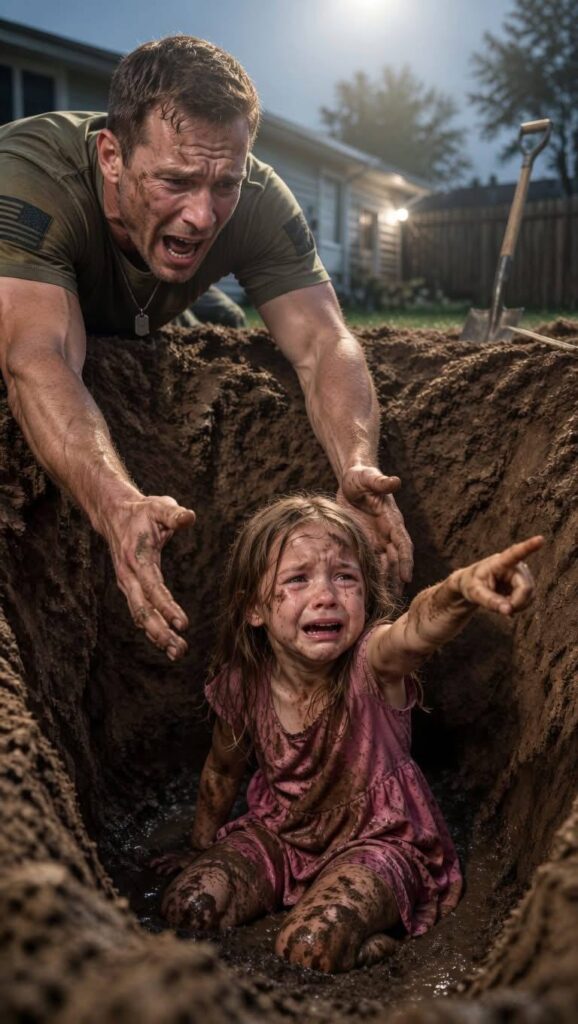
It was a pit. Three feet wide, four feet deep, carved with surgical precision into the clay. And standing at the bottom, shivering violently in soaked, mud-caked pajamas, was my daughter. Her tiny fingers clawed desperately at the dirt walls.
“Daddy?” her voice was a hollow, broken rasp.
I dropped into the hole, pulling her freezing body into my chest. She weighed nothing. She felt hollowed out, vibrating like a tuned string about to snap. I stripped my heavy jacket off and cocooned her in it, whispering frantic, broken promises into her matted hair.
“I’ve got you, baby. I’m here. You’re safe.”
She sobbed into my collarbone, her words coming out in jagged fragments. “Grandma said… she said corrupt girls sleep in graves. She said if I moved, I’d stay down here forever.”
A white-hot, blinding rage detonated behind my eyes. This wasn’t a discipline program. This was psychological torture. I hoisted her out of the pit, preparing to march inside and tear Myrtle Savage apart with my bare hands.
But Emma’s freezing fingers dug into my shirt. “Daddy, please,” she begged, her eyes wide with a terror that no child should ever possess. “Don’t look in the other hole. Please don’t look.”
My flashlight beam swung twenty feet to the left.
Another pit. Larger. Darker. But this one was hastily concealed beneath a layer of rotting plywood boards.
“Close your eyes, sweetheart,” I murmured, my heart hammering a frantic rhythm against my ribs. “Bury your face in my shoulder.”
Holding her tightly with my left arm, I approached the plywood and kicked it aside. The smell hit me like a physical blow—the unmistakable stench of putrefaction. I angled the beam downward.
Resting in the damp soil were small, human bones. A child’s skull. Scraps of a decayed jacket. And glinting in the LED light, a tarnished medical alert bracelet. The name Sarah Chun was stamped into the metal.
The soldier vanished. The father remained, staring into the abyss of absolute evil. I snapped three high-resolution photos of the grave, secured my daughter, and marched back to the house. Myrtle was calmly pouring boiling water into a teacup.
“If you move a single muscle, I will end you,” I promised, my voice a deadly, quiet hiss. I secured Emma in my locked, idling truck, dialed my oldest friend on the local force, Don Gillespie, and told him to bring the state troopers, the FBI, and body bags. Then, I kicked down three locked doors inside the farmhouse, rescuing nine starved, bruised children from windowless cells before the sirens finally pierced the night.
But as I sat on the tailgate of my truck watching the feds drag Myrtle away in handcuffs, Emma whispered something that effectively ended my marriage forever.
“Mommy drove me here,” she cried softly. “She told Grandma I needed to be punished.”
Chapter 3: The Architecture of Betrayal
The hotel suite in town was aggressively bright and warm, a stark contrast to the frozen horrors of the mountain. Emma was finally asleep, sedated by exhaustion and the gentle reassurances of the trauma pediatrician Don had smuggled in. I sat in the armchair by the window, a loaded sidearm resting on the table next to my glowing laptop.
I was pulling every thread I could find on the New Beginnings Spiritual Retreat. The web was horrifying. Desperate forum posts from parents claiming their children came back mute and bruised, only to be ignored by local authorities. A retired county social worker, Christina Slaughter, who had investigated the camp three years ago, found “no evidence of abuse,” and miraculously retired a month later to a sprawling waterfront estate in Florida.
My phone vibrated. It was Derek Mullen, my old spotter from the 75th Ranger Regiment. I had called him hours ago, needing someone who operated strictly outside the chain of command.
“Tell me you found the rot,” I answered.
“It’s deep, brother,” Derek’s voice crackled through the speaker. “Myrtle wasn’t operating alone. The property deed and the parent LLC are co-owned by a guy named Herman Savage. Her brother. He’s a sitting county judge. He handles all the juvenile and family disputes in your district. Every complaint against Myrtle’s camp landed on his desk. He systematically buried them all.”
I closed my eyes. “And the social worker?”
“Herman’s ex-wife. She was taking payouts from a shell corporation connected to the camp. But Eric… there’s a worse detail. I accessed the camp’s financial ledgers. They were charging elite families fifty grand a head. But there’s a recurring expense column. ‘Referral Bounties.’ Five thousand dollars paid out for every new child recruited into the program.”
“Who was the recruiter?” I asked, though the bile rising in my throat already gave me the answer.
Derek paused. “Brenda. Your wife’s signature is on twenty-two distinct wire transfers.”
I didn’t say a word. I hung up the phone, kissed Emma’s forehead, left her under the armed guard of a female officer Don provided, and drove back to the house I used to call home.
Brenda was sitting at the kitchen island, nursing a mug of black coffee, looking haggard. The moment I walked in, she shot to her feet. “Eric, thank God. The police called. They said Mom was arrested? It has to be a misunderstanding. Where is Emma?”
“I pulled her out of a grave at 2:00 AM,” I said, my voice dead. “She was freezing to death in a hole. Just a few yards away from the bones of a nine-year-old girl named Sarah Chun.”
Brenda’s coffee mug shattered against the hardwood floor. All the color drained from her face. “No… no, that’s impossible. Mom said it was tough love. She said the kids who ran away were just making up stories.”
“You sold our daughter for five thousand dollars.”
She flinched as if I had struck her. “What? No! I didn’t take money for Emma! She was just acting out. She wouldn’t eat her vegetables, Eric! She talked back! I was exhausted, and you were halfway across the world, and Mom promised me a few days would fix her attitude.”
“But you took the money for the other twenty-two kids, didn’t you?” I stepped into her space, towering over her. “You manipulated desperate parents into sending their children to a torture facility, and you collected a hundred grand to finance your lifestyle while I was getting shot at.”
“I didn’t know they were dying!” she shrieked, collapsing against the counter. “I swear to God, Eric, I thought she was just scaring them!”
“Pack your bags,” I commanded. “You have exactly ten minutes to leave my property. If you are ever within a hundred yards of my daughter again, I won’t bother calling the police.”
I watched her pack, a pathetic, weeping mess. When her car finally disappeared down the road, the silence of the house returned. But it wasn’t the silence of safety anymore. It was the silence of a battlefield right before the artillery starts falling. Myrtle and Brenda were just the foot soldiers. The real architects of this nightmare—the judge, the elite clients, the lawyers—were still breathing free air. And I was going to systematically suffocate them.
Chapter 4: The Ledger of the Damned
I met Derek in a dingy motel off the interstate at midnight. He had transformed the cheap laminate desk into a cyber-warfare hub. If the FBI was going to build a RICO case through the slow, bureaucratic channels of subpoenas and warrants, I was going to build an insurance policy using brute force.
“Herman Savage has standard residential encryption,” Derek muttered, his fingers flying across the illuminated keyboard. “Arrogant. These untouchable types always think the law is a shield, so they never bother with real cybersecurity.”
“Crack it,” I said, leaning over his shoulder. “I want everything. Bank accounts, offshore routing numbers, emails.”
Two hours later, the firewall collapsed. Derek pulled up the judge’s private cloud server. What we found was a masterclass in bureaucratic sociopathy. Behavioral Solutions LLC—a shell company set up to launder the camp’s blood money. Spreadsheets categorizing the children not by name, but by their “liability rating.”
And then, Derek opened a restricted folder labeled Permanent Solutions.
My blood ran cold. Inside were scanned death certificates for four children, all ruled as tragic accidents or suicides by a corrupt county coroner. Attached to each certificate was a heavily redacted email chain with the children’s parents.
“Eric, look at this,” Derek whispered in horror. “These wealthy families… they weren’t sending their kids here to be disciplined. These kids discovered their parents’ affairs, their corporate embezzlement, their abuse. The parents paid Myrtle a premium to silence them permanently.”
“Print it all. Encrypt the backups.” I grabbed my jacket. “Find the lawyer who registered that shell company.”
By dawn, I was standing inside the aggressively modern Pittsburgh office of Leon Donaghue, a high-powered corporate attorney. He looked up from his mahogany desk, a sneer forming on his perfectly tanned face. “Excuse me, you cannot just barge into my—”
I dropped the Permanent Solutions ledger directly onto his keyboard.
Donaghue’s eyes darted down, and the arrogance evaporated from his face, replaced by a sickening, pale dread.
“You set up the financial plumbing for a child trafficking and murder syndicate,” I stated, pulling up a chair and sitting down uninvited. “You laundered millions for Herman and Myrtle Savage.”
“Attorney-client privilege protects my—”
“Privilege doesn’t cover complicity to murder, Leon,” I interrupted, leaning forward. “The FBI is hitting your office with a federal warrant in exactly three hours. They are going to tear the drywall out looking for your servers. You are looking at a life sentence in a federal penitentiary.”
He swallowed hard, sweat beading on his forehead. “What do you want?”
“I want you to dial the FBI right now. I want you to offer them full immunity in exchange for turning over the entire financial web. Every parent who paid for a murder. Every dirty cop who looked the other way.”
Donaghue’s hands shook as he reached for his desk phone. But as he dialed, my own cell vibrated. It was Agent Morrison, the lead FBI investigator assigned to the case.
“Eric,” Morrison’s voice was strained. “We have a massive problem. Two of the highest-profile parents involved in the Permanent Solutions file—a tech CEO named Carlson and a real estate mogul named Drew—just vanished. They posted a million dollars bail and slipped their ankle monitors. We think they’ve fled the country.”
I looked at Donaghue, who was currently whimpering into his phone to the feds, and I felt a dark, calculated calm settle over me. “They didn’t flee the country, Morrison. They just went off the grid. And I know exactly how to hunt in the dark.”
Chapter 5: The Alaskan Gambit
Derek tracked their financial ghosts to a privately owned, off-grid hunting cabin deep in the Alaskan wilderness. Carlson’s family trust owned a thousand acres of inaccessible tundra, accessible only by bush plane. They thought the vastness of the frozen north would protect them while their high-priced legal teams strangled the prosecution with red tape.
They clearly hadn’t considered what happens when a Ranger decides the justice system is moving too slowly.
Derek and I jumped out of a seaplane ten miles from the coordinates, humping sixty pounds of gear through knee-deep snow and razor-sharp pine forests. The temperature was twenty below zero. The air burned my lungs, but the frozen landscape felt infinitely cleaner than the corrupted courtrooms back in Pennsylvania.
We reached the perimeter of the cabin at 0200 hours. A single plume of smoke drifted from the chimney. Two snowmobiles were parked near the reinforced steel door. They felt untouchable out here.
“Standard breach,” I whispered into the comms mic. “Non-lethal. We don’t want them dead; we want them terrified and talking.”
Derek took the back door; I took the front. On his mark, I kicked the heavy wooden door precisely at the lock mechanism. The frame splintered violently. I surged into the living room, my tactical flashlight blinding the two men who had been drinking expensive scotch by the fireplace.
Carlson scrambled for a hunting rifle leaning against the wall, but I crossed the room in two strides, driving the butt of my sidearm into his sternum. He collapsed, gasping for air. Derek had Drew pinned face-down on the Persian rug, expertly applying zip-ties to his wrists.
I dragged Carlson up by his collar and threw him onto the leather sofa next to his shivering accomplice.
“You’re McKenzie,” Drew stammered, blood trickling from his lip. “The soldier. You can’t do this. We have rights. Our lawyers—”
“Your lawyers are currently being indicted for racketeering,” I interrupted softly, pulling up a chair and sitting directly in front of them. The fire cast long, dancing shadows across their terrified faces. “You sent your own children to a psycho in the woods because they threatened to expose your corporate fraud. You paid for their executions.”
“We had no choice!” Carlson spat, defiant even in defeat. “My son was going to destroy a billion-dollar empire! Do you know how many jobs would have been lost? It was a necessary sacrifice!”
I stared at him, marveling at the bottomless depth of his delusion. “There is always a choice. And now, I’m giving you yours.” I tossed a satellite phone onto Carlson’s lap. “You dial Agent Morrison. You dictate a full, unconditional confession, waiving your right to an attorney. You agree to testify against Herman Savage and every other parent in that ledger. If you do that, maybe you avoid lethal injection.”
“And if we refuse?” Drew sneered. “You’re going to shoot us out here? You’re a supposed hero. You won’t execute unarmed men.”
I leaned in closer. The smell of their fear was intoxicating. “You’re right. I won’t execute you. But we are a hundred miles from civilization. I will shatter both of your kneecaps, strip you to your underwear, and leave you outside in the snow. I will let the Alaskan wilderness deliver the justice the courts are too cowardly to enforce.”
The silence in the cabin stretched out, heavy and suffocating. Carlson looked at the dark windows, then at the frozen steel of my eyes. He knew I wasn’t bluffing.
With trembling, blood-stained hands, Carlson picked up the satellite phone and dialed the FBI. We waited until the federal extraction choppers breached the horizon before Derek and I melted back into the tree line, leaving the monsters to the mercy of the law. But as I watched them get loaded into the belly of the helicopter, a cold truth settled in my gut: we had excised the tumor, but the disease of power and greed was chronic.
Chapter 6: Ashes and Embers
The trials consumed the next two years of my life.
The media circus was unprecedented. The Pennsylvania Chamber of Horrors dominated every headline globally. I sat in the front row of the gallery for every single verdict. I watched Myrtle Savage, frail and weeping, get sentenced to four consecutive life terms without the possibility of parole. I watched Herman Savage, stripped of his robes and his arrogance, realize his elite friends had entirely abandoned him as he was dragged away to a maximum-security prison.
Brenda’s trial was the only one that physically hollowed me out. She took the stand, trying to leverage her tears into sympathy, claiming she was a victim of her mother’s manipulation. The jury didn’t blink. The audio recordings of her negotiating her $5000 finder’s fees sealed her fate. Five years in federal prison.
I was granted absolute, undisputed sole custody of Emma.
Five years later, the dust had finally settled. I stood on the back porch of our new home—a quiet, unassuming house in a neighborhood far away from the shadows of the mountains. The summer air was thick with the smell of barbecue and freshly cut grass.
Emma was twelve now. She was tall, fiercely intelligent, and possessed a resilience that left me in awe. The nightmares that used to wake her screaming had slowly faded into infrequent, manageable ghosts. Therapy had helped her build a fortress around her mind. She was currently in the yard, laughing uncontrollably as she tried to wrestle a frisbee away from our golden retriever.
Don Gillespie stood next to me, nursing a cold beer. He had retired from the force, deeply disillusioned by how many of his colleagues had looked the other way while kids were being buried in the woods.
“She looks incredible, Eric,” Don said softly, watching her. “You did good. You pulled her out of hell.”
“She pulled herself out,” I corrected him. “I just handed her the ladder.”
“Did you get the letter from Brenda?” Don asked cautiously.
“Yeah. She gets out on parole next month. Says she wants to initiate supervised visitation.”
“What are you going to do?”
“I’m going to hand the letter to Emma,” I said, taking a sip of my beer. “She’s old enough to choose her own boundaries. I spent years fighting monsters so nobody would ever take her agency away again. I won’t be a hypocrite.”
Don nodded approvingly. We fell into a comfortable silence, listening to the crickets thrum in the twilight. We had won. The conspiracy was dismantled, the guilty were caged, and the victims finally had peace. It felt like the definitive end of the war.
But as the sun dipped below the horizon, my cell phone buzzed in my pocket.
It was an encrypted message from Derek. I opened it, the harsh blue light illuminating my face in the darkening evening.
Found an anomaly in a private behavioral clinic in upstate New York. High-net-worth clients. Three kids reported as ‘runaways’ in the last six months. Local PD is stonewalling. Sent you the coordinates.
I stared at the glowing text. The names change. The geography shifts. But the evil—the arrogant, wealthy belief that human life is a commodity to be bought, sold, and buried—never truly dies. It just adapts.
I looked up at Emma, her silhouette framed against the fading light, safe and whole. I slid the phone back into my pocket, a familiar, icy resolve locking my jaw. The war wasn’t over. It never would be.
But I was ready for the next battle.