
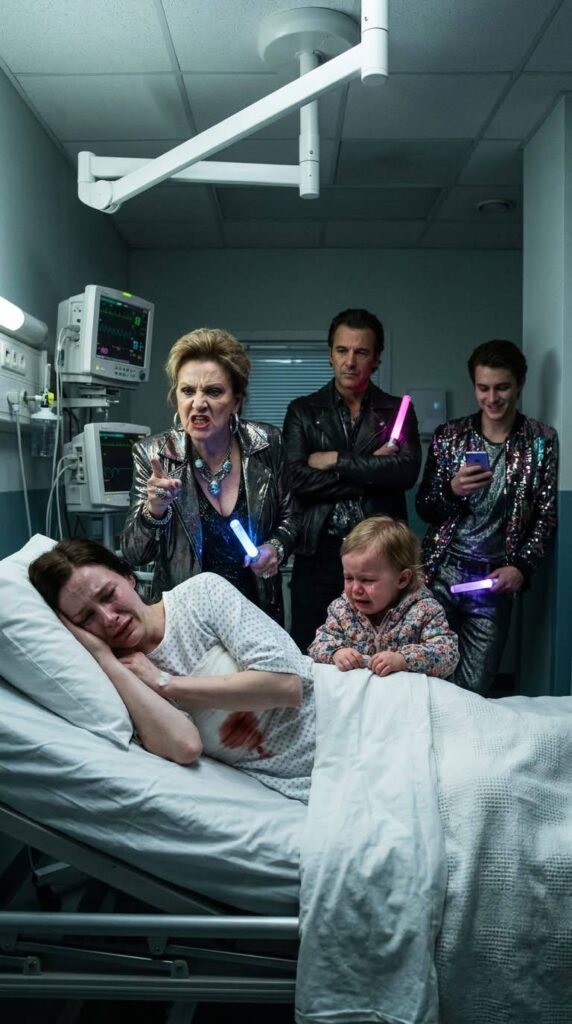
Chapter 1: The Ambulance and the Abyss
They say your life flashes before your eyes when you’re dying, but mine didn’t. Instead, I saw the sterile white ceiling of a Type III Ambulance, the rhythm of my heart dancing in jagged, terrifying spikes on a monitor that hummed with mechanical indifference. My name is Sarah Mitchell. At thirty-two, I was a woman who lived by the clock, a nurse at County General Hospital who understood the brutal efficiency of life and death. Yet, as the siren wailed through the rain-slicked streets of the city, I wasn’t thinking about medicine. I was thinking about Emma, my two-year-old daughter, whose small hand had been the last thing I felt before the world went grey.
“Pulse is thready. We’re in sustained V-tach,” the paramedic muttered, his voice tight with a professionalism that usually calmed me. Today, it felt like a funeral dirge. My chest was a cage of white-hot agony, a vise tightening around my lungs until every breath was a jagged shard of glass.
I fumbled for my phone with trembling fingers. I didn’t call a lawyer or a priest. I called my mother.
“Sarah? You’re calling rather late, aren’t you?” My mother’s voice was like a sudden frost. It carried that familiar, sharp edge of irritation, the kind she reserved for telemarketers and me.
“Mom… please,” I gasped, the words catching in my throat. “I’m in an ambulance. They’re taking me to the ER. It’s my heart. I need surgery. Emergency heart surgery.”
There was a pause. Not a pause of shock, but the heavy, sighing silence of someone being inconvenienced. “Sarah, honestly. You’ve always had such a flare for the dramatic. It’s probably just another one of your anxiety spells. You work too hard, and then you imagine these things. You know how you get.”
“Mom, I’m not imagining the defibrillator paddles,” I wheezed. “Please. I just need you to come to the house. Get Emma. She’s alone with the neighbor right now, but she needs you. I could… I could die tonight.”
“We can’t,” she said flatly. The finality in her tone was more painful than the cardiac arrest. “Your father and I have plans. We’re taking Marcus to see the Justin Bieber concert. We’ve had these tickets for months, Sarah. You have no idea how difficult they were to procure. Call a friend. Stop being so melodramatic.”
The line clicked. Dead. Just like the parts of my heart that were misfiring.
In that moment, as the ambulance hit a pothole and the monitors wailed a new, frantic warning, the crushing weight in my chest shifted. It wasn’t just blood and electricity anymore; it was the cold, hard realization that the people who brought me into this world would happily watch me leave it if it meant they didn’t miss a bass drop.
I looked at the paramedic. “I need to make two more calls,” I whispered. My voice had changed. The desperation was gone, replaced by a crystalline, surgical focus. “Before the anesthesia.”
The first call went to Elite Care Services, a high-end agency I had bookmarked for “someday.” Within seconds, I secured a NICU-trained nanny named Patricia. The second call? That was to my banking app. With a few taps, I diverted $3,800—the exact sum I had quietly deposited into my parents’ account every single month for eight years—into a locked savings account.
I closed my eyes as the ambulance doors burst open at the hospital entrance. My parents thought that money was a windfall from my brother’s “investments.” They were about to find out that the bank of Sarah Mitchell was officially closed for renovation.
Chapter 2: The Golden Boy and the Shadow
To understand why a mother would choose a rapper over her daughter’s life, you have to understand the legend of Marcus Mitchell. Marcus was three years my senior, and in the theology of our household, he was the Messiah. He was the high school quarterback, the homecoming king, the golden boy who could turn lead into gold simply by touching it—or so my parents believed.
I was the shadow. I was the quiet girl who brought home straight A’s only to be told, “Well, that’s the bare minimum, Sarah.” When Marcus failed a class, my father, Arthur, would buy him a car to “encourage his spirit.” When Marcus dropped out of college to pursue a string of disastrous “entrepreneurial ventures,” they emptied their retirement to fund his dreams.
“He’s a visionary,” my mother would say, clutching a glass of chardonnay while Marcus lounged on their sofa, thirty years old and unemployed. “He just needs the right break.”
I, meanwhile, worked three jobs to put myself through nursing school. I didn’t ask for a dime. When I bought my modest home, they didn’t visit for the housewarming. They were too busy attending a “launch party” for Marcus’s latest app—an app that allowed people to rate different types of artisanal dirt. It folded in six weeks.
The financial deception began when I was twenty-four. My parents had fallen on hard times—or rather, Marcus had fallen on hard times and dragged them down with him. They were three months behind on their mortgage. They were terrified.
“Arthur’s back is acting up,” Mom had sobbed over the phone. “And my hours at the boutique were cut. We’re going to lose the house, Sarah.”
I had $6,000 in savings. I gave them $4,000 that night. But the leaks in their boat never stopped. Eventually, I took over. I set up an automatic transfer of $3,800 to cover their mortgage and utilities. But I did it through a convoluted route. I told them Marcus had set up a “legacy investment fund” for them from his early tech days.
Marcus, never one to let a good lie go to waste, took the credit. He’d walk into their house with expensive cigars he’d bought with my parents’ grocery money, and they would beam at him. “Our generous son,” they’d say. “Thank God for Marcus. Sarah, why can’t you be more like your brother?”
I let them believe it. I told myself I was being “noble.” I was the martyr of the Mitchell family, the silent engine keeping the lights on while the star performer took the bows.
Then came the tragedy. My husband, David, died in a freak accident on a construction site when I was six months pregnant with Emma. I was shattered, a hollowed-out version of a human being. My parents’ response?
“This is going to make your schedule very difficult, Sarah,” my father had noted at the funeral, checking his watch. “We hope you have good insurance. We can’t be expected to babysit all the time; Marcus is moving back into his old room to focus on his new crypto-consulting firm.”
I raised Emma alone. I worked twelve-hour shifts in the ER, my feet aching, my heart heavy with grief, while my parents lived in a house I paid for, praising a son who stole my dignity.
I thought I could sustain it forever. I thought my endurance was infinite. But the heart is a muscle, and muscles eventually tear under too much tension.
The first skip happened during a double shift in July. I dismissed it as caffeine. The second skip, a week later, felt like a bird trapped in my ribs. By the time I saw Dr. Chin, the head of cardiology at General, the diagnosis was a death sentence draped in Latin: Ventricular Tachycardia.
“Your heart’s electrical system is shredded, Sarah,” Chin had said, his eyes kind but firm. “You need a catheter ablation. Immediately.”
I had planned to tell them. I had planned to ask for help one last time. But as I sat in the cardiac ICU after being wheeled in from the ambulance, listening to the rhythmic beep-beep-beep of the monitors, I realized the only person who had truly shown up for me was a woman I had hired for forty dollars an hour.
Chapter 3: The Silence of the ICU
The surgery lasted four and a half hours. There was a moment, according to the surgical notes I’d later read with clinical detachment, where my heart simply stopped. They had to “crash” me—hit me with the electricity they use to restart a stalled engine. I died for forty-seven seconds while my parents were likely recording “God’s Plan” on their iPhones.
When I woke up, the room was dim, smelling of antiseptic and the faint, sweet scent of lavender. Patricia, the nanny, was sitting in the corner, knitting something small and pink.
“Emma?” I croaked, my throat feeling like it had been scraped with sandpaper.
Patricia looked up, her face lighting up with a maternal warmth I hadn’t felt in decades. “She’s perfect, Sarah. She’s asleep in her own bed. I’ve been sending pictures to your phone every hour. You’ve been through the wars, haven’t you?”
I looked at my phone. There were forty-two messages. Not one was from my mother. Not one from my father.
There was a text from Marcus, though, sent at 11:30 PM: Hey, Mom said you’re having a ‘moment.’ Can you tell the bank to check the investment payout? It didn’t hit today. Parents are stressed. Peace.
I felt a coldness settle into my bones that no heated hospital blanket could fix. I was a nurse; I knew how to handle trauma. But this was a different kind of necrosis. This was a family dying from the inside out.
“Patricia,” I said, my voice gaining strength. “How long can you stay?”
“As long as you need, honey. I’m not going anywhere.”
I spent five days in that hospital. On the third day, my father finally called. I expected an apology. I expected tears.
“Sarah? Finally. Your mother said you were being difficult. Listen, there’s a problem with the ‘Marcus Fund.’ The landlord called Arthur. The payment bounced. We need you to call the bank and fix whatever glitch is happening. Arthur is very upset; he’s got a headache.”
I stared at the IV bag dripping clear fluid into my vein. “I’m in the ICU, Dad. I had open-heart surgery. My heart stopped. I died.”
“Yes, yes, the dramatic episodes. We heard. But the rent, Sarah. It’s four thousand dollars with the late fee. Just call Marcus’s bank. Or use your savings to bridge it. You’re a nurse; you make good money.”
“I’m not calling anyone,” I said. “And there is no Marcus Fund, Dad. There never was.”
“What are you talking about? Don’t be spiteful just because you’re tired.”
“I’m done, Dad. The money is gone. The daughter you think you have is gone, too. Don’t call me again unless it’s to tell me you’ve found a job.”
I hung up. The monitor spiked—a brief, angry flutter—and then settled into a steady, rhythmic thrum. It was the sound of a heart that was finally learning to beat for itself.
But the real war hadn’t even begun. Because forty-eight hours later, the rent was officially overdue, and the Mitchell family was about to learn the true cost of their Justin Bieber tickets.
Chapter 4: The Eviction of the Soul
I returned home to a house that felt like a sanctuary. Patricia had cleaned everything, stocked the fridge, and Emma was thriving. But the peace was short-lived. By Tuesday, the “Digital Siege” began.
The first wave was my mother.
Sarah Mitchell, answer your phone this instant! Arthur and I are being threatened with legal action! What have you done to Marcus’s account? This is beyond cruel!
I ignored it. I sat on my porch, drinking herbal tea, watching Emma play in the sprinkler. My incisions were sore, but my mind was a razor.
The second wave was Marcus. He actually had the audacity to show up at my front door. He looked disheveled, his expensive Italian leather shoes scuffed.
“Sarah, what the hell?” he hissed through the screen door. “I had to explain to them that the ‘fund’ was frozen because of an audit. Why did you stop the transfer? They’re freaking out!”
I opened the door just wide enough to look him in the eye. “Because I was dying, Marcus. And while I was dying, I realized I was paying for the privilege of being hated. Why didn’t you pay their rent this month?”
“You know I’m between ventures! The crypto market took a hit—”
“You’ve been ‘between ventures’ for ten years. You’re thirty-five, Marcus. You’ve lived off my sweat and blood while you let them spit on me. No more. I’ve already sent the bank statements for the last eight years to their email. Every single payment, traced back to my nursing salary.”
Marcus’s face went a sickly shade of grey. “You… you told them?”
“I sent the email an hour ago. Complete with the timestamp of the phone call I made to Mom from the ambulance. The one where she told me she wouldn’t save my life because she wanted to see a concert.”
“Sarah, you’re destroying the family!”
“No,” I said, my voice as cold as a surgical blade. “I’m just turning the lights on. It’s not my fault what you all look like in the dark.”
I shut the door and locked it. Ten minutes later, the screaming started on my voicemail.
It was my mother, her voice high and ragged. “You liar! You manipulative, jealous little girl! You’ve fabricated these documents to make your brother look bad! Arthur is having a heart attack—a real one, not your fake ones! If we lose this house, it’s on your soul!”
I didn’t blink. I knew my father. His “heart attacks” always coincided with being asked to take responsibility.
But then, a different kind of call came. It was Dr. Morrison, the ER attending who had seen me the night of my admission.
“Sarah? I’m calling because I’m looking at your chart. And I’m looking at the notes from the night of your surgery. I think there’s something you need to see. Can you come into the hospital tomorrow for your follow-up?”
“Is something wrong with the ablation?” I asked, a sudden cold dread coiling in my gut.
“No,” Morrison said. “The heart is fine. It’s the history that’s the problem. I caught your parents in the waiting room the day you were discharged. I think you need the full story of what happened while you were under the knife.”
I didn’t know it yet, but the Justin Bieber concert wasn’t even the worst thing they’d done that night.
Chapter 5: The Medical Record of Betrayal
The hospital smelled of floor wax and old coffee. I walked through the halls of County General with a cane, Emma’s small hand gripped in mine. We met Dr. Morrison in his private office. He looked like he hadn’t slept in a week.
“Sarah, I’ve been a doctor for a long time,” Morrison began, sliding a folder across the desk. “I’ve seen families at their best and their absolute worst. But I’ve never seen a social worker report like this one.”
I opened the folder. My eyes scanned the professional, detached language of the hospital’s social services.
10:45 PM: Contacted parents of patient (Sarah Mitchell) regarding emergency cardiac bypass/ablation. Advised patient was in critical condition. Mother (identified as Margaret Mitchell) stated they were at a concert and could not attend. Physician intervened to stress the possibility of patient expiration.
I looked up. “I knew that. She told me.”
“Keep reading,” Morrison whispered.
11:15 PM: Mother called back the ER nursing station. Asked if the patient had ‘passed yet.’ When told the patient was still in surgery, Mother asked if the patient’s life insurance policy would cover the ‘Marcus Mitchell Legacy Fund’ if the patient failed to survive the night. Social worker noted Mother seemed more concerned with the ‘disruption of cash flow’ than the patient’s status.
The room tilted. The walls seemed to breathe. I felt the physical sensation of a fault line cracking open right through my chest.
They hadn’t just ignored me. They were waiting for me to die. They were calculating the profit margins of my corpse while I was still being stitched back together.
“They were here, Sarah,” Morrison said quietly. “They came by at 2:00 AM, after the concert. Not to see you. They went to the billing office. They tried to claim they were your ‘executors’ to get access to your accounts. Security had to escort them out.”
I didn’t cry. The time for tears had ended in the back of the ambulance. I felt a strange, terrifying sense of peace. It was the peace of a survivor who realizes the enemy isn’t at the gates—the enemy is the gate.
“Thank you, Doctor,” I said. I took the papers. I had all the evidence I needed.
I walked out of that hospital and drove—illegally, against my doctor’s orders—to the house I paid for. My parents’ house.
I didn’t knock. I used my key.
The living room was a disaster. Boxes were half-packed. My mother was sitting at the kitchen table, looking like a ghost. My father was clutching his chest, groaning on the recliner. Marcus was nowhere to be seen.
“Sarah!” my mother gasped, standing up. “You… you shouldn’t be here. You’re sick.”
“I’m the healthiest I’ve ever been,” I said. I threw the social worker’s report onto the table. “I know about the insurance, Mom. I know about the 2:00 AM visit to the billing office.”
The silence that followed was absolute. Even my father’s fake groaning stopped.
“We… we were just worried about our future,” Arthur stammered, his face turning a mottled purple. “You’ve always been the stable one. If something happened to you, what would happen to us? To Marcus?”
“Marcus is a thirty-five-year-old man who can’t even pay a phone bill,” I said. “And you? You’re two people who valued a concert and a payout over my life. The eviction notice arrives tomorrow. I’ve already contacted a realtor. This house will be on the market by Friday.”
“You can’t!” Mom shrieked. “We’re your parents! You owe us!”
“I’ve paid you three hundred and sixty-four thousand dollars,” I said, quoting the number I’d memorized. “Consider the debt settled. You have thirty days. After that, the locks change.”
“Where will we go?” she sobbed. “Marcus’s condo is being foreclosed on!”
“Then I suggest you buy a very large tent,” I said. “And maybe you can play some Justin Bieber music to keep yourselves warm.”
I walked out. As I descended the front steps, I felt my heart beat—thump-thump, thump-thump—strong, steady, and entirely, beautifully alone.
Chapter 6: The Anatomy of Peace
Six months later, the world looked very different.
The house had sold for a significant profit, money I put directly into a college fund for Emma. My parents were living in a cramped, one-bedroom senior apartment on the other side of the state, supported by Marcus’s meager earnings as a delivery driver. It turned out his “entrepreneurial spirit” was remarkably well-suited to dropping off bags of Thai food.
I was back at General, working the floor, but my life had changed. I no longer stayed for the triple shifts. I no longer sacrificed my sleep for a family that wouldn’t even sacrifice a ticket for me.
I sat in my backyard on a crisp October evening. Patricia was there, helping Emma carve a pumpkin. We weren’t “employer and employee” anymore; she was the grandmother my daughter actually deserved.
My phone buzzed. A letter had arrived in the mail earlier that day, and I finally opened it. It was from my mother.
Dear Sarah, it began. The apartment is cold. Arthur’s back really is bad this time. Marcus doesn’t speak to us. He blames us for ‘ruining the arrangement.’ I spend every night thinking about that phone call. I told myself you were drama. I told myself you’d be fine. But I see the chart every time I close my eyes. I see the words ‘Mother asked if she had passed yet.’ I don’t ask for forgiveness. I know I don’t deserve it. I just wanted you to know that I am finally, truly, ashamed.
I read the letter twice. I looked at the flickering candle inside Emma’s pumpkin.
I didn’t feel rage. I didn’t feel pity. I felt… nothing. And that was the greatest victory of all. Forgiveness isn’t about letting the other person off the hook; it’s about realizing the hook doesn’t matter anymore.
“Mama, look!” Emma shouted, pointing at the glowing orange face of the jack-o’-lantern. “It’s happy!”
“It is, baby,” I said, pulling her into my lap. “It’s very happy.”
My heart was no longer misfiring. The scars from the ablation were there, small white lines against my skin, but the internal scars—the ones Marcus and my parents had spent thirty years carving—were finally fading.
I realized then that family isn’t the people who share your blood. It’s the people who share your breath. It’s the doctor who tells you the truth you don’t want to hear. It’s the nanny who stays when the sirens start. It’s the daughter who looks at you like you’re the sun, even when you feel like a guttering candle.
I picked up my phone and sent a text to my “Chosen Family” group chat: Dinner at my place Sunday. Pot roast and peace. Who’s in?
The replies came back instantly. In. In. Bringing the wine. Bringing the dessert.
I smiled. For the first time in my life, I wasn’t the shadow. I was the light.
And as for my parents? They were exactly where they chose to be. In the dark, listening to the echoes of a concert that had ended a long, long time ago.
I stood up, took Emma’s hand, and walked into my home. The door clicked shut, the sound of a certain, final, and beautiful resolution.