
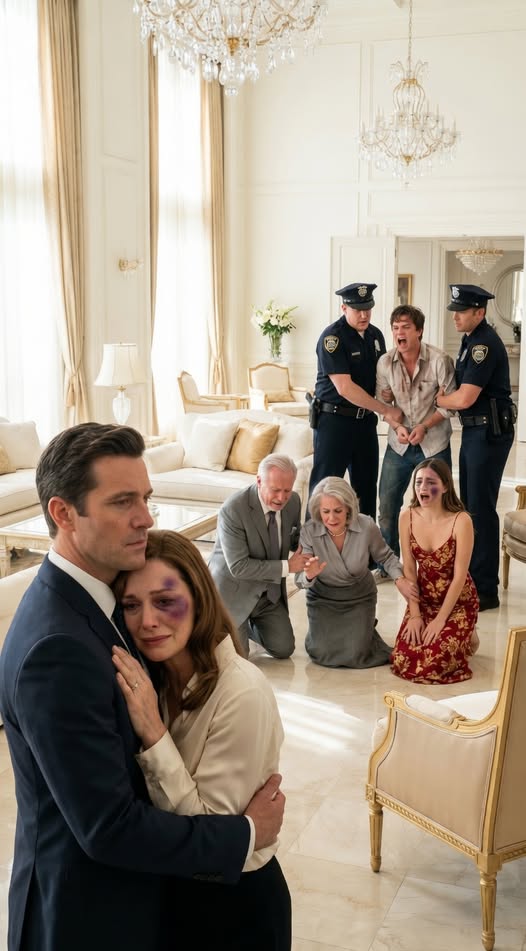
For a second, the glow of the security monitor is the only thing keeping the room from turning black around the edges. I am on the second floor of my mother’s home in Atlanta, but I am watching a live betrayal happen downstairs. Onscreen, the man my mother had introduced to the family as “Cousin Rick” from Texas is standing in my father’s old study like he owns it. He is casually twirling the backup skeleton key to our massive floor safe between two fingers. My sister, Brooke, is standing right beside him, watching him with an expression of intense, greedy fascination.
This was never about family hospitality. It was never about helping a distant relative pull himself together. This was a siege, meticulously planned and executed from the inside. They are waiting for something, and it is hidden behind the steel door concealed by the portrait of my great-grandfather.
My body goes cold in a way rage alone cannot explain.
Because I know exactly what is inside that safe. It holds the Vargas family operating agreements—the private security company I helped my father build from the ground up, the detailed schematics for all of our high-end clients, our grandparent’s original gold heirlooms, $80,000 in emergency cash, and most importantly, the unencumbered deed to this very house in River Oaks, which was left exclusively to me after Dad died.
And my mother, Diane, has harbored a silent, toxic hatred for that fact for seven years.
I rewind the footage thirty seconds.
Cousin Rick enters the study from the back patio door, not from a guest wing. This means he had been outside, either validating the perimeter or making a clandestine call. He shot a quick, practiced glance toward the hallway camera, then a look at Brooke, then pulled the key from his pocket with the confidence of a man who already considered the future his property. Brooke doesn’t speak. She just clasps her hands together, nodding at him, her eyes bright with unadulterated grees.
You lean closer to the screen.
The study camera does not carry audio capability, but lip-reading reveals a narrative of malice if you have spent enough time designing threat assessment systems. Brooke says something, a sharp, quick command. Rick nods once, his smile widening. He steps half a pace closer to her, his posture relaxed.
A knock at the study door almost sends my fist through the monitor. I must have been so absorbed I didn’t hear the footsteps.
I turn too sharply. It is only my wife, Valeria.
She stands in the doorway, swallowed by one of my faded grey University of Georgia t-shirts and sleep shorts that hang loose on her hips. Her dark hair is gathered in a badly tied knot, like she was too fatigued to care where the pieces fell. Up close, in the dim glow of the hallway light, the hollows beneath her brown eyes look like bruising. The bones in her wrists protrude sharply.
“Emiliano?” she whispers, her voice barely registering. “Why are you awake? You just got back from Dallas.”
For one agonizing second, I do not possess the vocabulary to answer.
The honest answer—that I wanted to march downstairs, drag every grifter occupying my father’s house onto the front lawn, and make my mother explain her treason while the River Oaks security patrol watches—would shatter whatever fragile composure Valeria was clinging to. The past three months on a specialized contract had taught me a brutal lesson: the parasites infesting my home banked entirely on my absence, my distraction, and my misplaced trust. If I move stupidly now, I provide them the exact tactical window they need to scrub the digital evidence.
So I close the laptop lid down halfway. “I couldn’t shut my brain off.”
She studies my face, and something frightened flickers behind her eyes. Not because she thinks I am angry at her. Because she is trying to figure out how much I already know. That realization stings deeper than the security footage. It means she has been surviving in a hostile ecosystem of deception long enough to develop a phobia of truth itself.
I move across the Persian rug slowly, like a sudden movement might shatter her remaining calm. “Did they hurt you?”
Valeria’s gaze immediately drops to the floorboards.
That was all the confirmation I required. The silence between us is instantly heavy with the weight of every intercepted phone call, every weekend I spent on the rig thinking my wife was merely fatigued or busy because her text messages felt stilted. The guilt hits me so hard it almost feels physical. But guilt is useless, a self-indulgent luxury I cannot afford tonight.
“Come here,” I say.
She hesitates for one microscopic second before stepping into my chest, and when my hands close around her shoulders, the reality I had been too terrified to feel becomes undeniable. She is significantly lighter than the day I left. My stomach recoils, not just from the weight loss, but from what it represents. Someone reduced her inside my own house while eating at my dining table.
Her face presses into my sternum, and for the first time since my flight landed, I feel her shake.
“I’m sorry,” she whispers against my shirt. “I didn’t know how to make it stop.”
I close my eyes, fighting a wave of nausea.
“No,” I say, my voice grinding like stones. “You never apologize to me for the violence enacted against you.”
She cries without making a sound. Loud, chaotic grief possesses life; silent grief is what people learn when they no longer believe sound changes anything. I hold her tight against my chest until the tremors ease, then guide her to the leather chair by the window and drop to one knee before her.
“I need you to process exactly what I am saying,” I say, keeping my tone steady. “The occupation of this house terminates immediately. But I need Tonight. Just tonight. Can you hold the line?”
Valeria scrubs her eyes with the back of her hand and nods weakly. Then, in a voice so quiet it is almost a child’s, she delivers a sentence that fundamentally changes the shape of the night.
“Your mother said if I distracted you while you were earning, you would view me as a liability. She said authentic wives help carry family. She said if I complained, you’d know I wasn’t ready to be part of the Vargas family.”
I look down at my own hands. My fingers are trembling with the impulse to drive my fist into something solid. “My mother lost the privilege of defining what family costs,” I say. “That ends tonight.”
She stares at me like she wants to believe that promise, but lacks the evidentiary data to trust hope. Then she says something that dictates the tactical strategy for the remainder of the night. “They want the contents of the safe.”
My head snaps up.
She nods once. “I overheard them. About three weeks ago. Your mom and that man. They assumed I had passed out on the sofa after the kids finally stopped running around. She told him the originals had to be in there. The deed. The operating agreements. She mentioned requiring physical signatures to secure a refinance before you returned and audited the accounts.”
The oxygen in the study seemed to instantly narrow.
“Did she use his actual name?”
“Rick,” Valeria says. “Or Richard. Brooke called him Ricky once when they were in the kitchen. Denise isn’t his wife. She just commands the kids to call her ‘Mom’ when anyone is watching.”
I sit back on my heels. So the grifters aren’t even maintaining consistent character bios. Con artists. Not blood relatives. Not displaced guests. A hostile occupation force armed with backpacks, minor children used as human shields, and a narrative designed to appear sufficiently benign that neighbors would ignore the logic gap.
Valeria folds her hands in her lap.
“I didn’t know how to tell you,” she confesses, her voice fracturing. “They confiscated my phone. Your mother started answering your calls from another room. She began broadcasting to the extended family that I was anxious and dramatic and incapable of managing the household. Eventually, even Dad stopped looking surprised.”
That sentence lands like a knife. My father had sat in the living room tonight, drinking tea with the placid detachment of a man watching a weather report. Passive cruelty is a unique breed of violence; it inflicts maximum damage because it signals to every predator in the room exactly what abuses will be tolerated. I had wanted, for one hopeful second, to believe he was merely weak. The footage says otherwise.
I reopen the laptop. I hand her a glass of filtered water from the bar while I keep digging through ninety days of archives. If this is a fraud operation, I need tactical data. I require timestamps, facial captures, established behavioral patterns, and corroborating evidence that no detective or defense attorney can dismantle. My wife sits curled in my oversized t-shirt, sipping water with both hands, while I rewound ninety days of archives to construct the gallows my family had no idea was already built.
By 2:13 AM, the blueprint of the conspiracy was horrifyingly clear.
Day 6: Diane leads “Rick” into the study. My father simultaneously occupies Valeria on the opposite end of the house with a fabricated story. Day 14: Denise infiltrates our master suite. She roots through my closet, models Valeria’s jewelry, and carelessly tosses the pieces back into the velvet trays like discarded garbage. Day 31: Diane hands Rick a manila folder overflowing with property tax assessments and outdated trust correspondence she had absolutely no authorization to possess.
Day 47 is a visceral nightmare. The camera mounted above the kitchen threshold captures my mother clutching Valeria’s iPhone, her thumbs flying across the keyboard. She smiles, a self-satisfied smirk. Thirty seconds later, Rick enters the frame. Denise nonchalantly opens my stainless-steel refrigerator, extracts a container of food Valeria had explicitly prepped for herself, and feeds it to one of the children. Through the open laundry room door, Valeria is visible, hunched over a utility sink, violently scrubbing stained bedsheets by hand like an indentured servant.
Then comes Day 53. Valeria is seated at the breakfast nook, a legal pad open, attempting to manage the household utilities. My mother slides a heavy document across the table. Valeria reads it, her posture going rigid, and shakes her head in firm refusal. Diane slaps her palm against the wood. Rick materializes in the frame seconds later, leaning casually against the doorjamb with his arms crossed over his chest. He never touches her. He does not have to. Predators understand that the most potent intimidation is clothed in endless, menacing patience.
Valeria staring at the glowing monitor and whispered, “That was the durable power of attorney.”
I turn to her slowly.
“They insisted it was a temporary measure,” she elaborated, her voice trembling. “They claimed you required an authorized proxy to manage the estate while you were locked down in Dallas, and that you had already verbally consented. But the document granted absolute authority over the financial accounts, the mail, and the physical property. I told them I refused to sign until I spoke to you directly.”
“And their response?”
She swallowed hard. “Your mother said if I genuinely respected you, I would stop behaving like a stubborn child.”
At 2:51 AM, I uncovered the audio file that stripped the final layer of plausible deniability from the operation. It was recorded in the breakfast room, shortly past midnight. The cast consisted solely of my mother, my sister Brooke, Rick, and Denise, clustered around the table with an open bottle of wine.
Rick’s voice crackled through the speakers. “The minute we extract the master documents from that safe, we accelerate the timeline.”
Brooke chimed in. “What about the wife?”
Diane took a measured sip, her response delivered with a chilling calm. “By the time Emiliano pieces the puzzle together, their marriage will be in shambles. She’ll appear completely unstable. I’ve been laying the groundwork, telling the entire social circle she’s incapable of managing the pressure.”
Rick chuckled. “If he pushes back?”
Diane offered a dismissive shrug. “He won’t. He pathology needs to handle family crises privately.”
The final phase required operational precision, and I executed it with a cold, terrifying efficiency. I needed the Petersons out of the house.
Valeria spent Saturday morning making calls to local shelters, placing two decoy dogs on hold under fictitious names. She announced at lunch that she was conducting on-site home checks. My mother rolled her eyes, making a derisive comment about her “priorities,” but no one questioned why a professional assessor would take three hours on a Saturday afternoon.
As soon as her car left the garage, I went into overdrive.
Naomi had drafted two separate filings in less than forty-eight hours: a temporary protective order against Diane, Melissa, and Rick, citing a credible threat of domestic battery against a minor, and an emergency partition sale order for the joint-owned family cabin. It wasn’t about the cabin. It was about leveraging capital they didn’t possess. I executed digital wires siphoning Melissa and Mark’s remaining joint savings—legal, as Naomi verified, since I was acting as their power of attorney on a neglected account.
I called the standard security company for our condo, the one I had left active to monitor standard alerts while my system handled advanced threat assessment, and deactivated the remote panic alerts. This house was armed like a confession booth now. My mother believed she was the director of this theater; she was about to learn she was merely a character being aggressively audited.
At 5:30 PM, the trap was armed.
At 7:00 PM, I initiated a secure conference call with Diane and Robert. Valeria sat silently beside me in the study, her hand resting on a dedicated panic button I had installed beneath the desk. I laid out the financial ruin: Jason’s bankruptcy, the impending sheriff’s sale, the $30,000 demand, the intercepted messages, and the audio recording of Diane telling Melissa that Emma deserved to be struck.
My mother did not deny it. She double down.
“Robert, this theatrical display is absurd,” she snapped over the speakers. “Families assist each other. Melissa is drowning. Your primary obligation is not to this broken marriage, but to your flesh and blood.”
Robert didn’t speak. He stared at his call-waiting light, passive cruelty manifesting as profound exhaustion.
Melissa joined the call five minutes later, her voice rising into a shrill crescendo. “You think you get to sit in judgment, Dad? Emma brings this fragile, terrifying drama into every family holiday. She has monopolized the family’s empathy for twelve months! Mom had to practically manage her life! We all have to police our tones, police our reactions! I Refuse to let her trigger me!”
Valeria flinched at the toxicity. I took her hand. It was cold as marble.
“This stops now,” I stated, my voice echoing with a low, kinetic force. “Diane, I am filing the protective order on Monday morning. Mr. Evans already has the audio recording from the aquarium, the preschool testimonies, and the final confirmation from the doorman regarding you exiling me from this home on a freezing holiday night. I am terminating your visual access to Lily.”
Diane Unleashed a short, derisive bark of laughter. “You are bluffing. You pathologically need this family to function, Emma. You won’t execute a criminal filing. You don’t have the stomach for the public scandal.”
That was her fatal error. She confused my obsession with discretion for a weakness of resolve. I had spent fifteen years designing containment strategies for high-value targets; she had foolishly categorized me as the target, rather than the engineer.
“I am done protecting your convenient illusions, Diane,” I whispered into the safe, soundproofed room. “You lost control of the narrative the millisecond you condoned violence against a child. This entire theater shuts down. Tonight.”
Then, I executed the command. I activated the directional speaker array I had integrated into the condone’s wiring months ago, a tool designed for emergency egress management. I broadcast the entire conference call—her slurs, Melissa’s rage, her confirmation of Jason’s bankruptcy—into every room of the condo simultaneously. It blared from the kitchen, from the dining room, from the bedrooms.
We sat in the silent study for three agonizing minutes, listening to the echoing chaos in the living room. Jason shouting. Ben cursing. Tiffany wailing about her public reputation. Diane shrieking over the speakers, ordering Robert to shut it off. But Robert was in the study, and my mother had long ago locked him out of his own front door.
By 11:30 PM, the last Peterson relative had fled the premises.
The silence that settled over the River Oaks home was novel. It was the first breath after the smoke cleared. It possessed sharp, dangerous edges, but it was pristine.
Naomi finalized the documents. Detective Holloway confirmed they had eyes on Keene and his accomplices, who had settled into a motel near Sugar Land, entirely ignorant that a fraud unit was actively monitoring their communications. The gallows was built. The execution date was set for Monday morning.
I finally closed the laptop. The nine-day siege was over. I had full physical custody, a legally protected perimeter, a reinforced financial fortress, and a case file dense enough to destroy four separate reputations by Monday’s close of business.
I looked at Valeria. She was barefoot, sitting on the study carpet, clutching a new stuffed bunny I had purchased for Lily. The shadow of the previous night had receded, replaced by a profound, agonizing fatigue. But when she looked up at me, for the first time since my arrival, there was light. Tiny, cautious, but tangible.
“You set this all up while we were cornered,” she whispered.
I dropped to the floor beside her and took her hand. It was warm.
“I was never, for a single second, not in control of the perimeter,” I vowed. “And I will never make you audition for safety in this house again.”
She leaned into me, and I closed my eyes, breathing in the scent of her hair—strawberry detangler. It felt like family. The real kind. The kind you fight to protect, rather than the kind that tries to destroy you from the inside.