
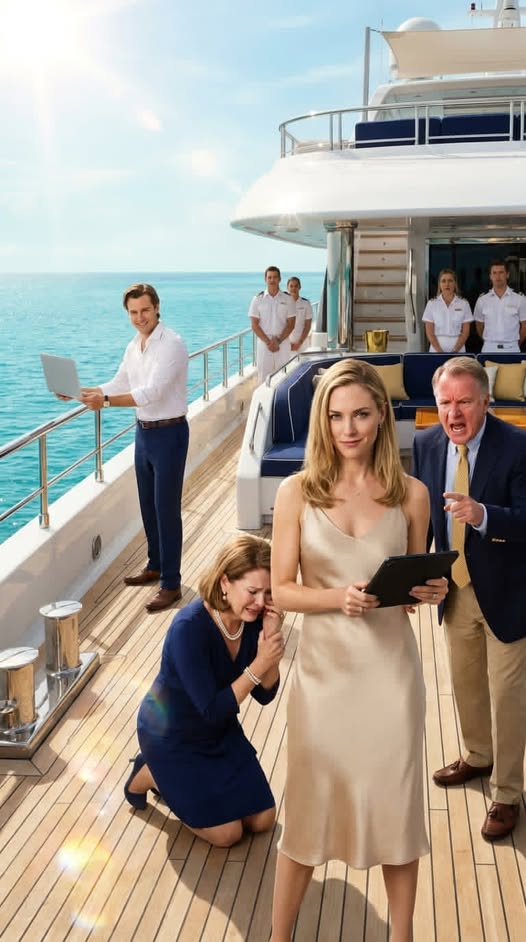
“THE ONLY THING YOU INHERITED, CALEB, WAS OUR FATHER’S DELUSION. I INHERITED HIS COLDNESS—AND I’M LEAVING YOU BOTH TO IT,” I said, my voice cutting through the static of the radio as the lights of my own yacht flickered out, leaving my family in the heart of a rising storm.
It’s funny how long you can let a parasite feed on you before you finally decide to cut off the host. For thirty-one years, I had been the host. But tonight, the feast was officially over.
Chapter 1: The Captain and the Parasites
The air off the coast of the Outer Banks, North Carolina, was thick with humidity and the sharp, stinging scent of salt. I breathed it in deeply, letting it fill my lungs as the twin diesel engines of The Horizon hummed beneath my feet. She was an eighty-foot marvel of sleek fiberglass and cutting-edge maritime engineering, a vessel I had purchased entirely in cash.
I am Elena Whitman. I didn’t marry into this wealth, and I certainly didn’t inherit it. I am a software engineer, the founder of a fintech startup that revolutionized decentralized banking. I was the first woman in the Whitman bloodline to build a multi-million dollar empire from scratch, dragging myself up through a patriarchal industry that constantly demanded I prove my worth. I had worked twice as hard, slept half as much, and sacrificed my twenties to build a fortress of financial independence.
And yet, to the men standing on my aft deck, I was merely a walking trust fund waiting to be liquidated for their benefit.
My father, Richard Whitman, was a relic of a bygone corporate era. He was a man who genuinely believed a daughter’s success was merely a modern-day dowry to be managed and eventually transferred to her brother. And then there was my brother, Caleb Whitman. At thirty-four, Caleb was the family’s “Golden Son,” a serial, failed entrepreneur whose string of bankrupt ventures—a doomed crypto exchange, a shuttered fusion restaurant, a defunct logistics app—were entirely subsidized by my father’s rapidly diminishing influence and, more recently, my own coerced capital.
This trip was supposed to be a “family getaway,” a rare weekend where we could put business aside and enjoy the fruits of my labor. But Richard was already pacing the teak deck like an admiral inspecting a conquered galleon, and Caleb was treating my hired crew with the sneering, arrogant disdain of a petty lord.
I stood at the helm, my hands steady on the leather-wrapped wheel. I had spent two years taking advanced maritime courses to ensure I could captain my own vessel; I refused to own something I couldn’t completely control. Behind me, in the luxurious lounge, I heard the sharp, celebratory pop of a vintage Cristal cork.
“You know, Elena,” Richard shouted over the wind, swirling the expensive champagne in his glass. “This boat is a bit small for the Whitman name. When Caleb takes over the estate, we’ll need something with at least three decks. Something you can land a helicopter on.”
My jaw tightened, a familiar, acidic burn rising in the back of my throat. I didn’t have an estate for Caleb to take over, but in my father’s mind, my assets were already communal property.
Caleb laughed, a harsh, braying sound, before casually tossing a handful of expensive shrimp cocktail over the side into the churning wake. “Don’t worry, Dad. Once I sell that beachfront villa Elena’s ‘holding’ for me, I’ll buy us a real ship. Something that doesn’t look like a starter toy.”
I didn’t turn around. I didn’t validate their delusions with an argument. Instead, I watched the glowing display of the GPS console. We were now thirty miles from the nearest port. The water here was deep, dark, and utterly unforgiving.
Out of the corner of my eye, I saw a shadow fall over the bridge. Richard walked up the narrow stairs, not carrying a drink, but holding a thick, heavy legal envelope. He didn’t ask me to look at it. He simply stepped forward and dropped it onto the navigation console, slapping it down right over the radar screen.
Chapter 2: The Sinking of a Career
The envelope sat there, an ugly beige stain against the glowing blue technology of my bridge. I didn’t need to open it to know what it was. For weeks, they had been dropping heavy-handed hints about “liquidating dead weight” and “reinvesting in the family.”
“Sign it, Elena,” Richard commanded, his voice carrying the absolute, unquestionable authority he used on his subordinates three decades ago. “Caleb’s latest venture failed because he didn’t have the right ‘image.’ Investors want to see stability. That villa will give him the prestige he needs to secure his Series A funding.”
He was talking about my primary residence—a ten-million-dollar modern architectural masterpiece in Miami. The home I had designed. The home I had bled for. Richard expected me to sign it over because, in his archaic worldview, a man needs a sprawling estate to start a family, and a daughter can just live in a penthouse somewhere out of the way.
I looked at my father. I looked at the deep lines around his eyes, the arrogance set into the very bones of his face. I didn’t yell. I didn’t cry. Instead, a terrifying, absolute cold clarity washed over me. I realized, in that exact second, that Richard Whitman had never looked at me and seen a daughter. He saw a safety net. A resource. A battery to keep his favored son powered.
I looked back down at the deed resting on the radar. “No.”
The single syllable hung in the air, heavier than the humidity.
Caleb stepped forward, his face flushed an ugly, blotchy red from the wind, the wine, and the sudden, shocking sting of my defiance. “You think you’re so smart?” he spat, the veneer of the Golden Boy peeling back to reveal the entitled brat beneath. “With your little ‘coding’ and your stupid ‘apps’?”
He lunged forward and grabbed my workstation laptop from the captain’s table.
My heart hammered against my ribs. That laptop didn’t just have emails. It contained the core source code for my company’s upcoming IPO. Because of extreme security protocols, the last six months of my encryption work were stored locally, completely unbacked-up on the cloud.
“This is why you’re so arrogant,” Caleb snarled, holding the sleek silver machine over his head like a trophy. “You think this little plastic box makes you better than us. You think it gives you the right to disrespect this family.”
“Caleb, put it down,” I said, my voice dropping to a dangerous whisper.
Before I could react, before I could even take a step toward him, Caleb walked to the open edge of the bridge and hurled it with all his might into the ocean.
“There,” Caleb sneered, brushing his hands together as if dusting off dirt. “Now you’re just a girl on a boat. Sign the papers.”
I rushed to the railing. The laptop vanished instantly into the violent white foam of the yacht’s wake. It was gone. Six months of grueling, sleep-deprived, brilliant encryption work—the very foundation of my billion-dollar IPO—was sitting at the bottom of the Atlantic.
A profound, suffocating silence fell over the bridge. Caleb smirked, waiting for the tears, waiting for the hysterical breakdown that would signal his victory. He was waiting to break the horse so he could finally put on the saddle.
I looked at the empty space on the table where my life’s work had been seconds ago. Then, I turned and looked at my brother’s smug, flushed face. I didn’t cry. I didn’t scream.
I leaned over and whispered, “You’re right, Caleb. I’m just a girl on a boat. And it’s time I left.”
Chapter 3: The Silent Sabotage
I turned my back on them and walked steadily down the narrow, carpeted stairs toward the lower decks.
“Let her go,” I heard Richard say dismissively from the bridge. “She’s throwing a tantrum. Give her ten minutes to cry it out, she’ll come back up and sign. She always does.”
They thought I was retreating to my cabin to weep into my silk pillows. They fundamentally misunderstood the nature of the woman they had just pushed over the edge. I didn’t walk to the master suite. I bypassed the luxurious guest cabins and moved with lethal purpose toward the reinforced steel door at the stern.
I swiped my thumb across the biometric scanner, and the heavy door to the server room slid open with a soft pneumatic hiss.
The air inside was freezing, chilled to protect the humming racks of hardware that acted as the brain of the yacht. In the server room below deck, my fingers flew across my emergency tactical tablet. Caleb thought he had destroyed my power when he threw my laptop into the sea. He didn’t realize I didn’t need a laptop to destroy them. I had designed and built this boat’s custom security and navigation system myself. I knew every backdoor, every firewall, every failsafe.
I tapped the screen, opening the master control directory.
Override Command Initiated.
I systematically began to amputate the ship’s vital functions. I locked the engine throttles, freezing the transmission. I disabled the satellite internet and the long-range VHF radios. Finally, I engaged a localized “Geo-Fence” lock—a digital anchor that physically prevented the boat’s navigation system from plotting a course toward shore.
ACCESS DENIED. ENGINES: STANDBY. COMMS: OFFLINE.
Through the thick soles of my deck shoes, I felt the vibrations of the yacht fundamentally change. The aggressive, forward thrust of the twin diesels sputtered, then slowed to a pathetic, idling crawl. We were dead in the water.
Above me, muffled by the layers of steel and teak, I heard Caleb shouting at the steward for another bottle of wine, completely oblivious to the digital execution I had just performed.
I slipped the tablet into my waterproof duffel bag, alongside my hidden emergency satellite phone and my passport. I walked out of the server room and moved silently to the hidden mechanical compartment in the lower hull. With the push of a button, the hydraulic bay doors opened, revealing the motorized dinghy. I lowered it smoothly into the dark, rolling water and stepped inside, untying the mooring line.
I had a full tank of fuel—more than enough to reach the coast. They had enough imported champagne and caviar to last a week. But there wasn’t a single person left on board that yacht who knew how to reboot a digitally locked marine engine.
As I drifted fifty yards away from the yacht, the wind picking up and whipping my hair across my face, I pulled out a small, black remote from my pocket. I looked at the glowing, magnificent profile of The Horizon.
With a single click, the yacht’s massive deck lights went black, severing its connection to the grid and leaving the ship a dark, silent tomb in the middle of the unforgiving ocean.
Chapter 4: The Realization of the “Dead Zone”
The sudden blackout was the catalyst. From fifty yards away, sitting in the small, bobbing dinghy, I could hear the immediate shift in the atmosphere on board. The music cut out. The laughter stopped.
“What the hell is going on?” Caleb’s voice carried over the water, laced with the sharp, high pitch of sudden panic. “Where are the lights? Get the captain up here!”
“Elena!” Richard barked, the sound echoing hollowly off the fiberglass hull. “Elena, stop playing games and turn the breakers back on!”
I reached into my duffel and pulled out the dinghy’s integrated radio handset. I tuned it to the encrypted frequency that connected directly to The Horizon’s emergency PA system. I watched as the sky above us began to shift. The sunset was entirely gone, swallowed by a bruised, violent purple that signaled the arrival of a massive coastal squall. The wind was howling now, tearing the tops off the waves and spraying freezing salt water into my face.
I pressed the transmit button.
The speakers on the yacht crackled to life, the sound booming across the dark water. I could see the silhouettes of Richard and Caleb rushing to the railing, gripping the steel, peering frantically into the blackness.
“Dad? Caleb? Can you hear me?” My voice was crystal clear, a calm, disembodied specter speaking to them from the blackness of the sea.
“Elena!” Richard screamed, his voice cracking. I could see his face pale in the moonlight as the reality of his situation began to dawn on him. “Get back here! This is dangerous! Start the engines!”
“I can’t do that, Dad,” I replied, my voice perfectly level. “I’ve locked the bridge. The physical anchor is dropped, but the winch is digitally disabled. You’re sitting on twenty tons of steel that won’t move an inch until I say so. I’ve revoked your access to my house, my money, and my boat.”
“You crazy bitch!” Caleb shrieked, leaning over the railing, trying to spot my dinghy in the swelling waves. “You can’t leave us here! A storm is coming!”
My laugh was cold, void of any familial warmth. “You said I was nothing without the family name, Dad. You said I was just a girl. So, use the Whitman name to sail the boat home. Or maybe Caleb can use his incredible ‘entrepreneurial spirit’ to hack the firewalls and fix the engines.”
“Elena, please!” Richard begged, the authoritarian patriarch entirely broken, reduced to a terrified old man on a dark boat.
“I’m going to port,” I said, ignoring his pleas. “I’ll call the Coast Guard in the morning. Maybe.”
I cut the transmission and dropped the radio into my bag. I gripped the tiller of the dinghy’s outboard motor and twisted the throttle.
As the small engine roared to life, a massive, eight-foot wave slammed violently into the side of the yacht. Through the darkness, I heard the crash of breaking glass and the heavy thud of Caleb being thrown across the deck, crashing into the teak tables. As the eighty-foot boat tilted dangerously in the swelling sea, I turned my dinghy away, pointing the bow toward the distant, sweeping beam of a lighthouse. I didn’t look back, leaving behind the sweet, satisfying sound of my brother finally, truly screaming for help.
Chapter 5: The Cold Light of Day
I didn’t sleep that night. I reached the coast just as the storm broke, tying the dinghy off at a private, secluded marina before the worst of the rain hit. I walked two miles in the downpour to a luxury coastal hotel, checking into the penthouse suite under a corporate alias.
The next morning, the Atlantic was calm, glittering under a bright, deceptive sun. I stood by the floor-to-ceiling windows, wearing a plush white hotel robe, holding a steaming mug of black coffee. The large flat-screen TV on the wall was tuned to the local news.
The screen showed aerial footage of The Horizon being unceremoniously towed into the public harbor by a massive Coast Guard cutter. The camera zoomed in on the deck. Richard looked like a hollowed-out, broken old man, wrapped in a foil thermal blanket, shivering uncontrollably. Caleb was flanked by two harbor police officers, actively being questioned about the “missing” $50,000 corporate laptop he had drunkenly thrown into the sea, which constituted a massive destruction of corporate property.
I sat down on the balcony overlooking the beach. Resting on my knees was my new laptop—a top-of-the-line machine I had purchased at an electronics store the minute they opened at 8:00 a.m.
My phone buzzed on the glass table. It was my lead corporate attorney.
“It’s done, Elena,” he said, his voice crisp and professional. “The Miami villa has been officially transferred into an irrevocable blind trust. Richard and Caleb can’t touch it. I’ve also filed the restraining orders, and we are preparing the civil suit against Caleb for the destruction of the intellectual property. He’s looking at massive financial liability. He’ll be dealing with creditors for the rest of his life.” He paused. “And the yacht? It’s currently impounded for the investigation. Do you want it back once it clears?”
I looked out at the ocean, watching the gentle waves roll into the shore. I didn’t feel a shred of guilt. When Caleb threw my laptop into the water, he thought he was drowning my value. But sitting in this hotel room, opening a blank code editor, I realized my work wasn’t in the machine. The code, the brilliance, the value—it was all in my head. I could rebuild it. I had already started.
“No,” I told my lawyer, my voice light and unburdened. “Sell it. Donate every cent of the money to a scholarship foundation for young women in software engineering. I don’t want anything that reminds me of their scent.”
As I hung up the phone, a small, red security notification appeared on my new screen. My lips curled into a smirk. Someone was currently trying to access my private, encrypted cloud server from a tracked IP address located inside a local North Carolina police station. Even in custody, Caleb was desperately trying to steal my data one last time.
I tapped the screen, permanently blocking the IP and initiating a total wipe of his linked devices. I closed the laptop, feeling a profound, absolute sense of peace I hadn’t known since I was a child. The parasites were gone. The host was finally free.
Chapter 6: The New Horizon
Six months is a long time in the tech world. It’s enough time to rewrite an entire codebase. It’s enough time to launch a company. It’s enough time to forget the people who tried to hold you back.
The bell at the New York Stock Exchange rang, echoing loudly through the financial district, signaling the most anticipated IPO of the year. But I wasn’t there to hear it.
I was standing on a rugged, windswept pier in Maine, the cold Atlantic breeze biting at my cheeks. My phone, tucked into the pocket of my heavy wool coat, was vibrating non-stop, flooded with messages from my board of directors congratulating me on my net worth officially crossing the billion-dollar mark.
I didn’t care to check them. I was the most successful woman in my industry, but the money was just a metric. The real victory was the silence. My lawyers had thoroughly dismantled Richard and Caleb. Without my financial subsidies, they had lost the family estate to the bank. They were currently living in a cramped, two-bedroom apartment in a dreary suburb they had once mocked, entirely irrelevant to the world and to me.
I looked down at the dark, swirling water crashing against the pier. I looked at the ocean where I had once lost everything, and realized I had actually gained the world. My family had tried to sink me, but they failed to realize a fundamental truth: you can’t drown a woman who knows how to swim.
“Captain Whitman,” a rough, friendly voice called out from the end of the dock. It was my new navigator, a seasoned local sailor I had hired to help me map the northern coastline. “The new boat is fueled and ready. Where to?”
I turned to look at my new vessel. It wasn’t an eighty-foot superyacht built to impress old money. It was a rugged, custom-built expedition trawler, designed to break ice and sail across oceans. It was built for endurance, not for show.
I smiled, a genuine, warm expression that reached my eyes. “Anywhere but back.”
As I stepped off the pier and onto the steel deck of my new boat, I noticed a small, brown paper package resting on the captain’s chair. It was heavily taped, bearing my name and a return address from a coastal post office in North Carolina.
I pulled out a pocket knife and sliced it open. Inside sat a heavily salt-damaged, corroded, water-logged hard drive. Attached to it was a handwritten note on stained diner paper:
Found this in a fisherman’s net near the Outer Banks. Figured out who it belonged to from the serial numbers. Thought you might want the last laugh.
I stared at the ruined piece of metal. It was the ghost of my past, the anchor Caleb had tried to tie around my neck. I ran my thumb over the rusted casing. I didn’t plug it in. I didn’t try to salvage it. I didn’t need to look backward to know I had won.
I walked to the edge of the deck, raised my arm, and tossed the hard drive straight into the rusted metal trash can sitting on the dock. It hit the bottom with a hollow, final thud.
I walked up to the bridge, started the engines, and sailed away into the open horizon.
If you want more stories like this, or if you’d like to share your thoughts about what you would have done in my situation, I’d love to hear from you. Your perspective helps these stories reach more people, so don’t be shy about commenting or sharing.