
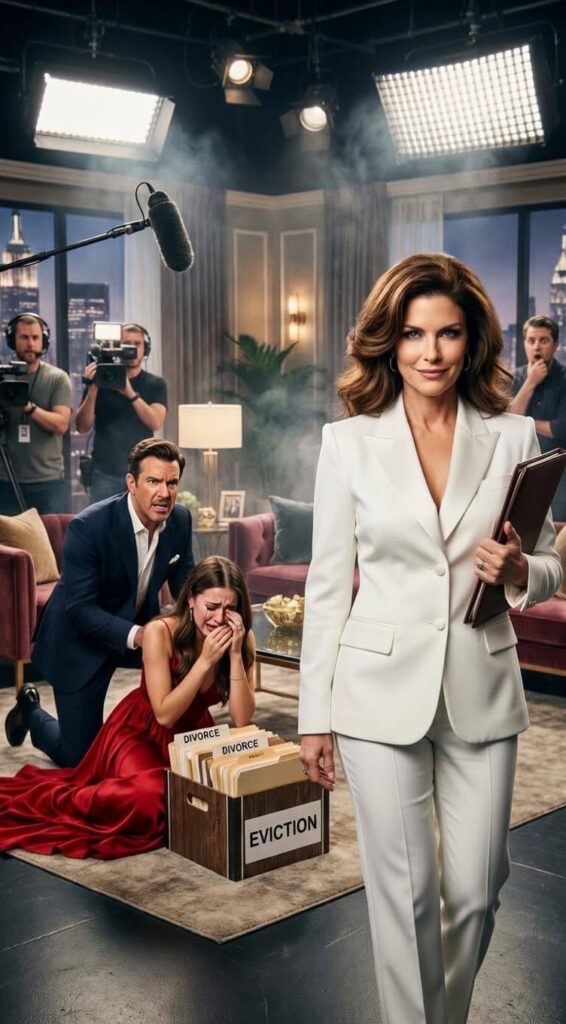
The air inside Soundstage 4 always tasted faintly of ozone, burnt coffee, and desperation. For most, the sprawling Hollywood lot was a factory of dreams, a place where starlight was manufactured under hanging grids of heavy tungsten lights. For me, it was my living room. I knew every taped mark on the floor, every scuffed cable, every shadowed corner of the set of City Lights, the world’s current reigning television drama.
I stood quietly in the wings, wrapped in an oversized, oatmeal-colored cardigan and faded denim jeans. My fingers were curled tightly around a battered, leather-bound notebook. Inside those worn pages lived the soul of the show—the dialogue, the character arcs, the very pulse of the narrative that had captivated ten million viewers every Sunday night. But to the dozens of crew members bustling past me, I was just Sarah. The quiet, supportive wife. A docile plus-one living permanently in the glamorous shadow of my husband, Mark Sterling, the high-profile studio manager who strutted across the set as if he had built the walls with his bare hands.
Nobody knew about the late-night writing sessions in our pitch-black home office. No one knew about the heavily encrypted emails bounced through proxy servers to the network executives, or the massive, astronomical royalty checks quietly accumulating in offshore accounts. To the world, the creator of City Lights was a reclusive, brilliant enigma known only as S.L. Knight.
“Make way, people! Watch the dress!”
A sharp, reedy voice cut through the ambient hum of the crew. Tiffany Blair, the show’s skyrocketing lead actress, swept past me. She left a suffocating wake of aggressive, floral perfume and pure, weaponized entitlement. She was beautiful, in a harsh, manufactured sort of way, wrapped in a scarlet silk gown meant for the upcoming live broadcast.
She stopped abruptly, her stiletto heel catching on a stray piece of gaffer tape. She looked up, her perfectly arched eyebrows drawing together as her eyes landed on me. She looked me up and down, her lip curling in an unmistakable sneer.
“Who let the help stay on set during technical rehearsals?” Tiffany demanded, turning to the First Assistant Director, a young man who immediately began to sweat. “Seriously? She looks like a stalker fan who wandered in off the street. Get her out of my sight before I lose my motivation. I can’t work with civilians breathing my air.”
A cold, heavy stone dropped in my stomach. I looked past Tiffany, searching for my anchor. Mark stepped out from behind the camera monitors. He was wearing a sharply tailored Italian suit, looking every bit the Hollywood kingmaker. He walked toward us, but instead of defending his wife of twelve years, he reached out and placed a hand flat on the curve of Tiffany’s silk-clad waist. It was a gesture far too lingering, far too familiar to be professional.
“Sorry, Tiff,” Mark murmured, his voice dripping with practiced honey. “I’ll handle it.” He turned to me, his eyes blank, devoid of the warmth he used to reserve only for me. “Sarah, honey, maybe go wait in the car? Or grab a coffee across the street? You’re distracting the talent. We have a live show to prep.”
I stared at the hand resting on the actress’s waist. The talent. I swallowed the sharp, metallic taste of humiliation coating the back of my throat. I nodded once, a brief, compliant dip of my head, and clutched my notebook tighter.
As I turned and walked toward the heavy, soundproof exit doors, I passed the craft services table. Mark’s unlocked phone was resting next to a tray of untouched fruit. The screen suddenly lit up. A banner notification popped across the glass. It was a message from Tiffany.
“I can’t wait for the live finale tonight. When are you finally going to tell that ‘fan’ of yours that we’re moving into the penthouse tomorrow?”
The breath rushed out of my lungs as if I had been physically struck. I stopped, the neon exit sign buzzing faintly above my head. The penthouse. The multi-million-dollar downtown loft I had secretly authorized my holding company to purchase just last month, assuming Mark wanted it as an investment property.
Before I could fully process the gravity of the betrayal, sharp footsteps echoed behind me. Tiffany had followed me to the perimeter of the set, Mark trailing just behind her like an obedient shadow. She wasn’t finished.
“Listen to me carefully,” Tiffany barked, pointing a manicured, acrylic finger over my shoulder at the show’s executive producer, who was hovering nervously nearby. “My boyfriend—Mark Sterling—owns this entire studio. If this drab little woman isn’t permanently banned from this lot by the end of the hour, I’m walking. I mean it. I won’t have her ruining the vibe of my space. And you know damn well the live finale can’t happen without me.”
I turned slowly. I looked at Mark. He was standing slightly behind her, nodding in agreement. He looked at me with a mixture of pathetic pity and overt annoyance. He actually believed her delusions. He had let his mistress convince him that his mid-level management position equated to ownership. He didn’t know that his paycheck, the camera equipment, the very concrete beneath his expensive Italian shoes, belonged to an anonymous holding corporation that I controlled entirely.
“Just go, Sarah,” Mark sighed, rubbing his temples as if I were a migraine he couldn’t shake. “You’re making a scene. We’re under a lot of stress. I’ll bring your things home tonight… or, you know what, maybe I’ll just have my assistant send them over. Just leave the keys on the counter.”
Have my things sent. Twelve years of marriage, dismissed in front of a grip crew by a man who was using my genius to fund his infidelity.
The stinging heat behind my eyes vanished. The wounded, supportive wife died right there on the scuffed concrete floor of Soundstage 4. In her place, the architect awoke. The emotional bleeding stopped, replaced by a cold, clinical, and terrifyingly clear calculus. They weren’t just discarding me; they were stealing my child. They were going to use my words, my story, to launch Tiffany into the stratosphere and fund their stolen life together.
I didn’t argue. I didn’t cry or scream. I looked at Mark, committing the cowardly slope of his shoulders to memory, and then I looked Tiffany directly in her heavily lined eyes. I let a slow, terrifyingly serene smile spread across my face.
“You’re right, Tiffany,” I said, my voice smooth and perfectly steady. “The show simply cannot happen without its lead. I’ll make sure tonight’s finale is… unforgettable.”
I pushed through the heavy soundproof doors and walked out into the blinding California sun. I drove straight to my private home office, locked the heavy mahogany door, and opened my encrypted laptop. I accessed the master file for the live finale script. I scrolled past weeks of agonizingly perfect dialogue, straight to the final, climactic scene. My fingers flew across the keyboard. I highlighted three full pages of Tiffany’s “Oscar-worthy” breakout monologue.
I hit the delete key.
In its place, I typed a single, cryptic stage direction. [The Truth is Delivered.] I saved the file, the encryption locking it into the network.
The air inside the plush, leather-bound office of Mr. Henderson smelled of expensive scotch and lethal litigation. He sat across the heavy desk from me, his hands steepled, reviewing the thick stack of documents I had just pulled from my briefcase.
“Mark thinks he’s the king of the studio because I let him sit on the throne,” I said, my voice completely devoid of the tremor it held just a few hours ago. I stared at the Los Angeles skyline through the floor-to-ceiling windows. “He doesn’t realize the throne is leased, the crown is a cheap prop, and I own the building they’re sitting in.”
Mr. Henderson, a man who charged a thousand dollars an hour to dismantle lives, offered a rare, grim smile. “We have the eviction notice for the downtown penthouse ready, Sarah. And the divorce papers are fully drafted, citing the morality and fidelity clauses in the prenup you insisted on all those years ago. He walks away with nothing.”
“Not just nothing,” I corrected, sliding a secondary folder across the desk. “I initiated a quiet audit of his studio management accounts. He’s been embezzling production funds for eight months. Buying Tiffany diamond tennis bracelets, flying her to Cabo on private charters. It triggers the moral turpitude clause. It’s felony fraud.”
Mr. Henderson opened the folder, his eyebrows rising as he scanned the irrefutable bank transfers. “This is… incredibly thorough, Sarah. How do you want these legal documents delivered? Courier? Process server at his current residence?”
I turned my attention to a flat-screen monitor mounted on the wall. I had tapped into the studio’s closed-circuit feed. The screen showed Tiffany on the soundstage, rehearsing her physical blocking for the final scene, pretending to weep beautifully.
“In front of ten million people,” I said quietly. “I want the world to see her ‘performance’ when she realizes her life just got cancelled.”
I left the law office and opened a secure proxy server on my phone. I composed an email, bypassing the writers’ room entirely, sending it straight to the live broadcast director and the head prop master.
From: S.L. Knight. Subject: Final Scene Revision. Message: New script pages and a locked prop box are being couriered directly to the set for the climax. Do not open the box until the red light goes live. It’s an artistic breakthrough. A surprise genuine reaction is required from the actress. Trust the process.
When I arrived back at the studio later that evening, the energy was electric. A live television broadcast is a high-wire act without a net, and the entire crew was buzzing with adrenaline. I slipped into the shadows of the darkened control room, pulling a stool into the back corner.
A few minutes before airtime, Mark walked into the control room. He was wearing a headset, puffing his chest out as the network executives patted him on the back. He caught sight of me in the dim light. He strutted over, a smug, victorious smirk playing on his lips.
“I thought I told you to go home, Sarah,” he whispered harshly, leaning in so the executives wouldn’t hear. “But since you’re here, watch this. This is how a real star is made. Tiffany is going to make television history tonight. It’s a shame you won’t be a part of this world tomorrow.”
I didn’t blink. I reached out, picked up a styrofoam cup of peppermint tea from the console, and took a slow, deliberate sip.
“Oh, don’t worry about me, Mark,” I whispered back, my eyes locking onto the bank of glowing monitors showing the live camera feeds. “I think I’ll be exactly where I need to be.”
The control room was a symphony of chaos and precision. “Standby Camera One,” the director barked into his headset. “Thirty seconds to live. Cue the dramatic underscore. And… action.”
On the massive primary monitor, the live feed beamed out to ten million households across the country. The set of City Lights was bathed in moody, cinematic shadows. Tiffany stood in the center of the lavishly decorated living room set, wearing her scarlet gown. The climax of the series had arrived. The narrative had built to this exact moment for five years: the heroine finally discovering the long-lost letter from her father that would explain everything and cement her legacy.
“Finally,” Tiffany whispered in character, a single, perfectly illuminated tear rolling down her cheek. She approached the ornate wooden box resting on the mantlepiece. The prop box I had personally arranged. “The truth.”
She reached out with trembling, dramatic fingers and flipped the brass latch. The heavy wooden lid clicked open.
Tiffany looked down into the box.
I watched her face on the high-definition monitor. The transition was spectacular. The manufactured, tragic beauty of her character instantly dissolved. The blood drained from her face so rapidly her heavy stage makeup looked like a mask. Her perfectly arched eyebrows shot upward in genuine, unadulterated shock.
Instead of the aged, tea-stained parchment of a prop letter, resting inside the velvet-lined box were two crisp, thick legal folders bearing the seal of Henderson & Associates.
Tiffany’s eyes darted frantically away from the box, staring dead into the lens of Camera One. Her chest began to heave. She completely broke character, her hands shaking as she pulled the top document from the box.
“This…” Tiffany stammered, her voice cracking, echoing through the silent, live soundstage. “This isn’t… Mark? Mark, what is this?!”
In the control room, the director panicked. “What is she doing? She’s off script! Cut to Camera Two! Cut to Camera Two!”
“Camera Two is locked out,” the technical director shouted, his hands flying across the switchboard. “Someone overrode the system! We’re stuck on Camera One!”
The studio went deathly silent. The live audience, usually prompted to gasp or applaud, sat in stunned, breathless confusion.
I stood up from my stool in the back of the control room. I walked out the side door, stepping directly onto the edge of the brilliantly lit soundstage. The heavy, rhythmic thud of my boots echoed across the silent set. I stepped out from behind the velvet curtain, walking straight into the harsh, blinding glare of the spotlight.
I looked directly into the massive glass lens of Camera One, offering a slight, knowing nod to the ten million people watching at home, before turning my gaze to the trembling, pale actress.
“Cut!” my voice rang out, authoritative, cold, and carrying the absolute weight of a god descending from the machine.
Tiffany took a stumbling step backward, dropping the folders onto the floor. “Sarah? What the hell are you doing? Get off my set!”
“The scene is over, Tiffany,” I said, stepping closer, my voice echoing through the boom mics hanging above us. “And so is your contract. Those aren’t props. The top folder is a formal eviction notice for the downtown penthouse my money paid for. You have twenty-four hours to vacate my property.”
I pointed a finger at the second folder resting by her silver stiletto. “And beneath them? My husband’s divorce papers. Signed, sealed, and delivered on prime-time television.”
A collective, audible gasp finally ripped through the live studio audience. I turned away from the sobbing actress and faced the stunned, paralyzed crew.
“In case anyone in the network suites is wondering,” I announced, my voice steady and clear. “I am S.L. Knight. I own this show. I own this studio. And I just decided to permanently kill off the lead character.”
The soundstage erupted into absolute pandemonium.
Mark burst through the heavy doors from the control room, his face a mask of purple, vein-popping rage. He sprinted across the cables, pointing a shaking finger at me.
“You crazy bitch!” Mark screamed, completely forgetting the cameras were still rolling, broadcasting his meltdown to the world. “I’ll have you arrested! I’ll ruin you! Security! Get her off this lot!”
He lunged toward me, but he never made it. Two massive security guards—men hired by my holding company, not his production budget—stepped smoothly into his path, forming an impenetrable wall of muscle.
One of the guards, looking entirely bored, reached into his jacket pocket and pulled out a thick manila envelope. He shoved it hard into Mark’s chest.
“Mr. Sterling,” the guard said, his voice easily picked up by the hot mics. “You’re being served. Felony corporate embezzlement and wire fraud. The authorities are waiting in the lobby. Please come with us.”
The live feed finally cut to black.
A week later, the digital world was still on fire. The tabloids, the blogs, the evening news—they were all screaming my name. “THE GHOST IN THE STUDIO,” one headline read. “THE GREATEST SCRIPT FLIP IN HOLLYWOOD HISTORY,” declared another.
The social media firestorm had been swift and merciless. Tiffany Blair had been dropped by her agency, her publicist, and her major brand endorsements within forty-eight hours. The internet is a cruel judge, and no studio in town wanted to touch an actress whose vanity and infidelity had been exposed on live, national television. She was toxic.
Mark’s fate was far worse. When he tried to retain a shark attorney to sue for half the value of the show, claiming he was a “creative partner,” the lawyers laughed him out of the room. My prenuptial agreement was an iron fortress, and the anonymous trust structures meant he had zero legal claim to S.L. Knight’s empire. Instead of a massive payout, Mark was facing a three-year federal prison sentence for the hundreds of thousands of dollars he had funneled into Tiffany’s bank accounts. He was utterly broken.
I sat comfortably behind the massive, reclaimed oak desk in the main executive suite—Mark’s old office. The room was currently being gutted and redecorated to my exact tastes. The heavy, masculine leather was gone, replaced by clean lines, natural light, and quiet elegance.
I picked up a framed photograph from the bottom of a cardboard box. It was a picture of Mark and me from five years ago. I looked at the docile, quiet woman in the photo, a ghost I hardly recognized anymore. I dropped the frame into the heavy-duty industrial shredder beside my desk, listening to the satisfying mechanical grind of glass and paper.
A soft knock interrupted the noise. My new assistant, a sharp, brilliant young woman who actually knew how to read a script, stepped into the office.
“Ms. Sterling?” she asked, holding a tablet. “The network executives are on line one. They want to double the production budget for Season 5. They’re begging for a pitch. They want to know what the new lead character will be like.”
I swiveled my chair around, looking out the massive window at the bustling, sun-drenched studio lot below. It was my lot.
“Tell them,” I said, a genuine smile touching my lips, “she’ll be smart. She’ll be quiet. And she’ll be the one holding the keys from the very beginning.”
My laptop chimed with a secure email notification. I opened it. It was a private, encrypted message from the head of a massive rival studio—a man who had been trying to unmask S.L. Knight for years.
Impressive show last week, Sarah. Truly. But I know about the ‘other’ script you wrote. The dark, gritty political thriller Mark was too blind to understand. I want to produce it. Name your price. We should talk.
Six months later, the Los Angeles air was cool and crisp, carrying the faint scent of rain and expensive exhaust fumes. I stood on the sprawling red carpet outside the Microsoft Theater for the Emmy Awards. For the first time in my career, my actual name was on the marquee, right next to my famous pseudonym. I wasn’t wearing an oversized cardigan. I was wrapped in a stunning, midnight-blue gown, wearing my power as comfortably as a second skin.
As I waited for my publicist to clear a path through the shouting paparazzi, I glanced across the crowded boulevard.
There, illuminated by the harsh, flickering neon sign of an all-night diner, was a woman scrubbing down the outdoor patio tables. She was wearing a stained apron, her face hidden beneath the brim of a cheap, faded baseball cap. But I recognized the slope of her shoulders. It was Tiffany. Her brief, supernova fame was gone, replaced by the crushing, invisible reality of the life she had once mocked me for seemingly living.
I didn’t feel a sudden surge of vindictive joy. I didn’t feel the urge to gloat. As I watched her wring out a dirty rag, I only felt a profound, settling sense of closure.
I turned away from the diner and looked up at the towering billboard for City Lights, featuring a brand-new, incredibly talented cast. I realized that for over a decade, I had allowed other people to narrate the story of my own life. I had let Mark play the heroic, successful provider, and I had let Tiffany play the untouchable star, while I relegated myself to the role of the silent extra.
In this industry, I thought to myself as the usher handed me my VIP ticket, everyone is desperately fighting to be in front of the camera. They crave the light. But the real power… the absolute, unshakeable power, belongs to the person who writes the words, builds the stage, and knows exactly when to say ‘Cut.’
“Sarah! Sarah! Over here! Give us a smile!” the photographers screamed, their camera flashes exploding like miniature supernovas.
I looked directly into the blinding lights. I didn’t shrink away. My smile was no longer a secret, placating thing. It was radiant, sharp, and entirely my own. I wasn’t a “fan” hiding in the shadows anymore. I was the story.
I walked down the red carpet, leaving the flashes behind. As I climbed into the back of my waiting town car to head to the after-party, my private cell phone vibrated in my clutch.
I pulled it out. It was an unknown number. I answered it, pressing the phone to my ear.
“Hello?” I said.
A familiar, gravelly, incredibly famous voice spoke on the other end. It was an A-list actor known for rejecting every script Hollywood threw at him for the past three years.
“I watched the broadcast, Sarah,” the gravelly voice said, a hint of dark amusement in his tone. “I’m the lead you’ve been looking for to anchor that new political thriller. And I don’t care about the studio money. I just want to help you tell the next truth.”
I leaned back against the plush leather seat, watching the blurry lights of the city streak past the tinted windows.
“I’ll have my people send over the contract,” I replied. I ended the call, smiled in the quiet darkness, and kept driving into the neon glow of my city.
If you want more stories like this, or if you’d like to share your thoughts about what you would have done in my situation, I’d love to hear from you. Your perspective helps these stories reach more people, so don’t be shy about commenting or sharing.