
Stepping into the monolithic headquarters at Camp Lejeune didn’t taste like the sweet nectar of triumph. It tasted of brass, floor wax, and the crushing, invisible gravity of fifty thousand souls suddenly resting on my shoulders. I was fifty-two years old, with three decades of uniform starch masking the human beneath, but that morning, I felt like a solitary sailor handed the helm of a dreadnought in the dead of a moonless night.
The brass nameplate beside the heavy oak door was pristine, gleaming too brightly against the institutional paint. Inside, the geography of command was identical to every other post I’d held: towering stacks of briefing binders bristling with red classified tags, a calendar that had been brutally hijacked by the institution, and a mountain of urgent dispatches that cared little for the pomp of my assumption of command ceremony.
The fanfare had been immaculate. The Marine band played with mathematical precision. The speeches echoed the hollow, polite reassurances politicians and brass use to convey trust while simultaneously shifting a monumental burden onto your collar. Once the final salute snapped down and the last hand was shaken, the pageantry evaporated. The base reverted to its true state: a sprawling, breathing ecosystem of young Marines, sailors, and civilians, all tethered by an invisible chain of absolute liability. A chain that ended perfectly, squarely, on my desk.
Command is a living, breathing beast. It demands your blood, your sleep, and your absolute attention. It harbors no pity for your personal aspirations.
Which made the juxtaposition of my domestic life utterly jarring. Two weeks into my tenure, I found myself standing in a sun-drenched coastal rental, barefoot in a faded t-shirt, watching my fiancé, Daniel Harper, unpack groceries with the mundane serenity of a suburban husband.
Daniel moved with a fluid, unassuming competence that naturally commanded trust. He wasn’t military, though he orbited our sun as a senior logistics systems contractor for the Department of Defense. He possessed a profound understanding of our operational rhythm, writing the software that dictated the global ballet of beans, bullets, and bandages.
He had asked me to marry him two months prior in the quiet chill of Virginia. No fanfare, no audience. Just a simple ring, a straightforward question, and a gaze so devastatingly honest I had surrendered my “yes” before my tactical mind could process the strategic implications.
He set a carton of organic eggs on the granite island, clearing his throat. The sound was a subtle tell.
“My parents are eager to meet you,” he announced, his focus intensely fixed on the eggs.
I paused, a wooden spoon hovering over a simmering marinara. “That sounds perfectly reasonable, Daniel.”
He offered a tight nod but refused to meet my eyes. The atmospheric pressure in the kitchen plummeted. Daniel wasn’t a man of theatrical pauses. When he hesitated, a storm was brewing.
“There’s… just one minor caveat,” he murmured.
I leaned my hip against the counter, crossing my arms. “In my experience, a caveat is never just one thing, nor is it minor.”
A ghost of a smile haunted his lips, appreciating the tactical assessment. “My father is a retired Marine. Gunnery Sergeant, Frank Harper. Vietnam era. Da Nang.”
Ah. I waited, letting the silence draw him out.
“He’s fiercely traditional,” Daniel appended, his voice dropping an octave.
“Define traditional in this operational context.”
Daniel vigorously rubbed the back of his neck, a physical manifestation of his internal friction. “He harbors the belief that the modern Corps has lost its edge. That leadership has grown highly politicized. Softer.” He inhaled sharply. “And… he fundamentally struggles with the concept of women occupying combat command echelons.”
The revelation landed with a dull, familiar thud. It wasn’t a shock; it was merely an occupational hazard. You don’t pin on the stars of a Major General without amassing a sprawling museum of other people’s fragile insecurities.
“He’s not a malicious man, Elaine,” Daniel rushed, desperation bleeding into his tone. “He’s fiercely proud. The Corps was his entire universe. It still is.”
“I comprehend the archetype, Daniel,” I replied smoothly. And I did.
Then, his shoulders hitched, and he deployed the true explosive. “He just… he doesn’t know your rank.”
I blinked. Once. Slowly. “What, precisely, does he believe my profession to be?”
Daniel looked like a man caught in the open during an artillery barrage. “I… might have led him to believe you are a civilian logistics consultant. A contractor.”
I let the silence stretch, thick and suffocating, allowing the sheer absurdity of his confession to permeate the room.
“You informed a retired Gunnery Sergeant that I am a defense contractor,” I repeated, my voice devoid of inflection.
“I panicked,” he confessed, staring at the floorboards.
“You have been in a state of panic for three consecutive years?”
He flinched. “Perhaps it was a sustained tactical retreat.”
By all rights, I should have unleashed hellfire. But Daniel’s deception lacked malice. It was the desperate, flawed lie of a man terrified of his father’s shadow, attempting to shield something fragile.
“Why, Daniel?”
He exhaled a ragged breath. “Because the millisecond he hears ‘Marine General,’ you cease to be a human being to him. You become a rank, a political statement, a threat. I needed him to meet Elaine first.”
It was a noble intention wrapped in a catastrophic strategic failure.
“And the current objective?” I inquired.
“He invited us for Sunday dinner.”
I turned back to the stove, stirring the sauce with calculated, rhythmic motions. In my world, the uniform is your skin. You can laugh, drink a beer, and pretend to be ordinary, but the stars on your collar cast a shadow you can never outrun. Part of me, a tiny, exhausted part, craved one evening where I wasn’t an institution.
“Very well,” I conceded softly. “We will attend.”
Daniel sagged against the counter, a profound relief washing over his features. “Are you certain?”
I threw him a sidelong glance. “Daniel, I have briefed the Joint Chiefs and survived congressional subcommittees full of men who desperately wanted to see me fail. I can survive a pot roast with a Gunnery Sergeant.”
He laughed, the tension breaking, and for a fleeting hour, we were just a couple making dinner.
But later, beneath the heavy Carolina moon, while Daniel slept soundly beside me, I stared at the ceiling shadows. The military hardwires you for loyalty. You learn to bleed for strangers because the mission demands it. But integrating into a family is a different theater of war entirely, especially when pride is the commanding officer.
I anticipated the dinner would be a tactical challenge. I anticipated the inevitable, bone-chilling silence when the truth detonated.
But as I lay there, listening to the rhythmic hum of the air conditioner, a cold dread coiled in my gut. The ultimate crucible wasn’t going to be Frank Harper’s fragile ego. It was going to be the terrifying realization of what Daniel’s lie truly meant for us. And the trap was already set.
Chapter 2: The Ambush at Dinner
The Harper residence sat thirty minutes inland, nestled in a manicured neighborhood where lawns were trimmed with geometric precision and American flags hung from porches like rigid punctuation marks. The late afternoon sun bled across the asphalt, turning the towering Carolina pines into silhouettes of spun gold.
Daniel gripped the steering wheel with white knuckles, his silence deafening. It was the quiet of a man endlessly rehearsing a conversation he prayed he wouldn’t have to have.
“Your heart rate is visible in your carotid artery,” I observed mildly.
He managed a hollow chuckle. “Is my terror that transparent?”
“Radiant.”
“I just… I need this to be smooth.”
I watched the suburban landscape roll by. “My father can be an overwhelming force of nature,” Daniel added, his voice tight. “He operates on the absolute conviction that discipline cures all ailments, and that authority is proven through sweat, not bestowed by a piece of paper.”
“Sounds exactly like a man who earned his rockers in the jungle,” I replied.
We turned into a driveway dominated by a pristine white house. A faded, crimson Marine Corps banner snapped lazily beneath the Stars and Stripes. Daniel killed the engine but his hands remained glued to the wheel.
“We can abort,” he whispered, staring straight ahead.
“I committed to this operation, Daniel.”
He finally turned to me, his eyes pleading. “If he escalates… if he gets intense…”
“Daniel.” I let my command voice bleed through, just a fraction. “I am a Marine. Let’s go.”
Frank Harper materialized on the porch before Daniel’s knuckles grazed the door. He was a monolithic figure for a man in his seventies, possessing that rigid, unyielding posture of someone perpetually bracing for an inspection. His silver hair was high and tight, his jawline carved from granite.
“Danny,” Frank barked, engulfing his son’s hand in a crushing grip.
“Good evening, Dad.”
Frank’s pale, assessing eyes snapped to me. It wasn’t a casual glance; it was a physical pat-down. He processed my posture, the cut of my clothes, the steadiness of my gaze—searching for the invisible seams of weakness.
“You would be Elaine.”
“I am,” I said, meeting his stare without blinking.
His handshake was calloused, brief, and entirely devoid of warmth. A sheer calculation of mass and intent. “Frank Harper.”
“An honor.”
Margaret, Daniel’s mother, appeared like a soft breeze behind him. She was petite, her eyes radiating the profound, exhausted patience of a woman who had spent half a century domesticating a hurricane. “Welcome, Elaine. Please, come in.”
The interior smelled heavily of roasted poultry, yeast, and lemon pledge. The hallway was a museum of martial history. Sepia-toned photographs of muddy platoons, shadow boxes gleaming with combat ribbons, and a pristine, folded flag encased in glass.
Frank noted my gaze lingering on a black-and-white photo of a younger, leaner version of himself leaning against a sandbag bunker.
“Khe Sanh,” he stated, his voice a low rumble.
“A brutal theater. Thank you for walking that line.”
He offered a noncommittal grunt that translated to cautious approval.
At the dining table, Frank claimed the head. I sat adjacent to Daniel, whose leg was practically vibrating under the mahogany table. Frank bypassed small talk, immediately launching his interrogations to establish dominance in his domain.
“Danny mentions you run logistics systems on the civilian side.”
“I orchestrate coordination and systems architecture, yes.”
Frank chewed a piece of chicken, his eyes narrow. “Crucial machinery. Amateurs discuss tactics, Elaine. Professionals study logistics.”
“A doctrine that remains undefeated,” I countered smoothly.
He smiled, a razor-thin expression of satisfaction. The meal progressed deceptively well. Margaret asked about my upbringing in Ohio; I deflected with charming anecdotes about Midwestern winters.
But Frank, like a moth to a flame, could not resist steering the conversation back to his sanctuary.
“So,” he began, resting his forearms on the table. “You spend time on installations during deployment surges?”
“Extensively.”
“Then you understand the absolute bedlam. The friction.” He didn’t wait for an answer, launching into a visceral monologue about his time in the mud. He spoke of raw recruits, the smell of fear, and the uncompromising anvil of discipline. They were heavy, sacred stones he pulled from his pockets to show the civilian.
Yet, as the wine flowed, his pride curdled into a bitter certainty.
“The institution is rotting from the top down,” Frank declared, gesturing with his fork like a bayonet. “Back then, you knew your commanders. They bled with you. Today? We have politicians wearing eagles and stars. People who demand authority but shrink from the bloody responsibility.”
“Frank,” Margaret warned, her tone sharp enough to cut glass.
“I am merely speaking facts, Maggie,” he dismissed her, locking his eyes onto mine. “Let me ask you a hypothetical, Elaine. Working adjacent to the Corps, you must observe that real command—the kind that keeps boys alive—is earned through respect. It is not handed out by some diversity committee in Washington.”
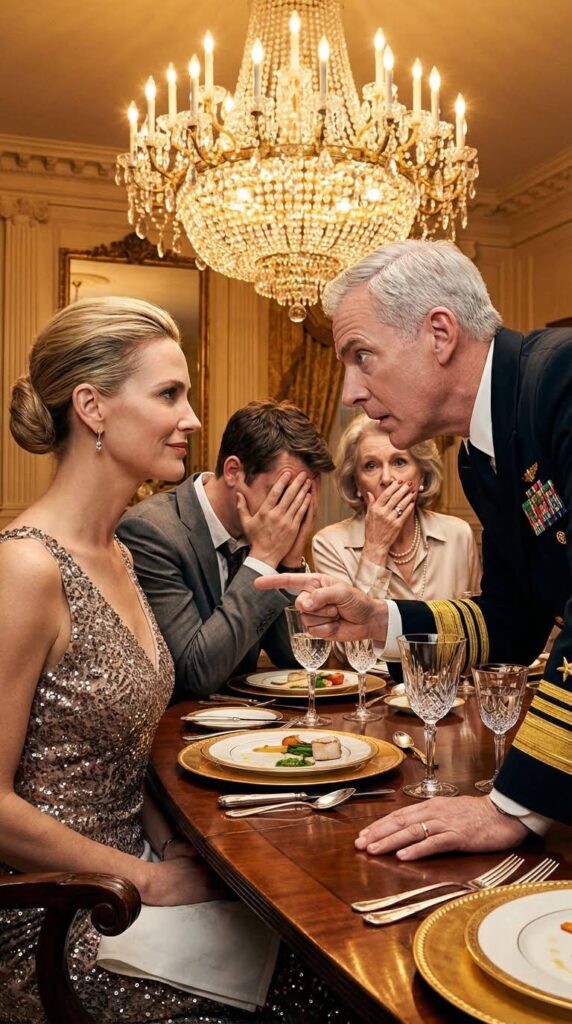
The dining room oxygen evaporated. Margaret stared at her napkin. Daniel’s face was buried in his hands.
Frank took a slow, victorious sip of his sweet tea.
He isn’t speaking to me, I realized with a sudden, icy clarity. He is speaking to a phantom. A frail, civilian contractor who has no right to occupy his airspace.
I carefully dabbed my mouth with the linen napkin, folded it with geometric precision, and placed it beside my plate. I locked my gaze onto his, holding it until the silence became a physical weight.
“Frank,” I said, my voice dropping to that terrifyingly calm register that commands absolute silence in a war room. “I possess a very intimate understanding of the burden of command. I am Major General Elaine Mercer. I assumed command of Marine Corps Base Camp Lejeune thirteen days ago.”
The grandfather clock ticked into the suffocating vacuum. Frank’s face went ash-white, his reality fracturing in real-time as he processed the monumental scale of his insubordination. But the true danger wasn’t Frank’s shattered pride. It was the terrified, guilty tremor in Daniel’s eyes, a harbinger of a much deeper betrayal yet to surface.
Chapter 3: Fallout and Fractures
Frank’s immediate reflex was pure, unadulterated denial. When a man’s foundational worldview is nuked from orbit, the brain rejects the data to protect the host.
“You expect me to swallow that?” his voice sounded like crushed gravel.
“I expect nothing, Frank. I am merely correcting your operational picture.”
He slammed his hands on the table, rattling the china. He leaned in, searching my eyes for the punchline. Finding none, he resorted to an interrogation. “If you command Lejeune, who is the current operations deputy?”
“I relieved General Wallace,” I fired back without missing a beat. “Colonel Rivera is holding the billet as acting deputy until the transition board concludes its findings on the fourteenth.”
Frank’s jaw clenched. The specificity was a kill shot. He tried one last, desperate maneuver. “The readiness inspection. Slated for October.”
“Reprioritized and advanced by fourteen days due to systemic supply chain backlogs from the 2nd Marine Division rotation. The strategic timeline could not absorb the delay.”
Margaret sucked in a sharp, audible breath.
I watched the fight drain out of the old warrior. It was a fascinating, tragic metamorphosis. The abstract concept of ‘rank’ suddenly materialized in his dining room, casting a shadow that swallowed him whole. He slumped back, his eyes unfocusing as he mentally rewound the last hour of condescension, realizing he had just spent sixty minutes lecturing a two-star general on the definition of leadership.
“Dad, I can explain—” Daniel stammered.
Frank shot his son a look so lethal it could have stripped paint. “Silence.”
He turned back to me, the arrogance replaced by a nauseating mixture of profound embarrassment and furious betrayal. “You sat there. You let me dig my own grave.”
“I arrived at this house as the woman your son intends to marry,” I replied, my tone neutral. “Not as a commanding officer requiring a salute. You made the decision to dig the grave, Frank. I simply declined to take the shovel from your hands.”
The blunt force of the truth struck him physically. He picked up his glass, hands trembling slightly, and drained it. “I owe you an apology, General.”
“Elaine is sufficient in this house.”
Dinner concluded in a state of shell-shocked silence. I excused myself to the back porch, craving the humid, oxygen-rich Carolina night. The chirping of cicadas was a welcome reprieve from the tactical disaster inside.
The screen door whined, and Daniel slipped out, looking like a man walking to the gallows.
“Elaine… God, I am so sorry,” he pleaded, his voice cracking. “I should have prepped him. I should have told you how deep the lie went.”
I leaned against the wooden railing, the night breeze cooling the heat in my blood. “You believed you were managing the battlefield, Daniel.”
“I was protecting us! I didn’t want your stars to eclipse everything we are.”
“You didn’t manage your father,” I corrected gently, though the words carried the weight of a judge’s gavel. “You managed me. You neutered my identity to make your life more convenient.”
Before he could mount a defense, the door opened again. Frank stood in the frame, looking ten years older. “Danny. Inside. Give us the perimeter.”
Daniel hesitated, but my nod sent him retreating into the kitchen.
Frank walked to the edge of the porch, staring into the impenetrable darkness of his manicured lawn. Minutes bled away.
“I was a colossal fool,” he finally rasped.
“You were defending your temple, Frank. It happens.”
He turned to me, his eyes shining with unshed, humiliating tears. “I spent my entire career preaching humility to boots. And the second a woman of true authority sat at my table, I tried to belittle her. I misjudged my son’s courage, and I vastly underestimated yours.”
“Apology accepted, Frank. Honestly.”
He nodded, a jerky, rigid motion. “He loves you. That boy loves you. If he possessed the sense to choose you, perhaps I didn’t fail him entirely.”
We forged a fragile truce that night. Frank called my office three days later, asking to meet at the base memorial garden—neutral, hallowed ground. Surrounded by the etched names of the fallen, he delivered a second, profound apology, one stripped of ego and dripping with genuine respect. We shared a second dinner that Sunday, a warm, redemptive evening where Frank treated me not as a general, but as an equal. I thought the war was over. I thought we had navigated the minefield.
I was wrong.
Tuesday afternoon, my chief of staff, a Colonel with eyes like flint, knocked and entered my office, locking the door behind him. He didn’t speak immediately. He walked to my mahogany desk and slid a thick manila folder across the polished wood.
The red ‘Inspector General – URGENT’ stamp glared up at me.
But it was the name of the contractor on the inquiry sheet that made my blood run cold, stopping my heart in my chest.
Daniel’s firm.
Chapter 4: The Breach
“Walk me through the blast radius, Colonel,” I commanded, my voice stripping away every ounce of humanity, leaving only the tactical machine.
My chief of staff stood at rigid attention. “A formal complaint filed by a rival defense contractor. The allegation is severe, Ma’am. They claim Mr. Harper’s logistics firm possessed highly classified, advance knowledge of our internal quartermaster requirements. They allege the proposal was illegally tailored.”
I stared at the black ink on the page, the letters swimming slightly. “Are they alleging a leak?”
“They are alleging an inappropriate convergence of interests,” he clarified, his tone delicate but firm. “The Inspector General is initiating formal interviews. Your name, General Mercer, is explicitly cited in the preliminary dossier as the primary vector of connection.”
Because I shared a bed with the man. Because my integrity, fiercely guarded for thirty years, was now inextricably linked to a civilian’s profit margin.
In the military, your honor is not a private asset; it is the currency by which you lead. You do not wait for the fire to reach your uniform.
“Draft the recusal orders immediately,” I snapped, standing up. “I am stepping away from any operational oversight regarding logistics contracting. Inform JAG. Inform the Pentagon. We throw the doors wide open for the IG.”
“Yes, Ma’am.”
When I pulled into my driveway that evening, the house was a mocking picture of domestic bliss. The porch light was on. Daniel’s SUV was parked perfectly. The smell of garlic and simmering tomatoes drifted through the front door.
I walked into the kitchen. Daniel was standing at the stove, a glass of wine in hand, smiling like a man without a care in the world.
“Hey,” he smiled, turning down the heat on the pasta water. “Long day?”
I dropped my briefcase on the island. I didn’t reach for a glass. I didn’t soften my stance. I reached into my leather bag, extracted the IG dossier, and dropped it onto the granite counter. The slap of the paper sounded like a gunshot.
Daniel’s smile vanished. His eyes locked onto the seal of the Inspector General. The color drained from his face so rapidly he looked sickly pale.
“Elaine…” he whispered, the pitch of his voice betraying total comprehension.
“You knew,” I stated. It wasn’t a question.
He swallowed, his Adam’s apple bobbing frantically. “There were… rumors of a complaint. A competitor throwing a tantrum. I didn’t think it would escalate to an official inquiry.”
“Did you know,” I asked, measuring every syllable with lethal precision, “that my name was being invoked in your boardrooms?”
“I never gave them anything classified! I swear to God, Elaine!” He stepped toward me, hands raised in surrender. “I never exploited you.”
“Did your team leverage my rank?”
His eyes darted to the floor. The silence was an agonizing confession. “A marketing director,” he mumbled. “He made an offhand comment to a procurement officer. Just… namedropping. I reprimanded him immediately. It was unofficial.”
Unofficial.
The word twisted the knife. “You orchestrated a three-year lie to hide my stars from your father because it made you uncomfortable,” I said, my voice echoing off the tile. “But the moment those same stars could tilt a multi-million dollar contract in your favor, you let your subordinates wield my rank like a golden key.”
“Elaine, please, it was a mistake. We can contain this.”
“Contain it?” I barked, the general finally breaking out of the fiancé. “You don’t get to borrow my integrity, Daniel! You do not get to gamble with the blood and sweat I bled into this uniform!”
He reached for my arm. I stepped back, my eyes cold enough to freeze water.
I saw him clearly then. Not as the man who bought me coffee or held me in the dark, but as a man who viewed reality as a clay he could mold to avoid discomfort. He managed his father. He managed his employees. He managed me.
“The engagement is terminated,” I said.
“Over one stupid comment?” he cried out, panic finally shattering his composure.
“Over a systemic failure of character,” I corrected. “Pack your things, Daniel.”
He packed his bags that night, weeping quietly in the guest room. I thought amputating the infected limb would save the patient. I thought the worst was behind me.
But two weeks later, the IG investigators returned to my office, their faces grim, carrying a thicker file. The rot, it seemed, had spread much further into my command than I ever could have imagined, and the storm was just making landfall.
Chapter 5: The Tempest
Late August on the Carolina coast is a masterclass in atmospheric deception. One moment, the sky is a brilliant, deceitful azure; the next, the barometric pressure plummets, and the horizon bruises into a violent, bruised purple.
The political storm of the IG investigation was suddenly eclipsed by a literal monster born off the coast of Africa.
At 0500 on a Monday, my operations officer practically kicked my door open, a glowing tablet clutched in his hand. “Ma’am. The models shifted at midnight. It’s hooking west. Direct trajectory for Lejeune.”
I snatched the tablet. The cone of uncertainty had collapsed into a lethal, crimson spear pointing directly at my base. “Timeline?”
“Seventy-two hours to tropical storm-force winds. Forty-eight before the civilian county initiates mandatory evacuation protocols.”
“Stand up the Emergency Operations Center immediately,” I ordered, my mind instantly compartmentalizing the lingering heartbreak. “Full crisis manning. I want logistics, medical, housing, and family readiness in the war room by 0700. We don’t wait for the civilian authorities to panic. We outrun them.”
By 0700, the EOC was a hive of controlled adrenaline. Colonel Rivera, my steadfast deputy, flanked me. I stood before the digital maps, projecting absolute, monolithic calm.
“We treat this as a Category 3 direct hit,” I told the assembled commanders, looking into eyes that held a flicker of genuine fear. “Evacuate the low-lying housing zones immediately. Double the generator fuel reserves. Sergeant Major, ensure the junior NCOs are visibly calm. Panic is contagious; so is discipline. Execute.”
For forty-eight hours, I existed on black coffee and adrenaline. The base transformed into a fortress bracing for a siege. Convoys of tactical vehicles moved families; sandbags were stacked in geometric walls.
When the outer bands struck, the sky turned a sickening, jaundiced yellow. The wind didn’t just blow; it screamed, a high-pitched mechanical howl that vibrated in the teeth. Inside the EOC, the lights flickered as the main grid died, replaced instantly by the deep, thrumming bass of the diesel backups.
At 0300, a frantic radio call broke through the static. A family, having defied the evacuation order, was trapped in a flooded neighborhood just outside the wire, a massive pine tree crushing their egress.
“Deploy the swift-water rescue assets,” I barked into the comms. “I want them extracted, I don’t care if you have to cut through the roof.”
We rode the leviathan out. By 0900 the next morning, the screaming faded to a ragged, exhausted gale.
I led the initial damage assessment convoy outside the gates into the civilian sector. The devastation was visceral. Ancient oaks were snapped like toothpicks; power lines danced dangerously in the standing water.
Near a flooded elementary school, I spotted a Coast Guard swamp buggy coordinating with local fire units. A tall, broad-shouldered officer in a soaked operational uniform was huddled over a laminated map.
I approached, my boots splashing in the toxic water. He looked up, his eyes sharp, scanning my rank insignia before meeting my gaze.
“Captain Marcus Lee, Coast Guard,” he stated, his voice a deep, steady anchor in the chaos. “We’re running water extractions in sector four.”
“Major General Mercer,” I replied.
“I’m aware,” he said. No deference, no awe. Just professional acknowledgment. “Your Marine rapid response teams were out here at dawn. They saved six lives on Elm Street before my boats could navigate the debris. Flawless execution, General.”
“We share the battlespace, Captain.”
We stood shoulder-to-shoulder, mapping out the search grids. There was an ease to his presence, a lack of ego that was intoxicating after months of Daniel’s constant, suffocating management. Marcus Lee didn’t care about my stars; he cared about the logistical puzzle of saving lives.
“If your infrastructure holds, I’m shifting my mobile command here,” he said, wiping rain from his jaw. “Solid work today.”
“You too, Captain.”
I returned to headquarters feeling a strange, hollowed-out clarity. The physical storm had passed, leaving behind splintered pines and bruised shores. It felt like a baptism by water.
But as I sat in my office, stripping off my soaked utility jacket, my legal officer appeared in the doorway. He was as pale as a corpse, clutching a sealed evidence bag.
“Ma’am,” he whispered, shutting the door behind him. “The IG cyber-crimes unit just pulled the forensic data from Daniel’s servers. They found internal emails. And… they know exactly who tipped them off to start the investigation.”
Chapter 6: Friendly Fire
“Who?” The word tasted like ash in my mouth.
My legal officer wouldn’t meet my eyes. He placed a single sheet of paper on my desk. “The initial tip wasn’t from a competitor, Ma’am. It was a domestic call. Traced to a civilian landline.”
I looked at the number. My blood pressure flatlined. I knew that number. I had dialed it to thank a woman for a pot roast.
It was Frank Harper’s house.
The architect of my professional nightmare was the man who had just welcomed me into his family.
I didn’t wait for an escort. I drove my government vehicle through the debris-littered streets, the setting sun casting long, twisted shadows across the broken landscape of North Carolina. I slammed the truck into park in the Harper driveway, killed the engine, and marched to the front porch.
Frank opened the door before I could knock. He looked at my face, read the lethal, uncompromising fury in my eyes, and didn’t even attempt to feign ignorance.
“Margaret,” Frank called out softly into the house. “Go to the sunroom. Close the door.”
He stepped out onto the porch, closing the door behind him. We stood in the humid twilight, two warriors on a battlefield of broken trust.
“You initiated the Inspector General investigation against your own son,” I said, my voice eerily flat.
Frank gripped the porch railing, his knuckles white. He looked old. Ancient. “I did.”
“Explain yourself. Now.”
He exhaled a shuddering breath. “After that first dinner… after I made a fool of myself, I started listening to how Danny talked about you. I heard him on a phone call with his partners. He wasn’t bragging about his brilliant fiancé. He was implying he had the ear of the commanding general of Lejeune.”
Frank turned to me, his eyes burning with a fierce, protective fire. “You told me, on this very porch, that your rank wasn’t a tool to be borrowed. I spent thirty years watching officers ruin their careers for a few bucks. I knew if his company got caught, the shrapnel would tear you to pieces.”
“So you called the wolves on him?”
“I called an old buddy at the Pentagon,” Frank corrected, his voice cracking. “An anonymous tip. I figured if Danny was clean, it goes away. But if he was using your stars… I had to sever the cord before he dragged you down with him.”
The revelation hit me with the force of a physical blow. I had come here to scorch the earth, to rage at a betrayal. But looking at Frank’s anguished face, I realized it wasn’t sabotage.
It was a violent, desperate act of protection. He had sacrificed his own son to protect the honor of the uniform, and to protect me.
“You should have come to me, Frank,” I whispered, the anger bleeding out of me.
“I know,” he choked out, a single tear cutting through the wrinkles of his weathered face. “But Danny is a smooth talker. I was terrified he’d convince you to cover for him. I had to make it official.”
I placed a hand on his trembling shoulder. The war between us was truly over.
Two days later, the trap closed. I was summoned to the federal courthouse in Raleigh to provide sworn, recorded testimony regarding the procurement scandal. It was the final nail in the coffin.
As I walked out of the briefing building toward my vehicle, a shadow detached itself from the memorial garden.
Daniel.
He looked entirely unraveled. His suit was wrinkled, his eyes manic with the exhaustion of a man who has watched his empire burn to the ground.
“Elaine,” he pleaded, stepping into my path.
“Step aside, Mr. Harper,” I commanded, my voice echoing off the granite walls of the fallen.
“They’re going to indict the firm,” he gasped, reaching out but stopping inches from my uniform. “If you testify… if you confirm the timeline… they’ll bar me from federal contracting for life. Please. Say you don’t remember the dates. Just give me that.”
I stared at the man I had almost promised my life to. He was still managing. Still negotiating. Still trying to alter reality to avoid the consequences of his own cowardice.
“I am going into that room,” I said, my voice possessing the terrible, unyielding weight of a mountain. “I will raise my right hand, and I will swear to tell the truth. I will not perjure myself to save a man who tried to use my soul as collateral.”
Daniel’s face crumpled into a mask of pure, venomous bitterness. “I loved you,” he spat. “And you are going to execute me.”
“You executed yourself, Daniel. I am just signing the death certificate.”
I walked past him, the click of my low heels on the pavement echoing like gunfire. He vanished into the Carolina humidity, his legacy in tatters. Tomorrow, I would raise my right hand and testify under oath, driving the final, fatal spike into his career. I just didn’t know if the hammer blow would shatter my own foundation in the process.
Chapter 7: The Horizon
The bureaucratic labyrinth of a federal inquiry is a slow, agonizing meat grinder, but when it finally concludes, the silence is deafening.
My testimony was brief, factual, and utterly devoid of emotion. It was the lethal dose the Inspector General needed. Daniel’s firm was blacklisted from Department of Defense contracts for a decade. He resigned in disgrace, slipping away to Virginia, leaving nothing behind but an apologetic, cowardly email that I deleted before finishing the first paragraph.
My command survived the scrutiny unblemished. I had recused myself early; I had acted with absolute transparency. The stars on my collar remained untarnished, but the woman wearing them felt hollowed out, scraped clean by the emotional shrapnel.
Winter crept into North Carolina, chilling the Atlantic and stripping the leaves from the oaks.
On a biting Tuesday evening, my phone vibrated on my desk. It was Captain Marcus Lee.
I’m off duty. Walking the shoreline at Emerald Isle. The wind is brutal, but the coffee is hot. If the General requires a tactical retreat from the puzzle palace, my location is compromised.
A genuine, unforced smile broke across my face for the first time in months.
I found him standing near the dunes, the collar of his peacoat turned up against the biting ocean wind, holding two steaming paper cups. He didn’t salute. He just handed me a coffee and fell into step beside me as we walked the foamy edge of the Atlantic.
“The IG report dropped today,” Marcus said softly, his eyes on the grey horizon.
“It did.”
“You survived.”
“I did.”
We walked in a comfortable, profound silence. It was a revelation—being in the presence of a man who didn’t feel the need to fill the quiet with his own ego, who didn’t look at my rank as a threat or a ladder.
“I’m not looking to complicate your operational tempo, Elaine,” Marcus said eventually, his voice barely carrying over the crashing surf. “But I excel at slow starts. If you ever want to stand down… just let me know.”
I looked at his rugged, wind-chapped profile. “A slow start sounds like an excellent strategy, Marcus.”
The following Sunday, I pulled my truck into the Harper driveway. The crimson Marine Corps flag still snapped proudly in the wind.
Margaret swung the door open, her eyes crinkling with joy, and pulled me into an embrace that smelled of vanilla and fierce loyalty. Frank was in the kitchen, carving a roast. He looked up, setting the knife down, and gave me a crisp, deeply respectful nod.
We sat at the table. Daniel’s ghost was gone, banished by the warmth of a family that had chosen integrity over blood. After dinner, Frank slid a small, velvet box across the mahogany table.
“Open it,” he grunted, looking everywhere but at me.
Inside rested a heavy, brass challenge coin. It was scarred and worn smooth at the edges from decades of being rubbed by a nervous thumb. The emblem of the 3rd Marine Division was faded.
“A buddy gave that to me in ’72,” Frank rasped, his voice thick with emotion. “Told me to hold onto it until I met someone who reminded me what the soul of this Corps actually looks like.”
I gripped the cold brass in my palm, the weight of it grounding me.
I had walked into this command expecting to fight wars on foreign shores. Instead, I fought a brutal, intimate insurgency for my own identity. I lost a fiancé, but I retained my soul. I gained a family that understood the true cost of honor, and I found a man who could walk beside a storm without trying to control the wind.
Looking around the table, listening to Frank argue playfully with Margaret, I felt the heavy, institutional armor slip away. I wasn’t just a General anymore. I was Elaine. And for the first time in a long time, the horizon looked absolutely clear.