
Chapter 1: The Forgery of Grief
The exact moment I understood the absolute, metallic weight of justice, I wasn’t standing in a courtroom. I was standing in the foyer of my childhood home, calmly handing a digital voice recorder to a state prosecutor while two uniformed police officers ratcheted cold steel cuffs around my mother’s wrists.
I am Madison. By profession, I am a museum curator. My entire life’s work revolves around verifying provenance—tracing the lineage of artifacts, distinguishing priceless historical truths from brilliant, deceptive forgeries. Yet, for thirty-one years, I had utterly failed to recognize that my own family was a masterful, predatory fake.
The unravelling of that forgery began on a bruised, gray Thursday morning in early October at Oakwood Cemetery in Westchester. I stood beside the open grave of my husband, Julian. The wind howled through the ancient oaks, whipping my black coat around my knees, acting as the only entity that had bothered to show up to mourn with me.
The presiding priest gently closed his leather-bound liturgy book, his eyes carrying a deep, uncomfortable pity. He asked if I required a moment alone.
I turned my gaze away from the freshly turned earth and looked at the three rows of folding chairs arranged beneath the green canopy. They were entirely empty.
I would soon discover that my mother, Stephanie, had taken it upon herself to send a “private, family-only” notice to Julian’s law firm, deliberately printing the incorrect time for his interment. She wanted me isolated. She had meticulously manufactured a vacuum of silence, a psychological quarantine designed to ensure that in my darkest, most shattered hour, I would have no choice but to crawl back to her for comfort. There were no distant footsteps crunching on the gravel pathways. There were no breathless late arrivals. Just twenty vacant seats holding nothing but the freezing autumn air.
“Yes,” I murmured to the priest, my voice devoid of any tremor. “I suppose I already am.”
The sound of the groundskeepers throwing the first heavy shovel of dirt onto Julian’s mahogany casket was a dull, suffocating thud. I kept my eyes bone-dry out of pure, clinical stubbornness. Julian used to tease me mercilessly for weeping over sentimental television commercials, but staring into that raw, gaping wound in the earth, my tear ducts were sealed. My heart wasn’t breaking. It was calcifying. It was hardening into a tactical shield.
When the workers finally scraped their shovels clean and retreated, I pulled my phone from my pocket and dialed my mother.
Stephanie answered on the fourth ring. Her voice floated through the speaker—light, airy, and dripping with a synthetic sweetness that made my stomach turn.
“Where is everyone?” I asked, the words clipping the cold air.
There was a pause on the line. It lasted exactly three seconds too long—the precise duration of a mind calculating its next lie. “Oh, Madison, darling,” she sighed. “People process grief in their own unique ways. Your father wasn’t feeling up to the emotional toll, and your sister, Alexa, had an emergency inventory check at the boutique. We simply didn’t want to crowd you.”
I stared at the twenty empty chairs. “You wouldn’t have crowded me.”
Then, she delivered the sentence that irrevocably altered the trajectory of my life. “You have always been our strong girl, Madison. You don’t need a public spectacle.”
To the woman who gave birth to me, the act of lowering my husband of eleven years into the ground was nothing more than a spectacle. She advised me to go home, take a warm bath, and rest. Then, she disconnected.
The dial tone buzzed against my ear, a mechanized insult. I stood there, tracing Julian’s name carved into the fresh granite headstone, and the truth washed over me like ice water. The silence of my family wasn’t an accident of grief. It was a calculated, deliberate weapon.
Halfway to the parking lot, my phone vibrated. A text from my sister, Alexa, illuminated the screen. Mom said the funeral went fine. Call us later. Went fine. Like a routine dental cleaning or an oil change.
I sat in the driver’s seat of my sedan, gripping the leather steering wheel until the blood drained from my knuckles. The anger that bloomed inside me wasn’t loud or chaotic. It was terrifyingly precise.
By 11:51 PM that night, I was sitting behind Julian’s heavy oak desk in our home office. It was the last sanctuary where I could still sense his formidable strength. It was also the perfect command center to begin the clinical dismantling of the bloodline that had abandoned me.
Julian had been the invisible financial spine of the Whitmore family for a decade. He was the primary benefactor of their lifestyle, quietly funding the security systems, the emergency lines of credit, and the shared accounts my parents treated as their personal treasury. As the sole executor of his estate, the digital keys to that kingdom were now exclusively mine.
By 2:30 in the morning, my mouse clicks echoed like gunshots in the quiet house. With cold, methodical keystrokes, I revoked every single access code. I purged Stephanie, my father Jeffrey, and Alexa from the emergency banking protocols. I locked them out of the shared security vault.
This wasn’t an act of spite. It was a necessary, overdue audit. They had assumed I would simply weep and play my designated role. But the game had fundamentally changed.
And as I opened the final digital folder on Julian’s encrypted drive—a folder ominously titled Whitmore Contingency—I saw a string of financial transfers that made the breath catch violently in my throat.
Chapter 2: The Architecture of the Will
The following morning, the soaring glass walls and polished marble floors of Clemens and Rowe felt entirely too pristine for the grime of my betrayal. I walked through the heavy mahogany doors of Julian’s law firm, breathing in the scent of lemon oil and expensive, billable silence. I hadn’t come for a shoulder to cry on. I had come for the balance sheets.
Mr. Thomas Garrett, a senior partner with neatly combed silver hair and a gaze as unreadable as a corporate merger, stood immediately when I entered his office. Julian had trusted this man with his deepest secrets, and today, Garrett was legally bound to hand those secrets to me.
We waded through the routine bureaucracy of death—insurance authorizations, death certificate copies, standard finalities. My signature looked jagged, like it belonged to a stranger, but I forced my hand to remain steady.
Then, Garrett paused. The rhythmic shuffling of papers ceased. He pulled a thick, red-banded folder from his desk drawer and slid it precisely across the polished wood.
“Julian updated his final testaments eight months ago, Madison,” Garrett said, his voice dropping an octave. “It was a strict precaution. He left you everything.”
I braced myself for the numbers, expecting the modest, comfortable cushion we had always discussed over dinner.
Instead, Garrett began listing an empire.
“Six luxury lofts in Manhattan, all zoned for commercial and top-tier residential income,” he read, turning the pages. “A private, fully-staffed oceanfront villa in the Hamptons, without a cent of mortgage debt. And, naturally, his controlling shares in the consulting firm.”
The air completely evacuated my lungs. I gripped the armrests of my leather chair. “Thomas… what is the total valuation?”
Garrett looked me directly in the eye. “You are the sole owner of an estate valued at eight million, five hundred thousand dollars.”
The number hit the desk like a shattered chandelier. Eight point five million. Why had Julian hidden the magnitude of our wealth?
“He wanted you secure,” Garrett explained softly, anticipating my shock. “Completely untouchable. When he finalized this, he used a specific phrase that I documented. He said, ‘If anything ever happens to me, I want Madison protected from everyone.’“
From everyone. Not just business rivals or strangers. He meant the people who shared my DNA.
Staring at the legal documents, a dark, clinical tally of the last decade flickered through my mind. I had been the silent, bleeding investor in the Whitmore family illusion. I was the daughter who quietly wired fifty thousand dollars to bail out Jeffrey’s catastrophic real estate ventures, all while he publicly lectured me on financial responsibility. I was the one who personally guaranteed Alexa’s boutique lease when no commercial bank would even look at her credit score. My compassion was a luxury asset they had shamelessly overdrafted for a generation.
You might wonder why, armed with millions and the knowledge of their parasitic nature, I still packed a suitcase and drove back to their Westchester estate that evening. It is the haunting question asked of anyone who survives a toxic home.
My therapist would later classify it as learned helplessness—a psychological cage where the victim repeatedly returns to the source of their pain because they have been systematically trained to believe the cage is the only reality that exists. I had spent thirty-one years performing for a love that was strictly, ruthlessly conditional. Walking back into their lemon-scented hallways, some broken part of me was still desperately searching for a sanctuary that was only a mirage.
I arrived close to midnight. The house smelled exactly as it always did—heavy pot roast and expensive floor wax. Come stay with us for a while, my mother had insisted via text. You shouldn’t be alone in that big, empty house.
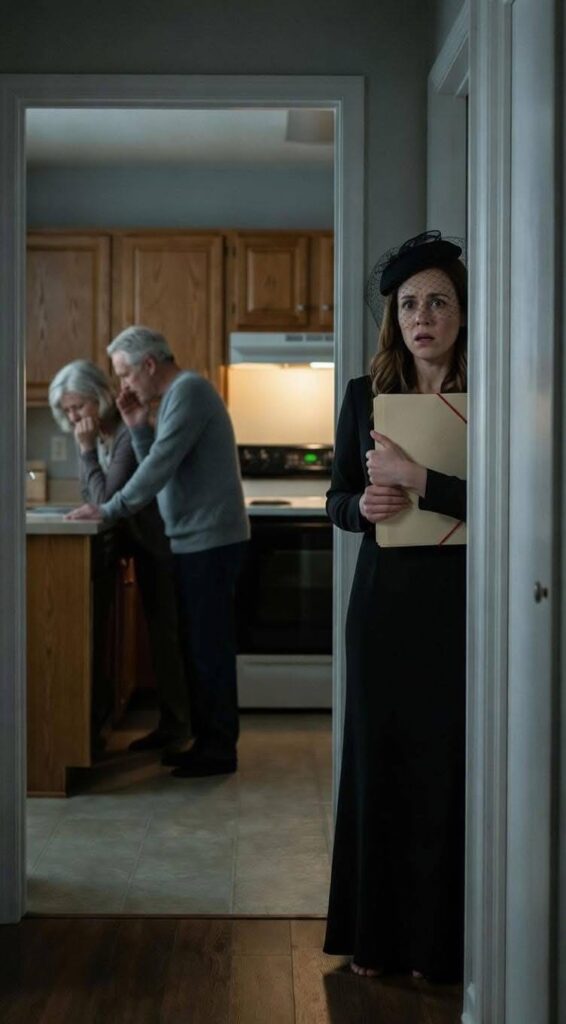
I stood barefoot in the darkened hallway, my suitcase handle still gripped in my hand, when the murmur of voices drifted from the kitchen.
I crept forward, pressing my back against the cool plaster of the wall.
Stephanie stood near the marble island, her silhouette sharp and predatory beneath the hanging pendant light. Jeffrey sat at the table, his shoulders hunched, nursing a glass of scotch.
“Once Dr. Gary declares her unfit, we take immediate control,” my mother whispered, the words dripping with a terrifying excitement. “She won’t even know what hit her.”
My blood turned to liquid nitrogen, but my mind snapped into clinical focus.
“Are we sure this is entirely necessary, Steph?” my father asked, his voice low, cowardly, and uneasy.
“Of course it is necessary!” she snapped back, slamming a glass onto the counter. “She just inherited six Manhattan lofts, Jeffrey! Six! She cannot handle that kind of capital in her fragile, grieving state.”
They knew a corrupt doctor’s signature couldn’t bypass a judge indefinitely, but it was the golden key they needed for an emergency 72-hour involuntary psychiatric hold. In those three days, while I was locked in a sterile ward for my own “protection,” they planned to file for a temporary, emergency conservatorship. By the time I was allowed to call a lawyer, the locks on my bank accounts and my life would already be changed.
“Emotional instability is incredibly easy to document,” my mother continued, her voice smoothing out into chilling calmness. “We start small. Just a few sedatives in her evening tea. Enough to make her seem disoriented and confused during the evaluation.”
I stopped breathing entirely. My own mother was discussing the proper dosage to chemically alter my mind and legally strip me of my liberty.
I forced myself to back away, sliding my feet silently across the hardwood floor, terrified that a single creaking floorboard would alert the predators in the kitchen.
Chapter 3: The Dead Man’s Switch
The next evening, the staging of the play commenced.
I sat at the antique dining table, watching a ribbon of steam curl lazily upward from a delicate porcelain teacup Stephanie had placed gently in front of me.
“Drink it while it’s hot, sweetheart,” she cooed, her face painted with that rehearsed, sickening warmth. “It’s a special chamomile blend. It will help ease the stress.”
I stared into the amber liquid, knowing with absolute certainty that it contained a double dose of the sedatives she had secured. Across the table, my father aggressively cut his steak, his eyes fixed firmly on his plate, utterly incapable of meeting my gaze. They were coming for the principal of my life, and this dinner was their closing statement.
I lifted the fragile cup to my lips, allowing the rim to touch my teeth. I took a tiny, infinitesimally small sip—just enough to wet my tongue and sell the performance—and then set it down. Slowly, over the next twenty minutes, I let my shoulders slump. I allowed my gaze to drift, unfocused, toward the ceiling. I let the mask of the broken, unstable widow slide perfectly into place.
The game had officially begun.
I woke the next morning to the gray light filtering through the floral curtains of my childhood bedroom. Stephanie was already hovering in the doorway, her predatory eyes scanning my face, searching hungrily for the neurological effects of the drugs.
I gave her exactly the masterpiece she wanted to see.
“Mom… everything feels so foggy,” I whispered, slurring my words slightly, pressing the heel of my hand against my temple as if the room were spinning. “I can’t… I can’t find the edges of my thoughts.”
A sharp, unmistakable glint of satisfaction flared in her eyes before she quickly masked it with a tragic pout. “Oh, my poor darling. Rest. Just rest.”
While they saw a sedated, compliant victim, I was secretly curating the most important, high-stakes exhibit of my entire career. I know that the most devastating displays are the ones that tell a story using the subject’s own artifacts.
During the quiet afternoon hours when they assumed I was unconscious, I locked myself in the guest bathroom. I dug into the hidden lining of my cosmetic bag and retrieved a secondary burner phone. Stephanie had kindly “suggested” she hold onto my primary cell phone to protect me from overwhelming condolence calls. She didn’t realize that being married to a brilliant corporate litigator meant I always had a backup communications protocol.
I dialed Thomas Garrett’s direct line.
“Madison,” he answered immediately.
“Thomas, it’s time. Activate the dead man’s switch.”
Julian, anticipating the absolute worst of human nature, had designed a fail-safe. It was a fully automated, deep-dive forensic audit—a digital hammer that would immediately execute the second my medical status was legally questioned, or if I was ever hospitalized without Garrett’s direct, written oversight.
Later that night, at 1:17 AM, I slipped out from under the heavy down comforter. Moving with the absolute silence of a shadow, I crept down the hallway toward my parents’ master suite. The air tasted of floor polish and old lies. I knelt beside the brass HVAC vent located just outside their door. The metal grate was cold against my palms. Using a coin from my pocket, I carefully unscrewed the grate, wincing at the microscopic scrape of metal on metal.
I pulled a high-fidelity digital voice recorder from my pocket, pressed a strip of double-sided industrial tape to its back, and secured it deep inside the duct wall. I replaced the grate, my hands as steady as a surgeon’s.
The next afternoon, while I slumped convincingly on the living room sofa, my burner phone vibrated silently against my thigh. It was a secure email from Garrett. The forensic audit had completed its initial sweep of the Whitmore family finances.
Under the cover of a thick throw blanket, I opened the encrypted files.
What I saw shattered the final, lingering fragments of my family’s facade. They hadn’t merely been waiting for Julian’s death to seize my assets. They had been feeding on me like parasites for over two decades.
The audit laid bare a systematic, horrific extraction of one million, five hundred thousand dollars from my childhood trust fund—money explicitly designated by my grandparents for my education and future security. Stephanie and Jeffrey had siphoned it off over twenty years through a labyrinthine web of shell companies, fake consulting fees, and falsified living expenses.
I felt a bitter, acidic irony burn the back of my throat. As a curator, I spent my days rigorously verifying the authenticity of centuries-old artifacts. Yet, I had never once questioned the provenance of my own financial history. For twenty-six years, Jeffrey had handed me official-looking annual statements printed on forged bank letterhead, showing modest, steady growth. I didn’t fail to look at the numbers; I simply didn’t know I was admiring a masterpiece of financial forgery.
My entire upbringing was a long-term investment they had liquidated one lie at a time. I wasn’t their beloved daughter. I was a bank account they had been overdrafting since I was five years old.
They believed they were one corrupt doctor’s signature away from an eight-and-a-half-million-dollar payday. They had no idea that the forensic trail they left behind was about to become the concrete that buried them alive.
Chapter 4: The Final Exhibit
The air in the living room felt dense, suffocatingly thick, like the ominous, static-charged moments before a massive supercell thunderstorm breaks open the sky.
I lay slumped against the plush velvet cushions of the sofa, my limbs heavy, my gaze intentionally fixed on a blank patch of wallpaper. Stephanie perched on the edge of the adjacent armchair, her hands clasped so tightly her knuckles were white. She was vibrating with anticipation as she watched Dr. Gary—the family physician who was eagerly bartering his medical license for a slice of my inheritance—remove a silver clipboard from his worn leather bag.
Dr. Gary knelt beside the sofa, clicking a small penlight. The beam cut harshly through the dimness of the room, sweeping across my pupils.
“Madison,” his voice was soft, practiced, and dripping with false empathy. “Can you tell me what year it is?”
I let a long, agonizing pause stretch between us. I allowed my eyelids to flutter, simulating deep cognitive fog. “It’s… 2026,” I whispered weakly. Even though I knew the date perfectly, I added, “It’s March, right?”
It was mid-October.
Jeffrey paced the perimeter of the Persian rug, his footsteps a nervous, rhythmic thud against the floorboards. “You see, Gary?” my father said, his voice laced with manufactured panic. “She is deteriorating incredibly fast since Julian passed. She doesn’t even know what season it is.”
Dr. Gary nodded solemnly, his expression carefully arranged into a mask of grave professional concern. He clicked his pen and began filling out the thick stack of paperwork resting on his clipboard—the Certificate of Temporary Incapacity, and the formal medical recommendation for a supervised financial conservatorship.
Stephanie leaned forward. She couldn’t suppress the predatory joy illuminating her features. She was already mentally evicting tenants, measuring the massive windows in my Manhattan lofts, and calculating the exact interest on eight million dollars.
“Will this documentation be enough for the judge, Gary?” Stephanie asked, her greed making her careless.
“It will be more than enough,” Dr. Gary replied quietly, not looking up from his writing. “Given her recent, severe bereavement and the observable, acute confusion, a judge will sign the 72-hour hold immediately.”
I let my head loll to the side, looking at my mother through half-open eyes. “Mom… help me,” I whimpered.
Stephanie reached out and stroked my hair. Her touch felt like dry ice against my scalp. “Shhh, it is okay, sweetheart. I am handling everything. You just rest.”
The sound of Dr. Gary’s pen scratching his signature across the bottom of the legal form echoed through the quiet room like a gunshot.
Scratch. Click. The ink was dry. The trap was set.
That was the exact moment I sat up perfectly straight.
The simulated fog vanished instantly from my eyes. The engineered weakness evaporated from my spine. I squared my shoulders, planting my feet firmly on the floor.
The room went eerily, violently silent. The sudden change in my posture was so jarring that Dr. Gary physically recoiled, dropping his pen onto the rug.
I looked directly into the doctor’s terrified eyes. “I hope you enjoyed signing that document, Dr. Gary,” I said, my voice ringing with absolute, terrifying clarity. “Because your medical license is about to become a historical artifact.”
Stephanie gasped loudly, her hand flying to her chest in a pathetic, theatrical display of shock. “What… what are you talking about? You tricked us!” she shrieked, her facade crumbling into dust.
I offered no verbal reply. Instead, I reached deep into the pocket of my cardigan and pulled out the digital voice recorder I had retrieved from the HVAC vent an hour prior.
My thumb found the cold plastic button. I pressed play.
The living room was suddenly filled with the unmistakable, crystal-clear audio of Stephanie’s own voice.
“Once Dr. Gary declares her unfit, we take immediate control… Just a few sedatives in her evening tea. Enough to make her seem disoriented…”
Jeffrey froze mid-step, his face draining of all color, transforming into a ghastly, pale mask of absolute horror.
Before the recording even finished playing, the heavy oak front door of the estate burst open with a deafening crash.
Chapter 5: The Ledger Settled
“Hands where we can see them! Nobody move!”
The authoritative command echoed violently through the foyer, shattering the last remnants of the Whitmore illusion.
Four uniformed police officers flooded into the living room, their hands resting on their duty belts. Right behind them walked Thomas Garrett, looking like an executioner in a bespoke suit, accompanied by Marcus Ruiz, the lead investigator from the state prosecutor’s office.
Dr. Gary shot to his feet, holding his hands in the air, but a towering officer was faster. He grabbed the doctor by the shoulder, spinning him around. “Dr. Gary, you are being detained for conspiracy to commit medical fraud and falsification of legal documents.”
Marcus Ruiz stepped past the struggling doctor and turned his cold gaze toward my parents.
“Jeffrey and Stephanie Whitmore,” Ruiz announced, his voice carrying the immense, crushing weight of the law. “You are both under arrest for attempted unlawful conservatorship, conspiracy to administer controlled substances without consent, and massive, sustained financial fraud.”
The sharp, metallic click of the handcuffs snapping tightly around my mother’s wrists was, without question, the most beautiful symphony I had heard in years.
Stephanie wrenched her head around, her eyes blazing with a feral mixture of unadulterated hatred and pure, suffocating terror. “You will regret this, Madison!” she screamed, spit flying from her lips as the officer forced her arms behind her back. “You are nothing without us!”
I stood up, walking slowly until I was inches from her face. I met her manic gaze without blinking. “I assure you, Stephanie. I won’t regret a single second of this.”
Jeffrey looked at me as a second officer secured his wrists. His face had completely crumpled, aging ten years in ten seconds, displaying a sudden, pathetic disbelief. “Maddie… please,” he stammered, tears welling in his cowardly eyes. “You could have just talked to us. We are family.”
I looked at the man who had stolen my future to fund his ego. “I tried to talk to you, Jeffrey. I tried to talk to you at the cemetery. But you didn’t show up.”
I stepped back, addressing them both as the officers began to guide them toward the door. “I asked the universe for a mother and a father. You chose to be predators instead. Enjoy the cage.”
As they were physically led out the front door, their faces illuminated by the frantic, flashing red and blue lights painting the dark Westchester night, I exhaled a breath I felt I had been holding for three decades.
I hadn’t just protected my husband’s inheritance. I had finally, irrevocably, protected myself.
Epilogue: The Provenance of Freedom
Two weeks after the arrests, I stood barefoot on the sprawling mahogany deck of the Hamptons villa, watching the dark, churning waters of the Atlantic Ocean roll in. The waves crashed against the shoreline with a steady, rhythmic power, sounding as though they had all the time in the world.
The legal machinery had engaged swiftly and mercilessly. Formal felony charges were filed. Dr. Gary’s medical license was suspended pending a permanent revocation hearing. I did not attend their preliminary arraignment; I simply didn’t need to look at their faces so soon. Instead, I had quietly packed my single suitcase, walked out of the Westchester estate, and never looked back.
The villa was slightly smaller than I remembered, featuring crisp white shutters and massive, panoramic windows facing the relentless ocean. Julian had always held my hand and promised this would be our “someday place.”
I suppose someday simply arrived much differently than either of us had planned.
As the evening sky bruised into shades of brilliant gold and deep violet, I stood against the railing and realized that the grief in my chest had shifted. It no longer felt like a heavy, suffocating blanket. It felt clean. I was not a piece of property to be managed, and neither was my late husband’s legacy.
The criminal cases moved with blistering speed because high-fidelity audio recordings do not lie, and digital forensic paper trails do not forget. Dr. Gary lost his practice and his freedom. Facing overwhelming evidence of their decades-long theft, Jeffrey and Stephanie eventually accepted a brutal plea deal that included years of strict probation, total asset seizure to pay heavy restitution fines, and permanent, binding legal restrictions barring them from ever holding power of attorney or petitioning for conservatorship again.
Alexa fled the state entirely, deeply terrified the audit would expose her boutique’s fraudulent leases. We now exchange only brief, incredibly careful text messages on major holidays.
Some bridges burn quietly, and I have made the conscious, empowering choice never to rebuild them.
Instead, I took the vast resources Julian left me and built something that actually mattered. I converted one of the massive Manhattan lofts into the Julian Harper Resource Center—a fully funded legal sanctuary for women facing financial coercion, familial theft, and conservatorship abuse.
I recognized that I hadn’t merely survived a horrific betrayal; I had survived a systemic pattern of abuse. Now, I spend my days teaching other survivors about legal awareness, forensic accounting, and the absolute power of leverage.
I have come to realize a fundamental truth: you do not need a massive crowd standing behind you to reclaim your power. You only need clarity.
For those of you who have always felt like you were standing on the crumbling edge, or who never quite fit into your toxic family’s picture-perfect narrative, I want you to know that you are not crazy, and you are not alone. Family is a sacred choice we actively make every single day; it is not a slave contract signed in blood at birth.
One year ago, I stood beside a cold grave, convinced the earth had swallowed everything I loved. But profound loss does not erase you. If you survive it, it reveals you.
Julian’s physical absence is no longer an open, bleeding wound. It has become the unbreakable foundation of the formidable woman I am today. I am still here. And for the first time in thirty-one years, I am not just surviving the forgery of my life.
I am writing my own, authentic truth.