
Chapter 1: The Invisible Colonel
The Sunday brunch was a masterclass in suffocating, old-money passive-aggression. I sat at the far, drafty end of the sprawling mahogany dining table, shifting my weight. My carbon-fiber prosthetic leg was aching with a dull, rhythmic throb, predicting the afternoon rain long before the dark clouds gathered over the sprawling Sterling family estate in upstate New York.
I was Sarah Vance, thirty-five years old, and a retired Colonel in the United States Army. I had left a piece of myself—literally and figuratively—in a dusty, nameless valley during a classified extraction gone wrong. Now, I chose to work as a night-shift security guard at a mid-level tech firm. The sterile, quiet hallways of the graveyard shift offered the solitude I desperately needed to keep the jagged edges of my PTSD at bay. I didn’t need the money. I needed the peace.
But peace was a foreign concept in this house.
Evelyn, my mother-in-law, didn’t even bother to make eye contact as she passed a crystal pitcher of mimosas down the table, deliberately skipping my empty glass.
“It’s just such a profound shame, Mark,” she sighed, touching her perfectly coiffed hair while looking at my husband. “You’re a senior partner at a prestigious architectural firm, and you’re married to… a night-watchman. I actively have to lie to my friends at the country club. I tell them Sarah is ‘early retired’ just so they don’t pity us.”
Mark, a man whose spine seemed to dissolve whenever he crossed his mother’s threshold, looked down at his plate of eggs benedict. He had moved us into the small, cramped guest house on the edge of the property under the guise of “helping his family through a temporary liquidity crisis.” He didn’t know that my night job was merely a therapeutic cover while I remotely managed a multi-million dollar veteran’s foundation. He only saw the limp, the cheap polyester guard uniform, and the silence he mistook for submission.
Jessica, Mark’s twenty-eight-year-old sister, was entirely engrossed in scrolling through digital bridal magazines on her iPad, aggressively planning her upcoming “Wedding of the Century.” She let out a sharp, mocking laugh.
“She’s not just a guard, Mom. She’s a completely broke guard,” Jessica sneered without looking up from a photo of imported orchids. “Sarah, I saw your uniform draped over the chair in the laundry room. Honestly, that cheap polyester blend must itch terribly. If you need a small loan for a decent dress for my wedding, just ask. Oh, wait, I forgot—you probably can’t even afford the gas to drive up to the venue.”
I took a slow sip of ice water. The cold glass grounded me. I didn’t defend myself. I didn’t tell them about the heavy, fireproof black safe box bolted beneath the loose floorboards of my tiny room. I certainly didn’t tell them about the Priority Card resting inside it—a piece of encrypted, solid titanium issued by the Department of Defense. It was a high-limit, black-budget government expenditure card reserved for top-tier operatives and commanders transitioning out of deep-cover operations, ensuring access to emergency federal funds anywhere on the globe.
To the Sterlings, I was a stain. A charity case. A crippled burden dragging down their upper-middle-class masquerade.
I finished my water and stood up, the mechanical whir of my knee joint cutting through the clinking of their silver forks. “Excuse me. I have a shift to prepare for.”
That evening, as I zipped up my dark blue jacket and headed out into the fading light, my mind was already shifting to the quiet perimeter checks of my job. Because I was looking forward to the silence, I didn’t look back. I didn’t see Jessica watching me from the deep shadows of the hallway. She wasn’t looking at my face, or my limp; her greedy eyes were entirely locked on the small, brass key I had accidentally left sitting on the edge of the kitchen counter—the only key to the room she was strictly forbidden to enter.
Chapter 2: The Theft of Valor
The dawn was breaking, casting a bruised purple light over the estate as I finally unlocked the door to the guest house. A twelve-hour shift on a throbbing stump usually left me numb, but the moment I stepped over the threshold, a primal, icy instinct kicked in. The air in my room was wrong. It smelled like expensive, cloying floral perfume.
I stepped into the center of my small bedroom. The rug was pushed aside. The floorboard was violently pried up, its edges splintered.
The safe was wide open.
My hand went immediately to my chest, my heart slamming against my ribs in a rapid, heavy cadence. I didn’t care about the few hundred dollars in emergency cash or the heirloom watch sitting inside. My fingers scrambled over the velvet lining, searching for the cold, heavy weight of titanium.
It was gone. The Priority Card was gone.
A civilian holding that card was dangerous. A civilian using it was a federal nightmare. It wasn’t just a bank account; it was a direct, encrypted tether to Department of Defense logistics and black-budget treasuries.
I didn’t panic. Panic was for civilians. I opened my encrypted laptop and logged into the Overwatch terminal. A glaring red alert was already pulsing on the screen. The card’s integrated GPS and transaction log had triggered.
Location: Vanderbilt’s Fine Jewelry, a high-end boutique in the city’s wealthiest district.
I didn’t even change out of my wrinkled security uniform. I drove the speed limit, my mind calculating the exact blast radius of what was about to happen. When I walked into the hushed, velvet-lined showroom of Vanderbilt’s, the contrast was jarring. I smelled of stale coffee and night air; the store smelled of polished glass and old money.
Jessica was standing at the VIP counter, admiring her reflection in a gold-rimmed mirror. Resting against her collarbone was a thick, cascading diamond necklace that sparkled like fractured ice.
“It’s absolutely perfect,” she was telling the jeweler, a nervous-looking man in a tailored suit. “And you said the funds cleared instantly? Splendid.”
“Jessica,” I said. My voice wasn’t loud, but it carried the low, dangerous frequency of an approaching storm. “Put the card on the glass. Now.”
She spun around, initially startled, but her expression quickly melted into a grotesque, triumphant smirk. She held up her hand. Pinched between her manicured index and middle fingers was my titanium ID, the DoD seal glinting under the halogen lights.
“This?” Jessica laughed, a light, dismissive sound. “I found it in your little lockbox. I figured since you’re a ‘crippled soldier’ surviving off government handouts, you wouldn’t mind sharing the wealth. You certainly don’t need one hundred thousand dollars for a new plastic leg or whatever sad little retirement you’re saving for. I have a wedding to win, Sarah. Consider this your ‘thank you’ for letting us graciously host you in our home.”
She turned back to the mirror, adjusting the diamonds, completely oblivious to the invisible tripwire she had just snapped. She hadn’t just stolen from a sister-in-law; she had compromised a secure military asset.
I didn’t reach for the card. I didn’t raise my voice or my hand. I stood perfectly still, reached into my uniform pocket, and pulled out my encrypted mobile device. I bypassed the standard screen and dialed a twenty-digit alphanumeric sequence.
“This is Colonel Sarah Vance, ID Alpha-Six-Niner,” I spoke into the receiver, my tone completely devoid of emotion. “My Priority Card has been compromised and unlawfully accessed by a civilian. I am officially declaring a Category 2 security breach. Initiate asset recovery and prepare for suspect apprehension.”
Chapter 3: The Storm Before the Wedding
The atmosphere in the main house the following evening was thick with the scent of Earl Grey tea and blinding delusion. They had summoned me to the living room for a “family intervention,” treating my stolen federal asset like a petty domestic squabble over borrowed shoes.
“Sarah, please, don’t be so terribly dramatic,” Evelyn said, taking a delicate sip from her china cup. Across the room, Jessica was busy angling her phone, snapping photos of the stolen diamonds on her neck for her Instagram followers. “It’s just money. Mark makes a wonderful living; he will pay you back out of his bonuses over the next ten years. You simply cannot ruin Jessica’s big day over a ‘priority card.’ We are family. We protect our own.”
I shifted my gaze to Mark. He was standing by the fireplace, looking at me with wide, pleading eyes that swam with pathetic pity. He was a man desperately trying to avoid a storm by pretending the sky wasn’t black.
“Sarah, please,” Mark whispered, stepping forward to gently touch my arm. I flinched internally but held my ground. “Just let this go? For me? I’ll make it right, I swear. Just don’t call the police. It would destroy my mother’s reputation in the community.”
“I won’t call the police, Mark,” I said, my voice smooth, yielding.
And I meant every single syllable. I absolutely would not call the local police. The local precinct didn’t have the clearance, the jurisdiction, or the firepower for what was currently in motion.
Over the next three days, I played the role of the defeated, broke veteran to absolute perfection. I watched in cold silence as Jessica, emboldened by my apparent surrender and intoxicated by the card’s lack of a visible spending limit, lost her mind. She swiped the titanium for another fifty thousand dollars. She paid off the historic estate venue in full. She upgraded the catering to imported wagyu and truffles. She bought ten thousand dollars worth of white peonies.
She was livestreaming her entire “luxury bridal week,” deliberately mocking me in the captions of her posts.
When your security guard sister-in-law is actually hoarding a secret settlement but is too stingy to share, you have to take what’s rightfully yours! #BridalVibes #WarriorMoney #Karma
She was so obsessed with the glowing screen of her phone that she didn’t notice the world shifting around her. She didn’t notice the pair of black, unmarked SUVs that had permanently parked at the end of our cul-de-sac. She didn’t notice the two ‘technicians’ from the telecom company who spent three hours working on the neighborhood relay box, quietly tapping the Sterling family’s phone lines and internet routers. She thought she had found a magic wand; she had actually swallowed a tracking beacon.
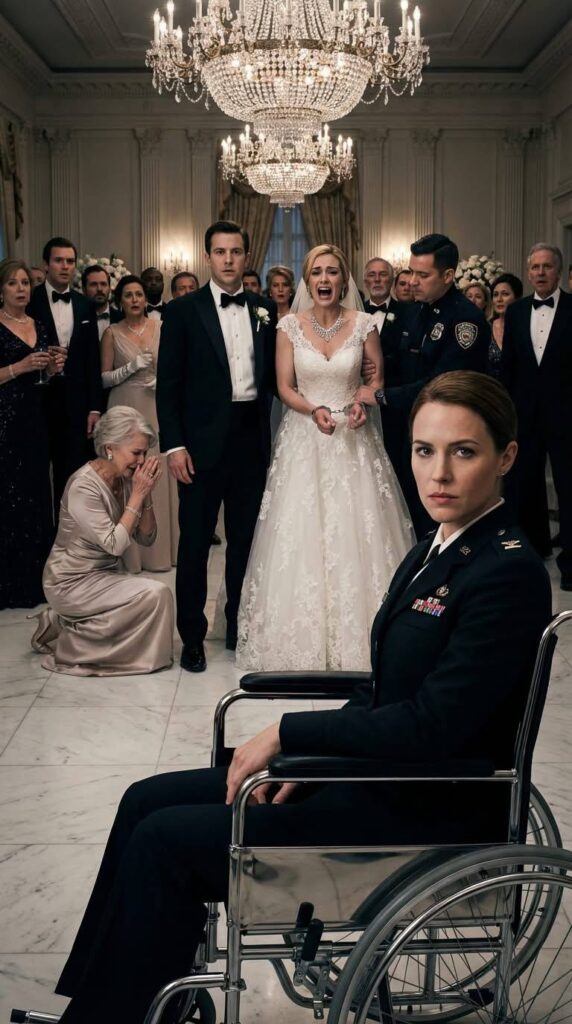
The morning of the wedding arrived with brilliant sunshine and cloudless blue skies. The guest house was empty. I stood before the full-length mirror, slowly buttoning the dark navy fabric of my Army Dress Blues—the uniform I had kept meticulously pressed and hidden inside a climate-controlled storage unit for two years. I pinned my silver eagles to my shoulders. I aligned my ribbons, the Purple Heart resting heavy over my chest.
My burner phone buzzed against the mahogany dresser. I glanced at the glowing screen. It was a text from an encrypted, untraceable number.
Target confirmed in position. Perimeter secured. Proceeding with public extraction.
Chapter 4: The Handcuffs and the Veil
The historic estate was a vision of excessive, stolen opulence. Five hundred guests, dressed in pastel silks and bespoke suits, sat on white wooden chairs arranged perfectly on the manicured grand lawn. A string quartet was playing a soft, sweeping classical piece as the ceremony began.
I didn’t walk through the guest entrance. I waited at the perimeter, out of sight, standing shoulder-to-shoulder with men who spoke my language.
Jessica was exactly halfway down the long, white silk aisle. Her custom designer train swept the grass, and the hundred-thousand-dollar Vanderbilt diamonds threw blinding prisms of light across the faces of the admiring crowd. She looked like a queen. She looked untouchable.
Then, the low, rhythmic thumping started. It grew from a distant vibration into a deafening roar, completely drowning out the frantic cellos of the string quartet.
The guests looked up in horror as two matte-black Blackhawk helicopters broke over the tree line, hovering aggressively over the edges of the estate. The downdraft whipped the imported white peonies into a frenzy, sending petals tearing through the air like snow.
Evelyn shrieked, dropping her mother-of-the-bride bouquet as the heavy wooden gates at the rear of the ceremony shattered inward. Twenty men wearing tactical gear, heavy body armor, and windbreakers emblazoned with CID (Criminal Investigation Command) swarmed the altar, their boots tearing up the pristine grass.
“What is the meaning of this?!” Evelyn shrieked, her voice cracking as she rushed toward the altar. “This is a private, exclusive event! My husband is a judge!”
The crowd was frozen in paralyzed shock. The tactical team formed a tight, impenetrable perimeter around the bride and the altar.
Then, I stepped out from the shadow of the ancient oak trees.
My polished dress shoes clicked against the stone pathway. My medals clinked softly with every measured, even step. The guests gasped, murmuring in frantic confusion. They hadn’t seen the ‘broke guard’ in the cheap polyester uniform; they were staring at a decorated Field Grade Officer of the United States Military.
The lead CID agent, a towering man with a face like carved granite, saw me approach. He immediately snapped a crisp, razor-sharp salute.
“Colonel Vance,” he barked over the dying whine of the helicopter rotors. “The stolen asset has been located and secured. The perimeter is locked.”
I returned the salute, then turned my gaze to Jessica. Her face was entirely drained of blood, whiter than her expensive silk veil. She was trembling so violently the stolen diamonds rattled against her collarbone.
“Jessica Sterling,” I said. My voice wasn’t a yell, but in the sudden, terrified silence of the lawn, it amplified like a gunshot. “You bypassed a Level-4 encryption device and misappropriated over one hundred and fifty thousand dollars of federal funds intended for national defense logistics. In the eyes of the United States government, you didn’t just steal money for a party. You actively compromised a senior military operative’s security. That is an act of domestic sabotage.”
“Sarah, please, tell them it’s a mistake!” Jessica cried out, her facade completely crumbling as the lead agent grabbed her wrist.
Click. Click.
The sharp, metallic sound of federal handcuffs locking around her wrists was, without a doubt, the most beautiful music played at the venue all day.
“It was just a credit card!” Jessica sobbed, mascara running down her cheeks, struggling weakly against the agents. “You’re my sister! How can you do this to family?!”
“I was your sister,” I replied, my voice as cold and unforgiving as the titanium she had stolen. “Right up until the moment you looked me in the eye and told me a ‘crippled soldier’ didn’t deserve to have her own life.”
As two agents forcefully dragged the sobbing bride back down the aisle she had just walked, ripping her veil in the process, the lead CID agent turned his dark sunglasses toward Evelyn and Mark. They were huddled together, shaking with terror.
“And as for the rest of you,” the agent stated, his voice flat and clinical. “The federal investigation into your complicity and harboring of stolen military assets starts right now. Nobody leaves this estate.”
Chapter 5: The Fallout of Arrogance
The Sterling family name didn’t just die; it was publicly, brutally executed.
Within forty-eight hours, the story had violently erupted across every major news network and national newspaper. SOCIALITE STEALS BLACK-OPS MILITARY ASSET TO FUND WEDDING DIAMONDS. The optics were a public relations nightmare that no amount of country club influence could fix.
Jessica was denied bail. She was sitting in a federal holding facility, facing a minimum of twenty years in a federal penitentiary for grand larceny, wire fraud, and violating the Espionage Act by handling a classified DoD asset. The diamonds were seized as federal evidence, roughly ripped from her neck in the booking room.
The collateral damage to the rest of the family was surgical and absolute. Because Evelyn and Mark had directly “benefited” from the stolen funds—attending a venue and eating catering paid for by the stolen priority card—the federal government swiftly froze all of their assets under the RICO act pending a deep-dive investigation. The bank accounts were locked. The credit cards were declined. Evelyn, completely stripped of her liquid wealth, was legally forced to list the sprawling family estate for auction just to afford the retaining fees for a team of cutthroat defense lawyers.
Three days later, Mark sat in the center of our now-empty apartment in the city. I was zipping up my canvas duffel bag.
“Sarah, please,” he begged, his voice hoarse from crying. “You have to use your influence at the Pentagon. Call the General. Get them to offer Jessica a lighter sentence. She’s your sister. She really didn’t know what she was doing.”
I stopped packing and turned to look at him. I felt absolutely nothing. The man I thought I loved was just a hollow suit holding up a fragile ego.
“She knew exactly what she was doing, Mark,” I said, my tone deadly quiet. “She knew I was a soldier. She knew I was severely injured serving this country. And she looked at my scars and decided that my sacrifice made me less of a human being. She thought it made me a target.”
I picked up my bag and walked to the front door. “And you? You stood by the fireplace and watched her do it because you didn’t want to ’cause a scene’ before dessert. You didn’t protect your wife, Mark. You protected a thief.”
I reached into my pocket, pulled out my diamond wedding band, and set it down on the kitchen counter with a sharp clink. It rested perfectly on top of the manila folder containing my finalized divorce filing.
I wasn’t going back to the graveyard shift. The Pentagon, alerted to my situation, had formally requested I return to active duty at the rank of Colonel to serve as a senior strategic consultant for veteran affairs in Washington. My prosthetic still clicked when I walked, and the phantom pains still flared when it rained, but the crushing, suffocating weight on my shoulders—the weight of trying to shrink myself to fit into a family that actively hated me—was completely gone.
I was at the airport departure gate, sipping black coffee, when I glanced up at the CNN broadcast on the terminal television. It was live footage of Evelyn Sterling. The former queen of the country club was being physically escorted out of her foreclosed mansion by two grim-faced bank bailiffs. She looked directly at the camera, her eyes hollow, her expensive makeup smeared.
My phone vibrated in my pocket with a small ping. I opened it. It was a direct text message from Jessica’s high-priced defense attorney: “Jessica is terrified. She’s willing to testify against her mother regarding financial complicity if you can help her secure a plea deal. Please advise.”
I didn’t reply. I pressed ‘Delete’, picked up my duffel bag, and walked toward my gate.
Chapter 6: The Colonel’s Peace
One year later, the air in Virginia was warm and thick with the smell of fresh paint and blooming dogwood trees.
The Vance Center for Healing was finally, officially open. I stood at the polished wooden podium, looking out over the manicured courtyard. Dozens of veterans—men and women missing limbs, carrying invisible scars, and fighting battles nobody else could see—were gathered in the sunlight. They finally had a state-of-the-art place to recover, to find community, and to heal with absolute dignity.
I was dressed in a sharp, tailored civilian charcoal suit, the fabric hiding the mechanics of my leg. But every single person in that courtyard knew my rank, and more importantly, they knew my story. I was respected not for the millions of dollars I managed, but for the character forged in the fires I had survived.
As I scanned the crowd, my eyes caught a movement at the very back, near the iron gates.
It was Mark. He looked ten years older. His suit was ill-fitting, his shoulders slumped with the heavy gravity of a ruined life. He had lost his partnership at the firm due to the scandal. He tried to catch my eye, raising a hesitant hand, his face a portrait of profound, agonizing regret.
I didn’t glare. I didn’t smile. I simply looked right past him, focusing my gaze on the American flag fluttering steadily in the gentle breeze above the center’s entrance.
“They often call us ‘broken,’” I said into the microphone, my voice steady, carrying over the silent courtyard. “They see our physical scars, they sense our silent struggles, and they mistakenly believe our inherent value has decreased. Sometimes, the ignorant think they can take from us because they assume we have already given up too much to fight back.”
I gripped the edges of the podium, looking at the proud faces of my fellow soldiers.
“But a warrior’s strength isn’t measured by what she has sitting in a bank account, or the clothes on her back,” I continued. “It’s measured by the indisputable fact that no matter how hard they hit you, no matter how many times they try to push you down into the dark, you will always find a way to march back up to the light.”
The courtyard erupted into applause. I stepped away from the microphone and walked down the stage stairs. My carbon-fiber prosthetic clicked firmly and rhythmically against the pavement. It was no longer the sound of a woman hiding in the shadows; it was the sound of an undeniable, marching advance.
As I got into my car and put the engine in gear, my encrypted phone buzzed softly on the dashboard. I opened the secure intake app. A new veteran recruit was requesting to join the center’s rehabilitation program—a young, female combat medic who had lost her way after a brutal deployment.
I scrolled down to read her intake file. Her name was Sterling.
I didn’t recognize the first name. It wasn’t a relative of Mark’s; just a cosmic, poetic coincidence of the universe. I looked at the name for a long moment, feeling the ghosts of my past finally settle into the earth.
I smiled, putting the car in drive.
“Everyone deserves a chance to start over,” I whispered to the empty car. “But this time, they’ll learn to do it right.”