
1. The Invasion of Sanctuary
I never thought I would have to become a ghost to my own family just to feel safe in my own home.
The penthouse was my fortress. Perched high above the bustling streets of downtown, it was a sanctuary of floor-to-ceiling windows, soft grey furniture, and quiet, sun-drenched mornings. It was a space I had worked fifteen grueling, eighty-hour work weeks for fifteen long years to afford. More than a collection of expensive real estate, it was the first place that had truly, entirely felt like mine after a brutal, soul-crushing divorce had left me feeling like a trespasser in my own life.
This penthouse was the architecture of my healing.
But my younger sister, Vanessa, treated my sanctuary like an open house. To her, my hard-won success wasn’t a personal achievement to be respected; it was a communal asset, a luxury hotel she had a lifetime pass to.
It started subtly, with a series of escalating “emergencies.” She would call me in a panic, claiming she needed a place to “crash for a few hours” after a fight with her on-again, off-again boyfriend. I would come home from my corporate law office to find my kitchen littered with greasy takeout boxes and my custom-made Italian sofa covered in the sticky, grape-jelly fingerprints of her two young, undisciplined sons, Mason and Noah.
When I finally confronted her about the lack of notice, she had simply laughed, a high, tinkling sound devoid of any genuine remorse. “Oh, stop being so dramatic, Maya. We’re sisters. What’s yours is mine, right?”
The first time I found out she had taken my master key from the kitchen bowl and made her own copies, I felt a cold, violating dread creep up my spine. It felt like a physical intrusion. I immediately hired a locksmith and had every single lock in the penthouse changed, upgrading to a high-tech digital keypad system.
It bought me exactly one week of peace.
I came home the following Friday to find Vanessa in my living room again, watching a reality show on my television.
“How did you get in?” I had demanded, my voice shaking with a mixture of rage and disbelief.
“Mom gave me the new passcode,” Vanessa had replied casually, not even bothering to look up from the screen. “She said you were being incredibly selfish and antisocial, and that you needed to learn how to share. Family doesn’t lock family out, Maya.”
The realization that my own mother was actively complicit in the violation of my boundaries was a staggering blow. I didn’t argue. I went to a security firm the next day and had a series of tiny, discreet, motion-activated cameras installed throughout the main living areas.
A week later, I sat in my office boardroom, my phone vibrating on the table. I watched, my blood turning to ice, a live feed of Vanessa hosting a “girls’ night” for three of her friends in my living room. They were drinking a bottle of my rare, expensive Italian wine directly from the bottle, their laughter echoing in my quiet sanctuary. In the background, her sons were using my custom-sculpted, imported Italian art piece as a makeshift coat rack.
When I called her, my voice trembling with contained fury, and ordered her out of my house, she had just laughed again. “Relax! We’re just having fun! We’re family, Maya. You need to learn how to let go.”
The final, unbreakable straw broke on a Friday night in November.
I returned home late from a stressful client dinner, my entire body aching with exhaustion. I unlocked my front door, expecting the blessed relief of silence and solitude.
Instead, the apartment was filled with the obnoxious, high-pitched blare of cartoons. Vanessa was in my kitchen, casually making a sandwich with my expensive, artisanal ingredients. Her two sons were fast asleep on my custom-made, white silk sofa, their muddy shoes leaving dark, smeared tracks across the pristine fabric.
But it wasn’t the trashed sofa or the stolen food that stopped my heart.
It was the sight of my master bedroom door hanging wide open. The one room in the house I had explicitly, repeatedly told her was off-limits. My most private, personal sanctuary.
I walked slowly down the hallway, a cold, sickening dread pooling in my stomach. My closet doors were open. Several of my expensive, designer overnight bags were missing from the shelf.
“What are you doing?” I whispered, my voice barely audible.
Vanessa turned from the counter, taking a large bite of her sandwich, entirely unbothered. “Oh, hey,” she said, chewing loudly. “The boys were exhausted, and my place is a mess. I figured we’d just stay the weekend here. It’s easier. I grabbed some of your luggage from the closet. Hope you don’t mind.”
The argument that followed was not quiet. It was a vicious, ugly, screaming match that finally, brutally aired a lifetime of repressed resentment. Her children woke up, crying from the noise, which only fueled her rage.
She finally cornered me in the foyer, her face inches from mine.
“You know what your problem is, Maya?!” Vanessa screamed, her voice cracking with a high-pitched, hysterical fury, pointing a trembling, accusatory finger at my chest. “You are cold, you are bitter, and you are completely broken! You’re a ghost rattling around in this empty, sterile museum! No wonder your marriage failed! No wonder he left you!”
She grabbed her now-wailing children by the hands, dragging them toward the elevator.
“You can change the locks all you want, Maya!” Vanessa shrieked over her shoulder, her final, parting shot designed to be the killing blow. “But you can’t lock out family! We will always have a key!”
She thought she had won the argument as she dragged her crying, traumatized children toward the elevator doors. She thought she had asserted her unbreakable, familial right to my life.
She had absolutely no idea that as I stood in the violated sanctuary of my home, a new, cold, and entirely different plan was already forming in my mind. A plan for her permanent, legal, and absolute eviction.
2. The Silent Sale
I didn’t sleep that night.
After Vanessa and her children finally left, I didn’t clean up the mess immediately. I simply sat on the edge of my bed, staring at the open closet, the empty space where my luggage used to be, and I let the sheer, violating poison of her words wash over me.
You can’t lock out family.
She was right. The horrifying, suffocating truth of that statement settled into my bones like a terminal illness. As long as my mother enabled her, as long as Vanessa believed she was entitled to my life, no lock, no alarm, and no boundary would ever be strong enough. They would always find a way in.
I spent the entire weekend scrubbing every single surface of my penthouse with bleach. I threw out the expensive wine glasses her friends had used. I hired a professional upholstery cleaner to steam-clean the muddy tracks from my silk sofa. I was trying to erase the physical feeling of her hands in my closet, the scent of her entitlement in my air.
But as I worked, a new, terrifyingly clear realization crystallized in my mind.
I couldn’t lock out my family.
But I could sell the locks.
I didn’t list the penthouse on the public market. I didn’t want open houses, nosy real estate agents, or a digital trail my mother could follow. I needed a swift, silent, and brutal transaction.
I called a single, private contact from my old, high-stakes corporate law days.
His name was Arthur Sterling.
Sterling was a ruthless, notoriously aggressive, and incredibly effective Senior Federal Prosecutor who specialized in dismantling organized crime rings. He was an intimidating, intensely private man whose personal life was a fortress of absolute, unbreachable security. He was also, as I knew from a brief conversation at a legal gala two years prior, quietly looking for a secure, high-floor, private-elevator-access downtown property that would be impossible for his various enemies to penetrate.
I met him for espresso the following Tuesday at a discreet, quiet café far from my usual neighborhood.
I didn’t haggle. I didn’t negotiate.
I offered him the fully furnished penthouse, complete with all the custom Italian furniture and my security system, at a ten percent discount off its market value in exchange for a ten-day, all-cash closing with no inspections.
Sterling raised a single, skeptical eyebrow. “That’s an incredibly generous offer, Ms. Vance,” he said, his voice a low, rumbling baritone. “What’s the catch? Is the building sinking?”
I took a slow sip of my espresso. “There is no structural catch, Mr. Sterling. The building is sound. But I feel it is my ethical duty to warn you of a specific, persistent pest problem.”
I looked him directly in the eye.
“My younger sister,” I stated, my voice flat and devoid of any emotion, “has a profound, pathological sense of entitlement. She has made copies of the keys, she has the digital passcode, and she has a habit of trespassing on the property at will. She believes, on a fundamental level, that she has a legal and familial right to access this penthouse whenever she pleases.”
Sterling listened intently, his cold, steel-grey eyes narrowing slightly as I spoke. A flicker of something that looked like dark amusement crossed his features.
He leaned forward slightly.
“Ms. Vance,” Sterling said, his voice a low, terrifying rumble that I had heard him use to intimidate witnesses on the stand. “I prosecute home invaders, terrorists, and mob bosses for a living. I build airtight federal cases that put dangerous, entitled men behind bars for the rest of their lives.”
He offered a small, cold, predatory smile.
“I wholeheartedly welcome the opportunity to practice my professional skills on my own time,” Sterling continued. “You have a deal. Leave the digital passcode active. And please, do not inform your sister of the sale. I would very much like to meet her.”
We closed the deal the following Friday in a quiet, anonymous law office. The massive sum of money was wired directly into my offshore accounts. I signed the deed, handed over the keys, and walked away from my fortress.
I spent the next week quietly, systematically packing my truly personal belongings—my clothes, my art collection, and my profoundly battered peace of mind—into a secure moving truck.
I relocated to a beautiful, discreet, and highly secure gated townhouse in a different zip code, on the other side of the city. I didn’t forward my mail. I didn’t update my address with my mother. I didn’t block their numbers from my phone yet; I wanted a front-row seat to the catastrophic collision that was about to occur.
Exactly one week after I had handed Arthur Sterling the keys to my former life, I was sitting in the quiet, sunlit garden of my new home, sipping a cup of hot green tea.
My phone, resting on the patio table, began to vibrate violently. It was a pre-arranged, encrypted alert from Sterling’s personal security team.
Front Door Unlocked. Guest Code 0408. Occupant Detected in Foyer.
It was 7:00 PM on a Friday. Vanessa had timed her invasion perfectly, assuming I was still at the office, working late.
She had just walked directly, arrogantly, and entirely willingly into the lion’s den.
3. The Friday Night Raid
(The following events were recounted to me in excruciating, satisfying detail in the official police report I received two weeks later, supplemented by the crystal-clear audio from the hidden security microphones I had neglected to inform Vanessa about.)
Vanessa burst through the front door of the penthouse without knocking, using the keypad code my mother had so generously provided. She was holding two bottles of expensive Chardonnay and laughing loudly with her two sons, Mason and Noah, who trailed behind her, already running their dirty hands along the pristine white walls of the foyer.
She was treating my former home exactly like her personal weekend hotel.
“Maya! We’re here!” Vanessa yelled into the quiet, empty apartment, her voice echoing off the high ceilings. “I brought wine! Let’s order some sushi and watch a movie! The boys want to have a sleepover!”
She threw her designer purse and car keys onto the massive marble kitchen island.
A man stepped silently out of the master bedroom hallway.
He was six-foot-three, built like a linebacker, and wearing an impeccably tailored, charcoal-grey suit that screamed federal authority. In his right hand, he held a sleek, legally permitted, semi-automatic handgun, the barrel pointed firmly, safely, at the floor.
Vanessa froze. The two bottles of Chardonnay slipped from her grasp. They hit the polished hardwood floor, shattering with an explosive crash, sending a spray of white wine and sharp glass skittering across the room.
Mason and Noah screamed, running to hide behind their mother’s legs.
“Who the hell are you?!” Vanessa shrieked, her voice high-pitched and ragged with sudden, overwhelming terror. “Where is my sister?! What have you done to her?! I’m calling the police!”
“I am Arthur Sterling,” the prosecutor said. His voice was a deep, resonant, and utterly terrifyingly calm gavel strike in the quiet room. “I am the sole, legal owner of this private property.”
He raised his left hand, slowly, deliberately pulling a cell phone from his pocket.
“And I,” Arthur Sterling continued, his thumb hovering over the dial pad, “have already called the police. You have triggered a silent, high-priority alarm for a forced, unauthorized entry into the primary residence of a federal law enforcement official.”
Vanessa scoffed, her deeply ingrained arrogance and entitlement momentarily blinding her to the extreme, physical danger she was in. She thought he was bluffing.
“You’re a liar!” Vanessa spat, her voice trembling but defiant. “My sister, Maya Vance, owns this penthouse! This is her home! I’m her sister! I have the security code!”
Sterling offered a cold, humorless smile. It was a terrifying expression.
“Having a stolen security code does not grant you title to a property, madam,” Sterling replied, his voice dropping to a glacial, uncompromising chill. “It makes you a burglar. A very, very stupid burglar.”
The heavy, authoritative thud of tactical boots echoed from the private elevator lobby just outside the penthouse door. A key turned in the new, high-security deadbolt.
The front door swung open.
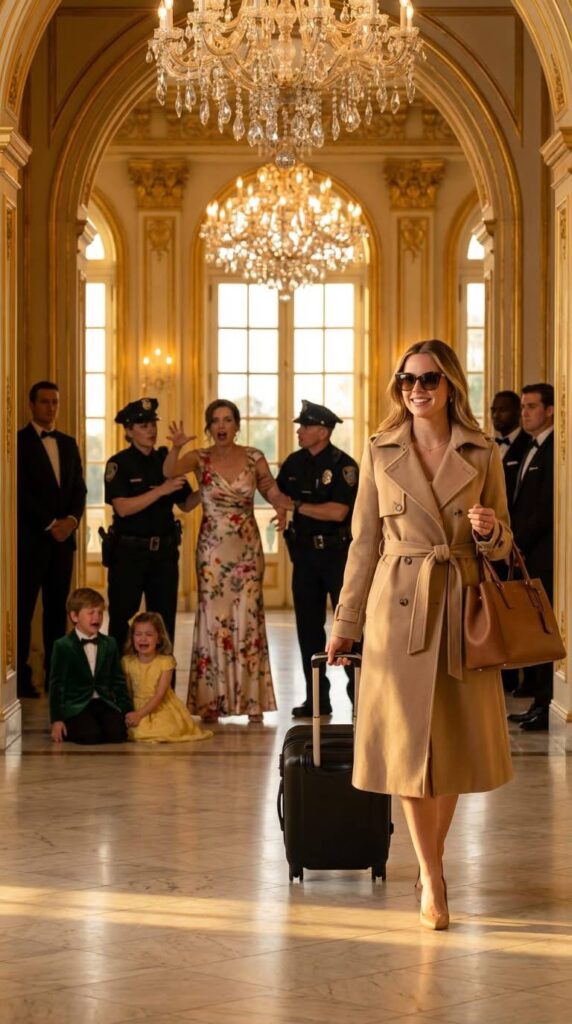
Four heavily armed, uniformed city police officers, responding to a top-priority, “officer in distress” call from a federal prosecutor, stormed through the open front door. They had their weapons drawn, their faces grim and ready for a hostile encounter.
Vanessa screamed, a raw, animalistic sound of pure, unadulterated terror. She grabbed her two crying children, pulling them tight against her body as the officers drew their weapons and ordered her to get on the ground.
Her “free, fun family weekend” at her sister’s expense had officially, irrevocably become a hostage situation of her own making.
4. The Begging on the Hardwood
My phone rang at exactly 7:45 PM.
The Caller ID was an unlisted, restricted number. I knew immediately who it was from.
I took a slow, deliberate sip of my hot green tea, let the phone ring three times, and then answered, putting the call on speakerphone.
“Hello?” I said, my voice perfectly calm.
“Maya! Oh my God, Maya, please! You have to help me!”
It was Vanessa. She was sobbing hysterically, her voice a desperate, broken, and entirely unrecognizable whine. In the background, I could hear the sharp, crackling squawk of police radios and the low, authoritative murmur of officers’ voices.
“They arrested me, Maya!” Vanessa wept, her voice tearing with sheer panic. “They have me in handcuffs! In the back of a police car! There’s a crazy, terrifying man in your house claiming he owns it! He has a gun! Please, you have to call them! You have to tell them I have permission to be there! Tell them I’m your sister!”
I leaned back in my comfortable garden chair, listening to the quiet, peaceful chirping of the crickets in my new backyard.
“I can’t do that, Vanessa,” I said, my voice smooth and utterly devoid of any sisterly warmth.
“Why not?!” she shrieked, the sound of pure, desperate frustration cracking through the speaker. “Why are you doing this to me?! I am facing ten years in prison for felony burglary of a federal official’s residence! My kids… oh my God, Maya, they took my kids! The police said they are taking Mason and Noah into protective custody! Please, I am begging you on my hands and knees! Fix this!”
I could picture her, kneeling on the cold, hard plastic seat in the back of a squad car, her life completely, totally unraveling.
“I can’t tell the police you have permission to be in my house, Vanessa,” I replied, taking another slow, deliberate sip of my tea. “Because it isn’t my house anymore.”
The line went dead silent. The hysterical sobbing stopped instantly. The only sound was the faint squawk of the police radio in the background.
The horrifying, impossible reality of what she had done—of what I had done—finally crashed down on her.
“You…” Vanessa whispered, her voice cracking, breaking into a sound of absolute, soul-crushing disbelief. “You sold it? You sold the penthouse? Without telling us?”
“You told me that family doesn’t lock family out,” I reminded her smoothly, my voice dripping with a cold, sweet, and incredibly satisfying irony. “You told me I couldn’t lock you out. So, I gave the locks to someone else. Someone with a much better security system than I had.”
Suddenly, a different, much more furious voice broke onto the line. It was my mother. She must have rushed to the precinct, or perhaps she was at the scene, screaming at the police.
“Maya! You psychotic, evil bitch!” my mother screamed, her voice a venomous, hysterical shriek. “You set your own sister up! You trapped her! You call this Sterling man right now and you tell him to drop the charges, or so help me God, I will disown you!”
I looked out at the beautiful, quiet, and entirely private garden of my new home. I looked at the high, impenetrable stone walls surrounding the property. I looked at the complete, total, and beautiful absence of my family.
“I’m sorry, Mom,” I said coldly, a genuine smile finally touching my lips. “But you were the one who told me to stop being so selfish and to learn how to share.”
I paused, letting the finality of the moment land.
“So,” I continued, “I generously donated my toxic sister problem to the federal government.”
And I hung up the phone.
5. The Cages They Built
The fallout from Vanessa’s “Friday Night Raid” was immediate, spectacular, and entirely of her own making.
Arthur Sterling, true to his ruthless, uncompromising reputation as a federal prosecutor, refused to drop the charges.
He didn’t pursue the maximum felony of burglary of a federal official’s residence—a charge that would have guaranteed a lengthy, brutal prison sentence. He was a prosecutor, not a sadist. But he didn’t let her walk away unscathed, either.
He argued, with terrifying, clinical precision, that Vanessa’s possession of the stolen security code, her repeated history of unauthorized entry, and her profound, arrogant sense of entitlement made her a clear and present danger to his personal property and security.
To avoid a public, humiliating trial that would have guaranteed at least some prison time, Vanessa was forced to take a brutal, life-altering plea deal.
She pleaded guilty to felony breaking and entering and criminal trespassing. She was sentenced to three years of intensive, supervised felony probation. She was slapped with a massive fine, five hundred hours of mandatory community service, and a permanent, un-expungeable criminal record that immediately cost her her mid-level marketing job.
My parents, desperate to save their golden child from a prison sentence, nearly bankrupted themselves paying for her exorbitant legal defense fees. The immense financial and emotional stress of the ordeal completely fractured their already fragile marriage.
They tried, of course, to find me. They hired a cheap, incompetent private investigator to track down my new address so they could “confront” me, to scream at me, to beg me for the money to pay off the fines.
They never found me.
I had learned my lesson well from my years in corporate law. I had purchased my new townhouse through an anonymous, impenetrable blind trust, a trick I had learned from the very corporate sharks I used to work with. My name wasn’t on the deed. It wasn’t on the property tax records. To the outside world, I was just another anonymous renter.
I changed my phone number. I scrubbed my social media presence. I deleted every digital breadcrumb that could possibly lead them back to my life.
I became a ghost to the very people who had spent my entire life treating my home, my resources, and my love like a public park they could trash at will.
I was finally, truly free.
6. The Right Kind of Silence
A year later.
The only news I ever heard of my family came through a single, brief, and incredibly awkward encounter with a distant cousin I ran into at a downtown coffee shop.
Vanessa was a shadow of her former self. The felony on her record had made it impossible for her to find a decent job. She was living in the cramped, damp basement of my parents’ heavily mortgaged suburban home, bitter, resentful, and complaining constantly about the indignity of her weekly check-ins with her probation officer.
My mother, now forced to work a part-time retail job to help cover the massive legal debts, spent most of her days acting like a long-suffering martyr, telling anyone in the family who would still listen how her cruel, cold-hearted, wealthy daughter had abandoned them in their time of need.
I listened politely to my cousin’s report. I bought her coffee, wished her well, and walked out of the shop into the bright, warm afternoon sun.
They were right about one thing. In the end, I was cold to them.
But you have to be cold to survive a house fire. You have to be ruthless to excise a cancer.
I drove back to my townhouse. I pulled my car into the secure, private, gated garage. I walked up the stairs from the garage, the heavy, reinforced door clicking shut behind me with a satisfying, absolute, and final thud.
My home was completely, utterly silent. But it wasn’t the lonely, sterile silence of my former penthouse. It was a warm, peaceful, and entirely chosen silence.
There were no sticky, uninvited fingerprints on my windows. There was no one drinking my wine without asking. There were no ghosts of past traumas or future invasions.
My sister, in her moment of ultimate cruelty, had screamed at me that I was bitter and broken. She had assumed that because my marriage had failed, because I had chosen to live alone, I was incapable of building a happy, secure life for myself.
She didn’t realize that my brutal divorce hadn’t broken me. It had educated me. It had taught me the most valuable, most powerful lesson of all.
It taught me how to expertly, legally, and permanently excise a parasite from my life.
I poured myself a glass of expensive, rare Italian wine. I walked out onto my private garden patio, listening to the beautiful, unbroken silence of a home that finally, truly, belonged only to me.
The cage was gone. And I was never going back in.