
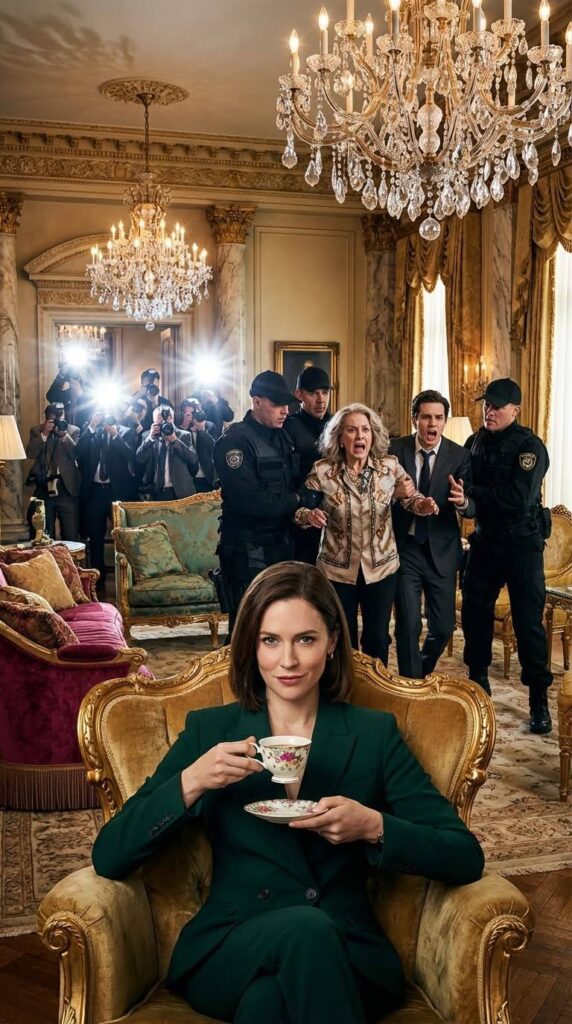
Chapter 1: The Phantom Returns
My sanctuary was a glass box suspended eighty stories above the frantic pulse of Manhattan. Up here, the air was filtered, the silence was absolute, and everything—from the exact angle of my minimalist mahogany desk to the temperature of the room—was entirely under my control. I was Elena Vance, CEO of a boutique logistics firm I had built from absolute zero. They called me the “Ice Queen” in the financial pages, a moniker I wore like Kevlar. Ice doesn’t bleed. Ice doesn’t break.
I was reviewing a quarterly projection, overlooking the steel-gray ribbon of the Hudson River, when my intercom chimed. My assistant’s voice sounded uncharacteristically hesitant. “Ms. Vance, there is a woman in the lobby. She doesn’t have an appointment, but she’s causing quite a scene. She claims to be your mother.”
The stylus in my hand snapped.
Ten years. A full decade of utter, suffocating silence. Not a single birthday card, not a text message, not a phone call when I had nearly faced bankruptcy at twenty-four, living off ramen and sleeping on a damp mattress on the floor. The last time I saw Beatrice, she was walking out the door of my cramped college apartment, having quietly drained the remaining ten thousand dollars of my student loan money to fund the “artistic awakening” of her precious son in Paris. She had left me with a stack of final notices and a broken heater in the dead of winter.
“Send her in,” I said, my voice deadened, recognizing that security dragging her out would only create a public spectacle.
When Beatrice walked through my frosted-glass doors, she didn’t carry an ounce of shame. She didn’t look like a mother seeking forgiveness; she moved with the indignant swagger of an auditor coming to collect. The years had sharpened her features, but she still wore the same faded, desperate glamour—too much cheap perfume and a silk scarf trying to hide the fraying collar of her coat.
She stopped in the center of the room, her eyes darting greedily over my custom-tailored charcoal suit, the panoramic view, and the Hermès leather desk set. She tutted, a wet, condescending sound.
“Well. You’ve certainly done well for yourself, Elena,” Beatrice said, crossing her arms. “It’s about time you started looking after the people who actually gave you life.”
A shadow moved behind her. Julian. He was thirty years old now, a perpetual man-child poured into designer streetwear that he absolutely could not afford. He didn’t even look at me. His eyes were glued to the sleek, multi-monitor setup on my desk, tracking the blinking financial tickers with a feral, predatory curiosity.
A cold dread coiled in my gut, a visceral regression to the frightened, starving girl I used to be. But the Ice Queen violently shoved that girl aside.
“I don’t owe you a single thing, Beatrice,” I said, my voice like crushed glass. I didn’t stand up. “State your business, or security will escort you out.”
She just smiled. It was a terrifyingly maternal expression that stretched her lips but left her eyes dead and calculating. “Oh, darling. You were always so dramatic. We’re family. I just wanted to see my little girl.”
Before I could press the security button, she lunged forward across the desk, wrapping her thin arms around my shoulders in a suffocating, forced embrace. I recoiled, my skin crawling at the scent of stale mints and entitlement.
As she pulled away, smoothing her coat, I was too distracted by the nausea churning in my stomach to notice the slight, almost imperceptible change of weight in the inner pocket of my blazer. I didn’t realize that in that one second of simulated affection, my mother had seamlessly practiced the only skill she had ever truly mastered: theft.
Chapter 2: The $5 Million Slap
It took exactly four hours for the illusion of their “visit” to shatter.
I was in the back of my town car, heading toward a dinner meeting, when the violent vibration of my private phone interrupted the quiet hum of the engine. I glanced at the screen, expecting a brief from my CFO. Instead, a fraud alert glared back at me in stark red text.
Transaction Approved: $5,000,000.00. Merchant: Prestige Realty Group. Card: AMEX Centurion – Ending in 4092.
My Black Card.
My hand shot to my inner blazer pocket. It was empty. The air in the car evaporated. The audacity wasn’t just criminal; it was bordering on psychotic. A Centurion card has no pre-set spending limit, but a five-million-dollar swipe required manual authorization, a signature, and the sheer, brazen confidence of someone who believed they were utterly untouchable.
“Change of plans, Marcus,” I told my driver, my voice eerily calm despite the adrenaline setting my blood on fire. “Track the merchant address. Greenwich, Connecticut. Get me there now.”
The Prestige Realty Group office was a monument to suburban excess—all white marble floors, towering columns, and ostentatious gold leaf detailing. I pushed through the heavy glass doors without knocking.
I found them in the grand foyer. Beatrice was seated at a mahogany table, flourishing a Montblanc pen over a towering stack of closing documents. Julian was leaning against a velvet chair, toasting his own reflection with a flute of complimentary vintage champagne.
“Cancel the transaction, Beatrice,” I commanded.
The clinking of the champagne flute stopped. The real estate agent, a woman in a stiff pink suit, looked up in alarm.
“Elena!” Beatrice gasped, though she recovered instantly, her face contorting into a mask of furious, righteous indignation. “How dare you follow us here! This is a private family matter!”
“You stole my property. You stole five million dollars,” I said, stepping closer, my hands balled into tight fists at my sides. “That is grand larceny. That is a federal felony.”
Beatrice stood up so fast her chair scraped violently against the marble. She closed the distance between us.
CRACK.
The slap was a gunshot in the cavernous room. The sting was immediate, radiating heat across my left cheek, leaving a metallic taste of blood in my mouth.
“STOP BEING SO COLD-BLOODED!” my mother screamed, her chest heaving, the deed to the mansion clutched tightly in her other hand. “You are filthy rich, Elena! You have tens of millions sitting in banks doing nothing! Julian has absolutely nothing! Give your brother a home! You should be on your knees, honored to provide for your own flesh and blood!”
I stared at her. She wasn’t looking at a daughter. She was looking at a faulty, stubborn ATM that was maliciously refusing to dispense her cash. Julian just stood there, sipping his champagne, grinning faintly behind his mother’s back as he jingled the heavy brass keys to the estate.
The burning in my cheek didn’t break me. It liberated me. The very last microscopic thread of daughterly guilt, the quiet, pathetic hope that she might have actually loved me, vaporized into ash.
I didn’t scream. I didn’t raise my hand to hit her back. I slowly reached up, wiped a speck of blood from the corner of my mouth, and checked my watch.
“I hope you like the view, Beatrice,” I whispered, my voice dropping to a terrifyingly soft octave. “Truly.”
Chapter 3: The Invisible Noose
The ride back to Manhattan was utterly silent. I didn’t cry. I didn’t shake. I operated with the clinical, merciless precision that had built my empire. While Beatrice and Julian were busy measuring windows for silk drapes they couldn’t afford, I was systematically dismantling the ground they stood on.
I dialed my private Centurion concierge line. “This is Elena Vance. Passcode: Winter-Seven-Alpha. I am invoking Emergency Asset Recovery protocols. The physical card ending in 4092 was stolen under duress. The five-million-dollar transaction authorized at Prestige Realty Group today was fraudulent. I want an immediate, hard freeze on the merchant’s account, and a total reversal of funds.”
“Right away, Ms. Vance. We will dispatch our internal fraud investigators and flag the local authorities.”
“Wait on the police,” I instructed, staring at the blurred lights of the highway. “I want my private security team coordinating with your legal department. Have them positioned outside the Greenwich address in exactly six hours.”
I hung up and opened Instagram. I didn’t need a private investigator to track Julian; his ego did the work for me.
His stories were a live feed of their spectacular hubris. Tap. There was Julian, jumping onto a massive, twenty-thousand-dollar tufted velvet sofa, holding my Black Card up to the camera lens like a severed head. Tap. There was Beatrice, spinning in a cavernous walk-in closet, declaring she was hiring a personal stylist tomorrow. “Started from the bottom, now we’re here!” Julian’s caption read in bright neon letters.
They were busy ordering a fleet of luxury furniture on a card they didn’t realize I had already incinerated digitally. They were planning a massive “Life of Luxury” housewarming livestream to brag to every distant relative and old friend who had ever doubted them.
I sat in the dark of my penthouse, nursing a glass of scotch, watching them dance in their financial grave. It was a strange, haunting grief. I wasn’t mourning the mother I was currently destroying; I was finally mourning the mother I had never had in the first place.
My phone buzzed. It was my lead attorney.
“The reversal is complete, Elena. American Express moved fast. The funds have been violently clawed back from the developer’s escrow. The house technically belongs back to Prestige Realty, and they are absolutely livid about the fraud. They’ve authorized an immediate, forced vacate order alongside local law enforcement.”
“What’s the timeline?” I asked.
“They move in twenty minutes. Do you want to be there?”
I walked over to the floor-to-ceiling window, looking at my faint reflection in the glass. I was no longer the crying, starving twenty-four-year-old begging for her mother to stay. I was the architect of my own reality.
“I wouldn’t miss it for the world.”
Chapter 4: The Livestream Massacre
The sweeping driveway of the Greenwich estate was lined with manicured hedges and a grotesque, tiered water fountain. Inside, the grand living room was brightly lit, acting as a stage for Julian’s digital vanity project. I stood in the shadow of the portico, flanked by two heavily armed private security contractors, watching the spectacle through the massive glass double doors.
“And this, everyone, is the master suite,” Beatrice was crooning loudly to an audience of three thousand live viewers on TikTok. She was holding Julian’s phone out, panning across the empty, echoing room. “My daughter finally realized that family is everything. It took her a while to learn respect, but she finally stepped up and did her duty. Isn’t it just beautiful?”
I gave a curt nod to the tactical team commander.
BOOM.
The heavy oak doors were violently pushed open, banging against the walls. Four men in dark tactical gear flooded the foyer, immediately followed by the developer’s furious attorney and two uniformed Greenwich police officers.
“What is this?!” Beatrice shrieked, dropping her hands, though the camera was still rolling, capturing every chaotic second. Julian froze, his smug grin melting into sheer terror. “Get out of my house! I own this property! I’m calling the police!”
“We are the police, ma’am,” one of the officers barked, resting his hand on his belt. “Step away from the phone.”
“Actually,” I said, stepping smoothly into the harsh ring light they had set up in the center of the room.
The comments on the livestream screen, visible over Beatrice’s trembling shoulder, were flying by in a blur. Wait, is that her daughter? Omg she looks pissed. Is that Elena Vance?!
I walked slowly across the marble, the click of my heels echoing over Beatrice’s hyperventilation. I didn’t look at Julian, who was already backing away, trying to blend into the shadows. I walked directly up to my mother. She was trembling, a pathetic mixture of feral fear and lingering fury. I reached out and calmly plucked the phone from her shaking hands.
I turned the camera around, looking directly into the lens, addressing her three thousand voyeurs.
“The funds used to purchase this home were reported stolen this afternoon,” I stated, my voice echoing with absolute authority. “The sale has been entirely voided for fraud. The bank has already recovered the five million dollars. And the luxury furniture you are currently watching my family brag about? It was purchased with a deactivated, stolen card. Legally, that is called ‘Theft of Services.’”
I turned the camera back to Beatrice, whose face had drained of all color. I looked at the two police officers.
“Officers, I am the legal owner of the card. I would like to formally press charges for grand larceny, identity theft, and five million dollars in attempted wire fraud.”
Beatrice’s knees gave out. She collapsed onto the cold marble floor she had so arrogantly thought she owned just ten minutes ago.
“Elena, please!” she wailed, her hands reaching out to claw at my pant leg. “You can’t do this! You’re sending your own mother to jail? Over money? You have so much of it!”
I knelt down, bringing my face inches from hers. I covered the phone’s microphone with my thumb, ensuring this final truth was meant only for her.
“No, Beatrice,” I whispered, the ice fully taking over. “I’m sending a common thief to jail. My mother died ten years ago in a freezing apartment when you left me with nothing. Welcome back to being homeless.”
Chapter 5: The Cost of Freedom
The months following the “Greenwich Eviction” were a chaotic, exhausting storm of legal filings, depositions, and tabloid headlines.
Faced with the overwhelming evidence of the livestream, the forged signatures, and the physical possession of the stolen card, Beatrice’s public defender advised her to take a plea deal. She was sentenced to five years in a minimum-security federal facility for grand larceny and identity theft.
Julian, possessing the survival instincts of a wet paper bag, attempted to hire a contingency lawyer to sue me for “severe emotional distress and loss of promised lifestyle.” The judge laughed the case out of civil court in under fifteen minutes and ordered Julian to pay my legal fees. Penniless and without his mother to shield him, he vanished into the suburban woodwork, likely crashing on the couches of the few friends he hadn’t yet alienated.
Then came the flying monkeys.
My aunt—Beatrice’s sister, a woman who hadn’t spoken to me since I was twelve—called my private office line weeping hysterically about “blood being thicker than water” and how I was a monster for locking up my own flesh and blood.
I didn’t argue. I didn’t try to explain the trauma. I simply hung up, had my accounting department draft an official invoice for the $10,000 Beatrice had stolen from me a decade ago, meticulously adjusted for ten years of compound inflation, and mailed it to my aunt’s home address with a note: Feel free to pay her debts if you care so much. She never called again.
As for the $5 million mansion in Greenwich? I bought it.
I bought it legitimately, with a clean wire transfer, and I tore down the ostentatious gold leaf. I didn’t buy it to live in; the very air in that house was permanently tainted by the stench of their greed. Instead, I established the Vance Foundation. I turned the sprawling estate into a fully funded, transitional sanctuary for young women who had been financially, emotionally, or legally abused by their families.
I visited the sanctuary once a month. Every time I walked through those polished marble halls, I didn’t hear the echo of Beatrice’s slap. I didn’t see Julian jumping on velvet furniture. I saw girls studying for their degrees, working with financial literacy counselors, and learning that they were not infinite ATMs for broken parents. They were human beings.
I was walking out to my car after one of these visits when my security director handed me a piece of mail that had bypassed the digital screeners. It was a standard, flimsy prison envelope. The return address belonged to Beatrice.
I stood under the glow of a streetlamp, the crisp autumn air biting at my cheeks. My hand shook for a fraction of a second, the phantom of the frightened twenty-four-year-old trying to claw her way back to the surface. I stared at the sealed flap. I had to make a choice: tear it open, read her desperate manipulations, and let the ghost back into my head, or let the fire finally consume it.
Chapter 6: The Master of the House
A year passed, smoothing the jagged edges of the betrayal into a quiet, enduring strength.
I sat at a small, intimately lit dinner table in a quiet SoHo restaurant on Christmas Eve. There were no sprawling mansions, no gold-leafed ceilings, and no demands for luxury. There was just excellent wine, roasting garlic, and a table full of “found family”—the mentors who had guided me, the friends who had held me together when I was starving, and the colleagues who respected my mind, not my bank account.
I reached into my leather tote bag and pulled out the cheap, gray prison envelope. I hadn’t opened it. It had sat in my desk drawer for weeks.
I already knew what the letter would say. I knew the cadence of her manipulation by heart: I’m so sorry, Elena. I was just desperate to help your brother. I’m sick in here. You have to forgive me, I’m your mother. Please send money for the commissary. It was a pathetic, exhausted script she had been rehearsing for thirty years.
I didn’t need to read the pages to know the ending of her story.
I held the envelope over the thick, pillar candle burning in the center of the table. The flame caught the edge of the cheap paper instantly. It curled, turning brown, then black, as the fire licked its way across the ink, turning decades of lies, theft, and guilt into weightless, floating ash.
“Is everything okay, Elena?” my friend Sarah asked, pausing with her wine glass halfway to her lips, gently touching my arm.
I watched the last glowing ember fade into gray dust on the white tablecloth. It was the absolute last thing Beatrice Vance would ever leave me.
I looked up at Sarah, and for the first time in a decade, I smiled without the ice. It was a warm, genuine expression that reached all the way to my eyes.
“Everything is perfect,” I said, my voice steady and light. “I just finally stopped being a daughter, and started being a person.”
As the dinner conversation flowed back into joyous laughter, my phone buzzed softly in my pocket. I pulled it out. It was a message from an unknown number.
It was a photograph. A young girl, maybe twenty-two, was standing on the front steps of the Greenwich sanctuary. She was holding up a college scholarship acceptance letter that I had personally signed off on the day before. Her smile was blindingly bright, entirely devoid of fear.
The cycle of parasitism was officially broken. The ghosts were dead. And the future? The future was finally, beautifully, and entirely my own.