
Chapter 1: The Golden Fortress
They say that the first billion changes you. They are wrong. The money doesn’t rewrite your DNA; it merely acts as a magnifying glass, amplifying whatever was already hiding in the marrow of your bones. I am Ethan Sterling. At thirty-four, the financial press likes to call me a prodigy, a ruthless architect of a real estate and tech empire that swallowed a sizable chunk of the Manhattan skyline. They see the bespoke suits, the private helipads, and the icy demeanor I wear in boardrooms, and they assume I was born with a calculator where my heart should be.
They don’t know about the smell of cheap bleach.
Long before the hedge funds and the IPOs, my world was defined by the sharp, acidic tang of industrial floor cleaner. My mother, Sarah, worked three jobs to keep the lights on in our suffocating, one-bedroom apartment in Queens. I remember waking up at three in the morning to find her sitting at the cracked kitchen table, her hands submerged in a bowl of warm water, crying silently because the chemical burns on her knuckles had split open again. She scrubbed the floors of the wealthy so I could go to college. She sacrificed her youth, her health, and her pride, all to buy me a ticket out of the gutter.
The fifty-million-dollar estate I eventually bought for us in the Hamptons was not a flex of wealth. It was an apology. It was a promise.
It was a fortress. Or so I thought.
I believed I had completed the picture of our perfect life when I married Victoria. At twenty-eight, she was a striking, polished product of old-money New York. She had the pedigree, the effortless grace, and the social connections that my new money couldn’t buy. More importantly, she played the role of the devoted wife and loving daughter-in-law with an Oscar-worthy conviction. I knew her family was quietly hemorrhaging cash—their ancestral wealth squandered by a father addicted to bad investments—but I didn’t care. I had enough money to float a small nation. I just wanted a partner who would help me care for Sarah in her twilight years.
I remember a gala we hosted last summer. I stood on the terrace, a crystal tumbler of scotch in my hand, watching my mother. She was wearing a custom silk gown, looking radiant, though she still occasionally hid her scarred hands in the folds of the fabric. I walked over, gently took her hand in mine, and kissed her knuckles.
“Mom,” I whispered, loud enough only for her to hear over the string quartet. “You’ll never have to touch a cleaning rag again. This empire is your retirement.”
Sarah smiled, a soft, genuine expression that warmed my chest. But as her gaze drifted over my shoulder, the smile faltered. I turned to follow her eyes and saw Victoria standing by the champagne fountain. For a fraction of a second, before she noticed me looking, the mask slipped. Victoria was staring at my mother with a look of absolute, unadulterated revulsion. It was the way one might look at a cockroach that had scuttled across a Michelin-starred dining table.
I dismissed it at the time as a trick of the light, a momentary lapse in my own perception. I believed I had built a fortress of peace for my mother. I couldn’t allow myself to see the cracks.
Fast forward to a rainy Tuesday in October. I was in London, locked in a suffocating conference room, hammering out the final details of a two-billion-dollar corporate merger. The negotiations were supposed to drag on through the weekend, overlapping with my anniversary. But a sudden, gnawing unease had settled in my gut that morning. Call it instinct, call it paranoia, but I abruptly stood up, handed the reins to my COO, and told the British executives the deal was closed on my terms, or not at all.
I boarded my private jet and flew back across the Atlantic, intending to surprise my wife and my mother. I didn’t call ahead. I wanted to walk through the doors of my home and see the life I had built, unscripted and raw.
My driver dropped me at the gates of the Hamptons estate just as the sun was dipping below the horizon, casting long, skeletal shadows across the manicured lawns. I unlocked the massive oak front doors with my fingerprint, expecting the usual ambient sounds of the house—classical music playing softly from the central system, the clinking of our private chef preparing dinner, or the low murmur of the television in the den.
Instead, I was met with a heavy, suffocating silence.
It wasn’t a peaceful quiet. It was the kind of dead air that follows a gunshot. I left my luggage in the foyer, my expensive leather shoes making no sound on the thick Persian rugs as I moved down the hallway. The silence seemed to be emanating from the east wing. Specifically, from the massive, gold-accented kitchen.
As I drew closer, the silence was finally broken by a sound that made the blood in my veins turn to glacial ice.
It was the sound of weeping.
Chapter 2: The Red Stain on White Marble
I stopped dead in the shadows of the arched stone doorway leading into the kitchen. My breathing ceased entirely. The scene unfolding before me was so surreal, so aggressively cruel, that my brain initially refused to process it.
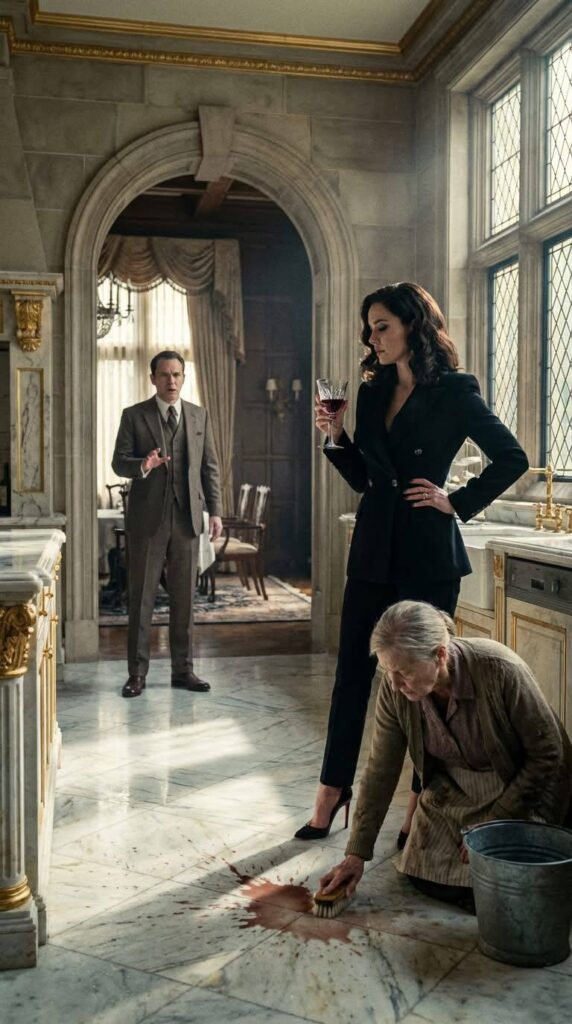
The kitchen was a sprawling masterpiece of imported Italian white marble and brushed brass. In the center of the room, kneeling on the hard, cold stone floor, was my mother.
She was wearing her comfortable grey cardigan, the one I had bought her in Paris. Her shoulders were shaking violently. In her trembling, arthritic right hand, she clutched a cheap, plastic toothbrush with frayed bristles.
Standing over her, swaying slightly and holding a half-empty crystal glass of vintage Bordeaux, was my wife.
Victoria was dressed in a pristine white tennis outfit, fresh from the country club. Her face, usually so perfectly composed, was contorted into a sneer of pure, aristocratic malice.
“Missed a spot, you old peasant,” Victoria hissed, her voice slurred but vicious.
With a lazy, deliberate flick of her wrist, Victoria tilted the glass. The dark red liquid cascaded downward. It soaked into Sarah’s grey hair, matting it to her scalp, and splashed down the back of her neck, pooling violently onto the pristine white marble floor. It looked exactly like a fresh kill.
Sarah let out a broken, ragged sob, dropping the toothbrush. She wrapped her arms around her own torso, curling inward. “Please, Victoria,” my mother begged, her voice a frail, reedy whisper that tore at my soul. “My back… I can’t bend anymore. Please let me get up.”
Victoria laughed. It was a sharp, ugly, grating sound that echoed off the vaulted ceilings. She nudged my mother’s ribs with the toe of her custom-made tennis shoe.
“If you tell my husband about this, I swear to God I’ll put you in a cage in the basement,” Victoria snarled, leaning down so her face was inches from my mother’s ear. “He believes me. He loves me. He doesn’t give a damn about a washed-up cleaning lady from the slums. You are only here because I allow it. Now scrub.”
A lesser man would have screamed. A lesser man would have rushed forward, lost control, and perhaps done something that would land him in a police cruiser. But I did not build a billion-dollar empire by losing my temper. I built it by observing, calculating, and executing with absolute, devastating precision.
I did not move from the shadows. I did not breathe. I simply reached into the breast pocket of my suit jacket and pulled out my phone. My thumb was perfectly steady as I opened the camera app, switched to video, and hit record.
I stood there in the dark and forced myself to watch. I recorded thirty agonizing seconds of the horror. I captured the red wine dripping from my mother’s chin. I captured the toothbrush scraping against the grout. I captured every vile, classist threat that spewed from my wife’s mouth. I documented the absolute destruction of the illusion I had married.
When I had enough, I stopped the recording. I opened my contacts, bypassed the police, and dialed the private, encrypted number of my lead attorney and fixer, Marcus. The phone didn’t even ring fully before he answered.
“Sir?” Marcus said, his voice instantly alert.
“Assemble the extraction team. Bring the master file on the in-laws. I need you at the Hamptons property in twenty minutes,” I whispered, my voice sounding completely detached from my own body. “It’s time.”
“Understood.”
I hung up the phone and slipped it back into my pocket. In the kitchen, Victoria was raising her hand, her palm open, preparing to strike my mother across the face for the crime of daring to cry and smudging the floor.
I finally stepped out of the shadows. The heels of my shoes cracked like gunshots against the marble.
“The pre-nup has a ‘moral turpitude’ clause, Victoria,” I said. My voice was not loud, but it cut through the room like a frozen scalpel. “I suggest you stop moving before the police arrive.”
Victoria froze, her hand suspended in the air. She whipped her head around, her eyes widening in absolute terror as she saw me standing there, a phantom returned from London, watching her kingdom crumble.
Chapter 3: The Surgical Strike
The silence that followed was heavy enough to crush bone. The crystal wine glass slipped from Victoria’s limp fingers, shattering against the marble, sending shards of glass and droplets of red wine spraying across the hem of her pristine tennis skirt.
The transition was sickeningly fast. The venom vanished from her face, instantly replaced by the wide, doe-eyed mask of a panicked victim. She practically threw herself across the kitchen, sliding on the wine-slicked floor, and scrambled to grab the fabric of my trousers.
“Ethan!” she cried out, her voice pitching up an octave into a frantic, hysterical whine. “Ethan, my god, you’re home early! Honey, you… you misunderstand what you just saw. It’s not what it looks like!”
I stood completely rigid, staring down at her grasping hands with the same mild disgust one might reserve for a leech. I didn’t reach down to help her up.
“She’s getting confused, Ethan,” Victoria babbled, tears welling up in her eyes with practiced ease. “Her mind is slipping! She spilled the wine herself and insisted on cleaning it. She demanded to use the toothbrush! I was just… I was trying to stop her, I was just making a bad joke to lighten the mood!”
I slowly reached down and peeled her fingers off my suit, one by one, dropping her hands back to her sides.
“I watched you,” I said, my voice dead and devoid of any fluctuation. “I watched you pour wine on the woman who worked three minimum-wage jobs just so I could eventually afford to buy you that ridiculous eight-carat diamond currently sitting on your finger. A diamond, by the way, that I just remotely deactivated the insurance policy for while standing in the hallway.”
Her jaw dropped. The fake tears evaporated, replaced by a profound, dawning horror. “Ethan… you can’t…”
“I haven’t trusted you for six months, Victoria,” I continued, stepping around her to walk toward my mother. “You think I didn’t notice the subtle ways you kept Sarah out of the family photos? The way the staff looked at you when I wasn’t in the room? I built the security framework for half the data centers on the East Coast. Did you really think I wouldn’t wire my own house? There are hidden, audio-enabled cameras in every room of this estate, save for the bathrooms and your private dressing room.”
Victoria scrambled backward, her back hitting the center island. “You spied on me?” she gasped, attempting to pivot to righteous indignation.
Before I could answer, the heavy oak front doors opened with a heavy thud. The sound of synchronized, heavy footsteps echoed through the foyer. A moment later, Marcus, my lead attorney, stepped into the kitchen, flanked by four massive men in dark suits from my private security detail.
Marcus didn’t waste time with pleasantries. He was holding a thick, black leather dossier.
“Mr. Sterling,” Marcus nodded to me, then turned his shark-like gaze to my wife. He pulled a crisp, white document from the folder and held it out to her. “Mrs. Sterling. Section twelve, paragraph four of your prenuptial agreement. Any physical, emotional, or psychological abuse directed toward the Primary Beneficiary’s family—specifically, Sarah Sterling—results in the immediate and total forfeiture of all marital assets.”
Victoria didn’t take the paper. Her chest was heaving.
“Furthermore,” Marcus continued seamlessly, “we have spent the last three weeks conducting a forensic audit of the Sterling Foundation. We have incontrovertible proof that you have been secretly siphoning funds intended for your mother-in-law’s elder-care charity, routing them through dummy shell corporations, and depositing them directly into your father’s offshore accounts to service his gambling debts.”
The color drained entirely from Victoria’s face. She looked like a corpse.
I looked at my watch. “I have already frozen your black cards. I have revoked your access to the penthouse in Manhattan, the ski lodge in Aspen, and the villa in Como. The jewelry you are wearing will be cataloged and seized by security before you leave.”
Cornered, the animal inside her finally lashed out. Victoria scrambled to her feet, her face twisting into an ugly, desperate snarl.
“You think you can just throw me away?!” she screamed, spittle flying from her lips. “I am a Vanderbilt descendant! You’re just a glorified trash collector with a lucky algorithm! I will drag your name through the mud. I’ll take this to the press! I’ll tell the world how controlling and dictatorial you are. I’ll ruin your stock prices!”
I couldn’t help it. A small, cold smile touched the corner of my mouth.
“Go ahead, Victoria,” I whispered. “Call the press. But before you dial, you should probably know something. Last week, I finalized a shadow acquisition. I bought the parent company of the tabloid conglomerate your father currently owes ten million dollars to. I am now his primary creditor.”
I took a step closer, letting my height shadow her completely.
“You aren’t just going to be homeless, Victoria. You, and your entire bloodline, are about to be blacklisted from every country club, every bank, and every social circle on the Eastern Seaboard.”
Chapter 4: The Eviction
The fight completely left her body. Victoria sagged against the marble island, her eyes glazed, the magnitude of her absolute ruin finally crushing the breath from her lungs. She had played a dangerous game of chess against a man who owned the board, the pieces, and the building the tournament was held in.
I turned away from her, the disgust finally complete, and gave Marcus a slight nod.
“Escort her to the guest quarters,” Marcus instructed the security detail. “Allow her to pack one suitcase of clothing she brought into the marriage. No jewelry. No electronics purchased by Mr. Sterling. Then, escort her off the property.”
Two of the security guards stepped forward, gripping Victoria firmly by the upper arms. She didn’t struggle. She was completely catatonic.
“Get out of my house,” I whispered, not looking back at her.
As they dragged her toward the doorway, she seemed to snap back to reality. She looked around the cavernous, glittering kitchen, the marble halls she had so arrogantly believed she ruled. “You can’t do this!” she whimpered, her voice cracking. “Ethan, please! Where will I go? My family has nothing!”
I slowly pointed a finger at the cheap plastic toothbrush still lying on the floor in a puddle of spilled wine.
“The same place you wanted to send my mother,” I said, my voice echoing off the walls. “To the gutter. The only difference is, she had the strength and the character to climb out of it. You never will.”
As they hauled her out of the kitchen, her wails echoing down the hallway, I immediately dropped to my knees on the cold, hard floor. I didn’t care about the spilled wine. I didn’t care about the wrinkles in my bespoke suit.
I took off my twenty-thousand-dollar blazer, bundled the soft, imported wool in my hands, and gently began to wipe the sticky red wine from my mother’s face and hair. Her skin was freezing. She was still trembling, staring blankly at the spot where Victoria had stood.
“I’m so sorry, Mom,” I choked out, the icy facade finally cracking as a hot tear tracked down my own cheek. “I’m so sorry I let a snake into our home. I thought I was protecting you. I was a fool.”
Sarah slowly lifted her scarred, worn hand and rested it against my cheek. She wasn’t looking at me. She was looking toward the hallway, listening to the fading sounds of Victoria’s protests.
“I don’t want her in a cage, Ethan,” Sarah said softly, her voice remarkably steady despite the trauma. There was no anger in her eyes, only a profound, heavy pity. “I don’t want to punish her like that.”
I stopped wiping her face. “Then what do you want, Mom?”
“I just want her to know what it feels like to be invisible,” Sarah whispered. “I want her to know what it feels like to be the person scrubbing the floor, while the rest of the world walks right over you without looking down.”
Five minutes later, the massive oak doors of the mansion slammed shut, locking from the inside with a heavy, mechanical thud.
Standing on the rain-slicked driveway, shivering in her tennis outfit and clutching a single, battered canvas duffel bag, Victoria watched the taillights of the security SUVs fade into the night. As the cold reality of her exile settled over her, her cell phone buzzed in her pocket.
She pulled it out with trembling fingers. It was her father.
When she answered, his voice was frantic, breathless with panic. He told her that their largest creditor had just executed a hostile call on their debts. The bank was seizing their townhouse. The cars were being repossessed. They were ruined.
“Who did it, Daddy?” Victoria sobbed into the rain. “Who bought the debt?”
There was a long, terrible pause on the line before her father answered, his voice hollow with defeat.
“The paperwork just came through. The holding company is registered to a woman named Sarah Sterling.”
Chapter 5: The Weight of Stone
Revenge, I learned, is a dish best served not cold, but with meticulous, bureaucratic efficiency.
Six months passed. The divorce was a slaughter. Victoria had nothing to bargain with, no leverage, and a mountain of debt courtesy of her family’s sudden, catastrophic liquidation. The high-society friends who once kissed her cheeks at charity galas suddenly didn’t recognize her number. In the brutal ecosystem of New York’s elite, poverty is a highly contagious disease, and Victoria was patient zero.
I was driving back to the city from a site inspection upstate on a bleak afternoon in early spring. The fuel gauge on my Aston Martin dipped low, prompting me to pull off the highway at a dingy, dilapidated gas station on the outskirts of Yonkers.
As I stepped out to pump the premium fuel, my eyes caught movement near the convenience store entrance. A woman was kneeling on the oil-stained concrete. She was wearing a faded, oversized uniform shirt and cheap, rubber gloves. She was aggressively scrubbing a patch of dried motor oil with a heavy-bristled industrial brush.
Her hair, once perfectly highlighted and styled, was a dull, greasy blonde, tied back in a haphazard knot. Her face was gaunt, aged by a decade in the span of six months.
It was Victoria.
She paused to wipe sweat from her forehead with the back of her wrist. In that moment, she looked up and saw me. She saw the tailored suit, the quarter-million-dollar car, and the life she had so carelessly thrown away.
She froze. The brush slipped from her hands, clattering against the concrete.
I didn’t smile. I didn’t gloat. I didn’t even acknowledge her existence. I simply turned away, finished pumping my gas, slid back into the leather interior of my car, and drove away without looking in the rearview mirror. My mother had wanted her to feel invisible. I was merely fulfilling that wish.
That evening, I attended an art gala in Manhattan. The gallery was bright, warm, and filled with the low, sophisticated hum of conversation. I walked through the crowd and found my mother standing before a massive, abstract canvas.
She looked breathtaking. The fear had entirely left her posture. The Hamptons estate, the scene of the trauma, had been completely gutted and renovated. The kitchen was gone. In its place, I had built a massive, two-story library and conservatory, officially named the Sarah Sterling Wing. My mother had taken the helm of the charity foundation, actively working with legislation to protect vulnerable elderly populations from financial and physical abuse. She had turned her deepest humiliation into her greatest weapon.
“You look beautiful, Mom,” I said, handing her a glass of sparkling water.
Sarah took the glass. I looked down at her hands. The chemical burns were long gone. Thanks to months of specialized dermatological treatments, her skin was soft, cared for, and adorned only with a simple gold band.
She looked down at her own hands, then up at the polished hardwood floor of the gallery.
“I realized something a few weeks ago, Ethan,” Sarah said, her voice rich with a quiet, profound wisdom. “I used to hate the floor. I thought it was my enemy. But the floor is just stone, or wood, or marble. It has no malice.”
She looked up at me, her eyes clear and bright. “It was never about the floor. It was about who we choose to let walk on it. And who we choose to kneel for.”
I wrapped my arm around her shoulder, pulling her close. “You’ll never kneel again.”
As we watched the exhibit, a young woman approached us. Her name was Elena. She was one of the junior partners at Marcus’s law firm, the one who had meticulously drafted the financial trap that ensnared Victoria’s family. She was brilliant, fiercely independent, and treated my mother with a genuine, unforced reverence that made my chest tighten.
Elena smiled at Sarah, engaging her in a passionate conversation about the new elder-abuse legislation. I stood back, watching them. For the first time in years, the icy fortress around my heart felt a genuine thaw. I found myself wondering, just maybe, if I could learn to trust someone again.
But as I reached into the interior pocket of my tuxedo jacket to check my phone, my fingers brushed against a thick, heavy envelope that hadn’t been there when I put the suit on.
I pulled it out. There was no stamp, no return address. Just my name written in sharp, erratic cursive.
I cracked the wax seal and unfolded the single sheet of paper inside. It was a photograph of Elena, taken covertly from across a street, with a red circle drawn around her face. Below it, a single sentence was scrawled in black ink:
You took everything from us, Sterling. Now we know what you’re looking at next.
Chapter 6: Infinite ROI
The threat in that envelope, like the desperate flailing of a dying animal, ultimately amounted to nothing.
When a snake tries to bite a titan, it only breaks its own fangs. The remnants of Victoria’s family, drowning in the debt my mother now legally owned, attempted a clumsy blackmail scheme involving Elena. It took Marcus exactly forty-eight hours to identify the hired photographer, trace the funds back to Victoria’s desperate father, and deliver a final, crushing blow. We didn’t just ruin them financially; we handed the extortion evidence to the federal authorities. The socialites who once snubbed us were now reading about the Vanderbilt descendants facing federal racketeering charges. They were completely, permanently eradicated from our timeline.
Two years later, the air in New York felt entirely different.
The sun was setting in a blaze of violent orange and soft purple over the newly expanded Sterling Estate. I stood on the wraparound porch, leaning against the white wooden railing, a glass of iced tea sweating in my hand.
Down in the expansive gardens, among the meticulously curated rows of blooming flora, I watched my mother. She was kneeling in the rich, dark soil, but this time, it was by choice. She was wearing gardening gloves, a wide-brimmed straw hat, and a smile so radiant it rivaled the sunset.
Beside her, giggling hysterically with a smudge of dirt on her nose, was my one-year-old daughter, Lily.
And walking down the stone path carrying a basket of freshly cut hydrangeas was Elena. My wife. She stopped, kissed my mother on the cheek, and lifted Lily into the air, spinning her until the garden echoed with the sound of pure, unadulterated joy.
There were no plastic toothbrushes here. There were no puddles of red wine staining the marble. There was no screaming, no belittling, no venom hiding behind designer dresses.
There was only peace. A genuine, hard-fought, bulletproof peace.
I turned and walked back into the house. In the main hallway, hanging directly across from a multi-million-dollar modern art installation, was a small, cheap, plastic frame. Inside it was a faded, creased photograph taken twenty years ago. It showed a teenage version of me, awkwardly tall and skinny, standing next to a much younger Sarah in the cramped kitchen of our Queens apartment. She was wearing her blue cleaning smock, her hair tied back, looking exhausted but fiercely proud.
I reached out and traced the edge of the cheap frame.
The financial press still calls me a ruthless machine. They still analyze my quarterly earnings and debate the trajectory of my tech acquisitions. Let them. They will never understand the true currency of my life. They look at my empire and see market caps, stock dividends, and real estate monopolies.
They don’t know that every skyscraper I bought, every server farm I built, and every corporate war I waged was simply a means to an end.
I looked back out the window, watching my mother laugh as my daughter handed her a slightly crushed, slightly imperfect red rose.
I built a billion-dollar empire just to see my mother smile. And standing here today, watching her teach my daughter how to grow life from the dirt we once had to scrub, I know the truth.
The ROI is infinite.