
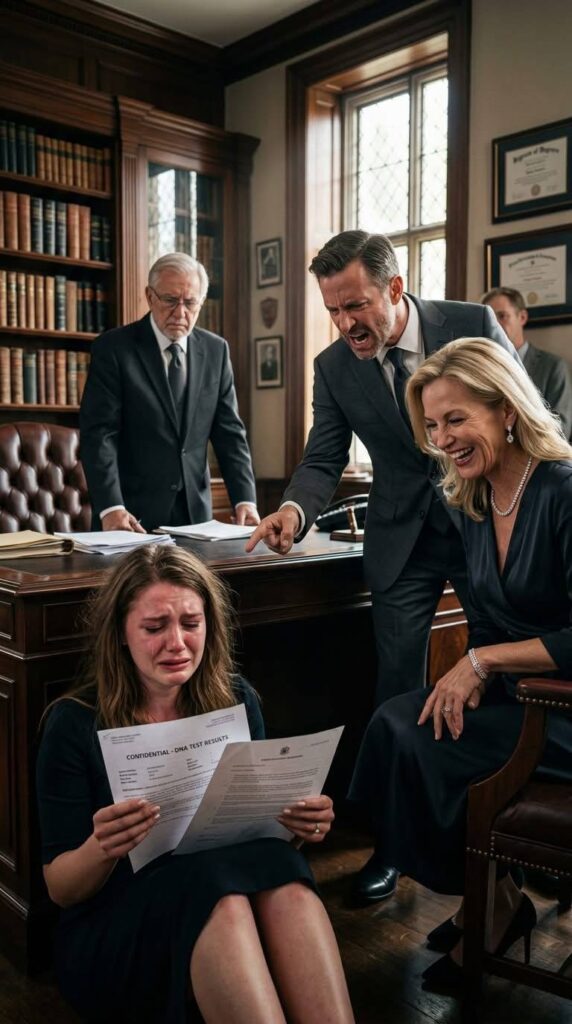
For twenty-three years, I lived in the shadow of a woman who looked at me and saw a crime. I grew up in a house of marble and cold intentions, where every hallway felt like a gauntlet and every meal was a lesson in my own invisibility. They say blood is thicker than water, but in the Callahan household, blood was a currency I simply didn’t possess.
Chapter 1: The Inventory of Shadows
The office of Mr. Whitmore smelled of expensive decay—a cloying mixture of aged parchment, lemon-scented furniture polish, and the stagnant air of secrets kept too long. My mother, Eleanor Ruth Callahan, had been in the ground for six days, and the grief in the room was as thin as the veil she’d worn at my father’s funeral years prior.
My brother, Marcus, checked his gold Patek Philippe for the fourth time in ten minutes. He sat in the center of the room, his posture radiating the entitlement of a man who had already spent his inheritance in his mind. Next to him, Vanessa was hunched over her phone, her thumb flicking rapidly across the screen.
“Can we expedite this, Vanessa?” Marcus sighed, leaning back in the tufted leather chair. “Some of us have companies to run. Responsibilities that don’t pause for dramatic readings.”
I sat in the corner. It was a familiar position—the fringe, the margin, the afterthought. I was the jagged piece in the Callahan puzzle that never quite fit, no matter how much Eleanor tried to sand down my edges with her sharp tongue.
“Mr. Whitmore,” Vanessa added, not looking up from her device, “Mother was very clear about the distribution. Just give us the numbers so we can get through probate.”
Mr. Whitmore, a man whose face was a map of seventy years of legal battles and family collapses, adjusted his spectacles. He looked at me for a heartbeat longer than the others. There was a flicker of something in his eyes—pity? Anticipation? He cleared his throat, the sound like dry leaves skittering across stone.
“Mrs. Callahan’s instructions were surgically precise,” he said, his voice a steady baritone. “The will is to be read in its entirety. In order. Without interruption. Those were the conditions of her signature.”
Marcus groaned, loosening his silk tie. “Fine. Let’s get to the ‘distribution’ then.”
I watched them, my “siblings,” and felt the familiar ache of being a ghost in my own skin. Eleanor had never needed to say I wasn’t wanted; she communicated it through the absence of touch. When I was eight, I’d reached for her hand in a crowded department store, and she’d recoiled as if my skin were a live wire. “You don’t belong here,” she’d whispered, her eyes dark with a private, incomprehensible malice. “Don’t ever forget that.”
I never did.
Mr. Whitmore opened the heavy cream-colored folder. “I, Eleanor Ruth Callahan, being of sound mind and body…”
The standard legal jargon drifted through the room like smoke. Vanessa was granted the estate in Connecticut—the sprawling colonial where I’d spent my loneliest summers. Marcus received the investment portfolio and the controlling interest in the family’s textile empire. There were generous endowments for her alma mater and the church.
My name hadn’t been mentioned once. I felt a strange, hollow relief. I expected nothing, and for the first time in my life, Eleanor was being honest.
Then, Mr. Whitmore reached page three. His hand hesitated. He took a slow, deliberate breath, and the atmosphere in the room shifted. The air grew heavy, thick with a sudden, suffocating pressure.
“I must now address the matter of my daughter, Sarah,” he read.
Vanessa’s head snapped up. Marcus stopped fidgeting.
“Sarah, whom I have raised for twenty-three years, is not my biological child.”
The silence that followed wasn’t just the absence of sound; it was a physical weight. It was the sound of a foundation cracking under the weight of a twenty-three-year-old lie.
I felt the world tilt. The mahogany desk seemed to recede into a dark tunnel. My heart didn’t race; it stopped. It sat in my chest like a cold stone.
“In October of 1998,” Mr. Whitmore continued, his voice devoid of emotion, “I entered Mercy General Hospital in Brentwood, California, with the intention of delivering my third child. The delivery was complicated. The child did not survive.”
I couldn’t breathe. I was aware of the fact the way one is aware of a bone snapping before the pain actually registers.
“In my grief, and a medication-induced state, I made a decision that has haunted every hour of my existence. In the nursery ward, I found another infant. A baby girl with no visitors, no flowers by her bassinet, no name on her wristband except Baby Girl Thornton.”
Marcus was staring at me now. But it wasn’t the look of a brother realizing his sister was a victim. It was the look of a man realizing he’d been sharing his silver spoons with a common thief.
“The mother had died in childbirth,” Mr. Whitmore read, the words falling like lead weights. “The father was unknown. I took her. I switched the wristbands. I left the hospital with someone else’s child and told myself I was giving her a better life. But every time I looked at her, I saw my sin. I saw the child I lost. Sarah, you were never meant to be a Callahan. You were a replacement. And replacements are never the same as the original.”
I looked at the clock on the wall. Tick. Tick. Tick. Outside, a car horn blared in the mundane world of Brentwood, oblivious to the fact that my entire identity had just been incinerated.
“This is a joke,” Vanessa hissed, standing up so abruptly her chair screeched against the hardwood. “This is a sick, demented joke! She was losing her mind at the end! The dementia, the paranoia—”
“Your mother was perfectly lucid, Miss Callahan,” Mr. Whitmore interrupted, his voice like iron. “She had three independent psychiatric evaluations before signing this. She wanted the truth to be the last thing you ever heard from her.”
He looked at me, his eyes softening just a fraction. “And there is more.”
But as I stared at the manila envelope he held out, I realized the nightmare was only beginning.
Chapter 2: The Name of a Ghost
“I leave Sarah nothing,” the lawyer continued, the finality of the sentence echoing through the oak-paneled room. “She was never entitled to the Callahan name, and she is not entitled to the Callahan fortune. However, I have enclosed a sealed envelope containing the original documentation from Mercy General. Her biological mother was named Patricia Anne Thornton.”
Patricia.
The name felt like a prayer and a curse simultaneously. I reached out, my fingers numb, and took the manila envelope. It was heavy. It was the weight of a stolen life.
“We need DNA tests,” Marcus barked, his face flushed a violent shade of red. “We aren’t just taking the word of a dead woman’s confession! This could be a legal nightmare. If she’s not a Callahan, we need to ensure she has no claim—”
“The DNA tests were conducted six months ago,” Mr. Whitmore said calmly. “During Sarah’s annual physical. Mrs. Callahan arranged it. The results are in that file, Marcus. They are conclusive. She is not your sister.”
I remembered that physical. Eleanor had been uncharacteristically insistent. “You look pale, Sarah. You need blood work.” She’d driven me herself—a rare occurrence—and sat in the car like a gargoyle while I went inside. She’d known. She’d been preparing the final blow for months.
“She’s not our sister,” Marcus whispered. He wasn’t talking to me. He was talking to Vanessa. Relief was washing over him, a cruel, shimmering light. “She was never one of us. I always knew there was something… off.”
“Something cheap,” Vanessa added, her voice dripping with the venom she’d inherited from Eleanor. “The way she looked, the way she acted. It makes sense now. She’s just a… Thornton. Whatever that is.”
I stood up. My legs felt like they belonged to someone else, but my voice, when it finally came, was strangely steady. It was the voice of a woman who had nothing left to lose.
“I don’t want your money, Marcus,” I said. “And I don’t want this name. If I’m not a Callahan, then I don’t have to pretend to care about your ‘reputation’ anymore.”
“Where are you going?” Marcus demanded as I turned toward the door. “There are papers to sign. You have to formally renounce any claim to the estate. We won’t have you coming back in ten years trying to sue for a piece of the foundation.”
“Send them to my apartment,” I said, not looking back. “I’ll sign whatever makes you go away faster.”
I stepped out of the office and into the blinding light of a Tuesday afternoon. The world looked exactly the same—the same palm trees, the same luxury SUVs idling at the curb—but I was a different species entirely.
My phone buzzed in my pocket. A text from Marcus: Don’t you dare talk to the press. The family name is off-limits.
I deleted it.
Another from Vanessa: We need to discuss how to handle the public narrative. Mother’s legacy is at stake.
I blocked her.
I walked until my feet ached, ending up in the small, one-bedroom apartment I’d rented two years ago. It was in a neighborhood Eleanor had called “unfortunate,” a place where the paint peeled and the neighbors played loud music. I had moved there to escape her, but I realized now I’d just moved to a place that matched the “unfortunate” girl I had always been in her eyes.
I sat on my secondhand sofa and stared at the envelope for three hours. The sun set, casting long, orange shadows across the floor, and still, I didn’t move. I was terrified that if I opened it, the girl named Sarah Callahan would truly vanish, leaving nothing but a void.
When I finally broke the seal, my hands were stone-still.
Inside was a birth certificate. Baby Girl Thornton. Born October 14th, 1998, at 3:47 a.m. Weight: 6 lbs, 8 oz.
And beneath it, a death certificate. Patricia Anne Thornton. Same date. 4:12 a.m. Cause of death: postpartum hemorrhage.
She had lived for twenty-five minutes after I was born. Twenty-five minutes of holding a daughter she would never see grow up. And then, Eleanor Callahan had walked into that nursery with empty arms and a heart full of grief, and she had stolen the only thing Patricia Thornton had left in this world.
There was a photo, tucked into a hospital record. It was a polaroid, grainy and faded. A woman with dark, downturned eyes—my eyes—wearing a waitress’s apron. She was laughing, a wide, genuine smile that reached her ears. She looked… alive. In a way Eleanor Callahan never had.
I was staring at the face of my mother.
My phone rang. The caller ID was an unknown number from a local exchange. I answered it without thinking.
“Is this Sarah Thornton?” a woman’s voice asked. It was professional, but there was an underlying tremor of urgency.
“Who is this?”
“My name is Detective Angela Reeves, with the Brentwood Police Department, Cold Case Division. We received a package of documents today from a Mr. Whitmore. Sarah… I’ve been looking at your file for the last hour. And I think there’s someone you need to talk to.”
My heart hammered against my ribs. “Who?”
“Your aunt. Her name is Margaret. And she’s been looking for you for twenty-three years.”
Chapter 3: The Woman in the Terminal
The flight to Oregon was a blur of plastic cups of water and the humming of jet engines. I felt like I was suspended in a liminal space, neither the girl I was nor the woman I was supposed to be.
Detective Reeves had explained the reality of my “adoption.” When Patricia died, her sister Margaret Thornton Wells had tried to claim me. But the hospital told her there had been a mistake—that the baby had died shortly after the mother. Eleanor hadn’t just stolen me; she had faked a death. She had buried a stranger’s grief to cover her own crime.
“Margaret never believed them,” the detective had told me over the phone. “She hired P.I.s for years. She thought you’d been lost in the foster system. She never dreamed you were living five miles away in a mansion.”
When I stepped off the plane in Portland, the air smelled of pine and rain. I scanned the crowd at the gate, my pulse thrumming in my throat.
I saw her immediately.
She was a small woman with grey-streaked hair and the same dark, downturned eyes that had stared at me from the polaroid. She was holding a piece of cardboard with the name SARAH written in shaky, hand-drawn letters.
When our eyes met, she didn’t just smile. She collapsed. Not a fall, but a slow sinking to her knees, her hands flying to her face. I ran. I didn’t care about the people staring or the luggage in my way. I reached her and we collided in a heap of tears and damp wool.
“I knew it,” she whispered into my hair, her voice breaking. “I knew Patty’s girl didn’t just vanish. I felt you. All these years, I felt you out there.”
We spent the next four hours in her small, sun-drenched kitchen. She fed me homemade soup and showed me boxes of memories. She told me about Patty—the “wild one” who wanted to be an actress, who loved jazz and hated the cold.
“She wanted you so much, Sarah,” Margaret said, clutching my hand. “She’d already picked out the name. Sarah, after our grandmother. She was so scared to be a single mother, but she told me, ‘Margaret, this baby is my second chance. This baby is going to have everything.’”
I felt a surge of hot, bright anger. I hadn’t had everything. I’d had a cold house and a mother who resented my every breath. I’d been robbed of this woman’s laughter and this kitchen’s warmth.
“Eleanor Callahan stole my life,” I said, the words tasting like ash.
“She did,” Margaret agreed softly. “But she couldn’t steal you. Look at you. You have Patty’s chin. You have her stubbornness. I can see it in the way you hold your shoulders.”
The next morning, my phone erupted.
The story had broken. Mr. Whitmore had filed the necessary paperwork with the state to amend the records, and in a town like Brentwood, a “philanthropist” being outed as a baby kidnapper was the scandal of the century.
Marcus called. I let it go to voicemail.
“You’ve destroyed us, Sarah! The foundation is losing donors by the hour. The press is camped out at the house. You need to release a statement saying Mother was mentally ill, that she did it out of love. If you don’t, I swear to God, I will sue you into the dirt!”
I listened to it twice, then deleted it. He was still worried about the foundation. He was still worried about the “Callahan” name—a name that was now synonymous with a crime.
I went for a walk in the Oregon woods, the silence of the trees a stark contrast to the screaming headlines on my phone. I realized then that I didn’t want revenge. Revenge would require me to stay tethered to them. I wanted the opposite. I wanted to be gone.
But Marcus wasn’t finished.
Three days later, he showed up at Margaret’s front door. He looked haggard, his expensive suit wrinkled, his eyes bloodshot. He didn’t look like a king anymore; he looked like a man watching his kingdom burn.
“We can fix this,” he said, pushing past Margaret into the living room. “I’ve brought an NDA and a settlement agreement. Five million dollars, Sarah. Five million to walk away, change your name, and never speak to a journalist again. We’ll say it was a misunderstanding, a legal error.”
I looked at him—really looked at him. I saw the fear in his eyes. He wasn’t afraid for me, or for the mother he’d lost. He was afraid of being ordinary. He was afraid of being the son of a criminal.
“No,” I said.
“Ten million,” he countered, his voice rising. “Don’t be a fool. Think about what you could do with that. You’re living in a hut in the woods! Take the money and go be a Thornton somewhere else.”
“My mother died with nothing,” I said, stepping toward him. “She died with twenty-five minutes of motherhood and a name that meant something to her. You think you can buy the last twenty-three years? You think you can put a price on the fact that I grew up wondering why my own mother hated me?”
“She wasn’t your mother!” Marcus screamed.
“I know,” I said, my voice dropping to a whisper. “And that’s the best news I’ve ever heard.”
“You’re making a mistake,” he hissed, his face inches from mine. “Without the Callahan name, you’re nobody. You’re a waitress’s brat from a cold case file.”
“I’d rather be a nobody than a Callahan,” I replied. “Get out of my aunt’s house, Marcus. And if you ever contact me again, I won’t just talk to the press. I’ll talk to the District Attorney about the ‘donations’ you’ve been funneling out of that foundation for the last five years.”
The color drained from his face. He’d forgotten I’d spent two years working in the foundation’s accounting office. I knew where the bodies were buried—and not just the ones Eleanor had hidden.
He left without another word.
Chapter 4: The Birthday
Eight months later, the dust had settled. The Callahan Foundation had folded, its assets liquidated to pay for the massive legal settlements and the damage to the family’s various business interests. Marcus and Vanessa had retreated to a villa in Europe, hiding from a public that now viewed them with a mixture of disgust and mockery.
I didn’t follow the news. I had other things to do.
I stood in a small courtroom in Portland, my hands tucked into the pockets of a new linen dress. Margaret sat in the front row, beaming.
“The petition to legally change your name is granted,” the judge said, signing a document with a flourish. “From this day forward, you are legally recognized as Sarah Anne Thornton.”
I walked out of the courthouse and felt the sun on my face. It felt different. It felt like it was actually shining on me, not on the shadow I’d been pretending to be.
We had a party that night. Not a gala with black-tie catering and stiff conversation, but a backyard barbecue with Margaret’s kids and grandkids. There were mismatched chairs, a dog chasing a frisbee, and the smell of charred burgers and summer grass.
My youngest cousin, a five-year-old girl with messy pigtails, handed me a card. It was covered in glitter and lopsided hearts. HAPPY BIRTHDAY SARAH, it read in big, purple letters.
“It’s not my birthday, honey,” I laughed, kneeling down to hug her.
“Mommy said it’s the day you became you,” the girl said solemnly. “So that’s a birthday.”
I looked at Margaret, who was watching me from the porch, a glass of iced tea in her hand. She nodded, a knowing smile on her face.
I thought about Eleanor Callahan. She had spent twenty-three years trying to convince me I didn’t belong. She had used her final breath to try and shatter me with the truth, hoping the weight of my “unimportant” origins would crush me.
But she had failed.
The truth hadn’t destroyed me. It had unburdened me. It had stripped away the marble and the cold and left me with something I never thought I’d have.
A home.
I looked up at the Oregon sky, the stars beginning to peek through the twilight. Somewhere, maybe, Patricia Anne Thornton was watching. Maybe she was laughing that big, loud laugh Margaret had told me about.
I reached for a piece of cake, the frosting sweet and thick. I took a bite, and for the first time in my life, I didn’t feel like a replacement.
I felt like the original.
My name is Sarah Anne Thornton. And I finally belong.