
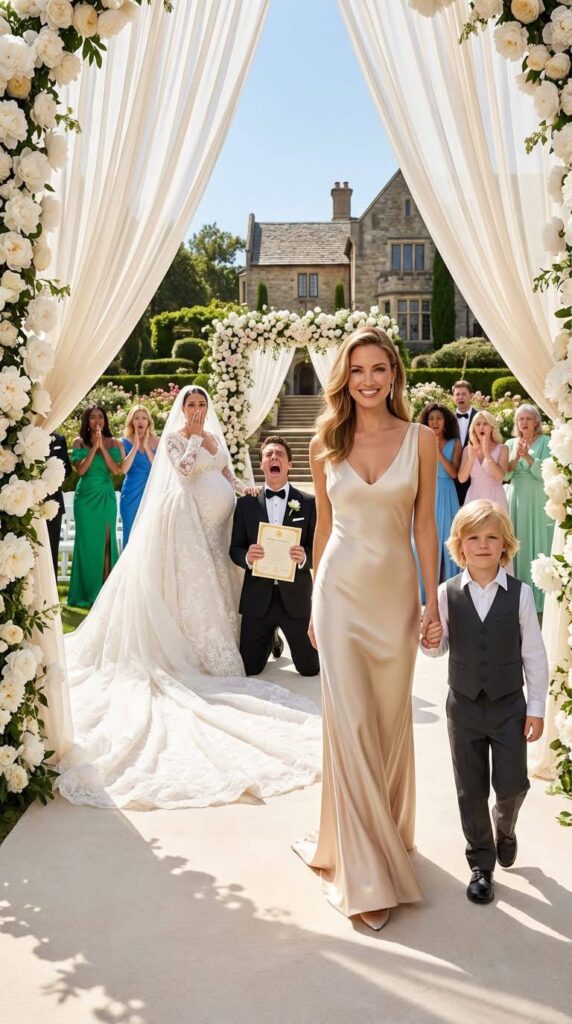
“FINALLY, A REAL HEIR! LEAVING THAT TRASH BEHIND WAS THE BEST DECISION I EVER MADE!” My ex-husband’s roar vibrated through the grand ballroom, his hand splayed possessively over his new bride’s silk-covered belly. He didn’t see me standing in the shadow of a limestone pillar. He didn’t see the gold-leafed envelope my son was holding—an envelope that didn’t contain a wedding gift, but a truth so absolute it would dismantle the very foundation of Richard Sterling’s world.
This is not a story of a woman scorned; it is a chronicle of a mother’s calculated patience. It is the narrative of a decade-long silence that matured into a weapon. For years, I allowed Richard to believe he had discarded us like refuse in a gutter. I watched him build a monument to his own vanity, oblivious to the fact that his greatest pride—his precious “bloodline”—was nothing more than a house of cards I was about to set ablaze.
Chapter 1: The Invitation from the Ghost of Poverty
The memory of the night it ended still tastes like copper and rain. Ten years ago, the Upper East Side felt like a battlefield. I remember the sound of the dumpster lid clattering shut—a metallic punctuation mark on my marriage. Richard had thrown my bags and our eight-year-old son’s toys into the trash, his face twisted in a sneer that suggested we were infectious. “You’re dead weight, Sarah,” he had hissed, his breath smelling of expensive scotch and cowardice. “I’m meant for a legacy. You’re just… trash.”
I am Sarah Miller. I am no longer the broken woman who spent that night huddled in a motel room, counting pennies while my son, Leo, slept fitfully beside me. I rebuilt myself with the same precision I now use to design skyscrapers. As an independent architect, I understand that the strength of a structure is not in its gilding, but in its foundation.
Leo grew up watching that reconstruction. At eighteen, he is no longer the boy who cried when his father’s silver Porsche sped away. He is brilliant, quiet, and possesses a stillness that often unnerves me. He has Richard’s height and the Sterling jawline, but his eyes carry a depth of justice that his father could never comprehend.
The invitation arrived on a Tuesday, delivered by a courier as if it were a royal summons. It was a heavy, gold-leafed card that felt oily to the touch. Richard Sterling was marrying Tiffany Montgomery, a socialite half his age, at their sprawling estate in Greenwich, Connecticut. It wasn’t just a wedding; it was a coronation. And he wanted me there. He wanted to rub his “ascension” into my face, to show the woman he discarded that he had finally found his “true” life.
I stood in my modern, minimalist kitchen—a space I had earned through eighteen-hour workdays and sheer willpower—holding the invitation over the trash can.
“He wants us to see him win, Mom,” Leo said, leaning against the doorframe. His voice was devoid of the heat I felt rising in my chest. He looked at the Sterling family crest embossed on the envelope. “He thinks he’s a king. He’s forgotten that kings can be dethroned.”
I looked at my son, seeing the cold, steady light in his eyes. He wasn’t looking for an apology. He was looking for a reckoning.
“We shouldn’t give him the satisfaction of seeing us, Leo,” I whispered, my fingers trembling slightly. “The scars are finally starting to fade.”
Leo walked over and placed his hand firmly on mine, stopping me from dropping the card. “Don’t. We’re going. I’ve been waiting for this for three years—ever since I found those old medical records hidden in the back of the attic.”
Cliffhanger: Leo pulled a folded, yellowing document from his pocket. It bore the letterhead of a specialist we had seen a decade ago, but the notations at the bottom were in a red ink I had never seen before. “He didn’t just leave us because he was bored, Mom. He left because he was afraid of what this paper says.”
Chapter 2: The Lion’s Den
The Sterling Estate in Greenwich was a $10-million monument to excess. The air was thick with the suffocating scent of lilies and the metallic tang of expensive perfume. As we stepped out of the car, I felt the weight of a hundred gazes. The “old money” crowd shifted, their whispers trailing behind us like smoke. They remembered the scandal. They remembered the “low-class” wife who had been traded in for a newer, shinier model.
I wore a dress of midnight navy—understated, architectural, and costing more than Richard’s monthly car payment. Beside me, Leo was a shadow in a perfectly tailored suit. We didn’t look like trash. We looked like the inevitable future.
Richard spotted us near the champagne fountain. He didn’t approach to welcome us; he approached to gloat. He looked bloated with his own importance, his skin flushed. Beside him stood Tiffany, a woman whose beauty was as fragile and manufactured as a glass ornament. She looked at me with a mixture of pity and the smug triumph of a woman who believes she has stolen the sun.
“I’m glad you came, Sarah,” Richard bellowed, loud enough for the surrounding guests to turn. “I wanted you to see what a real life looks like. Tiffany is a Sterling in spirit. She’s giving me what you never could—a bloodline that actually matters.”
He turned his gaze to Leo, his lip curling in a sneer. “I hope your mother taught you how to work a service job, boy. Because that’s the only legacy you’ll ever have. You were a mistake I’ve finally corrected.”
I felt the familiar sting of his words, the old shame trying to claw its way up my throat. But Leo didn’t flinch. He stood perfectly still, a slight, unsettling smile playing on his lips. He reached up and patted the breast pocket of his suit, where the gold envelope rested against his heart.
“You’ve always been obsessed with your name, Richard,” Leo said quietly. “It’s a shame you never learned what it actually takes to carry it.”
Richard laughed, a harsh, grating sound. “Watch me, boy. Watch a master build an empire.”
The orchestra suddenly stopped. A hush fell over the manicured lawn. Richard straightened his tie, looking like a man about to address his subjects. He began to walk toward the podium, his chest puffed out.
Cliffhanger: Just as the celebrant prepared to speak, Richard held up a hand. “Ladies and gentlemen,” he roared into the microphone, “before we begin the vows, I have an announcement that will change the Sterling name forever. A gift that proves the gods favor the strong.”
Chapter 3: The Speech of a King
Richard’s speech was a narcissistic monologue that would have been comical if it wasn’t so cruel. He spoke of “purity,” of “legacy,” and of his “divine right” to lead the Sterling line into the next century. He spoke as if he were the architect of the universe itself.
Then came the humiliation.
“To find gold, one must sometimes sift through the dirt,” Richard said, pointing a finger directly at the back of the room where Leo and I stood. The crowd parted, creating a corridor of mockery. “Ten years ago, I was bogged down by trash. I had a wife who couldn’t keep up and a son who was a constant reminder of my own failure to choose better. Leaving them was the best decision I ever made.”
The guests chuckled—a soft, cruel sound that rippled through the garden. I felt the world shrinking, the cold Greenwich air turning into a vacuum.
“But today,” Richard continued, his voice rising to a crescendo, “I am redeemed! Tiffany is four months pregnant with a son. A true heir. A pure Sterling who won’t be tainted by the mediocrity of the past! Look at them—clinging to my coattails while I build a future they can’t even imagine!”
He patted Tiffany’s stomach as the room erupted in applause. The mocking laughter intensified. Tiffany beamed, her hand resting over his, looking like the queen of a very small, very ugly kingdom.
My knees felt weak. The sheer weight of his public hatred was a physical force. I wanted to run, to hide, to disappear into the Connecticut woods. But then I felt Leo’s hand—cold, steady, and firm—on my arm. He wasn’t shaking. He was grounded.
“It’s time, Mom,” Leo whispered.
He stepped out of the shadow of the pillar. The room fell into a confused silence as the eighteen-year-old Richard had just called “trash” began to walk toward the stage. He moved with the grace of a predator, his eyes locked on his father.
“Congratulations, Dad,” Leo said, his voice amplified by the silence of the stunned crowd. He reached the foot of the stage, looking up at Richard with an expression of profound pity. “But I think you forgot to check your mail before you started your speech.”
Cliffhanger: Leo reached into his pocket and pulled out the gold envelope. He didn’t hand it to Richard; he laid it on the edge of the podium, right next to the microphone. “It’s a gift from the clinic you visited ten years ago. You might want to read the bolded part out loud. For the sake of your… legacy.”
Chapter 4: The Sound of Silence
Richard stared at the envelope. For a second, a flicker of genuine fear crossed his face, a momentary lapse in the mask of the Great Man. He thought it was a lawsuit. He thought it was a desperate plea for money. He wanted to crush us one last time in front of his peers.
“Always looking for a handout, aren’t you?” Richard sneered, grabbing the envelope. He ripped it open with a violent motion, holding the paper up as if to show the crowd how “pathetic” his former family was. He even leaned closer to the microphone, his smug grin still firmly in place. “Let’s see what the ‘trash’ has brought to the party.”
His eyes scanned the document.
The silence that followed was absolute. It wasn’t the silence of respect; it was the silence of a vacuum before an explosion.
The lab report was from exactly ten years and two weeks ago. It was a comprehensive fertility panel Richard had secretly taken just before he left me. The diagnosis was written in cold, clinical, irreversible terms: AZOOSPERMIA DUE TO ADULT MUMPS COMPLICATIONS. STATUS: PERMANENTLY INFERTILE.
The date on the report preceded his “miraculous” conception with the mistress who had broken our marriage. It preceded Tiffany’s current pregnancy by a decade.
Richard’s smug grin didn’t just fade; it vanished, replaced by a grey, ash-like pallor. The microphone, still live, picked up the sound of his ragged, panicked breathing. The paper in his hands began to rattle—a frantic, staccato sound that echoed through the $10-million garden.
“This… this is a forgery,” Richard whispered, but his voice cracked, betraying the terror screaming in his mind.
“It’s from your own private portal, Richard,” I said, stepping forward into the light. My voice was calm, resonant. “You hid it in the attic because you couldn’t face the fact that you weren’t the ‘perfect specimen’ you thought you were. You blamed me for your own biology. You called us trash because you were broken, and you didn’t have the courage to own it.”
Richard looked at Tiffany’s pregnant belly. He looked at the crowd of “old money” guests who were already pulling out their phones, sensing the scent of blood in the water. Then he looked back at the paper.
A guttural, soul-shattering scream erupted from his throat—a sound of a man watching his entire identity incinerate in real-time. He turned toward Tiffany, his eyes wild with a new, frantic hatred.
Cliffhanger: As Richard screamed, Tiffany didn’t cry. She didn’t protest. Her face went deathly pale, and she took a sharp step back, her hand dropping from her stomach. She wasn’t looking at her husband; she was looking toward the exit, where a handsome young “security guard” was already turning to walk away.
Chapter 5: The Collapse of the Empire
The descent was swifter than I could have imagined. In the age of the smartphone, a Sterling’s downfall travels at the speed of light. By the time Leo and I reached the parking lot, “The Sterling Sterility Scandal” was already trending in local social circles.
Behind us, the estate was a theater of chaos. I heard the sound of glass breaking—Richard had apparently gone into a blind rage, destroying the five-tier wedding cake and the floral arrangements. Someone called the police. The blue and red lights began to dance against the limestone walls of the mansion, a fitting end to a “royal” evening.
Leo drove. He was silent, his hands steady on the wheel of the modest SUV I had bought with my own earnings. The contrast between the violence we had left behind and the quiet of the car was jarring.
“How did you know for sure, Leo?” I asked, watching the Connecticut trees blur past. “I knew he was cruel, but I didn’t know he was a liar on that scale.”
“I found the original files when I was looking for my old birth certificate before we moved out of the city,” Leo said, his eyes fixed on the road. “He’d hidden them in a lockbox in his study. He’s known for ten years, Mom. He knew he was sterile when he claimed that mistress was pregnant with his ‘real’ son. He knew it when he married Tiffany. He just wanted the lie more than he wanted us.”
He looked at me in the rearview mirror. “He blamed you for ‘failing’ to give him more children, when he was the one who was empty. He didn’t leave us because we were trash. He left us because we were the only witnesses to his reality, and he couldn’t stand the sight of us.”
The legal fallout was immediate. Richard’s business partners, men who traded on “integrity” and “legacy,” began pulling out of the Sterling Group by Monday morning. A man who could lie to himself for a decade was not a man to be trusted with a pension fund.
Cliffhanger: My phone buzzed on the dashboard. It was a text from Richard’s lead counsel, sent in a frantic, midnight burst of desperation: “Richard is demanding an immediate, court-ordered DNA test for Leo. He’s claiming that if the report is true, then Leo isn’t his either. He’s trying to sue you for ten years of ‘fraudulent’ child support.”
Chapter 6: The New Legacy
Six months later.
The DNA results were the final, poetic irony of Richard Sterling’s life. Leo was, beyond any biological doubt, Richard’s son. The infertility had been a result of a late-onset complication from a bout of mumps Richard had contracted after Leo was conceived, but before he decided to start his new life.
In his rush to build a “pure” bloodline, Richard had thrown away the only biological heir he would ever have. He had discarded the “gold” thinking it was “trash,” only to spend the rest of his life chasing ghosts.
Today, I stand on the lush green lawn of a prestigious university. The sun is bright, the air smells of hope and fresh-cut grass. I am watching Leo, dressed in his graduation gown, receive his honors in Engineering. He is radiant. He is whole.
Richard is a shadow now. He is broke, his assets liquidated to pay for the “fraudulent” business dealings that came to light during his divorce from Tiffany. (It turned out the “security guard” was the actual father of her child, a secret she had intended to use to secure her own “legacy”). I saw Richard a few weeks ago, sitting on a park bench near my office. He looked twenty years older, his expensive suit frayed at the cuffs, staring at nothing. I didn’t even stop. He is a ghost, and I have stopped living in a haunted house.
I looked at Leo as he tossed his graduation cap into the air, a roar of joy erupting from the class. He didn’t look like a Sterling. He looked like a Miller.
“You did it, Leo,” I said, hugging him as he ran toward me, the diploma clutched in his hand.
“We did it, Mom,” he corrected me.
My phone rang—a new developer in Chicago wanting me to lead a billion-dollar sustainable housing project. I looked at the screen, smiled, and declined the call. For the first time in a decade, the future wasn’t a battle I had to win. It was a life I was allowed to live.
“Let’s go home, Leo,” I said. “We have a legacy to build, and it has nothing to do with a name.”
If you want more stories like this, or if you’d like to share your thoughts about what you would have done in my situation, I’d love to hear from you. Your perspective helps these stories reach more people, so don’t be shy about commenting or sharing.