
Chapter 1: The Shattered Sanctuary
I am Maria Mills, Sergeant, United States Special Forces. Ninety days ago, I dragged myself out of an anesthetic fog in a sterile military hospital ward. My left shoulder was locked in a rigid brace, radiating a dull, mechanical ache, and the right side of my face was so grotesquely swollen I could barely pry my eyelid open. Yet, the brutalized state of my own body was a mere footnote compared to the horrific tableau burned into my retinas. I could still see my mother, a ghost in her own skin, standing perfectly still in the ruined doorway of my apartment. Her eyes had been hollow, vacant pools of nothingness as she watched my stepfather, Corbin, crush the cartilage of my windpipe. Right before the darkness swallowed me, I had managed to blindly drag my thumb across a shattered phone screen, dispatching a three-letter transmission that thwarted my own murder.
Promoted Content
But before I detail how my chosen family breached the wire to answer that SOS, I need to exhume the graveyard of my past. Long before I learned to navigate foreign battlefields, my original paradise was systematically dismantled in a sleepy, sun-bleached suburb of Los Angeles.
My early youth was a California illusion—a pristine, fragile bubble I foolishly assumed was bulletproof. We occupied a single-story ranch house in the San Fernando Valley. The atmosphere there permanently held the scent of scorched asphalt, freshly sheared lawns, and the aggressive pink bougainvillea vines that choked our chain-link fence. My father, an aerospace engineer logging hours at a sprawling plant in Burbank, operated with a quiet, loving precision. The exact hands that drafted intricate, classified schematics were the very hands that patiently showed me how to coat my first foam surfboard with wax. To this day, the cloying, sweet smell of coconut surf wax triggers a visceral ache in my chest.
He was a creature of the tides. Every Saturday morning, he would strap my board into the bed of his rusted Ford Ranger. The vinyl dashboard was split from decades of ultraviolet abuse, and the radio dial was stubbornly stuck on a classic rock frequency. But to me, that rattling pickup was a golden chariot. We would cruise down to Santa Monica, where he stood in the icy Pacific and taught me the architecture of the water.
“The ocean is an indifferent beast, kiddo,” he would murmur, his heavy hand anchoring my shoulder as we tracked the incoming sets. “But you never offer it your back. You square your chest and face the break.”
My mother, a high school literature teacher who mined poetry out of the mundane, preferred the dry safety of the sand. She would sit wrapped in a thick towel, devouring paperback novels, her face wearing a serene, untouchable smile. She was our gravity. In that specific era, I was invincible.
Perfection, however, is spun glass. It shatters the second you apply pressure. The collapse occurred on a miserable, weeping Tuesday afternoon. My father was navigating the 405 freeway through a torrential downpour when a commercial semi-truck hydroplaned and jackknifed across three lanes. He was dead before the sirens even started wailing.
I distinctly recall the pair of California Highway Patrol officers hovering on our porch. Rainwater dripped steadily from the stiff brims of their hats. Their expressions were professionally blank, their delivery sterile and rehearsed as they dropped the verbal payload that incinerated our universe. My mother didn’t merely stumble. She folded. Her knees hit the linoleum, and a sound erupted from her chest—a raw, feral shriek of such catastrophic disbelief that it still vibrates in my jaw when I close my eyes.
The subsequent months were suffocating. Our home, previously rich with the aroma of my dad’s dark roast coffee, now reeked of rotting sympathy lilies and the metallic tang of foil-wrapped casseroles abandoned by neighbors. My mother resigned from her teaching position. Her geographic footprint shrank entirely to her master bedroom, the blackout curtains sealed shut against the light.
At twelve years old, I transformed into an apparition haunting my own corridors. I survived on peanut butter scraped onto stale bread over the kitchen sink. I deciphered the washing machine’s faded dials by myself. I trained my feet to glide over the floorboards, utterly paralyzed by the fear of disturbing the asphyxiating silence.
Poverty crept in like a slow-acting venom. The life insurance payout was a joke. Envelopes bleeding red Past Due stamps multiplied on the counter. When my mother finally dragged herself out of bed, she moved with a devastating, lethargic shuffle, pawning off chunks of our history. Her wedding band went first. Then my dad’s collection of vintage socket wrenches. I watched her pawn our survival, feeling a desperate, clawing helplessness.
When I turned fourteen, Corbin Vance breached our perimeter.
He was an independent building contractor, recommended by a pitying neighbor to patch our rotting roof. He was a massive structure of a man, his broad shoulders eclipsing the doorframe, projecting an aggressive kinetic energy our dead house hadn’t hosted in years. He wielded a charismatic, easy grin and calloused hands. He patched the shingles. Then he bled the radiators. Then he rehung the back gate, aggressively refusing payment for the overtime.
He imported noise. The rhythmic percussion of his framing hammer, the sharp scent of cut pine, the guttural idle of his heavy-duty truck—it was undeniable proof that the earth was still spinning. He began showing up with bags of groceries, telling terrible, canned jokes until my mother actually laughed. It was a rusty, startling sound. He took her to steakhouses. He aggressively reorganized her chaotic mortgage paperwork.
“A woman as delicate as you shouldn’t be hauling this freight alone,” he told her one evening, resting a heavy hand on her knee. I watched the dead light in my mother’s eyes flicker back to life. She looked at him like he was salvation.
The afternoon they announced their engagement, Corbin summoned me. He held a small, velvet-lined jeweler’s box. Inside lay a fragile, silver chain. As he stepped behind me to clasp it around my neck, he closed the distance until his chest pressed against my back. The heat of his breath washed over my ear.
“Your dad is in the dirt,” he whispered, a subterranean growl engineered for my ears only. “I run the logistics now. I take care of her, and I take care of you. Provided you learn your place.”
A spike of glacial terror drove itself into my spine. It was not a vow of protection. It was a declaration of ownership.
A few feet away, my mother stood clapping, her vision blurred by ecstatic tears. She saw a generous patriarch embracing her orphaned child. She had absolutely no idea he had just locked the first collar around my throat.
The true occupation began the evening they returned from the courthouse. I had retreated to my bedroom—my final sanctuary—clamping my dad’s oversized vintage headphones over my ears, drowning the world in Tom Petty chords. Without warning, the solid wood door flew inward, rebounding violently against the drywall.
Corbin loomed in the threshold, back-lit by the hallway bulbs, his jaw set in a rigid line of fury. He marched forward, his heavy boots shaking the floor, and violently snatched the headphones off my skull. They clattered against the baseboards.
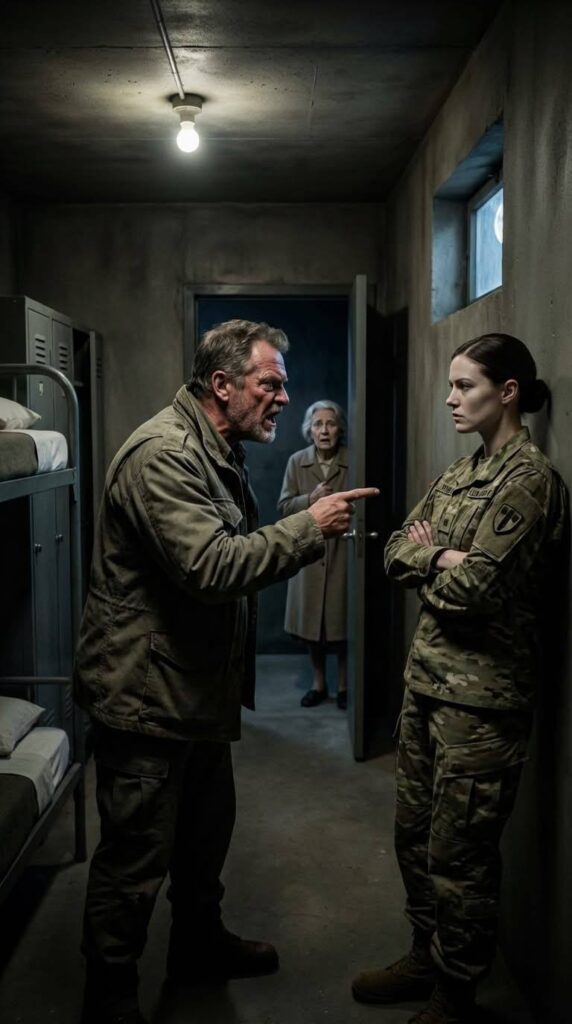
“Under this roof, we do not operate as independent contractors,” he snarled, pointing a thick finger an inch from my nose. “We are a unit. Interior doors remain ajar unless you are unconscious. Do we have an understanding?”
My pulse hammered wildly against my ribs. I darted my eyes past his massive torso, desperately scanning the hallway. My mother was hovering in the shadows. Say something. Defend me. She didn’t meet my gaze. She stared rigidly at the carpet fibers, wrapping her arms tightly around her own ribs as if shielding herself from a freezing wind. Her absolute silence was his coronation. Her cowardice was my death sentence. As I watched her actively choose submission over her own daughter, the floor dropped out from under me.
Chapter 2: The Architect of Fear
The years following Corbin’s ascension were a masterclass in psychological starvation. He rarely utilized physical violence. He was far too cunning for that. The penitentiary he constructed wasn’t welded from iron bars; it was mortared with intimidation, engineered shame, and my mother’s total capitulation.
My bedroom door remained perpetually cracked open, a drafty reminder that I possessed zero privacy. The house inhaled tension and exhaled dread. Every action required tactical calculation.
Publicly, Corbin was the neighborhood’s patron saint. On lazy Sunday afternoons, he would command the backyard grill, flipping burgers with a beer sweating in his fist. He would hook a heavy arm around my mother’s neck, pulling her into his side, and brag to the neighbors, “I’m a blessed man. She’d blow away in the wind without me.” The guests would chuckle, assuming it was coarse affection. I saw the microscopic flinch in my mother’s shoulders. It was a public branding.
When I hit seventeen, I discovered a hairline fracture in the prison walls. I had penned a deeply personal essay about my father’s surfing lessons, submitting it to a district-wide literary competition. I won first place. My English teacher had pulled me aside, her eyes shining, insisting I possessed a rare, raw talent. Gripping that embossed certificate, I felt a euphoric rush of adrenaline. It was a visa to a reality outside the Valley.
I sprinted home, desperate to inject this joy into my mother’s veins. I breached the kitchen, panting. She was at the stove, Corbin nursing a bottle of IPA at the dining table.
“Mom, look what I did,” I gasped, thrusting the paper forward.
Her lips parted into a genuine, beautiful smile—a ghost from the before-times. But it evaporated the millisecond Corbin shifted his weight.
“Bring that here,” he commanded, his voice dead flat.
My stomach plummeted. I surrendered the parchment. He scanned the typography, his eyes snagging on the title. A slow, venomous smirk crawled across his face.
“Literature?” He scoffed, tossing the award onto the counter where it slid into a puddle of condensation. “What’s the strategic objective here? You going to pen greeting cards for minimum wage?” He snapped his gaze to my mother. “This is your failing, Ara. You continuously pump her head full of this useless, bohemian garbage.”
The oxygen drained from the room. The silence was deafening. This was her moment. The universe was begging her to step between us, to validate my existence. I stared at her, my lungs burning.
She physically shrank. “I’m sorry,” she whispered to him. Then, she turned her hollow eyes to me. “Maria, please just put that paper in the trash.”
Corbin’s insults were flesh wounds. Her words were an artillery strike. He wasn’t just belittling my achievement; he was forcing my own mother to act as the executioner of my dreams.
That autumn, I secured a clandestine escape hatch: a twenty-hour-a-week barista gig on Ventura Boulevard. Behind the espresso machine, I wasn’t an inmate. I was competent. I joked with the line cooks. The first paycheck was a pathetic ninety-four dollars, but holding that flimsy paper felt like wielding a loaded weapon. It was financial independence.
I walked through our front door that Friday on a high, but hit a brick wall. Corbin was stationed at the kitchen table, a blank composition notebook squared perfectly in front of him.
“Hand it over,” he demanded, extending a calloused palm.
My fingers went numb. I handed him the check. He flipped it, signed my name with his own aggressive scrawl, and shoved the notebook toward me.
“Log it. Date, hours, gross, net.” He tapped the ruled lines with a heavy knuckle. “Effective immediately, your wages funnel to me. You think the kilowatts you burn and the water you waste are a charity? You occupy my real estate. You pay the toll.”
He seized my singular ticket to the outside world and weaponized it into rent for my own cell.
The final steel door slammed shut on the evening of my eighteenth birthday. My mother, executing a pathetic, silent rebellion, had baked a massive tray of my favorite lasagna. As we sat in the suffocating quiet, Corbin slid a thick manila folder across the oak table.
I opened it. It was a fully completed registration packet for the local, bleak community college. He had already checked the box for an Associate’s Degree in Administrative Assisting.
“This is your operational timeline,” he dictated around a mouthful of pasta. “You will commute. You will reside here. You will increase your hours at the cafe to subsidize the household.”
The injustice boiled over. “I want to major in investigative journalism,” I choked out, my voice cracking. “I am applying to state universities. I’m moving out.”
Corbin’s fist slammed onto the wood, launching a water glass into the air. “You ungrateful little parasite!” he roared, his face flushing a dangerous violet. “You don’t negotiate! Your mother doesn’t even pull a wage. You owe this house!”
Hours later, the house plunged into darkness. I lay rigid in my bed, staring at the ceiling. Through the drywall, I heard the muffled audio of a late-night talk show. It was Oprah Winfrey. The faint audio drifted through the vents: “Turn your wounds into wisdom.”
I threw off my covers. I crept down the hallway, the floorboards cold beneath my bare feet. I slipped into my mother’s bedroom. Corbin was a massive, snoring lump under the duvet. My mom sat in the bay window, a fragile silhouette against the glowing smog of the Los Angeles basin.
“Mom,” I breathed, my voice trembling. “Why do you let him destroy us?”
She didn’t offer her usual frantic excuses. She slowly turned her head. The streetlights caught the wet sheen of tears streaming down her cheeks.
“Because I am terrified, Maria,” she confessed, her voice a ragged, broken frequency. “I am terrified of the silence. I am terrified of starvation. At least… at least there is a roof.” She reached out, her icy, trembling fingers gripping my wrist with shocking strength. Her eyes were suddenly feral with clarity. “You possess armor I never had. Do not let him grind you into dust. Go. Extract yourself.”
It was not a mother abandoning her child. It was a hostage whispering the combination to the lock. She had just handed me my discharge papers.
The following dawn, I lied to Corbin about a study group. I caught two grimy MTA buses across the valley to a strip mall in Van Nuys. I pushed open the glass door of the Armed Forces Career Center. The space smelled of bleached floors and burnt coffee. Sergeant Miller sat behind a metal desk, his face carved from granite, but his eyes were surprisingly weary and kind.
I delivered a highly sanitized narrative. I claimed I craved structure. I wanted to forge mental calluses. He fanned out glossy pamphlets—Navy, Air Force, Infantry. Then, his thick finger tapped a specific booklet. Special Forces. The cover featured operators fast-roping into a hostile canopy, their faces painted in aggressive resolve.
“This pipeline is designed to break human beings in half, kid,” Miller grunted.
“I’m already broken,” I replied, my voice dead calm. “I just want to control who puts me back together.”
Because I was months shy of my birthday, I required a guardian’s signature. That evening, while Corbin was drowning beers at a local sports bar, I dropped the enlistment packet onto my mother’s lap.
She scanned the bold print. The blood vanished from her face, leaving her chalk-white. She looked up, her eyes a chaotic storm of pure maternal terror.
“Maria, these people… they will hurt you,” she pleaded, her hands shaking so violently the papers rattled.
“It hurts worse to stay in this room,” I answered.
She stared out the window into the black street for an eternity. Then, she picked up a blue ballpoint pen. Her signature, Ara Mills, jagged and trembling, bled into the dotted line. She couldn’t blast her own way out of the bunker, but she had just handed me the detonator.
I ambushed Corbin the next night at dinner. I refused to ask permission; I delivered a sitrep.
His brain short-circuited. Confusion warped into disbelief, which rapidly ignited into a homicidal rage. He kicked his chair backward, the wood screeching against the linoleum.
“You think you’re a goddamn operator?” he shrieked, spit flying from his lips. “You are my property! You consume my oxygen! You are going nowhere!” He raised his heavy right hand, pulling it back—a kinetic threat that had conditioned me to flinch for years.
I didn’t blink. I planted my heels, squared my shoulders, and locked my eyes onto his.
“You do not possess the title to my life,” I stated, my voice echoing with an icy, lethal calm. “And you do not own this structure. My father’s blood paid this mortgage.”
His arm hovered in the air. For a fraction of a second, the bully peered behind my eyes and realized the terrified child was dead. He was staring at a hostile combatant. He slowly lowered his hand.
The morning of my extraction, the atmosphere was suffocating. Corbin sat paralyzed in the recliner, a cancerous lump of resentment. As I hauled my canvas duffel toward the front door, he kicked a small cardboard box of my belongings. A Santa Monica seashell skittered across the tiles.
“You’ll wash out and come crawling back, you failure,” he spat.
I ignored the audio. I bent down and retrieved a single, faded Polaroid of my father in his Navy dress whites. I slid it into my breast pocket.
My mother crushed me against her collarbone on the porch. She didn’t weep, but her entire skeletal frame vibrated with suppressed agony. She shoved a crumpled envelope into my palm—two hundred dollars in wrinkled bills she must have smuggled away penny by penny.
“Become titanium,” she whispered furiously into my hair.
I walked down the asphalt driveway. I boarded the idling Greyhound. I took a window seat, and as the air brakes hissed, I finally allowed myself to look back. My mother stood on the curb, growing smaller and smaller, a fragile prisoner fading against the backdrop of my childhood home. The engine roared to life, carrying me toward a brutal salvation, but my chest hollowed out with a terrifying realization: I had just abandoned my first friendly behind enemy lines.
Chapter 3: Forged in the Mud
Selection and Assessment at Fort Bragg, North Carolina, was a meticulously engineered purgatory. The millisecond our boots hit the tarmac, our civilian identities were incinerated. Cadre members with vocal cords made of crushed glass screamed into our faces, driving our physical bodies past the absolute limits of biological endurance. We were submerged in freezing mud, marched through suffocating humidity, and deprived of sleep until hallucinations blurred the tree lines.
They wanted to snap our spines. But there was a critical distinction here. Corbin had systematically dismantled me to ensure I remained weak and compliant. The United States Army broke me down to isolate the impurities, intent on forging the remaining iron into a lethal weapon.
At 0400 hours, when the klaxon blared and my deltoids felt like they were filled with battery acid, Corbin’s smug, contemptuous smirk would flash in my mind’s eye. The rage was an endless fuel source. I would throw my legs over the cot. This agony had a tactical objective. It was consensual. The nightmare in the Valley was not.
Initially, I was an island. A surfer girl drowning in a platoon of hardened, aggressive recruits. My primary antagonist was a recruit named Sloan. She hailed from a barren ranching county in West Texas, composed entirely of rawhide and fast-twitch muscle. She communicated in grunts and possessed a stare that could peel paint off a Humvee. We operated in a state of vicious rivalry, constantly attempting to break each other’s pace on the obstacle courses.
The paradigm shifted during a deep-woods land navigation evolution in the Uwharrie National Forest. We were humping a twenty-mile route, strapped with sixty-pound rucksacks. At mile twelve, my boot caught a slick mossy root. I felt a sickening, audible crack in my right ankle. A supernova of white-hot agony fired up my tibia. I hit the mud hard, the weight of the ruck pinning me to the earth.
I’m compromised, I thought, bile rising in my throat. I’m a wash-out.
I fully expected Sloan, humping right behind me, to step over my body. The mission dictates you leave the weak. Instead, she halted. She didn’t utter a syllable. She dropped to one knee, ripped a pressure dressing from her IFAK, and violently snapped two thick branches, lashing a crude splint to my leg.
She then stood, unclipped my sixty-pound rucksack, and hefted it directly over her own chest. She was hauling one hundred and twenty pounds of dead weight. She looked down at me, her face an unreadable mask of grit.
“Get vertical, LA,” she growled, spitting mud from her lips. “We don’t leave friendlies in the dirt.”
That night, shivering beside a pathetic, smokey fire, our uniforms crusted in freezing clay, we passed a cold tin of ravioli back and forth. She requested no gratitude; I offered no apologies. In that heavy silence, the six-year isolation I had carried cracked wide open. I had a squad.
Our commanding officer, Captain Eva Rustava, was a phantom of a woman with glacial gray eyes who never dispersed compliments. During my final evaluation, I sat rigidly at attention in her spartan office. She scrutinized my file for three agonizing minutes.
“Mills,” she stated, her voice unnervingly quiet. “Your psychological profile indicates you enlisted because you were fleeing a hostile environment. Runners historically quit when the pain of the course outweighs the fear of the past.” She closed the manila folder. “But I haven’t been watching a runner. I’ve been watching a honey badger. You adapt, and you endure. Welcome to the unit.”
It wasn’t affection. It was peer validation from an apex predator. It was worth a dozen Purple Hearts.
Following graduation, I was assigned to a specialized detachment on the West Coast. I was issued a drab, beige one-bedroom apartment in base housing. It was spartan, but the deadbolt belonged to me. The first time I navigated a civilian grocery store, I suffered a mild panic attack in the produce aisle. I could purchase whatever I desired. I possessed total autonomy.
That evening, my hands sweating, I dialed my mother’s cell phone.
She answered on the third ring, her voice a compressed, terrified whisper. Through the receiver, I could hear the canned laughter of a sitcom echoing in the background. Corbin’s television.
“Mom, sitrep. I’m okay,” I forced a bright tone. “I passed. I have my own apartment now.”
The silence on the line stretched so long I checked the screen to see if the call had dropped. I heard her shallow, rapid breathing.
“I am so proud of you, baby,” she choked out, her voice fractured with unshed tears. Then, a sharp intake of breath. “I have to terminate the call.”
The line went dead with a harsh click. I stood in my sterile kitchen, the silence ringing in my ears. I was an emancipated operator, but my mother was still a prisoner of war.
Months bled into a comfortable, structured routine. Tactics, range time, weekend beers with Sloan. But my weekly check-in calls home were toxic drips of anxiety. My mother spoke in manic, clipped codes. I would ask about her health; she would deploy the rehearsed, “Everything is peachy, Maria.” But I could always hear him. He would aggressively clear his throat, or I’d hear him bark, “Who’s burning up the minutes?”
One Sunday, I enthusiastically recounted a grueling mountain hike Sloan and I had conquered. I wanted to inject some of my acquired strength into her.
“That sounds beautiful,” she murmured distractedly. “Corbin just finished erecting the new perimeter fence in the backyard. It’s… it’s extremely tall.”
The hollow, defeated tone of her voice made my blood run cold. He wasn’t landscaping. He was raising the prison walls to obscure her from the neighbors.
The psychological cold war went hot the week before Christmas. A card arrived in the mail. Tucked inside was a printed photo of my mother standing rigidly beside a synthetic pine tree. She wore a brittle, terrifyingly fake smile. I held the photo to the light. There, poorly spackled with thick liquid foundation near her left temple, was the unmistakable, crescent-shaped shadow of a healing contusion.
The oxygen vanished from my apartment. My heart began to physically batter my ribcage. The abuse had evolved from economic and psychological warfare to kinetic violence.
I dialed her number, my hands shaking violently.
“Mom. The contusion on your temple,” I demanded, skipping all pleasantries. “Who struck you?”
The panicked silence was deafening. “Oh, Maria, no! I tripped over the garden hose on the patio. You know my balance is terrible.”
The lie was so fragile, so pathetic, it made me nauseous. She was now actively running counter-intelligence for her abuser.
“Pack a bag. I am flying in,” I ordered, my combat programming taking the wheel.
“No! Please, God, no, Maria!” she shrieked, sheer panic tearing her vocal cords. “He won’t tolerate it! You will ignite a fire!”
A sudden scuffle echoed through the speaker. A heavy, booming voice intercepted the line.
“What exactly are you going to do, GI Jane?” Corbin snarled, his voice thick with arrogant malice. “Call the local PD? Who are they going to believe? A decorated local businessman, or some estranged, rebellious runaway?”
He hung up. I stared at my phone, a highly trained killer completely immobilized by a civilian bully.
I marched straight to the on-base gym and viciously attacked a hundred-pound heavy bag until my knuckles split open and bled onto the canvas. Sloan found me an hour later, leaning against the chain-link fence, hyperventilating. I debriefed her on the entire situation.
She didn’t offer sycophantic sympathy. She tossed me a clean towel.
“You cannot extract a hostage who actively fights the rescue team, Mills,” Sloan stated, her voice flat and pragmatic. “But you can establish a forward operating base. Remind him you exist. You aren’t that terrified high schooler anymore. Stop reacting like a victim and start operating like a Sergeant.”
She was entirely correct. I was letting ghosts dictate my strategy.
I returned to my quarters, booted up my laptop, and booked a direct commercial flight to LAX.
The cab dropped me at the edge of the driveway. The pink bougainvillea looked diseased. The overcast sky matched the oppressive aura radiating from the property. I marched up the concrete, mentally reciting an old scripture my grandmother favored, wielding it like Kevlar: Yea, though I walk through the valley of the shadow of death, I will fear no evil.
My mother cracked the door before I knocked. She was skeletal, her collarbones jutting sharply against her sweater, her eyes ringed with bruised, purple exhaustion. She embraced me, but her body was rigid, vibrating like a trapped bird.
“You violated protocol coming here,” she hissed, her eyes darting over my shoulder.
Corbin eclipsed the hallway behind her. He wiped axle grease onto a rag, his eyes conducting a slow, predatory sweep of my posture.
“Well. The prodigal soldier returns,” he sneered, a syrupy, menacing grin showing his teeth. “You look tough in the boots. Still hiding a terrified little girl in your chest cavity, though.”
I scanned the living room over his shoulder. My stomach violently revolted. Every single photograph of my father—our history—had been purged. The walls were now infested with taxidermy and posed, arrogant photos of Corbin gripping dead deer by the antlers. He had completely rewritten the history of the house in his own image.
For twenty-four hours, I engaged in a high-stakes game of counter-surveillance. Corbin refused to break visual contact, hovering near every conversation, polishing his hunting rifles on the kitchen island just to send a message. When he finally stepped onto the porch to smoke, I ambushed my mother in the laundry room.
I shoved a laminated card into her palm. “This is a domestic extraction network. Safe houses, burner phones, legal counsel,” I whispered intensely.
She stared at the card like it was coated in anthrax. Utter terror flooded her eyes. She violently shoved it back into my pocket as the sliding glass door opened. “I don’t require this. The situation is stable, Maria,” she babbled, her voice climbing an octave.
The realization was a knife to the gut. The cage was locked from the inside now.
Dinner was a psychological torture session. Corbin held court, chewing with his mouth open, aggressively boasting about his dominance over the local contracting market. He draped a heavy, possessive hand over my mother’s trembling wrist. “She’d be in a cardboard box without me,” he proclaimed.
My military discipline shattered.
“So the fist that caused the contusion on her skull?” I asked. My voice was a dead-calm whisper that instantly froze the room. “Is that part of your charitable housing program, Corbin?”
My mother dropped her fork. It clattered loudly against the porcelain. Corbin stopped chewing. The jovial mask melted away, revealing the obsidian, homicidal rage simmering just beneath his skin.
He leaned across the mashed potatoes, his eyes burning into mine. “You better secure your comms, little girl. You abandoned this unit. I held the line.”
At 0500 the next morning, as I hauled my duffel to the door to catch my Uber, he cornered me in the narrow entryway. My mother was cowering in the kitchen.
He invaded my personal space, his chest inches from my face. “You think you can conduct a raid on my territory and just dust off?” he growled, the smell of stale beer washing over me. “I possess your grid coordinates. I know what base you sleep on. If I don’t get peace and quiet in this house, I swear to God, I will bring the war to your doorstep.”
It wasn’t a bluff. It was a tactical guarantee.
As the jet engines whined, lifting me above the sprawling grid of Los Angeles, a sickening certainty settled in my gut. I hadn’t neutralized the threat. I had merely provoked the beast, and it was only a matter of time before it followed me home.
Chapter 4: The Breach
Returning to the highly regimented ecosystem of the military base should have felt like slipping behind blast doors. Instead, Corbin’s parting vow clung to my uniform like radioactive dust. I had unwittingly dragged the civilian nightmare into my secure sector.
I spiraled into severe hypervigilance. My daily routines—weapons maintenance, physical training, tactical debriefs—felt hollow. Every time a white F-150 rolled past the motor pool, a spike of adrenaline forced bile up my throat. In my apartment, I developed a psychotic ritual, physically testing the deadbolt on my front door five times before I could attempt sleep.
Sloan identified the psychological fracture immediately. We were running drills on the flat range when my hands developed a micro-tremor while seating a fresh magazine into my M4.
“He’s established a beachhead in your frontal lobe, Mills,” Sloan barked, never taking her eyes off her paper target. Pop. Pop. “You’re letting him run a psychological operation on you. Shut it down.”
I attempted to compartmentalize, but a bully’s greatest weapon is unpredictable terror. Two weeks post-extraction, the first ghost transmission arrived.
My cell phone vibrated violently at 0200 hours. The caller ID glowed: MOM.
I swiped the screen. “Mom? Sitrep.”
Her voice was a frantic, hyperventilating wreck. “Maria… he’s gone. He packed a bag. He said he had to finalize a contract… but Maria, his hunting rifle case is missing from the garage.”
The line went dead. I repeatedly hit redial, but the calls routed directly to voicemail.
A cold sweat erupted across my neck. I immediately escalated the intelligence to Captain Rustava. She received the data with grim professionalism, but her hands were tied by jurisdiction. Without a recorded, explicit threat to life, military police could not intercept a civilian. “Maintain elevated situational awareness, Sergeant,” Rustava ordered, her eyes telegraphing the grave danger her rank prevented her from voicing.
Forty-eight hours later, my personal cell rang. Blocked Caller.
I accepted the call, holding my breath. “Mills.”
Absolute silence. Then, filtering through the static, the faint, tinny audio of a radio. It was Garth Brooks’ Friends in Low Places—the exact track Corbin would drunkenly slaughter at his backyard barbecues. My stomach plummeted into my boots. He was advertising his proximity. He was hunting me.
The harassment escalated into physical proximity. On a Tuesday, I discovered a crushed Marlboro Red cigarette butt sitting perfectly center on my apartment’s rear concrete patio. Corbin’s exact brand. On Thursday, an anonymous, textless email bypassed my spam filter. Attached was a highly pixelated photograph of the rotting wooden treehouse my father had built me in the Valley. A thick, red digital ‘X’ was slashed across the image.
The secure perimeter of the base was an illusion. I was a rat in a maze, and the snake was already inside the glass.
The climax arrived on a Friday night, carried by a violent coastal storm. Torrential rain lashed horizontally against my cheap vinyl windows, and the wind howled through the pine trees like a dying animal. I sat rigidly on my sofa, my eyes welded to the reinforced front door.
At 2200 hours, a sound cut through the thunder.
Tap. Tap. Tap.
It was sickeningly polite.
My nervous system detonated. I froze, my muscles locking into stone.
“Identify yourself!” I commanded, but my voice betrayed me, emerging thin and fragile.
No response. Just the relentless drumming of the storm. My heart hammered a frantic SOS against my sternum. I crept forward, pressing my eye to the peephole. Nothing but the rain-swept concrete walkway under the flickering amber porch light.
It’s paranoia, I lied to myself. It’s just debris hitting the siding.
I exhaled a shaky breath and pivoted away from the wood.
In that exact fraction of a second, the universe ruptured.
A deafening explosion of splintering timber and shrieking metal tore through the apartment. The entire front door violently separated from its hinges, blowing inward as if struck by a breaching charge.
Corbin stood in the ruined frame. He was soaked, his clothes plastered to his massive frame, the storm raging violently behind him. His eyes were completely bloodshot, radiating a pure, psychotic ecstasy.
“I gave you fair warning,” he bellowed over the thunder, a terrifying, predatory grin splitting his face. “You cannot outrun me.”
For one paralyzed nanosecond, the terrified twelve-year-old girl seized control of my brain. Then, a decade of brutal, localized muscle memory ruthlessly crushed her.
As Corbin lunged into my living room like a rabid silverback, I did not retreat. My feet automatically shifted into a wide, rooted combat stance. I slipped inside his wild, looping haymaker, dropping my center of gravity to capture his forward momentum. I drove my hips underneath his belt line and executed a flawless, textbook hip throw.
Physics does not care about your rage. The three-hundred-pound contractor launched over my shoulder and violently impacted the cheap particle-board coffee table. The furniture detonated into a cloud of compressed sawdust and jagged laminate.
But a living room is not a sparring mat, and Corbin was fueled by years of fermented hatred. He rose from the debris with a terrifying roar, a jagged shard of imitation oak protruding from his forearm. He charged again, a battering ram of meat and bone.
We slammed backward into the drywall, the impact shattering a framed graduation photo. I drove a savage knee-strike directly into his femoral nerve, attempting to deaden his leg. He grunted, but his sheer mass allowed him to absorb the kinetic energy. He seized the fabric of my t-shirt and violently hurled me across the room.
I collided awkwardly with the sofa frame. The oxygen exploded from my lungs. Before I could recover my footing, he was on top of me, pinning my hips to the floorboards. I tasted hot copper as his cinderblock fist clipped my jaw. I threw up my guard, desperately trying to deflect the clumsy but devastating blows raining down on my skull.
I bucked my hips, attempting to sweep him into a triangle choke, but his weight was an anvil. He threw a wild hook that caught my left shoulder at a horrific angle. I heard the sickening, wet pop of the joint dislocating. My left arm went completely dead, a useless appendage pinned beneath my ribs.
My vision swam, the edges of the room bleeding into gray static. And then, through the haze of violence, I saw her.
Standing in the shattered doorway, silhouetted by the lightning, was my mother. He must have forced her into the truck, a terrified captive audience to his final victory.
She stood absolutely frozen. Her face was a blank, catatonic mask, her eyes as empty as blown glass. She wasn’t screaming. She wasn’t reaching for a weapon. She was passively watching her husband beat her only child to death on a cheap rug.
That passive observation—that ultimate, staggering betrayal—inflicted more trauma than Corbin’s fists ever could.
“You are just as pathetic as your dead father!” Corbin roared, spit flying into my eyes.
The mention of my father acted as a defibrillator. It ignited a localized nuclear reactor in my chest. I wasn’t fighting for my own survival anymore; I was fighting to protect the honor of a good man against a parasite.
I thrashed violently, using my legs to bridge, but the structural failure in my shoulder ruined my leverage. He drove his knees into my biceps and then his massive, calloused hands—the hands that had built the fence around my mother’s prison—clamped down around my trachea.
“You ruined my unit!” he hissed, his whiskey-soaked breath hot against my face.
The pressure was absolute. The airway collapsed. My lungs began to scream, burning for oxygen that was denied. The gray static in my vision blossomed into large, black inkblots. The roaring of the storm faded into a muffled, distant hum. I was sinking rapidly into a freezing, lightless ocean. My body began to involuntarily relax, the fight bleeding out into the floorboards.
But piercing through the asphyxiating darkness, a voice echoed in my auditory cortex.
We don’t leave friendlies in the dirt. Sloan.
My unit. My true family.
With a final, desperate surge of electrical activity in my brain, my one functional arm—my right arm—swept blindly across the hardwood. My fingertips grazed smooth, cold glass. My cell phone. It had spilled from my pocket during the throw.
I couldn’t see the screen. I was operating entirely on tactile memory. Thumb swipe up to bypass the lock screen. Tap the bottom right quadrant for messages. Tap the top banner where Sloan’s unread message from earlier sat.
My thumb hovered over the digital keyboard. I slammed it down three times.
S. O. S.
My hand fell limp. The cold, crushing ocean swallowed me whole, extinguishing the last flicker of light. I let go, surrendering to the void, entirely unaware of the violent symphony of sirens screaming into the night.
Chapter 5: The Lighthouse
I have no concept of how long I drifted in that pitch-black trench.
When my consciousness finally breached the surface, the initial input wasn’t pain, but noise. It was a chaotic symphony of violence—heavy combat boots stomping the floorboards, aggressive, overlapping shouts of authority, and the unmistakable, sharp ratcheting sound of heavy-duty zip-ties locking into place.
I forced my swollen right eye open. Hovering directly over my face, her expression stripped of its usual stoic armor and replaced by raw terror, was Sloan.
“Stay with me, Mills. You’re secure,” she barked, her hands applying pressure to my neck.
I managed to roll my head. My destroyed living room was flooded with uniforms. Two massive Military Police officers had Corbin pinned face-first against the drywall. He was thrashing and spitting obscenities, but the illusion of his monstrous power had evaporated. Stripped of his isolated kingdom, surrounded by heavily armed operators, he was just a pathetic, balding civilian bleeding on government property.
I would later learn the mechanics of my rescue. When Sloan received the three-letter transmission, she bypassed the 911 dispatch entirely. She triggered our unit’s rapid-recall protocol. The first boots to kick through my ruined doorway belonged to two snipers from my detachment who lived three buildings down. They had physically peeled Corbin’s fingers off my throat.
The timeline fractured again. I awoke in a sterile, brilliantly white room at the base medical facility. The cloying scent of iodine and bleach replaced the smell of rain and copper. My dislocated shoulder was locked in a heavy mechanical sling, throbbing with a dull, chemical rhythm.
Sloan was asleep in a plastic visitor’s chair, her chin resting on her chest, still wearing her mud-spattered tactical gear. Resting on the rolling tray table beside my bed was a highly specific pink cardboard box: a half-dozen glazed donuts from the sketchy 24-hour bakery off-base that I worshipped. That tiny, incredibly specific gesture of brotherly love shattered my emotional dam. Hot tears tracked through the bruising on my cheeks.
By 0900 hours, the brass arrived. Captain Rustava entered, flanked by the base commander, Colonel Thorne, a towering monolith of a man whose chest was decorated with combat ribbons.
Colonel Thorne approached the foot of my bed, his face set in granite. “Sergeant Mills. I have reviewed the MP reports.” His voice was a low, seismic rumble. “An incursion against one of my operators inside the perimeter is an act of war against the United States Army. This civilian has committed a fatal tactical error.”
Corbin’s arrogance had finally outpaced his intellect. He believed he was driving across state lines to murder a helpless teenage stepdaughter. He failed to compute that he was actively assaulting a Special Forces Sergeant embedded within the most fiercely protective, lethal community on earth. He had kicked a hornets’ nest with bare feet.
The MPs debriefed me on my mother’s status. They had secured her in the passenger seat of Corbin’s idling truck. She was entirely unresponsive, locked in a fetal position, suffering a massive psychological rupture. She had been admitted to the psychiatric ward two floors above me.
When the nurses finally cleared me for a wheelchair, I navigated to her floor. I peered through the wire-reinforced glass of her door. She sat staring blankly at a white wall, looking incredibly small and hollowed out. The festering resentment I had harbored toward her for years instantly dissolved, replaced by a crushing, oceanic pity. She wasn’t a traitor. She was a deeply traumatized prisoner of war who had been subjected to psychological torture far longer than I had. Corbin’s objective hadn’t just been my murder; he had successfully executed her spirit.
A week later, as the swelling receded, the Army deployed their heavy artillery. Captain Monroe, a razor-sharp prosecutor from the JAG Corps, arrived in my room.
“Colonel Thorne has authorized maximum prosecution, Sergeant,” Monroe stated, unpacking a digital recorder. “Attempted murder on a federal installation. I require a comprehensive sitrep. Do not omit a single detail of the past ten years.”
I stared at the blinking red light of the recorder. I was no longer a victim whispering in the shadows. I was a sworn witness preparing for an offensive strike.
The military tribunal was devoid of cinematic theatrics. It was a cold, surgical dissection of a monster. Under Captain Monroe’s brilliant legal maneuvering, I took the witness stand in my Class A dress uniform. I stared directly at Corbin, who sat slouching in his chair, attempting to project the aura of a wrongly accused patriarch.
I delivered ten years of horror with the detached, factual cadence of an after-action report. The financial extortion. The physical intimidation. The final breach. The JAG Corps buried the defense in forensic data, telecommunication logs, and MP testimonies.
The pivotal moment occurred during cross-examination. Corbin’s civilian defense attorney attempted to assassinate my character, portraying me as an insubordinate, violent youth.
“Isn’t it a fact, Sergeant Mills, that you harbored a pathological resentment toward Mr. Vance’s parental authority?” the lawyer sneered.
Before I could engage, a localized earthquake occurred in the gallery. Sloan, Captain Rustava, Colonel Thorne, and thirty other operators from my detachment stood up in absolute unison. They did not shout. They did not gesture. They simply stood at attention, creating a terrifying wall of decorated olive drab, locking their eyes onto the civilian attorney.
It was a staggering, silent deployment of power. The attorney swallowed hard, lost his train of thought, and rapidly abandoned his questioning.
The jury deliberated for forty-five minutes. Guilty on all charges. The judge delivered a maximum federal sentence, ensuring Corbin would expire in a concrete cell. Justice wasn’t a parade. It was the heavy, metallic echo of a deadbolt locking from the outside.
Six months post-trial, my mother was discharged from the inpatient facility. The pharmacological fog had lifted, leaving her fragile but incredibly lucid.
We rendezvoused at a quiet cliffside park in Palos Verdes, overlooking the Pacific—my father’s sanctuary. We sat on a weathered wooden bench, the salt spray cooling our faces.
“I am so deeply sorry, Maria,” she finally whispered, her eyes tracking the rolling waves. “The terror paralyzed me. I failed my primary mission. I failed to be your mother.”
I reached across the space and gripped her hand. Her bones were thin, but her return squeeze was fiercely strong. “I know, Mom. And I’m sorry I had to self-extract and leave you behind.”
We required no further dialogue. The ocean absorbed the silence, bearing witness as we slowly began laying the suspension cables for a new bridge between us.
The trauma Corbin engineered left deep grooves in my psychology. But as the quote I heard through the drywall years ago dictated, I weaponized the wound. With Colonel Thorne’s bureaucratic backing, I launched Operation Safe Harbor. It is a heavily encrypted, back-channel support network for service members and dependents trapped in domestic abuse situations. I travel base to base, training command staff to identify the subtle, insidious red flags of coercive control before it escalates to physical breaches.
Corbin intended to use violence to permanently silence me. Instead, he unwittingly forged me into a megaphone for the invisible casualties.
My specific extraction is complete, but the overarching campaign continues. I am still an active-duty operator, but my area of responsibility has expanded. On clear weekends, my mother and I drive down to Santa Monica. She brings a paperback novel. I don’t touch the surfboards anymore, but I sit beside her in the sand, absorbing the California radiation.
Corbin attempted to drown me in his engineered darkness. He failed to calculate that extreme pressure only hardens the core. My ultimate legacy will not be defined by the night he broke down my door. My legacy will be the architecture of the safe houses I built on the ruins.