
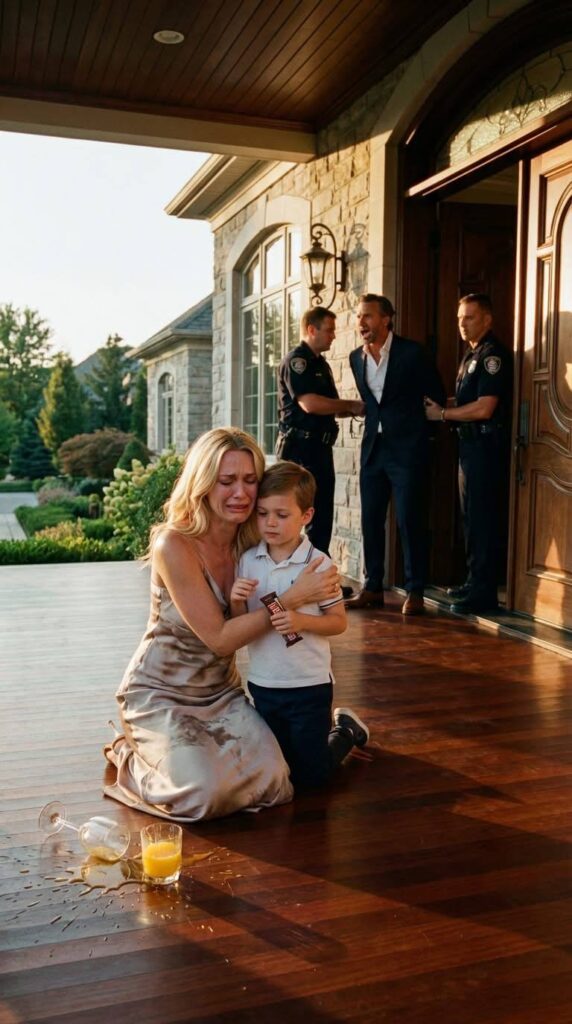
Chapter 1: The Ossification of Sterling Heights
“MY SON’S ‘WISH’ WASN’T FOR A TOY; IT WAS FOR MY LIFE,” I whispered, staring at the crumpled silver foil in my trembling, sweat-slicked palm as the ruby-red tail lights of my husband’s SUV faded into the thick morning fog of the valley. He thought he was driving away with my son; he didn’t realize he was driving toward his own tactical execution.
My life used to be a blueprint of absolute, unwavering precision. As a senior architect at Vance & Associates, I spent my days designing structures that could withstand category-five hurricanes and centuries of tectonic shift. I was a woman of steel and glass, rooted in the cold, hard logic of load-bearing walls and reinforced concrete. But over the last six months, that version of me—the woman who could command a construction site with a single look—had begun to dissolve into a terrifying, unidentifiable fog.
The Sterling Heights estate, a five-million-dollar masterpiece of modern brutalism I had personally designed as our “forever home,” had transformed from a sanctuary into a beautiful, gilded hospital ward. The pristine white walls seemed to vibrate with a low-frequency hum of impending doom. My limbs felt as though they were being slowly injected with cooling lead, and my mind—once my greatest asset, capable of calculating structural stress in seconds—was often lost in a thick, suffocating cloud of neurological “forgetfulness.”
My doctors called it “idiopathic multi-organ fatigue.” I called it a slow-motion burial.
“Morning, El! Got your liquid gold ready. You look a bit pale today—better drink up if you want to keep that architectural genius firing,” Max Thorne said. His voice was a jarringly cheerful note in the oppressive morning gloom. He slid a tall, heavy crystal glass of bright, pulpy orange juice across the cold marble of the kitchen island.
Max, my husband’s younger brother, had moved into the west wing six months ago to “help out” during my sudden decline. He was a man of quick, oily smiles and deep, hidden debts, always one bad hand at an offshore casino away from total ruin. Yet, here he was, playing the role of the devoted house-guest, humming a tuneless melody as the juicer whirred with a mechanical, predatory hunger.
Julian Vance, my husband, entered the kitchen a moment later. His silk tie was perfectly knotted, his presence a masterclass in performative, high-society concern. He leaned down and kissed my forehead with a dry, clinical precision that sent a shiver of ice down my spine.
“Drink it, honey,” Julian whispered, his hand lingering just a second too long on my shoulder, his thumb pressing into my collarbone. “Max knows exactly what you need. We’re just worried about you. You’ve been so… erratic lately. I’d hate for you to miss a single dose of your ‘special vitamins’.”
I took a sip of the juice. It was sweet, cloyingly so, but there was a faint, metallic bitterness at the back of my throat—a chemical aftertaste I had grown used to. I believed it was just the high concentration of the expensive supplements they insisted were the only thing keeping my heart beating. I didn’t notice the way Max and Julian exchanged a split-second, knowing glance over my bowed head. I didn’t see the cold, predatory calculation in their eyes.
I was a variable they had already solved in their lethal calculus.
It was Friday morning. Julian was taking our six-year-old son, Leo, on a weekend camping trip to the Greywood Reserve. I was too weak to even stand for long periods, let alone hike. As I buckled Leo into his car seat, my hands shook so violently I could barely manage the safety latch.
Leo was unusually quiet. His face, normally a canvas of exuberant curiosity, was a mask of pale, adult-like gravity. He didn’t wave to the house. He didn’t ask about s’mores. Instead, he gripped my hand with a strength that made me gasp and pressed a sticky, crumpled ‘Choco-Blast’ candy wrapper into my palm.
“Don’t throw it away, Mommy,” he whispered, his wide brown eyes searching mine with a terrifying, ancient intensity. “My wish is inside. Read it when the car is gone. Promise? You have to promise.”
“I promise, baby,” I whispered, kissing his cold cheek, feeling a sense of dread that felt like a physical weight in my stomach.
As the car pulled away, I noticed Max standing in the upstairs window, holding a small, brown apothecary jar and smiling at me in a way that made my blood turn to liquid nitrogen.
Chapter 2: The Cipher in the Foil
The silence of the house after the SUV disappeared behind the heavy iron gates of Sterling Heights was absolute. It felt as though the air had been sucked out of the rooms, leaving me in a vacuum of clinical luxury. I leaned against the heavy oak front door, my breath coming in shallow, wheezing gasps, my heart hammering a frantic, irregular rhythm against my ribs.
I looked down at the silver foil wrapper in my hand. It was just a piece of trash, sticky with chocolate residue. But Leo was not a child of whimsy; he was a child of facts, blueprints, and Lego bricks. He didn’t believe in magic; he believed in what he could see.
I moved to the foyer’s wainscoting and smoothed out the silver foil. My vision blurred, then snapped into a sharp, painful focus. Scrawled in jagged, blue crayon—the kind Leo used for his “secret” architectural drawings—were the words that shattered my reality into a thousand jagged shards.
MOM DON’T DRINK MAXS JUICE. I SAW HIM PUT WHITE SALT FROM THE JAR BEHIND THE FRIDGE IN IT. HE SAID IT MAKES YOU SLEEP. DON’T SLEEP MOMMY. PLEASE WAKE UP.
The room tilted on its axis. The metallic taste in my mouth, which I had endured for months, suddenly transformed from a “supplement” into the battery acid of realization. I looked toward the kitchen, toward the half-empty glass of “liquid gold” sitting on the island like a goblet of hemlock.
White salt. The jar behind the fridge.
I moved toward the kitchen, my adrenaline fighting a desperate war against the toxins already circulating in my blood. Every step felt like wading through waist-deep molasses. I reached the massive, industrial-grade refrigerator and, with an agonizing groan of effort that felt like it would snap my spine, I used a crowbar from the utility closet to pry the appliance away from the wall.
There, tucked in a layer of dust and shadows where no one would ever think to look, was a small, unlabeled glass jar. It was filled with a fine, crystalline white powder that shimmered with a deceptive, diamond-like beauty.
I opened the jar. Odorless. I touched a single, microscopic grain to my tongue. Tasteless.
I remembered a case study I had encountered during my graduate years about industrial contaminants and structural sabotage. It was a substance nicknamed “the poisoner’s poison” because of its invisibility. It caused progressive organ failure, sensory neuropathy, hair loss, and the very neurological “forgetfulness” that had stripped me of my life.
Thallium.
The “vitamins” were an execution. The “care” provided by my husband was a calculated countdown to my funeral. And as I looked at the glass on the counter, I realized I had just ingested enough “white salt” to finish the job before the sun set.
I reached for my phone to call for help, but the screen remained black. I looked at the charging port and saw it had been filled with industrial adhesive. I was trapped in a house of glass, and the walls were closing in.
Chapter 3: The Forensic Audit of a Life
I didn’t panic. Panic is a structural failure of the mind. I am an architect; I look for the load-bearing truth. If I couldn’t use my phone, I would use the house itself.
I dragged myself to my home office, my legs burning with a sensation the doctors had dismissed as “anxiety-related nerve pain.” I knew better now. It was the Thallium dismantling my nervous system, fiber by fiber. I reached my desk and pulled a hidden emergency laptop from a floorboard safe—a device Julian didn’t know existed.
“Detective, I need you to listen very carefully,” I rasped into the VOIP line once I bypassed the house’s jammed Wi-Fi using an old satellite uplink. “This is Elena Vance. I am being poisoned. The suspects are at the Greywood Reserve. They have my son.”
But I couldn’t just wait for the police. The Greywood Reserve was a vast wilderness. If the police moved in with sirens blaring, Julian would know the game was up. And if Julian felt cornered, I didn’t know what he would do to the only witness who could put him in a cage: our son.
I had to conduct a forensic audit of my own betrayal.
Years ago, when I first designed Sterling Heights, I had installed a series of “nanny cams” and environmental sensors disguised as smoke detectors and recessed lighting. It was a security measure I’d never bothered to mention to Julian; I had considered it a redundant system for the babysitters we eventually stopped hiring.
I accessed the Vance Cloud server. My hands shook as I bypassed the recent logs and went straight to the footage from last Tuesday—a day I had been “particularly tired,” barely able to lift my head from the pillow.
On the screen, Max was standing at the kitchen island. He wasn’t humming. His face was a mask of methodical, cold-blooded efficiency. He pulled the jar from behind the fridge and measured a precise, leveled teaspoon into my orange juice.
Then, Julian walked into the frame. He didn’t look like the man I had shared a bed with for ten years. He looked like a project manager reviewing a construction deadline.
“Is the dosage holding? She looked like she had too much energy this morning,” Julian asked, checking his gold watch.
“She’s fading fast, J,” Max replied with a jagged, ugly laugh. “Another week of this ‘white salt’ and she’ll be a tragic memory of a brilliant woman taken too soon. You sure about the insurance payout?”
Julian nodded, his expression devoid of anything resembling human emotion. “The Vanguard Life Policy for ‘accidental organ failure’ pays out triple—four point five million—if the death occurs within the primary residence during a documented illness. We’re on schedule. Just keep her ‘hydrated’. I need to make sure the camping trip creates the perfect alibi. I’m the grieving father, miles away from the ‘tragedy’ at home, surrounded by witnesses at the park ranger station.”
I felt a coldness that had nothing to do with the toxins. My husband hadn’t just watched me die; he had choreographed it. He was using our son as a prop in his alibi for my murder.
As I watched the footage, I saw Julian hand Max a second, smaller jar. “This one is for the boy,” Julian whispered. “Just in case he starts asking too many questions about the ‘salt’.”
Chapter 4: The Calculus of the Kill
I didn’t have time for the luxury of a breakdown. The “wish” Leo had given me was a ticking clock. If Julian was planning to “silence” our son at the campsite, I had hours, maybe minutes, to act.
“Detective,” I spoke back into the laptop, my voice a low, vibrating thunder of maternal rage. “I have the footage. I have the motive. But you cannot go in with a SWAT team. You’ll spook him. He’s a narcissist—if he thinks he’s lost, he’ll burn everything down including the child.”
“What do you suggest, Mrs. Vance?” the detective asked. “You’re in no condition to travel.”
“I don’t need to travel,” I said, looking at the architectural controls of the house on my screen. “I designed this house to be a smart-home fortress. And I’m about to turn it into a lure.”
I spent the next hour working with the police via the secure link. We set up a perimeter around Sterling Heights, but we kept it invisible. No sirens. No lights. Just a silent ring of steel. Then, I prepared the final act.
I reached for my medicine cabinet and pulled out the one thing I knew could counteract the immediate lethality of the Thallium long enough for me to stand: Prussian Blue. I had kept it in the back of the cabinet after a project involving industrial dyes. It was the only known chelating agent for thallium. I swallowed the capsules, the bitter powder coating my throat.
Then, I dialed Julian’s satellite phone.
“Julian… help me… I can’t… I can’t breathe…”
I forced my voice into a fragile, gasping rasp. I lay on the floor of the foyer, right where the cameras would see me, making sure my face was pale and my eyes were wide with a simulated, terminal terror.
On the other end of the line, I heard the crackle of a campfire and the sharp intake of Julian’s breath.
“Elena? Elena, what’s happening? Talk to me!” His voice was a perfect, sickening mask of husbandly panic.
“The juice… it tasted… like metal. I collapsed… I can’t feel my legs, Julian. Please… come home… bring Leo… I don’t want to be alone when… when it happens…”
“We’re coming, honey! Max, get the gear in the car! Hang on, Elena! Don’t you dare close your eyes! I’m calling the paramedics right now!”
I hung up. I knew he wouldn’t call the paramedics. He would call Max, and they would speed home to be the “first responders.” They wanted to be there to “discover” the body. They wanted to be the ones to call the time of death so they could ensure no one looked too closely at the orange juice glass.
I heard the roar of the SUV’s engine through the house’s external microphones ten minutes earlier than expected. They weren’t just driving; they were flying. But as the car screeched into the driveway, I saw on the camera that Leo wasn’t in the back seat.
Chapter 5: The Collapse of the Structure
My heart nearly failed for real this time. Where is my son?
The front door was kicked open with a violence that spoke of a man in a desperate hurry to claim a multi-million-dollar prize. Julian and Max sprinted into the foyer, their boots thudding against the marble floors I had so lovingly chosen.
Julian was already on his phone, performatively shouting to a dial tone. “Yes, emergency! My wife! She’s stopped breathing! Sterling Heights! Hurry!”
They ran straight to the living room. I was slumped in my favorite armchair, my head lolling to the side, my eyes closed. I had used a bit of white chalk-dust from my drafting kit to make my skin look translucent, deathly.
“Is she gone?” Max whispered, his eyes scanning the room with a greedy, feral glint. He walked over to the kitchen island and grabbed the orange juice glass, moving to dump it in the sink.
“Wait, Max,” Julian said, his voice cold and steady. He walked over to me and reached for my pulse. His fingers were like ice against my neck. “She’s cold. Finally. The heart is still. The insurance surveyor will be here by Monday. We did it, Max. The ‘Thorne-Vance’ legacy starts today.”
“Not quite, Julian,” I said.
I opened my eyes. They were clear, focused, and filled with a maternal hatred so pure it seemed to physically push him back.
The look of sheer, existential horror on Julian’s face was the most beautiful thing I had ever designed. He stumbled back, his heels catching on the rug, his mouth opening in a silent scream of confusion.
“Elena? You… you’re…”
“I’m an architect, Julian,” I said, standing up with a strength that defied the poison in my marrow. “And you forgot that I designed the foundations of this family. I know where the rot is.”
Suddenly, the recessed gallery lights flared with a blinding, tactical intensity. The heavy velvet curtains of the dining room were ripped back to reveal a phalanx of eight armed officers, their weapons leveled at the brothers’ chests.
Detective Vance stepped forward, holding the silver ‘Choco-Blast’ wrapper in one hand and the jar of “white salt” in the other.
“Julian Vance, Max Thorne. You are under arrest for conspiracy to commit murder, attempted murder, and the kidnapping of Leo Vance.”
“Kidnapping?” I screamed, the facade of the trap breaking. “Julian, where is my son?”
Julian looked at me, a pathetic, cornered rat. “He… he was too smart, Elena. He saw too much. I left him at the ranger station… I told them he was lost so they would keep him there while I ‘rushed home’ to you. I was going to go back for him after… after you were gone.”
Max, realizing the game was over, lunged for the kitchen island, grabbing a heavy glass decanter and smashing it. “If I’m going down, I’m taking the evidence with me!” he roared, lunging not at the police, but at me.
Chapter 6: The Echoes of the Vault
The confrontation was over in seconds. Max was tackled to the ground before he could reach me, the glass shards of the decanter drawing blood from his own hands as the officers pinned him to the marble. Julian didn’t even fight. He simply collapsed into a chair, his head in his hands, the image of the “grieving widower” finally becoming a permanent reality—only he was the one who was socially and legally dead.
I didn’t stay to watch them be read their rights. I was in a police cruiser within minutes, escorted by two officers with sirens wailing, heading toward the Greywood Reserve.
When I arrived at the ranger station, the world felt like it was finally returning to its proper alignment. Leo was sitting on a wooden bench, wrapped in a bright orange ranger’s blanket, sipping a cup of cocoa. When he saw me, he didn’t cry. He simply stood up and walked into my arms, his small body shaking with a relief that no child should ever have to feel.
“You read the wish, Mommy?” he whispered into my neck.
“I read it, baby. You saved the whole house.”
But the investigation was only beginning. As the police conducted a deep-tissue audit of Julian’s life, the “rot” I had suspected turned out to be an entire underground system of decay.
Detective Vance visited me in the hospital two days later, while I was undergoing my third round of blood purification. He looked grimmer than usual, carrying a heavy blue folder embossed with the Vance & Associates logo.
“We searched Julian’s private offshore servers,” the detective said. “He wasn’t just poisoning you for the insurance, Elena. He had been skimming millions from the firm’s pension funds to cover Max’s gambling debts. You were about to conduct the annual audit. He knew you’d find the discrepancies within forty-eight hours.”
I leaned back against the pillows, the weight of the betrayal settling into my bones. “I suspected the firm was struggling, but I never thought…”
“There’s more,” the detective said, his voice dropping an octave. “We reopened the file on your business partner, Sarah, who died of ‘natural causes’ last year right before Julian took over her shares. We found traces of Thallium in her preserved hair samples. He’s been doing this for a long time, Elena. You weren’t his first project. You were just his last.”
The realization hit me with the force of a structural collapse. My husband was a serial predator who used the chemistry of death to build a kingdom of shadows.
As the detective turned to leave, he handed me a small, sealed evidence bag. Inside was Julian’s wedding ring. “We found a compartment inside the band,” he said. “It still had a dusting of the ‘white salt’ inside. He was carrying your death on his finger every time he kissed you.”
Chapter 7: The Foundation of Truth
Six Months Later.
The sun streamed through the floor-to-ceiling windows of my new home—not a brutalist fortress of glass and steel, but a modest, sturdy cottage on the North Carolina coast. I had designed it to be open, airy, and above all, honest. There were no hidden crawlspaces here. No “behind the fridge” shadows. Every wire, every pipe, and every intention was visible to the naked eye.
I was back at work, but my blueprints had changed. I no longer designed for corporations or ego-driven architects. I had founded the Guardian’s Wish Foundation, a non-profit that specialized in forensic architecture and domestic security for women in high-stakes, high-risk environments. I used my knowledge of “smart-home” technology to build sanctuaries that could detect the “rot” before it took hold.
I stood in the kitchen, the smell of salt air and fresh lemons filling the room. Leo was at the table, drawing a elaborate castle with a moat. He was a child again—loud, messy, and wonderfully curious.
“Mommy, can we make the lemonade now?” he asked, holding up a wooden squeezer.
“Of course, baby,” I said, walking over. We did it the old-fashioned way—by hand. No machines. No “liquid gold” mixtures. Just the fruit, the sugar, and the water.
“No salt today, Leo?” I joked softly, kissing the top of his head.
“No salt, Mommy,” he laughed, a bright, defiant sound that echoed through the sturdy wooden beams of our new life. “Just the sour stuff.”
Julian and Max were in separate maximum-security facilities, awaiting a joint trial for a string of “unexplained” deaths that had been reopened across three states. They were facing life without the possibility of parole, realizing too late that their “perfect” plan had been dismantled by the one variable they had dismissed: the observational power of a child with a blue crayon.
My phone buzzed on the counter. It was a message from Detective Vance.
“The board of Vance & Associates has been officially dissolved. The firm is yours again, Elena. Or what’s left of it. What do you want to do with the Sterling Heights property?”
I looked out at the ocean, at the horizon that felt endless and clean. I thought about the house of glass, the house of shadows, and the “white salt” that had almost erased me.
I picked up the phone and typed a single word: “Demolish.”
I realized that Julian had tried to destroy my internal organs, but he had inadvertently forged my soul into structural steel. I was no longer just an architect of buildings; I was the architect of my own destiny.
I picked up my glass of lemonade and raised it to the sun. The final verdict was in: the fog was gone, the “wish” had been granted, and for the first time in my life, the air was easy to breathe. The structure was sound.
If you want more stories like this, or if you’d like to share your thoughts about what you would have done in my situation, I’d love to hear from you. Your perspective helps these stories reach more people, so don’t be shy about commenting or sharing.