
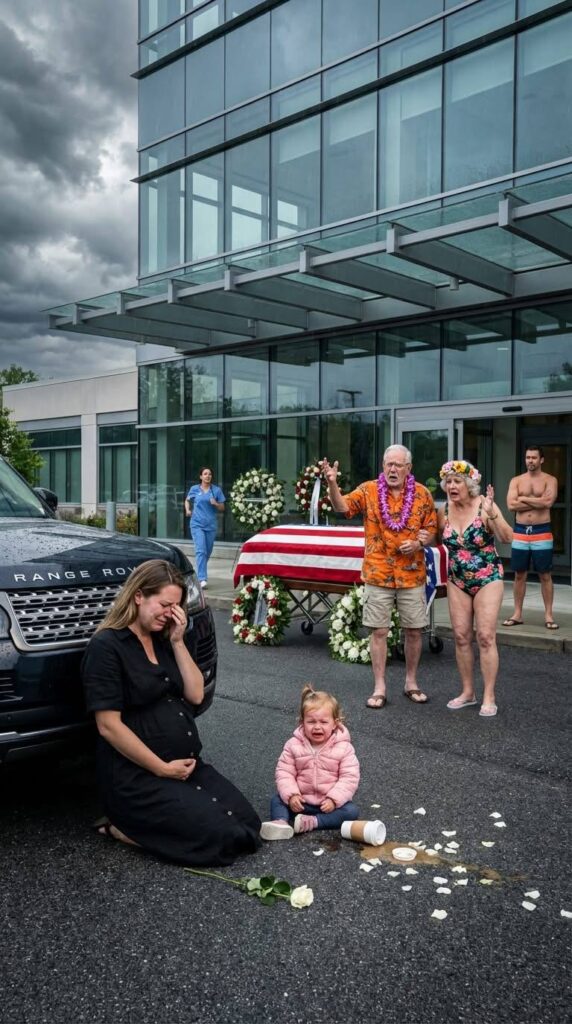
The Weight of Blood: A Covenant of Silence Broken
My hands are still trembling as I grip the steering wheel, the leather cold against my palms. I’ve just walked out of a Biscotti & Bean coffee shop, a place that smells of roasted hope and stale regrets. For four long, agonizing years, I lived in a fortress of silence I built myself, stone by stone, to protect what was left of my heart. But today, the walls came down. I didn’t just talk; I roared.
Looking back, the journey to this parking lot was paved with shadows and the echoes of a life I once thought was perfect. My name is Terra, and for a long time, I believed that love was synonymous with sacrifice—until I realized I was the only one being sacrificed.
Chapter 1: The Ghost in the Inbox
The catalyst for this upheaval arrived three weeks ago. It was a Tuesday, a day of mundane nursing shifts and toddler tantrums. I was scrolling through my emails, looking for a shipping notification, when I saw it. The sender’s name felt like a physical blow: Eleanor Vance. My mother.
The subject line was a masterclass in emotional manipulation: “We need to talk.”
I stared at those four words for forty-eight hours. I didn’t open it. I didn’t delete it. It sat there like a digital landmine. My mind raced back to the last time I’d heard her voice—the dismissive tone, the way she could make her needs sound like a global emergency while my world was literally collapsing.
When I finally mustered the courage to click, the contents were a frantic plea wrapped in thin layers of “family duty.” My older brother, Ryan, the golden boy, the high-flying stockbroker who once looked down on my nursing salary, had fallen from his pedestal. An affair had shattered his marriage, he’d lost his prestigious job at Blackwood Holdings, and he was spiraling.
Then came the kicker. My father, Arthur, a man who spent his life managing other people’s wealth but never his own emotions, had just had a heart stent put in at Saint Jude’s. My mother was “exhausted.” They didn’t ask how I was. They didn’t ask about Ethan, the grandson they’d never met. They simply demanded I come home to “fix everything.”
Fix everything. As if I were a mechanic for their broken lives. As if the last four years were just a long vacation I’d taken from my real job: being their crutch.
As I sat in my darkened living room, the blue light of the laptop illuminating the tears I didn’t know I was shedding, I realized the irony. They wanted the “old Terra” back—the girl who slept on couches to nurse them through minor ailments while her own dreams gathered dust. They had no idea that girl had died the same night her husband did.
I wonder, I thought, staring at the cursor, if they even remember the color we painted the nursery.
Cliffhanger: I reached for my phone, my thumb hovering over the “Delete” button, but then I saw a notification for a photo memory from four years ago today—the day the world ended.
Chapter 2: The Soft Yellow Room
Four years ago, life was a symphony of small, beautiful things. I was a nurse at Oakwood Memorial, and my husband, Jake, was a patrol officer with the 3rd Precinct. We didn’t have much—a cramped apartment on Willow Street and a mountain of student loans—but we had a vision.
We were expecting our first child, a boy we’d already named Ethan. We had spent weeks transforming the second bedroom into a sanctuary. We chose a paint color called “Morning Sunlight”—a soft, buttery yellow.
“This little one is going to have the best mom,” Jake had whispered one evening, his large, calloused hands resting gently on my swollen belly. He’d spent six hours that day refurbishing a secondhand crib he found at a local market. He was so proud of that crib. He wanted everything to be perfect for the son he would never get to hold.
That night, the sky was a bruised purple, leaking cold, relentless rain. Jake was gearing up for his night shift. He kissed my forehead, then knelt to kiss my belly. “Be good for your mom, little man. See you in the morning.”
Those were his final words. See you in the morning.
At 10:14 PM, the landline rang. It was Captain Thompson. His voice, usually booming and jovial, sounded like it had been dragged through gravel.
“Terra… there’s been an accident. A drunk driver. Jake… he didn’t make it, honey.”
The world didn’t just stop; it inverted. I remember the sound of the phone hitting the floor—a hollow, plastic clatter. I didn’t scream. I couldn’t breathe. The air in the room had turned to lead.
I made it to the hospital in a trance. When the nurses led me to the cold, sterile room where Jake lay, I felt like an intruder in my own life. He looked so peaceful, like he was just sleeping off a long shift, but the stillness was wrong. It was absolute. I touched his hand, expecting warmth, but it was like ice.
“I’m so sorry,” I whispered into the silence. “I’m sorry for the argument about the groceries. I’m sorry I didn’t hold you longer.”
And then, as if my grief had become a physical force, a white-hot pain tore through my abdomen. I buckled, clutching the side of the gurney. The stress, the shock, the sheer agony of loss had triggered labor. I was only thirty-four weeks along.
Cliffhanger: As the doctors rushed me toward the delivery unit, my vision blurring, I reached for my phone to call the only people I thought I could count on. My mother picked up on the fourth ring, but the sound in the background wasn’t what I expected.
Chapter 3: The Call from the Clouds
“Mom,” I sobbed, my voice cracking under the weight of a contraction. “Jake is gone. He’s dead, Mom. And I’m in labor. It’s too early. I need you. Please, I need you at Oakwood Memorial right now.”
There was a pause. A long, chilling silence that lasted longer than the pain in my gut. In the background, I heard a crisp, feminine voice over a loudspeaker: “Final boarding call for Flight 202 to Malé.”
“Honey,” my mother’s voice finally came through, calm and measured, as if she were discussing the weather. “We’re at the airport with Ryan. He got that massive promotion at the firm, and we’re going on that celebratory trip to the Maldives. We’ve had this planned for six months, Terra. Everything is non-refundable.”
I felt the blood drain from my face. “Mom? Did you hear me? Jake is dead. I am alone.”
“We know, dear, and it’s tragic. Truly. But there’s nothing we can do from a hospital waiting room that the doctors can’t do better. We’ll call you when we land in paradise. Just stay calm for the baby.”
The line went dead.
I stared at the ceiling of the delivery room, the bright fluorescent lights searing my eyes. I didn’t cry then. The tears had frozen into something sharper—something like glass.
I gave birth to Ethan at 3:12 AM. I was surrounded by strangers. A nurse named Linda held my hand. She saw the devastation in my eyes, the way I looked at my son—who was tiny, fragile, and struggling to breathe—and then looked at the empty chair beside me where my family should have been.
Ethan was rushed to the NICU. I was moved to a recovery room, alone with the ghost of my husband and the silence of my parents.
Over the next eleven days, while my son fought for his life in a plastic box, my phone remained largely silent. Then, a single text arrived from my mother. It was a photo of a turquoise ocean, a cocktail in the corner of the frame.
“Hope you’re doing okay, honey. The Maldives is breathtaking. You should try to get some rest. Love, Mom.”
I didn’t reply. Instead, I took a screenshot. I didn’t know why then, but a primal instinct told me that this image—this digital proof of their abandonment—would be my only weapon one day.
Cliffhanger: The day of Jake’s funeral arrived, and as I stood by the casket, holding a handful of dirt, I looked toward the back of the church, hoping for a miracle. But the only people there were men in uniform and a widow who lived next door. My family was still three thousand miles away, “soaking up the sun.”
Chapter 4: The Architecture of a New Life
Grief is not a straight line; it’s a labyrinth. After the funeral, I changed my number. I moved out of the apartment with the yellow room—the memories there were too loud, too haunting.
I used Jake’s life insurance—a modest sum he’d insisted on despite my protests—to pay off my debts and put a down payment on a small cottage on the outskirts of town. I went back to work, pulling double shifts while Mrs. Johnson, my eighty-year-old neighbor, watched Ethan.
Mrs. Johnson became the mother I never had. She didn’t offer platitudes; she offered beef stew and silent company. She taught me how to garden, how to find peace in the dirt.
And then there was Captain Thompson. He checked on us every week. He brought Ethan little police car toys and told him stories about how brave his father was. He became the anchor in our storm.
But the real turning point was Dr. Miller, a therapist who specialized in family trauma. In her office, surrounded by leather-bound books and the scent of lavender, I finally learned the word for my childhood: Parentification.
“Terra,” she said, her voice gentle but firm. “You weren’t their daughter. You were their emotional janitor. You were conditioned to believe that your value lied in how much of yourself you could give away to keep them comfortable. When you finally had a need that was bigger than theirs, they didn’t know how to handle it. So they ran.”
It was a revelation. I thought back to the years I spent sleeping on my parents’ couch after my mother’s back surgery, the promotion I turned down so I could drive Ryan to his rehab appointments after his “party phase.” I had been a martyr in a religion that didn’t believe in me.
I spent three years rebuilding. Ethan grew into a sturdy, laughing toddler with his father’s mischievous eyes. I became a head nurse. I was happy. Or, at least, I was whole.
Until the email.
Cliffhanger: I walked into that coffee shop today with a Manila Folder tucked under my arm. I saw them sitting in a booth—three people who looked like my family but felt like strangers. My mother reached out to hug me, but I stepped back, the folder hitting the table with a definitive thud.
Chapter 5: The Confrontation at Biscotti & Bean
The coffee shop was crowded, but as I sat down, a localized silence seemed to fall over our table.
My mother, Eleanor, looked exactly the same—impeccably coiffed, wearing a silk scarf that probably cost more than my monthly mortgage. My father, Arthur, looked diminished, his skin sallow. And Ryan… the golden boy was tarnished. He had the hollowed-out look of a man who had finally realized that his charm couldn’t fix his character.
“Terra,” my mother started, her voice trembling with practiced fragility. “You looks… well. We’ve been so worried. Why did you cut us out? We didn’t even know where you were.”
I didn’t answer. I just looked at her. The silence stretched until it became uncomfortable, until Ryan shifted in his seat.
“Look, Sis,” Ryan said, trying on a smile that didn’t reach his eyes. “We know things were… tense back then. But we’re family. I’ve hit a bit of a rough patch. Dad’s health isn’t great. We need you back in the fold. We need your help to get things organized.”
“Organized,” I repeated. The word felt like ash in my mouth. “You want me to fix your mess, Ryan? Like I did when you crashed Dad’s car? Like I did when Mom ‘couldn’t cope’ with your graduation?”
“That’s not fair,” my father grumbled. “We’re your parents. We raised you.”
“You used me,” I corrected him, my voice low and dangerous. I opened the Manila Folder.
I pulled out the first paper. It was a printed screenshot of a text message from five years ago. ‘Terra, I know it’s your birthday, but I need you to come over and scrub the kitchen. My back is acting up and your father is at golf.’
“I came,” I said. “I spent my twenty-fifth birthday cleaning your floor.”
I pulled out the second paper. It was the screenshot from the Maldives. The turquoise water. The cocktail.
“This,” I said, my voice finally beginning to shake with the suppressed rage of a thousand days. “This was sent to me while my husband was being prepared for an autopsy. While my son was in an incubator, struggling to take his first breaths. You were in ‘paradise.’ You told me to ‘stay calm’ while you drank mojitos on a beach.”
My mother’s face went pale. “We… we didn’t realize it was that serious. We thought the doctors—”
“You didn’t want to realize,” I barked, causing a woman at the next table to jump. “Because realizing would have meant sacrificing your comfort. And the Vances don’t do sacrifice. Only I do. Or rather… only I did.”
Cliffhanger: My father tried to reach for the photo, but I slammed my hand down on it. “Trauma doesn’t have an expiration date, Dad. You want a nurse? Hire one. You want a daughter? You should have been parents.” I stood up, but Ryan grabbed my sleeve.
Chapter 6: The Covenant of the Chosen
“Terra, wait,” Ryan pleaded. “I’m sorry. Okay? I’m sorry I wasn’t there. I was selfish. But I’m losing everything. Doesn’t that mean anything to you?”
I looked down at his hand on my arm. I felt nothing. No pity, no familial pull. Just a profound sense of distance.
“Sorry is a start, Ryan,” I said, peeling his fingers off my jacket. “But sorry doesn’t put Jake back in that chair. Sorry doesn’t hold my hand in the delivery room. You chose your comfort over my survival. You used up all the love I had for you. There’s nothing left in the reservoir.”
I gathered my papers. My mother began to sob—that soft, delicate weeping she used to get her way for thirty years. This time, I didn’t reach for a tissue. I didn’t offer a hug.
“Don’t call me again,” I said. “And don’t look for Ethan. He has a family. People who show up. People who know that love isn’t a feeling, it’s a verb.”
I walked out of the shop. The air outside was crisp, smelling of autumn and freedom. I got into my car and just sat there, breathing. For the first time in my life, I wasn’t responsible for anyone else’s happiness but my own and my son’s.
Two weeks later, a letter arrived. Handwritten. My mother’s elegant script. It was eight pages of justifications, excuses, and “we did our best.” There was no “I’m sorry for leaving you when your husband died.” There was only “I’m sorry you feel that way.”
I didn’t burn it. I didn’t cry over it. I simply put it in the drawer with the other folder. It was just more evidence that I had made the right choice.
This past Christmas was different. There were no silk scarves or expensive jewelry. There was just Mrs. Johnson bringing over a turkey that was slightly too dry, and Captain Thompson wearing a ridiculous Santa hat that made Ethan squeal with delight. Linda, the nurse who held my hand four years ago, came over with a homemade cake.
We sat around the table, the spirit of Jake a warm presence in the room. We told stories about him—the way he couldn’t cook a grilled cheese to save his life, his infectious laugh, his unwavering bravery.
Ethan looked up from his toy police car, his eyes wide and curious. “Mommy, why don’t we see the other grandma and grandpa? The ones in the pictures?”
I knelt down, brushing a stray hair from his forehead. “Because, baby, some people are family because of blood. But the people in this room? They’re our family because they choose to be. They’re the ones who stayed when the rain started.”
He thought about it for a second, then hugged my neck. “I like our family best.”
“Me too, Ethan,” I whispered. “Me too.”
I used to think that being a ‘good daughter’ meant setting myself on fire to keep them warm. I was wrong. Real love doesn’t ask you to disappear. Real love shows up. It stays. It holds your hand in the dark.
I’ve built a new world on the ruins of the old one. It’s smaller, yes. But it’s built on solid ground. And for the first time, the soft yellow in the nursery isn’t just a color—it’s the way the future looks.