
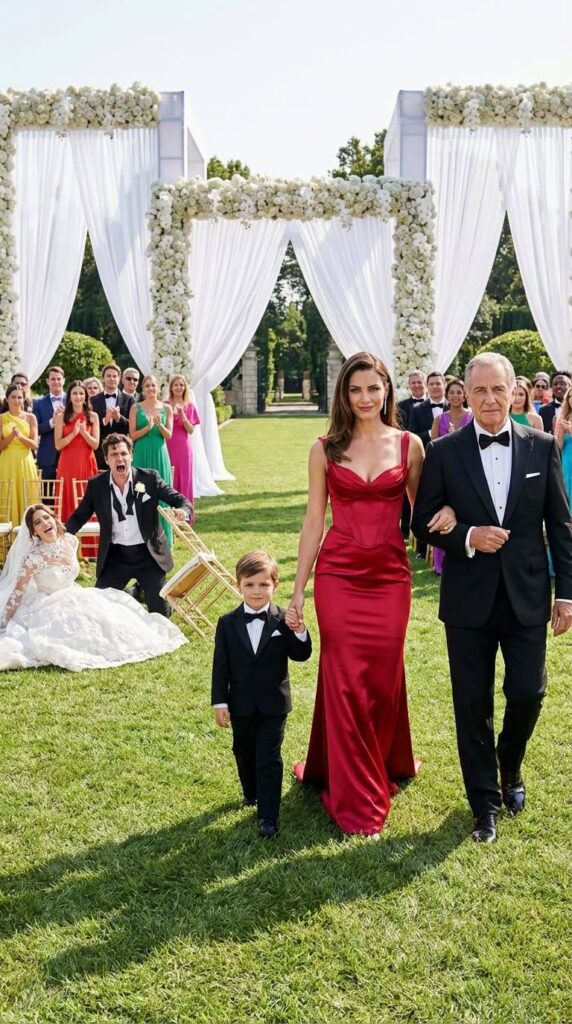
Chapter 1: The Facade of the Century
There is a specific kind of silence that falls over a room when a woman realizes her entire life is a meticulously constructed lie. It doesn’t sound like shattering glass or a sudden gasp. It sounds like the soft, rhythmic ticking of a Patek Philippe watch, counting down the seconds to an execution.
For five years, I had been the steady, quiet engine behind Julian Thorne. I was Elena Sterling, the pragmatic CFO of Sterling Global, a woman who understood profit margins, hostile takeovers, and the cold reality of compound interest. Julian was the artist, a charismatic but perpetually “misunderstood” architect whose grand visions were entirely subsidized by my family’s wealth. I thought we were a partnership of contrasts—his light to my shadow. I didn’t realize I was just the power grid keeping his neon signs glowing.
Promoted Content
The realization didn’t come with a dramatic confrontation. It came on a Tuesday evening, at our pre-wedding gala in a sprawling Manhattan penthouse overlooking Central Park. The air was thick with the scent of white orchids and the quiet hum of a hundred millionaires networking under the guise of celebration.
I had just stepped away from a group of Japanese investors, adrenaline still humming in my veins from closing a brutal maritime logistics merger. I navigated through the sea of silk and velvet to find Julian. He was standing near the floor-to-ceiling windows, looking impossibly handsome in a bespoke Tom Ford tuxedo, swirling a glass of vintage Krug.
“Julian,” I said, touching his arm. “The Yokohama deal. It just went through. We secured the shipping lanes.”
He barely looked up from his champagne. His eyes were already tracking a figure across the room—my younger sister, Clara. Clara was everything I wasn’t: vibrant, effortlessly beautiful, a socialite who wore her privilege like a second skin. She was laughing, tossing her head back, the center of gravity in a room full of heavy hitters.
“That’s nice, El,” Julian murmured, his voice dripping with a practiced, suffocating boredom. “But could you maybe wear the Vera Wang tomorrow instead of that stiff suit? You’re a bride, not a board member. Try to look a bit more like your sister; she actually knows how to light up a room.”
The celebratory words died in my throat, turning to ash. A cold dread coiled in my gut. It wasn’t just the insult; it was the sheer, brazen comfort with which he delivered it. I glanced toward the marble pillars near the entrance. My father, Arthur Sterling, stood there. He was a man who spoke little but saw everything. His grip on his polished mahogany cane tightened until his knuckles turned white. His eyes were fixed on Julian, and the look in them wasn’t protective; it was a predatory, absolute coldness. He knew. My father had always known.
Later that night, long after the last guest had departed and Julian had passed out in the guest bedroom—claiming ‘pre-wedding jitters’—I found it. I was hanging up his tuxedo jacket when a heavy, unfamiliar weight in the inner pocket caught my attention. A cheap, black burner phone.
My thumb hovered over the screen. It wasn’t locked. A single, unread message from Clara glowed in the sterile white light of the closet: One more day of pretending to love the ‘ugly duckling,’ and then the Sterling fortune is finally ours, baby.
Chapter 2: The Silent Departure
I didn’t scream. I didn’t cry. Tears are an inefficient use of energy when you are standing in the wreckage of your own future. Instead, my mind shifted seamlessly into a state I knew intimately: crisis management. I was looking at a toxic asset, a profound breach of contract. I didn’t want a messy divorce five years down the line. I wanted an annulment of his entire existence.
At 4:00 AM, I was sitting in my father’s oak-paneled study. The room smelled of old paper, leather, and unyielding power. Arthur sat across from me in a wingback chair, his hands folded over his cane. I slid the burner phone across the desk.
He read the text. Not a muscle in his face twitched. He simply looked up at me, his eyes dark and flinty. “What is your directive, Elena?”
“Total liquidation,” I replied, my voice steady, though my palms were slick with sweat. “I want him zeroed out. By 9:00 AM.”
A slow, terrifying smile crept onto my father’s face. “Consider it done. The jet is fueled.”
The sun rose over Manhattan, painting the skyline in mocking shades of gold and pink. The bridal suite was a cacophony of makeup artists, hairdressers, and popping corks. I wore my mask perfectly. I sat perfectly still as Clara, playing the role of the devoted Maid of Honor, pinned my veil.
“You look so beautiful, El,” Clara cooed, wiping away a fake tear that threatened to ruin her immaculate contouring. “He is so lucky to have you.”
“Yes,” I agreed, meeting her eyes in the mirror. “He really is.”
By 8:30 AM, while Clara was downstairs managing the florists, I slipped out the service elevator. I left my custom Vera Wang gown draped over a velvet chair. Pinned to the bodice was a handwritten note: I’m going to the one place where I’m valued.
I climbed into a nondescript black Uber. As we merged onto the FDR Drive heading toward JFK, I opened a secure application on my iPad. It was a live feed from the security cameras my father’s team had discreetly installed inside St. Patrick’s Cathedral earlier that week.
On the screen, the cathedral was packed with the elite of New York. Julian stood at the altar. He was sweating slightly, nervously checking his Rolex, but his smile was a picture of practiced charm. Clara, standing in the Maid of Honor’s position, took a step closer to him, ostensibly to comfort the anxious groom.
Through the lapel microphone my father had insisted Julian wear for the “videographer,” the audio fed directly into my earpiece. Julian leaned in, his lips brushing Clara’s ear.
“Finally, I’m marrying the right woman,” he whispered, loud enough for the microphone to catch every syllable. “Once she walks down that aisle and signs the papers, her father’s trust fund becomes our playground. I never have to touch her again.”
Clara giggled, a sharp, triumphant sound that made my blood run cold. They thought the delay was just bridal nerves. They didn’t know I was already thirty thousand feet in the air, watching them on a screen.
On the feed, the Priest suddenly stepped forward. He looked down at his phone, his face draining of color. He looked at Julian with a mixture of profound pity and absolute disgust. He raised a trembling hand, signaling the organist to stop the music. The silence that fell over the cathedral was deafening.
“I cannot proceed,” the Priest announced, his voice echoing off the vaulted ceilings.
Chapter 3: The Financial Guillotine
In the hushed, pressurized cabin of the Gulfstream, I took a slow sip of sparkling water. On my screen, St. Patrick’s had devolved into chaos.
“What do you mean, you can’t proceed?” Julian demanded, his charming facade cracking. A murmur rippled through the pews. Hundreds of silk-clad guests leaned forward, camera phones already rising like a sea of mechanical fireflies.
The Priest cleared his throat. “I have just been informed… the bride’s father has cut off all your funding.”
“What do you mean ‘cut off’?” Julian screamed, his voice pitching into a hysterical tenor. He patted his pockets frantically, pulling out his phone. I watched as realization hit him like a physical blow. His personal credit cards, his apartment lease, his private car service—all deactivated simultaneously by the Sterling Global accounting department at exactly 9:01 AM.
Then, the heavy oak doors at the back of the cathedral swung open. The murmurs died instantly.
Arthur Sterling walked down the center aisle. He wasn’t walking like the father of the bride; he was marching like the Chairman of the Board walking into a hostile boardroom. His boots echoed sharply against the marble. He stopped exactly three feet from Julian.
“The pre-nuptial agreement you signed last month had a ‘morality and loyalty’ clause, Julian,” Arthur’s voice boomed, devoid of any warmth. “My daughter found the burner phone. You are no longer authorized personnel.”
Julian stumbled backward, gasping for air.
“By 9:01 AM this morning, you were removed from every Sterling account,” Arthur continued, his tone clinical. “The luxury apartment in Soho? Evicted. Your belongings are currently on the sidewalk. The architectural firm we subsidized? Dissolved. You aren’t marrying into a fortune today, Julian. You’re marrying into a debt of six million dollars in advanced loans that I am now calling in. Immediately.”
Julian wheeled around, his eyes wide with terror, reaching out for Clara. “Clara! Clara, do something!”
Clara recoiled violently, stumbling back in her high heels as if Julian were infected with a plague. The social climber had just realized she was tethered to a falling rock. “Don’t touch me!” she hissed, her face contorted in fury. “You told me you had her handled! You told me you were smart!”
She turned and practically ran down the side aisle, abandoning him in front of six hundred people.
Alone at the altar, stripped of his money, his status, and his secret lover, Julian collapsed to his knees. His phone pinged—a sound loud enough to be picked up by the microphone.
I watched him pull it out with trembling hands. I had scheduled the video message to send at exactly 9:15 AM.
On his screen, he saw me. I was reclining in a leather seat in the first-class cabin, holding a glass of champagne. I smiled, but it didn’t reach my eyes.
“Check your pocket, Julian,” my voice echoed from his phone. “The left inner one.”
On the cathedral feed, I watched him blindly reach into his tuxedo jacket. His fingers pulled out a small, metallic disc. A GPS tracking device I had slipped into the lining days ago.
Chapter 4: The Architect of Ruin
By the time I landed in Paris, Julian’s life was an unrecognizable crater. My security detail informed me he had been escorted out of the cathedral by private guards. He had tried to go to Clara’s apartment, but she had already fled to a friend’s villa in the Hamptons, desperate to distance herself from the radioactive fallout of the scandal. He had no money, no home, and his face was plastered across every gossip blog on the eastern seaboard.
But I wasn’t finished. Leaving him broke was a personal victory; ensuring he could never hurt anyone else was a professional obligation.
I settled into a suite at the Ritz, opened my laptop, and began the corporate phase of my revenge. During my audit of the ‘wedding expenses’ the previous week, I had dug deeper into the architectural firm we funded for him. Julian wasn’t just a bad partner; he was a thief. He had been skimming off the top of renovation budgets for months, funneling the cash into offshore accounts to fund the extravagant lifestyle he thought he deserved.
I compiled the ledgers, the forged invoices, and the wire transfers into a single, encrypted file. I sent it directly to the Manhattan District Attorney’s office, cc’ing the NYPD fraud division. Then, I leveraged my father’s considerable influence in the real estate sector. Within two hours, Julian Thorne was permanently blackballed from every architectural firm in North America.
I was walking through the crisp, gravel paths of the Tuileries Garden, the Eiffel Tower piercing the gray sky in the distance, when my phone vibrated. It was Julian. I answered, pressing the record button.
“Elena! Elena, please, you have to talk to me!” His voice was ragged, desperate, lacking any of its usual smooth cadence. He sounded like a man drowning.
“Speak,” I said, my voice like ice.
“It was a mistake! A terrible, stupid mistake!” he sobbed. “Clara seduced me, El. She pushed for the money, she poisoned my mind! I love you. I’ve always loved you! Please, just call your father off. I have nowhere to go. I’m sitting on a curb in my tuxedo.”
I stopped walking. I looked out over the Seine, the water dark and moving relentlessly forward.
“You loved the ‘Sterling’ name, Julian,” I replied evenly. “You loved the platinum black card. You loved the status. I was just the quiet, boring girl who paid the bills while you played the tortured genius. But you forgot one crucial detail.”
“What?” he choked out.
“I’m the CFO. I know where every single cent is buried.” I paused, letting the silence stretch. “I didn’t just cut off your funding, Julian. I filed the police report for the two hundred thousand dollars you skimmed from the firm’s renovation budget. Embezzlement is a messy charge.”
“You… you didn’t.”
“The police are likely finding you right now,” I said.
Through the phone, I heard a scuffling sound, followed by a harsh, unfamiliar voice. “Julian Thorne? Stand up, please. Keep your hands where we can see them.”
“Elena!” he screamed, the sound muffled as the phone was dropped. “Elena, wait—!”
I hung up. I stood in the garden, breathing in the cold Parisian air, feeling my lungs expand fully for the first time in five years.
But there was one final loose end. My phone buzzed with a text from my father’s head of security: NYPD picked him up. He’s in custody. But Clara’s car just sped away from the Hamptons house. She didn’t look back.
I smiled grimly and typed my reply: Give the DA the second file.
The second file contained Clara’s signature on the offshore accounts. She wasn’t just a mistress; she was an accessory to fraud.
Chapter 5: The Price of Treachery
Six months is a long time in the corporate world, but it is an eternity when you are falling from grace.
I didn’t hide in Europe; I reinvented myself. Free from the emotional parasite that was Julian, and out from under the immediate shadow of my father’s empire, my mind was sharper than ever. I stayed in Paris and launched my own boutique venture capital firm, focusing on aggressive, tech-driven acquisitions. I was thriving.
Back in New York, the karma I had engineered was playing out with brutal precision.
Clara’s social exile was absolute. In our world, scandal is only tolerated if you have the money to paper over it. Without the Sterling trust fund—which my father had legally frozen pending the fraud investigation—she was nothing. Her “friends” vanished overnight. To keep her out of a jail cell, my father had struck a ruthless plea deal: she avoided prison time, but she was cut out of the will, banished from the family properties, and forced to live in a cramped, walk-up apartment in Queens. The stipulation was clear: if she ever spoke to the press, or to Julian, the DA would unseal her file.
My private investigator sent me weekly updates. One Tuesday, sitting at a cafe overlooking the Seine, I read the latest report. Clara was currently working at a high-end boutique on Madison Avenue—not as a VIP client, but as a stockroom assistant. The report detailed an incident where Clara had to endure a thirty-minute screaming match from a former sorority sister over a scuffed pair of Louboutins. She had to kneel on the floor and apologize.
As for Julian, his charm couldn’t charm a federal judge. The six million in debt, combined with the clear-cut embezzlement, landed him a solid five-year sentence in a mid-level security facility upstate. He was no longer the ‘architect of the stars.’ He was Inmate 84792.
A waiter brought my espresso and a stack of mail forwarded from my New York office. Near the bottom was a letter stamped by the New York State Department of Corrections. From Julian’s lawyer. A desperate plea to drop the civil suit that was keeping him in perpetual bankruptcy.
I didn’t even break the seal. I walked over to the small fireplace crackling in the corner of the cafe, tossed the envelope onto the logs, and watched the desperate ink curl and turn to ash.
My phone rang. It was Arthur. Our relationship had changed. The paternal condescension was gone, replaced by a deep, unspoken respect.
“The European yields are up twelve percent, Elena,” he said, his gravelly voice sounding almost warm. “You’re outperforming my domestic guys.”
“I learned from the best, Dad,” I replied.
“I always knew you had the Sterling ruthlessness in you,” he murmured. “I was just waiting for you to see Thorne for what he was. You handled it… perfectly.”
When I returned to my office that afternoon, there was a bouquet of black dahlias sitting on my desk. They weren’t from an admirer. They were from my lead investigator. Tucked inside the dark petals was a glossy photograph.
It was a candid shot from the prison recreation yard. It showed Julian, looking gaunt, terrified, and sporting a fresh, purple bruise across his jaw. Standing directly behind him, casting a long shadow, was his new cellmate.
I recognized the man instantly. It was Marcus Vance—a brilliant, volatile contractor whom Julian had completely destroyed and bankrupted three years ago to cover up his own structural mistakes on a high-profile build.
I traced the edge of the photo. Justice, it seemed, had a wonderful sense of poetry.
Chapter 6: The Right Woman
Two years later, the air in New York tasted like victory.
I returned to Manhattan for the Sterling Global fiftieth-anniversary gala. I was no longer the quiet daughter standing by the pillars. I was the Managing Partner of my own firm, and the newly announced successor to my father’s throne.
The ballroom at the Plaza Hotel was a sea of diamonds and bespoke suits. I navigated the room with ease, shaking hands, closing soft deals, entirely in my element. I was wearing a sleek, tailored emerald gown that felt like armor.
As I moved toward the lobby to greet a arriving dignitary, a commotion near the revolving doors caught my attention. Security was forcefully pushing a man back onto the street.
I stopped. It was Julian.
He was unrecognizable. The Tom Ford suits were gone, replaced by a cheap, poorly fitting polyester blend. He was frighteningly thin, his hair thinning, his posture stooped. He looked like a man who had been chewed up and spat out by a machine he thought he knew how to operate. He had served his minimum sentence and was out on parole, working menial jobs to pay off the interest on a debt he would never clear.
For a brief second, the security guards parted, and our eyes met across the expanse of marble.
He froze. I saw the desperate, flickering hope ignite in his eyes. He raised a hand, taking a half-step forward, his face contorting into a pathetic mask of sorrow and apology. He looked as if he expected a movie ending—the moment where the benevolent, formerly scorned woman takes pity on him and offers him a sliver of redemption.
I didn’t look away. I didn’t scowl. I didn’t feel a single ounce of anger, sadness, or triumph. I looked through him, as if he were a pane of dirty, cracked glass obstructing my view of the street.
The hope died in his eyes, replaced by total, crushing realization. He sagged, turning around, and let the security guards push him out into the cold rain.
I turned back toward the warmth of the ballroom. My new partner—a brilliant, sharp-witted man who knew my balance sheets as intimately as he knew my coffee order—stepped up beside me, handing me a glass of sparkling water.
“Everything alright, Elena?” he asked, noting the direction of my gaze.
I looked at him, then out at the glittering skyline of the city I now helped lead. I smiled, a genuine, powerful expression.
“You know,” I said, my voice steady and clear, “someone once told me I wasn’t the ‘right woman’ for a wedding. He was right.”
I took a sip of the water, the bubbles sharp against my tongue. “I was the right woman for a revolution.”
As I turned to walk back into the heart of the gala, the heavy brass doors sealing behind me, my phone buzzed in my clutch. I pulled it out.
It was a message from an encrypted, unknown number.
I saw what you did to them. Impressive. Are you ready for the next level?
I stared at the screen for exactly two seconds. My finger hovered over the glass. I didn’t need anyone’s games anymore. I was the one who set the rules.
I hit delete.
If you want more stories like this, or if you’d like to share your thoughts about what you would have done in my situation, I’d love to hear from you. Your perspective helps these stories reach more people, so don’t be shy about commenting or sharing.