
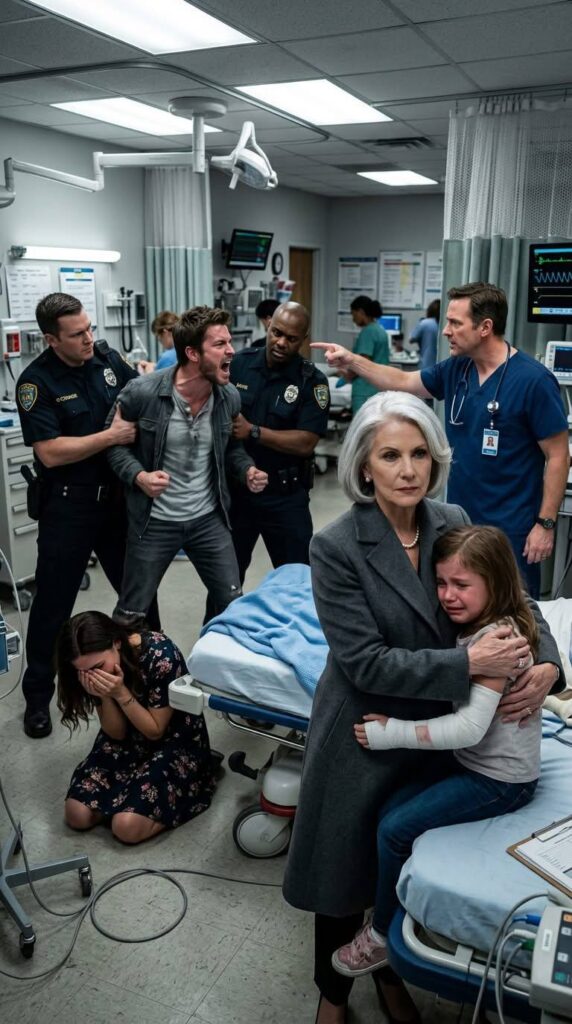
Chapter 1: The Triage Call
Over the span of forty years as a trauma surgeon, the shrill, demanding vibration of a telephone at three in the morning has fractured my sleep more times than I care to catalog.
When you live a life tethered to a pager, a call at that ungodly hour invariably signifies one grim reality: a human heart has ceased beating, or is perilously close to it, and you possess a very narrow, eleven-minute window to scrub in before the damage becomes absolute. Decades of that relentless pressure condition your nervous system. You bypass the luxury of waking up slowly. Your eyelids snap open, your soles hit the floorboards, and the cognitive processing catches up somewhere in the hallway.
So, when my nightstand vibrated violently at 3:17 on a Tuesday morning, illuminating the name of my sixteen-year-old granddaughter, Brooke, I was sitting bolt upright before the second pulse.
Brooke is the sole reason I maintain a ghost line—a secondary cell phone number entirely untraceable to anyone within her mother’s household. I had slipped it to her eight months prior, quietly, during a Sunday afternoon visit. I had watched her physically flinch when her stepfather’s tires crunched the gravel of the driveway. It wasn’t a theatrical gasp. It was the micro-flinch of a battered animal that has learned to associate a specific sound with impending pain. I observed it, I filed it away in the clinical vault of my mind, and I handed her a piece of paper. Call this if you ever need me. Any hour.
Tonight, she used it. I answered on the very first ring.
Her voice was an eerie, hollow monotone. It was the specific, terrifying cadence a teenager adopts when they have wept until their tear ducts are barren, leaving behind nothing but cold, brutal facts.
“Grandma. I’m at the hospital,” she rasped. “My arm. He broke my arm.” A ragged intake of air rattled through the speaker. “But he told the ER doctor I fell down the stairs. And Mom…”
The pause that followed was a chasm containing more grief than any child should have to shoulder.
“Mom stayed by his side. She agreed with him.”
“Which hospital, Brooke?” I asked, my voice devoid of panic. Panic is a luxury for amateurs.
“St. Augustine Medical Center. The ER.”
“I am leaving this second. Do not utter another word to anyone until I walk through those doors.”
“Okay,” she exhaled. It was the sound of a prisoner who had just been granted permission to drop a crushing weight. I terminated the call before my own heavy silence could infect her with anxiety.
My transition from bed to the driver’s seat took exactly four minutes. I grabbed the beige leather jacket I permanently kept hooked by the door—keys pre-loaded in the right pocket, phone in the left. Efficiency is distinct from rushing; rushing breeds fatal errors.
As I navigated the desolate, ink-black streets of Charleston, my mind bypassed fear and locked into surgical precision. I was not walking into that hospital blind. I was walking in carrying a digital ledger. For eight months, I had been meticulously building a case file on my phone. But as the neon red lights of the emergency room glowing in the distance drew closer, a chilling reality set in. The extraction of my granddaughter was going to require tearing my own daughter’s life to shreds.
Chapter 2: Charting the Pathology
To comprehend the sheer magnitude of the betrayal, we must dissect the pathology of Marcus Webb.
I identified his architecture the very first evening my daughter, Diane, introduced him fourteen months ago. He arrived at the dinner twelve minutes late, armed with an elaborate, over-rehearsed anecdote to excuse his tardiness. He pulled out Diane’s chair with a flourish that was performed entirely for my benefit, not hers. Within twenty minutes, he had seamlessly interrogated me about my hospital privileges, my financial portfolio, and the equity of my estate—all disguised as polite, gentlemanly curiosity.
I registered every inquiry not as conversation, but as a hostile inventory.
Diane sat beside him, glowing with the brittle, frantic happiness of a woman desperate to prove she was finally cherished. My daughter is a brilliantly intelligent urban planner, but she is also a woman who feels too deeply and trusts too easily. Marcus had diagnosed her vulnerability within minutes of meeting her. I had seen his type prowling the hospital waiting rooms for decades: the overbearing partner who answers for the patient, who reframes their pain as hysteria, and who slowly, methodically suffocates them under the guise of care.
I didn’t intervene then. He had committed no crime. But in October, my silent observation transformed into clinical documentation.
Brooke had pedaled her bicycle twelve blocks to my house on a sweltering Sunday afternoon, wearing a heavy, long-sleeved sweater. When she reached for a glass of lemonade, the cuff retreated, revealing a violent, purplish contusion blooming across her forearm. It was unmistakably a contact bruise. Forty years of examining trauma taught me the undeniable difference between skin striking pavement and skin being crushed by human fingers.
She offered a flawlessly rehearsed story about tripping on a cracked sidewalk. I treated the injury, smiled, and let her leave. Confronting her would have only alerted Marcus that I was a threat, tightening the leash around her neck.
Instead, the moment her bike turned the corner, I opened my phone and drafted Entry 01: October 14th. Unannounced visit. 4cm contusion, left forearm. Pattern inconsistent with reported fall. Pre-rehearsed alibi. Monitoring.
I logged forty-one entries over the next eight months. I documented his interruptions, Brooke’s sudden withdrawal from extracurriculars, the terrifyingly heavy makeup she wore along her jawline in November, and the chilling blankness in her text messages. I built a bulletproof, chronological autopsy of a domestic hostage situation.
But as my tires screeched into the St. Augustine parking structure, my heart hammered against my ribs. I killed the engine and sat in absolute darkness for four seconds. Four seconds of stillness is the difference between walking into a trauma bay as a reactive victim, and walking in as the surgeon who commands the field.
I stepped out onto the concrete. I had my clinical record, but as I marched toward the sliding glass doors, I knew Marcus was a cornered predator. If I miscalculated my next move by even a fraction, he would drag Brooke back to that house, and the next phone call I received wouldn’t be from her—it would be from the morgue.
Chapter 3: The Scrub Room
I established eye contact with Dr. James Whittaker before I even reached the nurses’ station.
James and I had survived our residencies together in this very hospital decades ago. He is an orthopedic surgeon of terrifying precision. When the pneumatic doors parted and I strode into the chaotic hum of the ER, his head snapped up. He recognized my posture instantly. He handed his glowing tablet to a resident without looking at it.
“Give us the corridor,” James commanded quietly. His tone possessed the absolute authority of a man who is never questioned. The resident scattered.
James met me halfway across the linoleum, his face drawn tight with exhaustion and suppressed rage.
“James. Tell me where she is, and tell me exactly what you documented in your report,” I demanded.
He held my gaze, his jaw ticking. “I haven’t filed the official paperwork yet, Dorothy.”
My blood pressure spiked, but I kept my facial muscles entirely slack. “Why the hell not?”
“Because the mother echoed the stepfather’s fabricated story word-for-word. The girl refused treatment twice while the bastard was standing over her. I needed to confirm she had a safe harbor before I put something permanent on a legal medical record.” He sighed, running a hand over his face. “I had the charge nurse slip her a personal phone ninety minutes ago.”
I exhaled a sharp breath. He had broken protocol to protect her. “Thank you. Where is the stepfather?”
“I exiled the parents to the family waiting area forty minutes ago under the pretense of ongoing imaging. He is agitated. Loud. The mother is catatonic.” James leaned in closer, dropping his voice to a clinical whisper. “Dorothy, the fracture pattern on her radius is utterly incompatible with a tumble down a staircase. It’s a forced, manual hyperextension. Someone snapped her arm backward.”
“I know,” I said, the words tasting like ash. “I need you to file the report now. Explicitly state the inconsistency between the injury and their alibi.”
James nodded grimly, turning back toward his office. “It’s already drafted. But Dorothy…” He hesitated, turning back. The look in his eyes made my stomach plummet. “I sent the imaging to a pediatric specialist at MUSC for a secondary blind read. The films caught something else.”
I went entirely still. “What else?”
“A healed fracture in the distal ulna. Same arm. It’s approximately six months old. It fused improperly because it never received medical treatment.”
The fluorescent lights above me seemed to buzz louder. Six months ago. Entry number twenty-six. A week she missed school for a “severe stomach flu.” She had endured the agony of a broken bone in absolute, terrified silence. My fists clenched so tightly my fingernails bit into my palms. The monster wasn’t just escalating; he had been torturing her for half a year. And tonight, he was pacing like a caged tiger just down the hall, waiting to claim his property.
Chapter 4: Establishing the Field
I found Brooke in Bay 4.
She was huddled on the exam table, her back pressed hard against the cinderblock wall, her knees tucked securely to her chest. Her left arm was encased in a temporary splint. She looked like a bird that had been violently batted out of the sky.
When I swept the privacy curtain aside, she gasped. It wasn’t a word; it was the sound of a dam breaking. A month’s worth of hoarded oxygen rushed out of her lungs. I fought the overwhelming maternal urge to weep. Tears would only validate her terror. She needed a commander, not a grieving grandmother.
I pulled the rolling stool directly beside the table, ensuring my eyes were level with hers.
“I am here,” I said, my voice an anchor in the storm. “You are completely safe. Nobody breaches this curtain without my explicit authorization. Can you tell me exactly what happened tonight?”
She narrated the nightmare in fragmented, clinical bursts. The dinner argument. The perceived disrespect. The sudden, explosive violence in the hallway. The agonizing car ride where Marcus calmly dictated the narrative of her ‘clumsiness’ while her mother sat paralyzed in the passenger seat, staring blankly out the window.
When she finished, I placed my hand gently over her uninjured one. “You executed everything perfectly tonight, Brooke. Hiding the phone. Trusting me. You did the right thing.”
“What happens now?” she whispered, her eyes wide and glassy.
“Now, I make a series of phone calls. And while I do, you stay exactly where you are.”
I stepped back out into the chaotic corridor and initiated a synchronized strike. My first call was to Patricia, the veteran charge nurse. I instructed her to trap Marcus in the waiting room and prep hospital security. My second call was to Renata Vasquez, a formidable on-call social worker I knew from a child abuse task force. She promised to be there in twenty minutes.
My third call was dialed from the shadowy silence of the stairwell. I phoned Francis Aldridge, my ruthless, brilliant sixty-three-year-old attorney.
“Francis. It’s Dorothy. It is 4:20 AM,” I stated. “I require an emergency temporary custody order for my granddaughter before the sun rises. I have a medical report citing manual hyperextension, an untreated historical fracture, a social worker en route, and a forty-one-point observational log spanning eight months.”
Francis was silent for exactly four seconds—her brain crunching the legal variables. “Send me the log instantly. I am getting dressed.”
I returned to the bay, prepping Brooke for the grueling social worker interview. She agreed, clutching her blanket like a shield. But as I turned to leave, her voice stopped me.
“Grandma… is Mom okay?”
Even shattered and bruised, her instinct was to protect the woman who had abandoned her. It broke my heart in two. “I don’t know, sweetheart,” I murmured.
I stepped outside just as Francis rounded the corner, her reading glasses perched on her nose, scrolling furiously through the notes I had emailed. Renata stepped off the elevator seconds later.
“Here is the field,” I told them, briefing them with surgical efficiency.
Renata slipped behind the curtain. Francis stood in the hallway, muttering to herself as she digested my log. But twenty minutes later, Patricia marched down the hall, her face tight with alarm.
“Dorothy,” the nurse warned, glancing over her shoulder. “Marcus Webb is escalating. He’s at the front desk demanding administration. He claims we are illegally detaining his stepdaughter and threatening a lawsuit if we don’t release her to him immediately.”
Francis looked up from her phone, her eyes narrowing into dangerous slits. “He can threaten all he wants. But if a judge doesn’t sign this emergency petition in the next hour, Marcus has parental rights. He can walk past security, rip the IV out of her arm, and take her home.”
Chapter 5: Closing the Margins
The margin for error had evaporated. We needed an airtight legal foundation to trigger the judge, and my notes, while clinical, were subjective.
“I need third-party corroboration,” Francis demanded, pacing the narrow tiles. “Someone outside the family who has witnessed the behavioral decay.”
I pulled out my phone and dialed Andrea Simmons, the principal of Brooke’s high school. It was barely six in the morning, but Andrea answered. When I explained the gravity of the situation, she didn’t hesitate. She provided a devastating verbal dossier: a guidance counselor’s logged concern when Brooke panicked at the sight of Marcus’s car; a creative writing essay dripping with metaphors of domestic imprisonment; unexplained absences correlating perfectly with the dates of the bruises I had documented.
“I need that in a sworn, written statement sent to my attorney within thirty minutes,” I instructed. Andrea delivered it in twenty.
At 6:45 AM, two uniformed Charleston police officers arrived, triggered by Renata’s mandatory CPS filing. I met the senior officer, a grizzled man named Garrett, in the corridor. I handed him the neatly compiled nightmare: the medical findings, the MUSC second opinion regarding the older fracture, and a printed summary of my eight-month log.
Garrett scanned the documents, his eyebrows rising steadily. “You’ve been building a shadow dossier since October?”
“I am a physician, Officer. I document pathology. It isn’t a hobby; it’s a reflex.”
At 7:04 AM, Francis received confirmation that Judge Harmon was reviewing the petition in his chambers. At 8:14 AM, my phone rang.
“The ink is dry,” Francis announced, her voice thick with triumph. “Emergency temporary custody granted. Ninety days. Marcus is legally barred from coming within a thousand feet of her. The extraction is complete.”
I walked back into Bay 4. Brooke was staring blankly at the ceiling. I sat down and delivered the news. “A judge signed the order. You are coming home to my house. He can never touch you again.”
She absorbed the words slowly. Her chin trembled, but she fought back the tears. “Can I… can I have a real cup of coffee?” she croaked. “The hospital stuff tastes like boiled cardboard.”
I smiled—a genuine, exhausted smile. “You can have anything you want.”
We exited the double doors at 9:02 AM. But before we could escape the sterile purgatory of the hospital, I had to sever the final infected limb of my past. I found Diane sitting alone in the family waiting area. Marcus was gone. The police had informed him of the restraining order, and the coward had fled to save his own skin, leaving his wife to face the wreckage.
Diane looked up at me, her eyes hollow, the ghost of a vibrant woman. “I should have called you,” she whispered, her voice cracking.
I sat across from her. I didn’t offer forgiveness. I didn’t offer a hug. I offered a brutal, honest boundary. “You can call me now. That door remains open. But what you do with it is your burden to bear, Diane.”
I placed my business card on the glass table. I walked away, leaving my daughter stranded in the wreckage of her marriage. But as we pulled into my driveway, the true weight of the aftermath settled over me. The legal shield was temporarily in place, but I knew Marcus Webb. A narcissistic abuser wouldn’t just surrender his prize without a bloodbath. The surgical extraction was over, but the war for Brooke’s permanent freedom had just begun.
Chapter 6: Post-Operative Care
The subsequent fourteen days at my house were cloaked in a deceptive quiet.
Brooke slept with the ferocious intensity of a soldier returning from a grueling deployment. She spent her afternoons curled on my back porch, scrolling mindlessly on her unrestricted phone, breathing in the fresh spring air through the cracked window of the guest room. I didn’t interrogate her. I merely cooked, maintained the perimeter, and ensured she knew that every room in my house belonged to her.
We engaged a brilliant trauma psychologist, Camille Torres, who began unspooling the tightly wound knots of Brooke’s psychological conditioning.
On the ninth day, the legal hammer fell.
Francis called me at dawn. “The District Attorney filed formal charges against Marcus yesterday afternoon. Two counts of felony assault, domestic violence, and child endangerment. The prior, untreated fracture we discovered on the X-rays established a systemic pattern of abuse. It elevated the charges from misdemeanors to felonies.”
“And Diane?” I asked, a knot forming in my throat.
“No charges. The investigation concluded she is a victim of severe coercive control. Marcus had systematically dismantled her agency. She’s cooperating with the prosecution, Dorothy. And… she asked if supervised visits with Brooke were possible.”
I relayed the request to Brooke that evening on the porch. I presented it clinically, emphasizing that ‘no’ was a complete and acceptable sentence.
Brooke stared out into the fading light of the garden. “Did she ask how I was doing? Or did she just ask for the visit?”
The perception of a sixteen-year-old is often sharper than any scalpel. “She asked for the visit,” I admitted.
“Tell her… not yet.”
I nodded, respecting the immense power embedded in that hesitation. But the most jarring development of the week didn’t come from my family. It came from a blocked number on day twelve.
“Mrs. Callaway? This is Renata, the social worker.” Her voice was cautious but laced with awe. “I testified before Judge Harmon on an unrelated case today. In chambers, he brought up your granddaughter’s petition. He told me that your forty-one-entry log was the most meticulously documented pre-crisis record he had witnessed in his fourteen years on the bench. He granted custody in forty minutes because your notes left nothing to deliberate.”
“It was just a habit,” I deflected, staring blankly at my kitchen wall.
“No,” Renata corrected gently. “Most families wait until the bones are broken to start paying attention. You built a fortress around her before the siege even began. You saved her life.”
I hung up the phone, the gravity of her words pressing into my chest. The temporary order was secure, but Marcus’s arraignment was looming. Brooke looked at me from across the kitchen island, the reality of the impending trial hardening her young face.
“He’s going to say I’m lying on the witness stand, isn’t he?” she whispered, her hands gripping her history textbook.
The trial was scheduled for seven weeks away. Twelve strangers would soon hold her fate in their hands. If our meticulously constructed fortress had a single structural crack, Marcus’s defense team would tear it down, humiliate her in open court, and try to drag her back into the dark.
Chapter 7: The Prognosis
Three months have passed since the shrill ring of the 3:17 AM phone call.
I am currently sitting at my mahogany desk, reviewing paperwork, when a sound drifts down the hallway that causes my pen to freeze. It is Brooke, laughing at a video on her phone. It isn’t the suffocated, calculated giggle she used to perform when Marcus was in the room. It is a loud, ugly, glorious snort of pure, unadulterated joy.
I file the moment away internally, the same way a surgeon notes the sudden, steady rhythm of a vital sign monitor after a code blue.
The healing is not linear. There are evenings when she retreats into a cavernous silence, processing the trauma with Camille. But she is doing the grueling work. Diane finally earned her first supervised visit six weeks ago. It was agonizingly awkward. Diane wept; Brooke did not. When the hour concluded, Brooke told me it was difficult, but that she felt nothing but pity for the woman who birthed her.
Marcus Webb’s trial is hurtling toward us. Francis has assembled a devastating armada of evidence: the surgical reports, the school’s documentation, my clinical logs, and the psychological evaluations. Brooke has elected to testify. She made the decision autonomously, looking me in the eye and declaring, If I don’t say it out loud, it’s like it never happened.
I told her I was proud of her, and I meant it with every fiber of my being.
However, in the quiet solitude of my own mind, I harbor a single, jagged regret. I stand by my meticulous documentation. I stand by the legal strategy. But I replay that Sunday in October on an endless loop. I saw the bruise. I knew precisely what had caused it. And I waited four months to hand her that secret phone number. I forced a child to endure a covert warzone for one hundred and twenty days longer than necessary because I prioritized clinical caution over instinct.
I carry that guilt not as a weapon to punish myself, but as a permanent, cautionary scar. It ensures that the next time my intuition screams, I will act one step sooner than protocol dictates.
This morning, Brooke wandered onto the back porch, a bowl of cereal balanced in one hand, her phone in the other. She squinted at the chaotic, vibrant explosion of my spring garden.
“You really need to deadhead those rose bushes, Grandma,” she critiqued, pointing a spoon at the overgrown thorns. “I can do it. My counselor says I need volunteer hours for school.”
“Pruning my landscaping does not qualify as community service, Brooke,” I replied dryly.
“It’s a service, and you live in a community,” she countered, deploying a perfectly composed, infuriatingly clever smirk that mirrored my own.
“Fine. Log your hours.”
She turned her face toward the morning sun, eating her cereal in the profound, irreplaceable safety of my backyard. She had called me in the dead of night because she possessed a number that worked, and because she believed, with absolute certainty, that I would come for her.
That is the entire anatomy of our survival. She believed I would come, and I did.
She smiled, a genuine, unburdened expression. The criminal trial loomed on the horizon, a violent storm we still had to sail through to ensure Marcus was locked in a cage. I sipped my coffee, my eyes scanning the perimeter of the garden. The immediate bleeding had been stopped, but as any seasoned surgeon knows, you never truly stop watching the monitors. The real test of our survival was just beginning.