
Chapter 1: The Digital Staccato of Betrayal
The morning began not with the gentle Denver sun, but with the relentless, glowing staccato of a smartphone vibrating against a nightstand. I am Sophia Bennett, a woman who has spent two decades meticulously crafting a life out of the wreckage of another. But as I reached for my phone, the digital glare revealed a haunting reality: twenty-nine missed calls from an area code in Illinois that I had long ago purged from my contacts, but never from my nightmares.
I stared at the screen until my coffee, once steaming and fragrant, turned to a tepid, bitter sludge in my hand. Deep in the marrow of my bones, I already knew whose ghost was rattling the chains. Some memories do not merely fade; they are predatory. They crouch in the peripheral shadows of your success, waiting for an ordinary Tuesday to drag you back into the cold.
Twenty years. That is how long it had been since I was Jennifer Caldwell, a twelve-year-old girl standing beneath the vaulted, echoing ceilings of Union Station in Chicago. I could still feel the phantom weight of my backpack and the crushing realization that the two people tasked with my survival had turned my terror into a wager.
They hadn’t just left me; they had placed a bet on my panic.
I built a future in Colorado with a new name, a career in graphic design, and a marriage anchored in honesty. I had almost convinced myself that the Caldwells were a fiction I’d read in a dark book. But those twenty-nine missed calls were a frantic reminder that the past is a debt that never truly settles.
Cliffhanger: I hesitated, my thumb hovering over the voicemail icon, terrified that hearing their voices would erase the woman I had fought so hard to become.
Chapter 2: The Architecture of a False Home
To the neighbors in Willow Creek, Illinois, we were the quintessential portrait of middle-class stability. My parents, Elias and Beatrice Caldwell, owned a flourishing chain of homegood stores—Caldwell’s Domestic Comforts. They sold the ingredients for a happy life: polished mixers, plush bedding, and high-end coffee makers.
On the weekends, the scent of charcoal smoke from my father’s grill wafted over white picket fences. My mother was a virtuoso of the neighborhood wave, her smile practiced and porcelain. We were the family people pointed to when they wanted to discuss “traditional values.” But inside the walls of our house, love was not a foundation; it was a performance, and my safety was entirely dependent on whether my mother was bored enough to invent a “lesson.”
“Lessons.” That was her favorite euphemism for psychological warfare.
If I misplaced a library book, I wasn’t just forgetful; I was “demonstrating a lack of respect for property.” If I scraped my knee and cried, I was “indulging in histrionics.” My mother possessed a terrifying talent for twisting the mundane milestones of childhood into indictments of my character. And my father? He was her enthusiastic accomplice, treating her cruelty like a team sport where the prize was my humiliation.
When I was eight, my sneakers were so worn the canvas had split, exposing my toes. At the mall, my mother accused me of “acting entitled” for asking for a replacement. She marched me to a central bench near the Pretzel Time stand and told me I needed to learn that “the world owes you nothing.” They left me there for three hours.
I remember the cloying scent of cinnamon and butter, my eyes fixed on the floor tiles, terrified to move. When they finally returned, my father didn’t offer a hand. He laughed, turned to my mother, and said, “I told you she’d be right where we left her. Pay up, Bea. That’s twenty bucks.”
Cliffhanger: I learned then that my fear was their currency, a realization that would culminate four years later in the cavernous halls of a Chicago train station.
Chapter 3: The B+ Catalyst
The catalyst for my final “lesson” was absurdly small. I received a B+ in my seventh-grade art class. To me, it was a triumph—art was the only place I felt I could breathe. But when I walked through the door, my mother held the report card like it was a confession of a crime.
“How,” she asked, her voice a low, dangerous silk, “can a girl who wastes so much paper drawing useless things still manage to fail at the one thing she claims to care about?”
My father sighed, leaning against the counter. “Maybe she’s just lazy, Bea. Maybe she thinks she can coast on ‘talent’ without effort.”
That night, I heard them in the kitchen, their laughter muffled by the floorboards. It was that specific, amused tone that always signaled a coming storm. My mother said I needed a lesson I would “never forget.” My father agreed, mentioning he’d put money on it.
The next morning, the atmosphere shifted into an eerie, manufactured cheerfulness. My mother flipped pancakes. My father offered me orange juice with a wink. They told me we were taking a “family day trip” to Chicago.
For a single, desperate moment, I let my guard down. I thought this was their version of an apology. I thought the report card fight was buried. I wanted so badly to be part of the “respectable family” the neighbors saw that I ignored the cold knot in my stomach.
The drive was an exercise in hypervigilance. My mother kept turning in her seat, her eyes bright and predatory. “Are you smart, Jennifer? Do you think the real world cares if a ‘smart’ girl is scared?” Every time I tried to disappear into the upholstery, they pushed harder, poking at my psyche like children with a captive insect.
Cliffhanger: As the Chicago skyline rose like a jagged wall of glass and steel, I realized with a sudden, sharp dread that this trip wasn’t a reset—it was a trap.
Chapter 4: The Pillar of Union Station
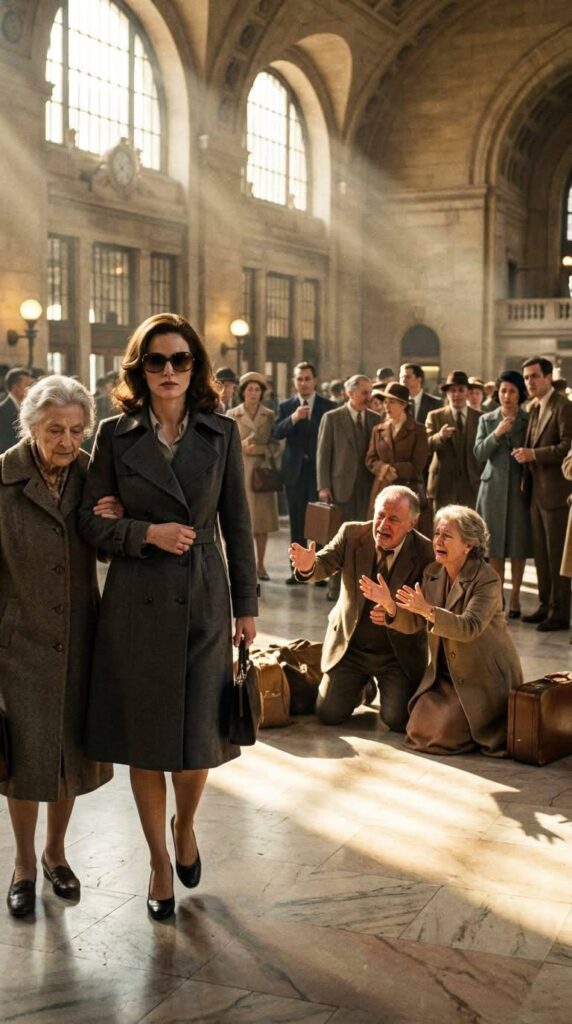
We arrived at Union Station around noon. The sheer scale of the building was suffocating. Thousands of strangers surged past us, a chaotic river of suits, rolling luggage, and urgent departures. I felt like an anchorless boat in a storm.
My mother pointed to a massive marble pillar near the main entrance. “Wait here while we find a better parking spot and grab a quick lunch,” she commanded. “Fifteen minutes. Maybe twenty. Don’t move an inch.”
I asked if I could go with them. My father’s laugh echoed off the high ceilings, drawing the eyes of passing businessmen. “You’re twelve, Jennifer, not two. Stop being a clingy brat.” My mother leaned in, her perfume a suffocating cloud of lilies. “Don’t you dare embarrass us in public.”
I nodded, my back pressed against the cold stone of the pillar.
Fifteen minutes became forty-five. Forty-five became an hour. The station clock was a giant, mocking eye. I had exactly nine dollars in my pocket. No phone. No way to call for help. I stayed by that pillar because I was more afraid of their anger if I moved than I was of the rising tide of panic.
Then, I saw it through the towering front windows.
Our car, a sleek, silver SUV, glided slowly past the curb. My heart leaped—relief so potent I almost sobbed. I ran toward the glass, waving my arms, expecting the car to pull over. But as it slowed, I saw them.
My father was behind the wheel, a wide, triumphant grin on his face. My mother was leaning out the passenger window, her face contorted with a cruel, joyful laughter.
“I bet fifty bucks you couldn’t even find your way to the curb!” she shrieked over the roar of traffic.
My father gave me a mocking thumbs-up, a gesture of “good job” for being an easy mark. Then, the car accelerated, merging into the stream of traffic and disappearing behind a wall of yellow taxis.
The world shifted on its axis. I stood frozen against the glass as the realization settled into my bones: My fear wasn’t a side effect of their parenting. It was the entire point.
Cliffhanger: I was no longer a daughter waiting for her parents; I was a punchline they had left behind in the heart of a city that didn’t know my name.
Chapter 5: The Compassion of Maria
The transition from “waiting” to “abandoned” is a physical sensation—it felt like falling through thin ice into an abyss. I wandered through the station for hours, my vision blurred by hot, shameful tears. I had been trained to believe that crying was a weakness to be mocked, so I kept wiping my face, trying to look like I belonged there.
I stayed away from the police. My parents had spent years telling me that authority figures were just waiting for a reason to “lock up difficult children.” I was a prisoner of the very fears they had cultivated.
The person who finally broke the spell was Maria, a station employee in her fifties with weary, observant eyes. She had watched me circle the same row of vending machines three times.
“Honey,” she said, her voice a calm, stabilizing anchor. “Are you lost?”
I lied. I told her I was waiting for my parents. But when she asked how long it had been, and if I had eaten, the dam finally broke. I sobbed into my hands, the truth spilling out in jagged, ugly pieces. I told her about the car. I told her about the bet.
Maria didn’t call me dramatic. She didn’t tell me to toughen up. She crouched down so her eyes were level with mine and said, “You are safe now. I am not going to let you disappear.”
The next few hours were a blur of antiseptic offices and serious-faced men in uniforms. Transit Police checked the security cameras. They confirmed my story. They saw the silver SUV slow down. They saw the woman leaning out to laugh.
One officer, a man with a thick mustache and a badge that gleamed like a warning, called my parents. I could only hear his side of the conversation. His professional mask shattered in ten seconds.
“No, ma’am,” he growled into the receiver. “Leaving a twelve-year-old in a major transit hub is not ‘resilience training.’ It is child abandonment. You have exactly one hour to get back here, or this becomes a felony matter.”
They didn’t come back.
My mother told the officer over the phone that they wouldn’t be “bullied by the state” and that I was “exactly where I needed to be to learn some grit.”
Cliffhanger: That night, instead of sleeping in my bed in Willow Creek, I was placed in the back of a social worker’s car, headed toward a future I couldn’t yet imagine.
Chapter 6: The Bennett Sanctuary
I was terrified of foster care. I had grown up on a diet of horror stories about what happened to children who “caused enough trouble” to be taken away. But when the car pulled up to a modest, cluttered house on a quiet street, I met Mark and Laura Bennett.
Mark was a photographer with permanent ink stains on his fingers and a laugh that felt like a warm blanket. Laura was a preschool teacher who smelled of lavender and craft paper.
“Do you want spaghetti or soup?” Laura asked that first night.
“I… I don’t know,” I whispered, waiting for the mockery.
“That’s okay,” she said, placing a gentle hand near mine—not on it, giving me space. “You don’t have to decide anything tonight.”
Nobody yelled. Nobody made a speech about my “ingratitude.” When I cried at the dinner table because the kindness felt like a trap, Mark just adjusted the light and asked if I liked the hallway lamp on or off at night.
In the Caldwell house, privacy was a luxury I was never afforded. In the Bennett house, Laura knocked on my bedroom door every single time.
As the weeks turned into months, the world began to look different. I realized that my hypervigilance—the way I scanned every room for an exit, the way I studied faces for a coming blow—wasn’t “grit.” It was trauma. And for the first time, I was around people who didn’t want to harden me; they wanted to heal me.
The family court case was a revelation of a different kind. My parents showed up with a high-priced lawyer, Beatrice in a navy blazer and pearl earrings, the very image of “Domestic Comfort.” They didn’t deny leaving me. They insisted it was “controlled parenting.”
“She’s too soft,” my father told the judge, leaning back with an arrogant tilt of his chin. “We were preparing her for the real world. This is a gross overreach of the system.”
Cliffhanger: The judge looked at the psychological evaluation—a report detailing years of emotional abuse and humiliation—and asked a question that would decide the rest of my life.
Chapter 7: The Choice of Pride
“Jennifer,” the judge said, her voice surprisingly soft. “Do you want to go home with Mr. and Mrs. Caldwell today?”
“No,” I said. The word was out of my mouth before my brain could even process it. I saw my mother’s face twist into a mask of pure, unadulterated shock—followed immediately by the familiar, cold fury.
The court offered a path to reunification: parenting classes, supervised visits, mandatory therapy. It was a second chance. But to Elias and Beatrice Caldwell, a second chance was an admission of guilt. They hated the oversight. They hated the teachers and social workers peering into their “respectable” lives.
My father complained that the case was damaging the reputation of the stores. My mother said she wouldn’t let “the state tell a Caldwell how to raise their own.”
In a move that shattered the last lingering piece of “Jennifer” inside me, they were given an ultimatum: commit to the two-year program or surrender their rights.
They chose surrender.
They handed me over rather than admit they had been wrong. They protected their pride by discarding their daughter.
Mark and Laura didn’t make a big scene when the news came. They just sat me down, and Mark handed me a new set of high-quality sketchpads. “We’re not going anywhere, Jennifer,” he said. “Unless you want us to.”
When the adoption was finalized, I asked to change my name. Jennifer Caldwell was the girl who stood by a pillar with nine dollars. Sophia Bennett was the girl who had a room with a locked door, a desk full of art supplies, and a mother who didn’t laugh when she was afraid.
I remember the first night I was officially a Bennett. Laura tucked me in, and I didn’t flinch. I fell asleep to the sound of Mark humming in his darkroom down the hall.
Cliffhanger: I thought the Caldwells were gone forever, a chapter of a book I had burned, until twenty years later, the digital echo of Illinois began to scream.
Chapter 8: The Denver Renaissance
Denver gave me the space I needed to stop surviving and start living. The air was dry and crisp, a stark contrast to the humid, heavy secrets of the Midwest. I threw myself into my work, eventually opening Bennett Design Studio. I became a specialist in branding for small businesses—the irony of helping people create honest identities was not lost on me.
I met Alex at a local gallery opening. He was a software engineer with a soul as steady as Mark’s. On our fifth date, I told him about Union Station. I braced for the pity, or worse, the “everything happens for a reason” platitudes.
Instead, he took my hand and said, “That should never have happened to a child. I am so sorry they failed you.”
We got married in a small ceremony. Mark walked me down the aisle, his eyes wet with a father’s pride. Laura fixed my veil, whispering that I was the bravest person she had ever known. We adopted a dog named Max, a rescue who had also been left behind too early.
I blocked every account, every number, and every possible bridge back to Willow Creek. I didn’t visit Illinois. I didn’t look at their social media. I was Sophia Bennett, and the world was finally whole.
But as I sat at my kitchen counter with twenty-nine missed calls, I realized that peace is a fragile thing for those of us who grew up in a war zone.
Alex walked into the kitchen, his face pale as he saw the expression on mine. “Sophia? What’s happened?”
“The past,” I whispered, my hand shaking as I finally clicked on the voicemail. “It’s looking for me.”
Cliffhanger: The voice that filled the kitchen wasn’t my mother’s. It was Hannah, my younger sister, whom I hadn’t seen since she was a toddler in mismatched socks.
Chapter 9: The Collapse of Caldwell’s Comforts
Hannah’s voice was a jagged rasp of grief and exhaustion. She told me the story I hadn’t been there to see.
The Caldwell empire had collapsed. Not because of a bad market, but because of the very tool they had used to control me: gossip.
A relative had posted a detailed account of the “Union Station Lesson” on a local community page after my mother had left a condescending comment on a parenting post. That one spark ignited a fire. Former neighbors came forward. Retired court clerks whispered. A disgruntled former employee shared stories of the “real” Elias and Beatrice.
Willow Creek, the town that had once protected them with its polite silence, turned on them with a vengeance. Customers vanished. Civic groups rescinded memberships. The stores were sold at a loss, and the house—the “Domestic Comfort” shrine—was foreclosed on.
My father had suffered a stroke six months ago. My mother was dying of late-stage cancer. They were living in a subsidized apartment on the edge of town, stripped of their reputation, their money, and their pride.
“They want you to come back,” Hannah said, her voice breaking. “Not because they’re sorry, Sophia. Because they’re terrified of dying without an audience. Because they have no one left to look at them.”
Hannah told me she had cut them off, too, after finding the old court records. She had looked at her own son and realized she couldn’t allow the Caldwell poison to touch him.
“I’m only calling,” she said, “because I thought you deserved to know that the game is over. They lost.”
Cliffhanger: Alex looked at me, the phone still glowing in my hand. “Are you going?” he asked. I looked at the sketchpad on the counter, the life I’d built, and I knew what I had to do.
Chapter 10: The Last Lesson
I flew to Chicago two days later. The city felt smaller than it had when I was twelve. I drove to a dreary hospital on the outskirts of Willow Creek, a place that smelled of bleach and the slow, inevitable decay of regret.
I walked into the room.
My father was a shriveled shadow of the man who had mocked me. My mother was a frail, pale ghost, her dignity a tattered robe she was still trying to pull around her shoulders.
For a long moment, nobody spoke.
Then, my mother started to cry—the loud, performative sob I remembered so well. She called me “Jennifer.”
“My name is Sophia,” I said, my voice as steady as a mountain. “And I didn’t come here to be your daughter.”
My father tried to speak, his voice a slurred whisper. “Mistakes… we made mistakes… Jennifer…”
“A mistake is forgetting to buy milk,” I interrupted. “What you did was a choice. You bet on my fear. You laughed while I panicked. You gave me up to protect your pride.”
I stood at the foot of the bed, not with anger, but with the cold, clinical clarity of a survivor.
“You told me the real world was hard,” I said. “And you were right. But it wasn’t hard because of strangers or circumstances. It was hard because of you. I found my way home twenty years ago. It just wasn’t your home.”
My mother reached out a thin, trembling hand. “Can you… forgive us?”
“Forgiveness is a debt I don’t owe you,” I replied. “I came here so you could see the woman you didn’t get to break. I am happy. I am loved. And I am entirely, completely free of you.”
I told them I wouldn’t be paying their bills. I wouldn’t be managing their care. I told them that Hannah was right to protect her son.
“The game is over,” I whispered. “You’re the ones left in the station now.”
Cliffhanger: I turned to walk out, and for the first time in my life, I didn’t look back to see if they were watching.
Chapter 11: The View from the Mountaintop
I stood in the hospital parking lot, the Illinois air feeling thin and insignificant. My hands were shaking, but not from fear. It was the strange, electric release of a haunting that has finally reached its end.
On the flight back to Denver, I thought about the little girl under the pillar. I wanted to tell her that being abandoned didn’t mean she was unwanted. It meant she was being released from a burning house.
Abuse doesn’t become “discipline” just because the parents use respectable words. Humiliation doesn’t build character; it builds walls.
Mark and Laura Bennett hadn’t just saved me; they had shown me that real love is steady. It doesn’t test you to see if you deserve it. It makes room for you before you even know how to sit down.
I landed in Denver and Alex was waiting at the gate, Max straining at his leash. I hugged him, the scent of his coat and the dry Colorado air finally grounding me.
“Is it done?” he asked.
“It’s done,” I said.
I went back to my studio the next morning. I sat at my desk and began to draw. Not a train window, not a locked door, but a vast, open landscape with a single woman standing on a mountaintop. And this time, she wasn’t looking for anyone behind her.
She was looking forward.
Healing isn’t a straight line. I still flinch when someone says, “I’ll be right back.” I still scan the exits of every crowded room. But those are just the echoes of an old war. The battle itself is over.
Real family is not a matter of blood; it’s a matter of who stands by you when you’re terrified. Real love doesn’t laugh at your pain. And real strength is knowing when to walk away from the people who share your DNA but not your soul.
The Caldwells bet that I couldn’t find my way home.
They lost that bet a long time ago.
Reflective Epilogue
For anyone listening who has been left in their own version of a train station, please hear this: Your survival is not a mistake. Your need for safety is not a weakness.
The people who hurt you might use big, noble words to justify their cruelty, but a lie remains a lie, no matter how much “Domestic Comfort” they wrap it in. You are allowed to walk away. You are allowed to change your name. You are allowed to build a life that is so quiet and full of peace that the past can no longer hear you.
Real healing begins the moment you stop calling cruelty a “lesson” and start calling it what it is.
What would you do if the people who broke you came calling twenty years later? Would you seek closure, or would you let the digital silence remain? Write “I am the architect of my peace” in the comments if you’ve had to build your own sanctuary.
Thank you for being part of my resurrection. Take a deep breath. You are safe now.