
The cold, gritty water seeped through the thin fabric of my maternity leggings, biting into my bruised knees. Seven months pregnant, my center of gravity was a distant memory, and my swollen belly pressed uncomfortably, almost painfully, against the unforgiving expanse of imported Italian marble. The scent of harsh chemical lemon and old dampness clawed at the back of my throat. I scrubbed. The coarse bristles of the brush scraped rhythmically against the stone, a metronome keeping time with my quiet, simmering humiliation.
“You missed a spot, Eleanor! Are you trying to give Serena a dirty house to move into?”
The voice belonged to Margaret Vance, my mother-in-law. It was a sound like rusted metal grating against glass. I didn’t need to look up to know she was lounging in the adjoining sunroom of the sprawling Vance Estate, a glass of iced tea clinking mockingly in her manicured hand. The ice hit the crystal with a sharp, rhythmic tink, tink, tink—a deliberate sound designed to remind me of her leisure and my servitude.
On the velvet sofa a few feet away lay my husband, Robert Vance. He was sprawled lazily, his thumbs flying across the screen of his smartphone, bathed in the pale blue light of his endless, self-important digital existence. He didn’t even lift his eyes from the glowing rectangle.
“Stop faking stomach pain to skip chores,” Robert muttered, his tone dripping with the kind of casual boredom that cuts deeper than outright rage. “You’re just a high-end maid, after all.”
I gritted my teeth, tasting the metallic tang of blood where I had bitten the inside of my cheek. I scrubbed harder, my knuckles turning stark white beneath the soapy water. A single, traitorous tear escaped my lashes, blurring my vision and splashing into the murky bucket beside me. It wasn’t a tear of sorrow. It was a tear of pure, pressurized rage.
For two years, I had inhabited this gilded cage in the heart of affluent Connecticut. I had played the meek, isolated orphan. I had played the grateful, submissive wife to a weak, narcissistic heir who fancied himself a titan of industry. I had endured the toxic, suffocating dynamic of a family that thrived on psychological torment. And now, the introduction of Serena—Robert’s glaringly obvious mistress—was not meant to be a secret shame. It was a weapon. She was being moved into the guest wing not out of romance, but as the ultimate tool for my degradation.
Yet, as the cold water soaked my skin and my child kicked violently against my ribs, something within me finally snapped. It wasn’t a loud, chaotic break. It was a small, almost imperceptible crack in my carefully constructed facade of submission. The deep cover I had maintained for so long had served its purpose, but the cost to my own soul was bordering on bankruptcy. The game was ending. But they had no idea who was holding the cards.
“You’re just a high-end maid,” Margaret sneered, taking a slow, deliberate sip of her drink. The ice clinked again. “And a rather slow one at that, especially with all that fake stomach pain. If you can’t manage a simple floor, I shudder to think how you’ll manage a newborn.”
Robert chimed in, tossing his phone onto the cushion. “Seriously, Eleanor, stop being so dramatic. Serena needs her space ready by dinner. She has allergies, so make sure there’s no dust on the baseboards.”
The silence that followed was heavy, thick with the scent of pine cleaner and absolute disrespect.
I stopped scrubbing.
I let the brush drop into the bucket with a hollow, echoing splash. Slowly, painfully, I pushed myself up. My hip joints protested with a dull ache, and my lower back screamed, but I ignored the physical limitations of my pregnant body. I stood tall. The shift was internal before it was external. The subservient slump of my shoulders vanished. My spine aligned, rigid as steel.
I wiped my wet hands on the front of my apron, deliberately untied the strings, and let the soiled garment fall to the wet marble. I turned to look at them. My gaze, usually cast downward in feigned timidity, was now steady, unwavering, and burning with a cold fire.
I reached for my wool coat draped over a nearby chair and slipped my arms into it. It was a movement of deliberate, unhurried power.
“My role as a submissive wife is over,” I stated.
My voice wasn’t loud. I didn’t yell. But the timber of it had changed entirely. The quiet, tremulous whisper of Eleanor Vance was gone, replaced by an unyielding resolve that sliced through the room’s smug, air-conditioned atmosphere like a scythe.
Robert choked on his sudden intake of breath, a coughing fit seizing him as he scrambled to sit up. Margaret’s cruel laughter died instantly in her throat. The condescension wiped from her face, replaced by a look of bewildered annoyance, as if a piece of furniture had suddenly spoken back.
“What did you say, you useless woman?” she demanded, her voice rising to a shrill, ugly pitch.
But her question hung in the air, pathetic and unanswered. I didn’t afford her a second glance. I simply turned on my heel and walked toward the grand double doors of the foyer, the heavy thud of my boots echoing against the marble, leaving them drowning in the sudden, terrifying vacuum of my absence. The front door clicked shut behind me, sealing them inside their own ignorance. But my exit was only the beginning. The trap was sprung, and they were already caught in the jaws.
The backlash, predictably, came fast and messy.
I was standing in the opulent, wood-paneled library an hour later, calmly gathering a few essential items, when Robert burst through the doors. His face was mottled red with uncharacteristic exertion and furious disbelief. He had spent his entire life bullying those weaker than him; my sudden defiance had short-circuited his fragile ego.
He slammed his fist onto the heavy mahogany desk, sending a silver letter opener clattering to the floor. “You’re going nowhere, Eleanor!” he spat, spittle flying from his lips. “Do you hear me? You have no money, no family, no place to go! You walk out that door, I freeze the accounts. I’ll make sure you don’t get a dime. You’ll be back begging by morning, living on the streets with that kid!”
I looked at him. Really looked at him. Stripped of his money and his mother’s backing, he was nothing but a hollow, terrified little boy throwing a tantrum. I merely smiled. It wasn’t a smile of warmth. It was a chillingly serene expression, a bare showing of teeth that made Robert physically recoil a half-step. He had never seen that face on me before.
“Your accounts, Robert, are the least of my concerns,” I whispered, turning back to my task.
He scoffed, though it sounded reedy and uncertain, and stormed out, locking the library doors from the outside. A pathetic attempt at imprisonment.
Later that night, while the household slept, the heavy silence of the mansion pressing against the windows, I moved with a quiet, lethal efficiency. I walked to the massive stone fireplace at the far end of the room. Reaching up, I counted three bricks from the left mantelpiece, pressed my thumb against a specific groove, and pulled. The loose brick slid out smoothly, revealing a small, dark cavity.
Inside sat a heavily encrypted burner phone.
I powered it on. The screen bathed my face in a harsh, pale light. There was only one contact saved, labeled simply: Director.
I pressed dial. It rang once.
“Go ahead,” a distorted, mechanical voice answered.
My voice dropped into a low, authoritative murmur, a cadence I hadn’t used in two grueling years. “It’s time. Full extraction protocol. The Vances are no longer… cooperative. Ensure the financial surveillance packages are sealed and ready for the DOJ.”
“Understood, Ma’am. ETA is twenty minutes. Godspeed.”
The line clicked dead. A cold, determined glint entered my eyes as I systematically wiped the device and crushed it beneath the heel of my boot. I walked to the tall arched windows, my gaze sweeping over the moonlit, sleeping mansion one last time. I felt the baby roll in my stomach, strong and vital. Soon, I thought. Soon, they will know exactly who they tried to break. I stood there in the dark, a predator observing its unaware prey, waiting for the sky to fall.
The ground trembled first. It was a subtle vibration in the floorboards that quickly escalated into a deep, bone-rattling thrum.
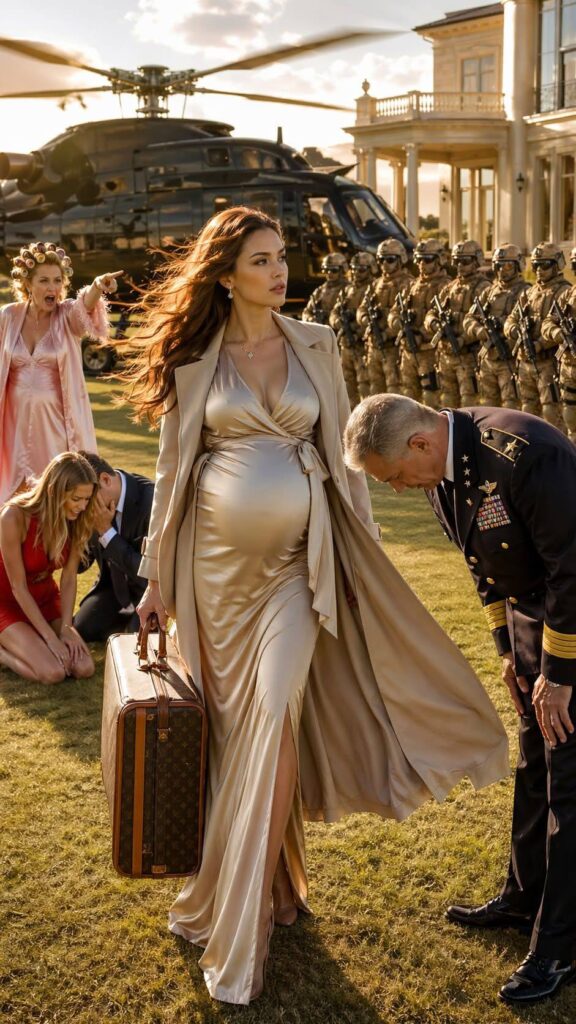
A heavy, mechanical roar tore through the quiet Connecticut night, growing exponentially louder until the very air seemed to vibrate. Two sleek, matte-black military helicopters, devoid of any identifying markings, descended rapidly from the twilight sky. Their massive rotors whipped the perfectly manicured lawns into a chaotic frenzy of flying grass and debris, flattening Margaret’s prized rose bushes in seconds. They landed with terrifying precision right on the front driveway.
Before the skids even touched the asphalt, the side doors slammed open. Snipers, clad in full tactical gear, their faces hidden behind grim balaclavas and night-vision goggles, rappelled down thick ropes. They hit the ground moving, fanning out and taking up fortified positions around the perimeter of the house, their laser sights cutting through the dust.
Simultaneously, a heavily armed tactical entry team stormed the grand front entrance. The heavy oak doors, which Robert had so proudly locked, were blown off their hinges with a deafening concussive blast that shattered the foyer windows.
Robert and his mother, clad in expensive silk sleepwear, stumbled out onto the upper veranda. Their faces were chalk-white, eyes wide with an absolute, primal terror as they stared down at the military invasion occupying their front yard. Margaret was clutching the railing, her knees visibly shaking. Robert looked like he might vomit.
Then, the chaotic noise of the rotors began to wind down, and a figure emerged from the lead helicopter.
Flanked by a phalanx of stern-faced, suited agents, I walked out from the shadow of the aircraft. I had shed the wool coat, revealing a tailored, dark tactical jacket that strained slightly over my pregnant belly.
A tall agent stepped forward, handing me an earpiece. “Madam Director, your security detail is in place. The perimeter is secure.” The agent’s voice crackled loudly over an amplified comms unit, booming across the estate.
I looked up at the balcony. I placed my hand protectively over my stomach, feeling the reassuring weight of my child, and met Robert’s terrified, uncomprehending stare. My eyes were as cold as the marble I had scrubbed hours before.
“You called me a high-end maid,” I said. My voice, routed through the helicopter’s external PA system, echoed in the sudden, eerie silence of the standoff. It was absolute and commanding. “Allow me to introduce myself. I am the Head of State. And your casual disrespect has just triggered a national security incident.”
On the balcony, Margaret clutched her chest, a strangled gasp escaping her lips. All color drained from her heavily contoured face, and her knees buckled, sending her collapsing against the wrought-iron railing. Robert stood utterly paralyzed. He stared at the woman he had belittled, abused, and planned to discard, his mouth opening and closing like a suffocating fish as the terrifying, monumental magnitude of his error finally crushed him. The true authority had stepped out from the shadows, and they were standing squarely in the crosshairs.
The takedown was surgical and entirely devoid of mercy.
Robert and his mother were led out the shattered front doors in heavy steel handcuffs, their wrists bound tightly behind their backs. The tactical team ignored Robert’s frantic, desperate pleas and Margaret’s shrill, sobbing demands for her lawyer. To the agents, they weren’t affluent socialites; they were targets. They were shoved unceremoniously into the back of armored black SUVs.
By dawn, the news channels had exploded. It was dubbed the ‘Vance Scandal.’ The media fed in a frenzy on the leaked details of a prominent local family’s alleged involvement in treasonous offshore financial activities—the very activities I had spent two years quietly gathering evidence on from within their own home. Their opulent, untouchable lifestyle crumbled into ash in a single, devastating news cycle.
Meanwhile, I was far away. I had been whisked via helicopter to a secure, subterranean government facility on the outskirts of D.C. The transition was jarring but deeply comforting. Instead of cold marble and mocking laughter, I was surrounded by a presidential-level medical team. They ran vitals, checked the baby’s heart rate, and ensured that the physical toll of my deep cover hadn’t compromised our safety.
Once cleared, I was shown to my office. It was a sterile, heavily fortified, yet strangely comfortable room. The walls were lined with secure monitors mapping global intelligence feeds. I sat down in the heavy leather chair, the familiar, immense weight of my responsibilities settling back onto my shoulders like an old, trusted friend.
I ran a hand over my swollen belly, feeling a sharp kick against my palm.
“You won’t grow up in the shadows, little one,” I murmured to the quiet room, a fierce promise vibrating in my chest. “You will know strength, and you will know respect. Unlike your father and grandmother, you will learn the true meaning of power. The kind that serves, not subjugates. The kind that protects the vulnerable, rather than exploiting them.”
I looked over at my desk. Beside a stack of classified briefings sat a small, framed photo. It was a picture of a younger me, smiling radiantly on the day I was sworn in—a ghost of a life I had voluntarily paused, almost lost to the suffocating dark of the Vance household. I reached out and touched the glass.
Suddenly, the secure red comms line on my desk began to flash urgently. A low, rhythmic chime filled the room. An intelligence aide stepped quickly through the blast doors, his face pale. “Madam Director, we have a situation in the Eastern Bloc. We need your eyes on it immediately.”
I nodded, the soft vulnerability of the mother vanishing, replaced instantly by the icy calculation of the commander. I picked up the receiver. The Vance chapter was closed, but the real war was just beginning.
A year later, the air in the White House press briefing room was thick with the rapid fire of camera shutters and the anxious hum of the world’s media.
I stood at the podium. I was no longer the frail, pregnant woman scrubbing floors, nor the shadowy operative hiding in plain sight. I was Director Eleanor Vance, standing tall, radiating a hard-won, absolute authority. Nestled securely in my left arm, utterly unfazed by the flashing lights, was my infant daughter, Lily. She possessed bright, inquisitive eyes and a calm demeanor that already mirrored my own.
Robert Vance’s name rarely surfaced anymore. When it did, it was buried in the obscure legal columns of back-page newspapers, a pathetic footnote in a much larger, sprawling history of corporate treason. He was serving a twenty-year sentence in a federal penitentiary. His mother, stripped of her assets and her social standing, had faded into total obscurity, her grand house repossessed and auctioned off by the state. They had become exactly what they had once accused me of being: nothing.
I looked out at the assembled press corps, letting the silence stretch until every pen was poised, every lens focused. I adjusted the microphone with my free hand, then looked down at Lily, who cooed softly, reaching a tiny hand toward the lapel of my tailored suit.
“Respect,” I stated, my voice echoing clearly across the broadcast feeds to millions watching worldwide. “Respect is not something demanded through fear, financial manipulation, or cruelty. It is not an inheritance. It is earned through integrity, conviction, and an unwavering commitment to the truth.”
I met the eyes of a veteran reporter in the front row. “It is the absolute foundation of every strong relationship, every stable nation, and every fulfilling life. When we allow that foundation to rot in the shadows of our own homes, we invite ruin into our society.”
I smiled. It wasn’t the chilling, predatory smile I had given Robert in the library, but a genuine, radiant smile born of survival and profound peace.
“And sometimes,” I added, my gaze sweeping across the room, encompassing the brilliant men and women of my intelligence team standing at the periphery, my beautiful daughter in my arms, and the vast, unwritten future I was now free to build, “the most powerful revolutions begin not with a bang, but with a quiet, resolute declaration that ‘my role as a submissive wife is over.’”
I stepped back from the podium as the reporters erupted into a frenzy of questions. What future could possibly hold a greater adventure? I thought to myself. Lily giggled, finally managing to grab the edge of the dangling microphone cable, pulling it like a bell rope to announce her arrival to the world.
If you want more stories like this, or if you’d like to share your thoughts about what you would have done in my situation, I’d love to hear from you. Your perspective helps these stories reach more people, so don’t be shy about commenting or sharing.