
Chapter 1: The Fracture
For one catastrophic, agonizing second, the earth simply stopped spinning on its axis.
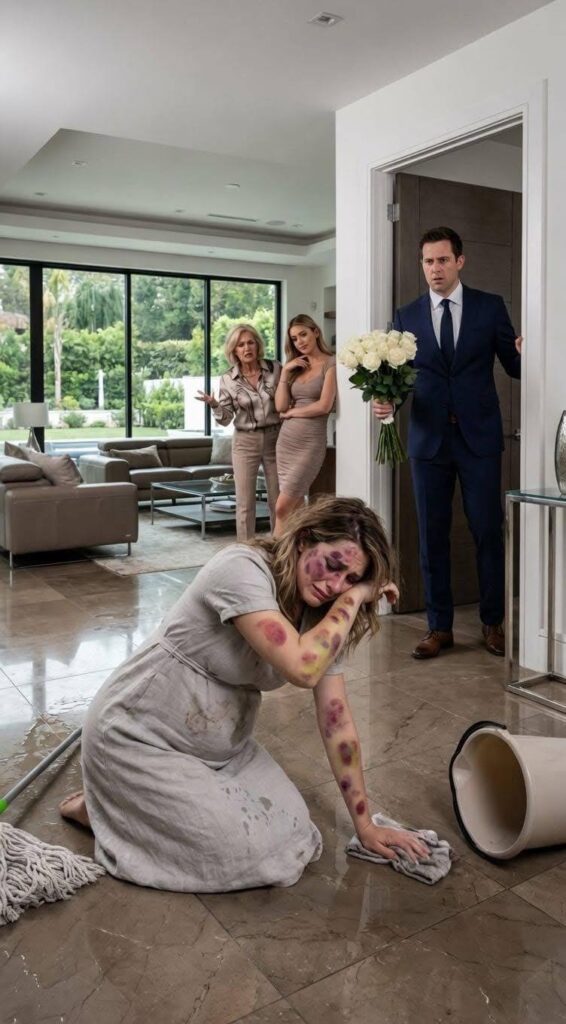
I stood paralyzed in the grand archway of my own living room in Greenwich, Connecticut, a bouquet of pristine white roses clutched in my right hand, a boutique shopping bag heavy with newborn clothes cutting into the palm of my left. The sprawling space before me was violently cleaved into two incompatible realities. On one side, the illusion of the life I believed I had engineered—a sanctuary of polished mahogany, velvet upholstery, and untouchable security. On the other, the grotesque truth: my wife, Audrey, seven months pregnant, kneeling on the cold marble floor. She was crying with a muted, breathy silence that was infinitely more terrifying than a scream, because it meant she had been meticulously trained that making noise would invite severe punishment.
The roses slipped from my numb fingers. They hit the floor with a soft, devastating thud.
Audrey violently flinched, her shoulders curling inward as if the delicate sound of falling petals possessed the physical weight to strike her.
That single, involuntary tremor was the precise moment my soul fractured.
It wasn’t the sight of Helen, the highly recommended maternity nurse, lounging comfortably in my custom leather armchair with a porcelain bowl of sliced fruit resting smugly in her lap. It wasn’t my mother, sitting rigidly on the sofa, her knuckles white around the clasp of her designer purse, her posture radiating an icy detachment as if this horrific tableau were merely a complicated theatrical performance she found distasteful. It wasn’t even my younger sister, Sarah, who stood frozen near the hallway, her face drained of all color, looking desperately as though she wished the plastered walls would swallow her whole.
It was my wife’s flinch. It was the sickening realization that when Audrey heard the front door open, her most immediate, visceral expectation was that her husband had arrived home angry.
I crossed the expanse of the room with a speed that sent the shopping bag spilling its pastel contents across the Persian rug in my wake.
“Audrey,” I choked out, dropping to my knees so hard the impact vibrated through my shinbones. “Hey. Look at me.”
She didn’t stop scrubbing.
Her right hand continued its frantic, mechanical rhythm, dragging a harsh, bleach-soaked rag over her left forearm in short, panicked strokes. The skin was already inflamed, stripped raw and weeping. Her chest heaved with shallow, broken pulls of oxygen.
“I’m almost clean,” she whispered, her voice a hollow, scraped-out sound. “Please, please don’t be upset. I’m almost done. I promise.”
A cold dread coiled tightly in my gut. I reached out and clamped my hand over the rag.
She fought me.
It wasn’t a struggle born of physical strength, but of pure, unadulterated terror. It was the full-body, frantic thrashing of a cornered animal convinced that halting her task would result in an unimaginable penalty. I pried the chemical-soaked cloth from her trembling fingers and gripped both of her wrists with as much gentleness as my shaking hands could muster, forcing her to lift her chin.
“I am not upset with you,” I said, my voice thick.
Behind me, the leather of the armchair creaked as Helen stood up abruptly. “Mr. Hayes, I assure you, this is not what it looks like.”
I didn’t turn around. I didn’t even blink.
“Mom,” I ordered, my eyes locked on the tear-streaked canvas of Audrey’s face. “Fetch a clean towel from the guest bathroom. Sarah, go get a heavy blanket. Do it now.”
For the first time in my thirty-four years of existence, my mother obeyed a command without a single syllable of arrogant resistance.
Sarah moved instantly, her shoes skidding against the floorboards as she bolted for the hall corridor. My mother followed a heartbeat later, her expensive heels clicking against the marble in a frantic, irregular cadence that betrayed her crumbling composure. But Helen remained exactly where she was. I could feel the heat of her indignation gathering like a static charge behind my back.
Audrey finally raised her dark, terrified eyes to mine. What I found in those depths forcibly pushed the remaining air from my lungs. It wasn’t confusion. It wasn’t the embarrassment of being caught in a vulnerable state. It was a suffocating amalgamation of relief and profound dread. Relief because her husband had materialized. Dread because some fractured piece of her psychology still believed I might side with the monsters in the room.
“Did she force you to do this?” I asked, my voice dropping to a dangerous whisper.
Audrey’s bottom lip quivered, her eyes darting nervously over my shoulder.
Before my wife could formulate a defense, Helen’s voice sliced through the heavy air. “The girl has been extraordinarily emotional, sir. You understand how these women get in the final trimester. She announced she felt filthy and absolutely insisted on scouring herself. I was merely attempting to supervise and calm her hysteria.”
I let go of Audrey’s wrists. I stood up.
I rose so deliberately, with such calculated slowness, that the ambient noise in the room seemed to vacuum itself away. When I finally pivoted to face Helen, the older woman instinctively took a half-step backward. She wasn’t accustomed to being the subject of predatory scrutiny. For six months, she had glided through my home wearing the armor of elite competence, carrying the smug, untouchable authority of a woman recommended by the wealthiest matriarchs in Connecticut. She wielded the phrase absolute trust not as a professional credential, but as a blunt-force weapon.
“You were attempting to calm her down,” I repeated, the words tasting like ash.
“Exactly, sir.”
“By calling her disgusting?”
“She vastly misunderstood the tenor of my voice.”
“By telling her that no one in this family would ever believe the word of an orphan?”
Helen’s mask slipped.
It was a microscopic failure of facial tension. A slight tightening of the skin around her mouth. A blink that lasted a fraction of a second too long. But it was entirely sufficient. Because those specific, venomous words were not something she ever anticipated being quoted back to her in the presence of the man who signed her exorbitant checks.
Sarah returned, sprinting into the room. She dropped to her knees beside Audrey, her hands shaking violently as she draped a thick, woven blanket over my wife’s trembling shoulders. My mother reappeared carrying a basin of warm water and a plush towel, but her gaze was firmly glued to the baseboards. She could not look at me.
I reached down, slipping my arms under Audrey’s armpits, and gently hoisted her to her feet. As she straightened, she let out a sharp hiss of pain. I looked down. Her knees were heavily mottled with dark, blossoming bruises from kneeling on the unforgiving stone.
I shifted my gaze to the woman who gave me life.
“How long?” I demanded, the silence stretching like a wire.
My mother kept her eyes on the floor.
“I asked you a question,” my voice cracked like a whip. “How long has this torture been operating inside my own home?”
Helen surged forward, a sudden, desperate edge creeping into her tone. “Your mother is fully aware that I have only ever sought to help your wife adjust to her new station in life. She is incredibly fragile, Nathan. She lacks fortitude. She requires strict discipline. Rigid structure. She fabricates absurd ideas in her head and—”
“Do not ever speak my name again.”
The absolute, sub-zero temperature of my own voice startled me. Helen froze, her mouth slightly ajar.
Audrey clutched the edges of the blanket tightly against her collarbone, leaning her weight heavily into Sarah as if gravity would conquer her the moment she lost human contact. Her forearms were a violent shade of crimson, but just below the cuff of her sleeve, I spotted a cluster of older, yellowish-purple marks resembling the distinct pressure of fingertips.
That tiny, horrifying detail sank deep into the darkest, ugliest quadrant of my soul. This was not a singular afternoon of escalating tension. This was a sustained, systemic operation. And the true architect of this nightmare was still standing in the room, clutching a silver basin.
Chapter 2: The Architect of Cruelty
“Sarah,” I instructed, never breaking eye contact with my mother. “Escort Audrey upstairs. Draw a warm bath for her if she can tolerate the water. Do not leave her side for a single second. Am I understood?”
Sarah nodded feverishly, wrapping an arm around Audrey’s waist.
My mother instinctively reached a hand out toward Audrey—perhaps driven by a sudden spike of guilt, perhaps a reflexive maternal instinct, or perhaps just a desperate, performative display of concern.
Audrey recoiled so violently she nearly toppled backward.
The motion was swift and unmistakable. My mother turned to stone, her manicured hand suspended uselessly in the dead air. A dark, ugly flush of absolute shame finally flooded her neck and cheeks.
That was the second seismic shock of the afternoon. It wasn’t just that the hired help was a sadist. It was the soul-crushing realization that the woman carrying my unborn child was mortally terrified of my own mother.
Once Sarah carefully navigated Audrey up the curving staircase and out of sight, I turned my full, unbridled attention back to the two women standing in the ruins of my living room. The massive flat-screen television was still broadcasting a daytime drama, the melodramatic dialogue filling the suffocating void. I snatched the remote from the glass table and killed the power.
The resulting silence was predatory.
“I want the unvarnished truth,” I said.
Helen crossed her arms tightly over her starched white blouse, a final, desperate grasp at authority. “The truth, sir, is that your wife is mentally unstable.”
A laugh clawed its way up my throat. It sounded like tearing metal.
“No,” I countered, stepping menacingly into her personal space. “The truth is that I came home early to find my pregnant wife scrubbing her flesh off her bones on the floor, while you lounged in my chair, overseeing her humiliation.”
“She required firm correction!” Helen snapped, losing her temper.
I stared at her. Then, I slowly shifted my gaze to my mother.
And suddenly, the optical illusion shattered. I didn’t see innocence or the confusion of an oblivious bystander. I saw the distinct, rigid terror of a master tactician watching her grand strategy collapse in real time.
“You hired her,” I said softly, the horrific puzzle pieces clicking together.
My mother stiffened, her spine turning to steel. “I beg your pardon?”
“You told me she came with impeccable references. You relentlessly pushed for her employment. You lectured me that Audrey needed someone seasoned, someone older, someone firm.” I took a slow, deliberate step toward the woman who raised me. “What exactly did you hire this mercenary to execute?”
“Nathan, you are being utterly ridiculous.”
But Helen’s stony silence answered the question before my mother’s polished denial could land.
Instantly, a massive avalanche of suppressed memories from the past six months buried me. Audrey progressively losing her vibrant laughter. Audrey profusely apologizing for dropping a spoon. Audrey timidly asking me, late at night, if I would abandon her if the pregnancy made her “difficult to manage.” Audrey flinching when a cabinet door slammed. The day she had stared at the wall with hollow, defeated eyes and whispered that Helen “meant well,” reciting the phrase with the flat, robotic cadence of a prisoner of war.
I had been presented with every single clue. I had arrogantly, blindly filed them all under the convenient label of “hormonal stress.”
The realization of my own negligent complicity was so nauseating I had to place a hand on the console table to steady my equilibrium.
“She has been whispering things to you,” my mother suddenly accused, her voice spiking with aristocratic panic. “Hasn’t she? That girl has always possessed a tragic, manipulative imagination. Nathan, you know exactly how women extracted from those impoverished backgrounds operate. They cling like parasites. They weaponize helplessness because it effectively manipulates men like you.”
I studied her face for a long, agonizing eternity. I looked at the familiar lines around her eyes, the set of her jaw, the expensive pearls at her throat, and I felt absolutely nothing.
“Get out,” I said, my voice barely above a whisper.
My mother blinked, genuinely baffled. “Excuse me?”
“You heard the directive.”
“This is my son’s estate.”
“No,” I corrected her, the ice in my veins freezing solid. “This is my wife’s sanctuary. And you have just definitively proven that you lack the capacity to respect that distinction.”
Helen attempted one final, desperate pivot. “If I am terminated right now, that girl will completely spiral. She is dependent upon my structure far more than your blind pity allows you to see.”
The sheer, monstrous arrogance required to construct that sentence was staggering. And highly illuminating. Because only a predator who had spent months systematically dismantling their victim’s psyche would dare utter it aloud.
I marched to the grand foyer and yanked the heavy mahogany front door wide open. The late afternoon sunlight spilled across the entry tiles, a warm, golden hue that felt entirely too peaceful for the psychological slaughterhouse this home had become.
“You have exactly sixty seconds,” I informed Helen, pointing toward the driveway. “If your shadow is still occupying my property when that minute expires, I am calling the state police.”
She let out a harsh, barking laugh, but it cracked midway through. “On what absurd charges? Cleaning with too much enthusiasm?”
“On charges of domestic abuse. Coercion. Unlawful detention. And if my wife testifies that you laid a single, violent finger on her skin, I will personally dedicate a fraction of my wealth to ensure every elite family on the East Coast knows precisely what kind of sadistic animal has been operating inside their nurseries.”
That threat found its target.
Women like Helen functioned entirely on the currency of whispered prestige and high-society networks. Her brand of psychological violence was only lucrative if wealthy matriarchs continued to disguise it as “professional rigor.” She shot a panicked glance at my mother, silently begging for an intervention. My mother remained perfectly still.
“Tell him,” Helen hissed, her veneer of respectability gone.
My mother clamped her lips shut, staring straight ahead.
And within that cowardly refusal, the true hierarchy of the house was entirely laid bare. Helen may have been the one inflicting the physical and psychological blows, but she was never the apex predator. She was merely the instrument. The blunt object my mother utilized when she desired violence but demanded her own hands remain clean.
“You stupid, arrogant woman,” Helen spat, but she directed the venom at my mother, not at me.
I didn’t utter another word as Helen scurried toward the service quarters to retrieve her belongings. I didn’t engage as she stormed out the front door, spitting half-coherent legal threats into the humid air. I simply watched her cross the threshold, and the moment her heel cleared the frame, I slammed the door shut and engaged the deadbolt.
When I turned back to the living room, my mother was weeping.
I could count on one hand the number of times I had witnessed my mother shed tears. Once at my grandfather’s burial. Once when Sarah suffered a ruptured appendix. Once at my wedding ceremony. And once when my father’s hedge fund faced a public scandal. Even standing here, watching the water ruin her immaculate makeup, I could not decipher if she was crying out of genuine remorse, terror of consequence, or the sheer, humiliating rage of being outmaneuvered.
“She wasn’t supposed to take it that far,” my mother choked out, dabbing her eyes with a silk handkerchief.
The sentence struck me like a physical blow to the sternum.
Not supposed to take it that far. Not, I was completely oblivious. Not, This is a horrific tragedy. Merely a logistical complaint regarding the scale of the abuse.
“What explicit directives did you give her?” I demanded, crossing my arms over my chest.
My mother glanced nervously toward the sweeping staircase, as if the phantom of Audrey’s silence were standing on the landing, taking notes. “I explicitly instructed her… to provide assistance.”
“Assistance with what?”
“With managing the household. With establishing rigorous routines. With preparing her.”
“Preparing her for what?”
My mother finally locked eyes with me, her chin lifting in a defiant, desperate attempt to reclaim her authority. “For the brutal realities of motherhood.”
I almost asked her if she possessed the self-awareness to hear her own insanity. But the grotesque answer was already standing right in front of me. For six agonizing months, perhaps longer, she had orchestrated a campaign to forcibly re-sculpt my wife into a mold she deemed socially acceptable. Tougher. Muted. Obedient. Infinitely grateful. Less visibly traumatized by her orphaned past. Less likely to solicit my tenderness. And because elite cruelty loves to masquerade as pragmatism, she had contracted a woman brutal enough to do the dirty work.
“You were systematically trying to break her spirit,” I stated, the horror settling deep in my bones.
“Absolutely not.”
“You are a liar.”
“She is profoundly weak, Nathan!” my mother suddenly exploded, her elegant restraint incinerating in a flash of temper. “You are completely blind to it because you are intoxicated by your own savior complex! She weeps at the slightest provocation, she constantly apologizes for her own existence, she clings to you as if you are her only source of oxygen. Bringing an heir into this family changes the entire dynamic. I was attempting to harden her before she irreparably ruined that child with her pathetic fragility!”
I stared at the woman who had nurtured me from infancy, and I felt a foundational pillar of my reality violently tear loose and collapse into the abyss.
My entire life, my mother had worshipped at the altar of endurance. Her core philosophy dictated that love could only be validated through deprivation. She believed that untempered tenderness spoiled the human spirit, and that survival was only valuable if it was first forged in the fires of pain. She had always viewed gentleness as a critical manufacturing defect. I had known this about her. I had simply, naively, never imagined she would weaponize that philosophy against the innocent woman carrying my son.
“Audrey is not weak,” I said, my voice eerily calm. “She simply made the catastrophic mistake of trusting the wrong predators inside her own sanctuary.”
My mother’s face crumbled, but the sight of her pain no longer registered on my emotional spectrum.
From the second floor, a muffled, heart-wrenching sound drifted down the staircase. It was Audrey, sobbing openly, the loud, jagged cries of a woman who finally felt secure enough to release months of strangled agony. That singular, agonizing sound dictated my entire future. Not tomorrow. Not after a period of reflection. Not after a cooling-off period.
Now.
“You need to leave. Immediately,” I told my mother.
Her head snapped back as if she had been slapped. “You cannot possibly be serious.”
“I have never been more serious in my life.”
“You are exiling your own mother over that girl?”
There is a specific vocabulary of betrayal that severs bloodlines cleanly, acting like a guillotine to a rope. Over that girl was the blade dropping.
I reached back and opened the heavy mahogany door a second time.
“Leave.”
She searched my features with a frantic, scanning gaze. She was looking for the son she had conditioned to soften, the boy she had expertly trained to act as the family mediator, the man who had spent three decades translating her toxic cruelty into “tough love” because the alternative was too terrifying to confront.
That man was dead. Perhaps he should have been killed off years ago.
When the finality of my posture registered in her mind, she gathered her purse with trembling, manicured fingers, lifted her chin in a pathetic display of ruined pride, and walked out into the evening air without uttering another syllable.
I slammed the door and locked the deadbolt twice.
Then, I stood alone in the grand foyer, surrounded by the crushing silence of the aftermath, and suddenly realized I had entirely forgotten how to process oxygen into my lungs.
Because righteous, blinding rage had functioned as my engine thus far, but now the adrenaline was evaporating, leaving only the catastrophic wreckage. My wife was upstairs, nursing psychological wounds I lacked the vocabulary to measure. There was a fragile infant developing in her womb, and I had no medical certainty that this sustained terror hadn’t caused irreversible damage. There were physical bruises I had callously overlooked, phantom fears I had lazily dismissed, and desperate, coded warnings I had ignored because I was too busy answering corporate emails, idiotically convincing myself that financial provision was synonymous with physical protection.
For one terrifying moment, the gravity of my own shame nearly drove me to my knees.
Then, Sarah appeared at the crest of the sweeping staircase.
“Nathan,” she called out softly, her voice thick with unshed tears. “She is asking for you.”
Chapter 3: The Severed Ties
I took the stairs two at a time, my heart hammering a frantic rhythm against my ribs.
The master en-suite was thick with a humid, lavender-scented steam. The massive soaking tub was already half-drained, the water swirling sluggishly down the chrome grate. A heavy towel lay discarded on the heated tile, soaked through with gray, soapy water. Sarah had clearly helped Audrey scrub away the caustic bleach and the stench of her humiliation, because Audrey was now sitting on the edge of our king-sized mattress, swallowed up by one of my oversized, worn cotton T-shirts. She was shivering inside a thick terrycloth robe, her wet, dark hair woven into a loose braid that hung heavy over her left shoulder.
She looked so fragile, so heartbreakingly small, that a physical ache bloomed behind my sternum.
Sarah slipped past me into the hallway, moving with the quiet reverence of a ghost, squeezing my forearm once in a silent gesture of solidarity before she disappeared. The heavy bedroom door clicked shut, sealing the two of us inside. And suddenly, it was only me, my wife, and the vast, terrifying chasm that unspoken fear can excavate inside a marriage without either partner fully realizing it until it is too late.
I crossed the carpet and knelt on the floor directly between her knees.
“I am so deeply sorry,” I breathed, the words fracturing the second they left my tongue.
Audrey refused to meet my eyes. She stared intently at her hands, resting in her lap. Her knuckles were inflamed and raw. I noticed a thin, angry red abrasion circling her left wrist where the coarse rag had scraped her skin. As soon as she felt my gaze tracking the injury, she reflexively reached over and tugged the oversized sleeve down to conceal it.
“Please don’t apologize to me like it’s a foregone conclusion,” she whispered, her voice trembling like a plucked string. “When you say it with that much gentleness, it makes me terrified that maybe… maybe you knew all along.”
That sentence acted like a wrecking ball against my ribcage.
I sat back hard on my heels, forcing myself to look at her—to truly, unblinkingly process the devastation written across her face. “No,” I swore, my voice shaking with absolute conviction. “I swear on my life, I didn’t know. But the failure is that I should have known.”
That specific admission altered the atmospheric pressure in the room. I could see the tension fractionally bleed out of her shoulders. Because denying the obvious signs would have been the easy, cowardly route for me, but it would have been psychologically devastating for her. What Audrey desperately required in this moment wasn’t the illusion of a flawless protector. She needed a brutally honest witness to her reality.
Audrey’s lower lip quivered violently. “I… I tried to warn you. Once.”
I squeezed my eyes tightly shut, bracing for the impact. “When?”
“It was the morning Helen accused me of deliberately wasting household groceries because my morning sickness forced me to vomit up my breakfast.” She swallowed audibly, a dry, painful sound. “You were sitting at the kitchen island, staring at your laptop screen. I touched your shoulder and told you that she terrified me. And you didn’t even look up. You just smiled at your spreadsheet and murmured that she was probably just an ‘old-school’ disciplinarian.”
The memory hit me with the force of a physical assault.
I remembered the exact morning. I was drowning in the logistics of a corporate merger, half-listening to what I arrogantly assumed was mundane, trivial domestic friction. I had kissed her temple absentmindedly, told her to take a nap, and walked out the door. I had operated under the lethal delusion that offering soft words without dedicating actual attention constituted authentic care.
It was a profound, catastrophic failure.
“Helen told me,” Audrey continued, her voice thinning out, “that if I persistently complained to you, you would eventually conclude that I was mentally unstable. Then, your mother began validating her. They would constantly tell me I was misremembering conversations. That I was prone to hysterical overreactions. That the pregnancy hormones were making me a dramatic burden. Sometimes, I would catch Sarah looking incredibly upset, but she never intervened. She just walked away.”
Hot, silent tears tracked rapidly down her pale cheeks, dripping onto the collar of my shirt. “After weeks of it, I genuinely started to believe I was becoming an intolerable burden. I thought maybe your exhaustion was entirely my fault. I thought maybe I smelled repulsive. Maybe my changing body looked grotesque. Helen would force me to bathe twice a day. Then three times. She repeatedly told me that pregnant women become utterly disgusting if they aren’t subjected to rigorous hygiene.”
I reached out with agonizing slowness and gently enclosed her trembling hands within mine.
She did not flinch this time.
“Did that monster ever strike you?” I asked, every muscle in my jaw locking tight.
Audrey hesitated. Her breath hitched.
Then, she gave a single, microscopic nod.
It was an infinitesimal movement. Barely a dip of the chin. But it was entirely sufficient to annihilate whatever fragile remnants of self-control I still possessed.
“Where?” I demanded.
“Never on my face,” she whispered, her tone saturated with a toxic, misplaced shame that did not belong to her. “My upper arms. The back of my thighs. Once, she struck me between the shoulder blades. She lectured me that bruises hidden beneath clothing didn’t officially count. She would maliciously pinch the soft skin under my arms if I moved too slowly. If I refused to make eye contact, she would grab my jaw and force my head up.”
I bowed my head, pressing my forehead against her knuckles, and allowed a wave of pure, homicidal rage to wash over my nervous system in absolute silence. Because if I opened my mouth right now, I would promise her violent retribution instead of the clinical safety she so desperately required. And safety was the only currency that mattered.
“We are leaving for the hospital right now,” I announced, rising to my feet.
The proposition terrified her instantly. “No. Please, Nathan. I can’t. I don’t want a room full of strangers interrogating me.”
“I know it’s terrifying,” I said softly, brushing a stray, damp curl away from her cheek. “But our baby’s vitals matter. Your internal health matters. We don’t have to broadcast our trauma to the entire world tonight, but a medical professional needs to evaluate you. Immediately.”
She squeezed her eyes shut, fighting an internal war, before finally offering a resigned nod. The battle lines were drawn. The casualties were counted. But the true war for our survival was only just beginning.
Chapter 4: The Clinical Truth
The aggressive, bluish glare of the hospital’s fluorescent lighting made everything feel entirely too visceral, stripping away the protective shadows of our home.
The triage nurse took one fleeting glance at the inflamed, raw abrasions on Audrey’s forearms and the dark, mottled contusions decorating her kneecaps, and her professional demeanor instantly shifted into something fiercely guarded and meticulous. The on-call obstetrician arrived within minutes, prioritizing the fetal monitor. As the rapid, rhythmic whoosh-whoosh of a strong, galloping heartbeat filled the cramped examination room, I hadn’t realized I was suffocating until the doctor finally smiled.
“Heart rate is optimal,” the doctor reported, watching the erratic spikes on the monitor. “Movement is within normal parameters. There are no immediate signs of fetal distress. Your son looks incredibly resilient.”
Your son. The phrase slammed into me, nearly breaking my composure in an entirely new place.
The doctor proceeded to examine Audrey for clinical dehydration, topical skin trauma, deep tissue bruising, and dangerously elevated blood pressure resulting from acute, sustained psychological stress. As she finished charting the injuries, she paused, lowering her clipboard, and asked with surgical gentleness, “Audrey, do you currently feel safe in your home environment?”
I stood frozen in the corner, watching my wife’s throat convulsively swallow before she answered.
“Yes. Now I do.”
The tragic addition of that singular word—now—devastated me more profoundly than the question itself.
An hour later, a hospital social worker tapped gently on the door. Her ID badge read Diane. She was a woman in her mid-fifties, wearing sensible orthopedics and possessing kind, weary eyes that had undoubtedly witnessed atrocities far exceeding our current nightmare. She didn’t waste oxygen offering hollow platitudes; she operated with the practical efficiency of someone who intimately understood that cruelty is terrifyingly common.
She pulled up a chair—close enough to project warmth, but strategically distant enough not to trigger claustrophobia. She methodically outlined our options. Official documentation. Filing a police report. Securing emergency restraining orders. Referrals to trauma counselors specializing in coercive domestic abuse during pregnancy.
Audrey looked entirely overwhelmed, shrinking into the hospital gown. I stepped in, answering the logistical queries, but Diane earned my eternal respect by consistently, deliberately returning her gaze to my wife, ensuring Audrey remained the locus of authority in the room.
When Diane briefly stepped out into the corridor to retrieve the discharge paperwork, Audrey grabbed my wrist.
“Your mother is going to hate me for the rest of my life,” she whispered, her eyes wide with lingering social panic.
I stared down at the woman I loved.
“My mother,” I replied, my voice hard as granite, “should be praying to whatever God she believes in that hatred is the only consequence she suffers from this.”
For the first time since the ordeal began, a flicker of genuine shock danced across my wife’s exhausted features. Because some deeply conditioned, terrified fragment of her psychology still fully expected me to split the difference. She expected me to minimize the damage. To preach patience. To actively protect my mother’s pristine social image while privately attempting to bandage her bleeding wounds behind closed doors.
I was permanently done playing the role of that man.
By midnight, we were back inside the walls of our estate, armed with soothing topical ointments, clinical medical notes, strict discharge instructions, and a thick manila folder stuffed with resources on surviving domestic trauma. Sarah was still sitting at the kitchen island, nursing a lukewarm cup of tea, looking like a condemned prisoner awaiting the executioner’s verdict. She scrambled to her feet the second the front door clicked shut.
“How is she?” Sarah blurted out, her voice cracking.
“The baby survived the stress,” I answered coldly.
Sarah collapsed back onto the barstool and began to weep. It wasn’t a delicate, aristocratic display. It was a torrential, ugly release of relief and built-up cowardice, the kind of tears that erupt when someone has exhausted every conceivable method of lying to their own conscience. Part of me knew I should be raging at her complacency. Perhaps the anger would arrive in the morning. But tonight, she just looked like a pathetic casualty of our mother’s totalitarian regime.
“I am so sorry, Nathan,” she sobbed into her hands. “At first, I just thought Mom was being an overbearing perfectionist. Then I convinced myself Helen was overly strict but temporary. But every time I gathered the nerve to intervene, Mom would pull me aside and hiss that I was making the situation worse. She insisted Audrey needed to stop acting like a spoiled infant before the baby arrived. She told me you were drowning in corporate stress and could not be distracted by domestic melodrama.” Her breathing hitched painfully. “I knew in my gut it was evil. I just… I kept freezing.”
I leaned my weight heavily against the marble island, staring at my sister.
“Freezing, Sarah,” I said softly, the words carrying the weight of a judge’s gavel, “is exactly how cruelty survives and flourishes.”
She nodded frantically, offering no defense, because there is absolutely nothing else to do when confronted with a universally true sentence.
“What happens tomorrow?” she asked, wiping her mascara-stained cheeks.
I already had the blueprint mapped out in my mind. Because the exact second I heard my mother complain that Helen hadn’t meant for it to go that far, the trajectory of my life became blindingly obvious. It wouldn’t be easy. It would be incredibly ugly. But it was absolutely necessary.
“Tomorrow,” I stated, staring out the dark kitchen window, “I begin the process of ensuring that no human being on this earth can ever inflict this upon her again.”
Chapter 5: The Scorched Earth
The subsequent seven days systematically incinerated my previous existence.
I did not fire Helen via a heated phone call. I executed her termination through my corporate attorney. A courier delivered the official notice to her residence, stipulating that all corresponding medical records, high-resolution photographs of the physical bruising, downloaded interior home security footage, and sworn written testimonies had been archived and preserved for potential criminal prosecution. Suddenly, the arrogant woman who had screamed her defiance in my living room was stripped of her vocabulary. She fired off one panicked text message claiming a “tragic cultural misunderstanding,” followed by a second message vaguely threatening a defamation lawsuit, and then she vanished into total silence. The specific brand of power Helen wielded evaporated instantly the moment an aggressive paper trail materialized.
I replaced every lock on the estate.
I unthreaded the spare house key my mother had possessed for three years from my personal keyring. I sealed it inside a sterile envelope addressed directly to her legal counsel. Accompanying the brass key were photocopies of the hospital physician’s intake notes regarding Audrey’s acute stress trauma, and a single, typed sentence: Do not ever attempt to contact my wife again.
Sarah willingly provided a sworn statement to the attorneys.
It wasn’t a perfect document. It didn’t magically erase her cowardly silence. But it was undeniably honest enough to inflict legal damage, and honesty finally causing collateral damage to the perpetrators is the only mechanism that forces systemic change. She detailed everything she had witnessed: the frequency of Helen’s escalating verbal hostility, the horrific “cleanliness lessons” conducted in the bathrooms, the persistent psychological threats regarding Audrey’s mental instability, and our mother’s relentless, overarching insistence that my wife desperately required “hardening.”
Predictably, my mother eventually called my personal cell.
Her initial tactic was weeping. When that failed to elicit my sympathy, she pivoted to profound offense. Then, she escalated into a blazing fury. Finally, she settled into the trembling cadence of deeply injured aristocratic dignity. She argued passionately that prominent families handle these minor “disputes” behind locked doors. She insisted that no uncultured judge could possibly comprehend the nuanced “context” of high-society expectations. She swore that Helen had acted entirely as a rogue agent. And finally, she venomously accused me of publicly humiliating the woman who birthed me over a girl who was inherently too genetically fragile to survive in our elite world.
I allowed her to lecture me for exactly three unbroken minutes.
Then, I cut her off. “She is my entire world.”
I hung up, blocked the number, and permanently severed the bloodline.
Audrey commenced intensive trauma therapy two weeks later.
During the initial sessions, she spoke with such a fractured, muted whisper that the clinician practically had to lean across the desk to decipher her words. On certain afternoons, she would return home so psychologically devastated and physically exhausted that she would immediately curl into a fetal position on our bed, clutching a pillow with one hand resting protectively over her swollen belly, sleeping for fourteen consecutive hours. On other days, she would sit on the patio and stare at the horizon, entirely mute.
But gradually, with agonizing slowness, the healing process allowed her to begin naming the horrors correctly. She stopped calling it discipline; she called it abuse. She stopped labeling it concern; she identified it as coercive control. And most importantly, she stopped believing it was her fault. It was never her fault.
I attended the sessions as well.
Because authentic love does not consist merely of retroactively swearing you would have intervened if you had noticed the bleeding. Real love requires the brutal self-interrogation of asking why you were too blind to see the carnage occurring directly in front of your face. It meant aggressively learning the stark difference between actively protecting your partner and lazily outsourcing their care to hired strangers. It meant internalizing the harsh reality that being a successful, financially generous, perpetually exhausted provider does not grant a man absolution from noticing when the woman he claims to cherish is slowly evaporating into a ghost inside his own house.
The baby arrived three weeks ahead of schedule on a violently stormy night in late October.
By the time her contractions began, the atmosphere inside our home had irrevocably shifted. It was profoundly quiet, yes, but it no longer felt like a haunted mausoleum. It felt fiercely reclaimed. There were no heavy, authoritative footsteps pacing the hallways that caused Audrey to instinctively flinch. There was no sharp voice barking orders from the kitchen demanding she hurry. The suffocating scent of Helen’s floral perfume had been eradicated from the upholstery. We still navigated difficult, triggering days, but safety had finally acquired a tangible texture, and our house had miraculously begun to feel like a sanctuary.
When active labor intensified in the delivery room, Audrey gripped my left hand with such desperate, crushing force that I temporarily lost circulation in my index and middle fingers.
“Don’t you dare let go,” she pleaded through gritted teeth, sweat beading on her forehead.
“I’m right here. I’m never letting go.”
And I didn’t.
Our son entered the world just as the gray dawn broke over the city skyline. He was furious, perfectly healthy, red-faced, and screaming with the most glorious, chaotic vitality I had ever witnessed. When the exhausted labor nurse gently laid him across Audrey’s bare chest, my wife immediately burst into tears. But these were not the silent, suppressed tears of terror or humiliation. They were the loud, gasping, unbearable sobs of a woman experiencing the profound shock of holding something flawlessly new, without the shadow of a predator attempting to poison the sacred moment.
I leaned down, kissed her damp forehead, and let my own tears fall freely against her skin.
We named him Liam.
Three months after his birth, a heavy, cream-colored envelope arrived in the mail. The elegant, cursive handwriting was unmistakable.
Chapter 6: The Anatomy of Softness
It wasn’t an apology. Not in any recognizable sense of the word.
It was a meticulously polished, four-page essay focusing heavily on “cultural misunderstandings,” generational divides, and historical context. It detailed how women of my mother’s specific era were raised under incredibly harsh conditions, how they survived the emotional austerity, and how her only true motivation was ensuring the absolute best outcome for her grandson. The entire letter was constructed like an elaborate mansion devoid of any mirrors. In four pages of expensive ink, she never once managed to pen the specific words: I deeply hurt her.
Audrey sat in the armchair by the window, reading the cursive script in absolute silence.
When she reached the final signature, she methodically folded the heavy paper in half and extended her arm, handing it back to me.
“I never want her anywhere near him,” she stated, her voice devoid of anger, fueled only by an immovable boundary.
I nodded, taking the letter and dropping it into the shredder. “Agreed.”
That was the definitive end of the discussion.
Some endings in life are highly cinematic—involving screaming matches on manicured lawns, dramatic courtroom testimonies, and violently slammed doors. But other endings are much quieter. They are comprised of a boundary fiercely held. A brass key unceremoniously returned in the mail. A child growing up in a home completely uninfected by specific, toxic voices. This was the quiet, permanent kind of ending.
Sarah still visits us on occasion.
She brings bags of organic groceries when Audrey is suffering from sleep deprivation. She sits cross-legged on the plush nursery rug and patiently allows Liam to yank her hair with his chubby, uncoordinated fists. Crucially, she no longer begs for our forgiveness every time she walks through the front door. This is a massive relief, because forgiveness that is obsessively demanded eventually mutates into just another emotional burden for the victim to carry. Instead, Sarah committed to the much harder, more agonizing work: she fundamentally altered her behavior.
One brilliant spring afternoon, nearly a full calendar year after the day I dropped the white roses on the marble floor, I walked into the nursery and halted in the doorway.
Audrey was sitting in the wooden rocking chair, gently swaying back and forth with Liam sound asleep against her collarbone. A beam of golden sunlight slanted through the plantation shutters, falling directly across her face and illuminating the soft, breathable cotton blanket draped over our son’s back. Her skin, which had once been scrubbed raw and bleeding under the tyrannical authority of a sociopath, looked incredibly warm, vibrant, and whole. If you knew exactly where to look under the harsh light, there was a faint, ghost-like discoloration on her forearm where the worst chemical irritation had burned her, but it was fading with time.
She sensed my presence in the doorway, glanced up, and smiled.
It was a genuine, radiant smile. Entirely unafraid. Completely unchecked by the fear of reprimand.
It was in that exact, sunlit moment that I finally understood a truth I will carry in my bones until the day I die.
The absolute cruelest element of what my mother and Helen had inflicted was never merely the physical scrubbing, the shouted insults, or the menacing threats. The true atrocity was the coordinated psychological campaign designed to convince a profoundly gentle woman that her inherent softness rendered her unfit to receive love. That requiring emotional reassurance was a pathetic, shameful defect. That her tragic history as an orphaned child made her fundamentally disposable to elite society. That the sacred right to motherhood could only be legitimately earned by enduring manufactured suffering.
Every single premise of their philosophy was a grotesque lie.
Audrey was never a weak creature.
She had survived childhood abandonment, crushing loneliness, the physical toll of a high-risk pregnancy, and systemic psychological torture executed inside the walls of her own sanctuary. And despite carrying all of that trauma, she still managed to carve out enough space in her soul to love our son with a tenderness so fierce and absolute that it completely remade the architectural energy of the house around her. Arrogant people consistently confuse softness with fragility, entirely because they lack the emotional intelligence to comprehend the staggering amount of raw strength it requires to remain kind after cruelty has brutally attempted to beat it out of you.
That night, long after Liam had been put down in his crib, I sat with Audrey on the back patio. A light, rhythmic rain tapped a gentle cadence against the garden stones. It wasn’t a violent storm. It was just enough precipitation to make the world feel incredibly close, insulated, and private. She rested her head comfortably against my shoulder, wrapping her arms around my torso.
“Do you ever think about that specific day?” she asked quietly into the dark.
I knew precisely which day she was referencing.
“Yes,” I admitted, resting my cheek against the top of her head.
“So do I.”
I waited, letting the silence stretch. For a long while, the only sounds were the rustling of wet leaves, the distant hum of highway traffic, and the tiny, static-laced breathing noises emitting from the baby monitor resting on the table beside her chair.
Then, she spoke again. “When you first walked through the archway that afternoon… I thought, for one agonizing second, that the absolute worst thing in the universe had just happened.”
My chest seized with a familiar, suffocating guilt. “You thought I was going to believe her lies.”
She nodded against my shoulder.
I stared out into the rain-soaked yard, swallowing the lump forming in my throat. “I violently hate that you had to feel that.”
“I know,” she murmured softly, turning her face upward to meet my gaze. “That is exactly why I no longer live inside that second anymore.”
I looked down at her.
She smiled up at me—a tired, authentic smile that proved she was stronger than any human being had the right to be after enduring what she had survived.
“Because then you dropped the roses, you knelt down on the floor,” she said, her voice steady and clear as a bell. “And you finally saw me.”
There are men in this world who spend their entire adult lives eagerly soaking up praise for what they financially provide, yet they go to their graves never learning that being authentically, deeply loved is entirely dependent upon what they are willing to notice. I had to fail spectacularly before I grasped that lesson. I had to come home early from the office, armed with flowers and designer baby clothes, and walk directly into the bleeding heart of the truth. I had to learn the terrifying reality that monsters very rarely announce their arrival wearing a monster’s mask. Sometimes, they arrive with glowing letters of recommendation. Sometimes, they disguise psychological abuse as “necessary structure.” Sometimes, they sit comfortably in your favorite leather armchair and casually eat your wife’s fruit while she kneels on the floor, begging the universe to be clean enough to deserve your affection.
But the narrative of that day did not conclude with their victory.
It concluded with a heavy mahogany door firmly locked, forever sealing the wrong women out in the cold.
And from that pile of ashes—slowly, painfully, but with absolute honesty—a real, enduring home finally began to rise.