
MAYBE IF YOU RAISED HIM BETTER, HE’D HAVE FRIENDS,” my sister-in-law smirked, her voice dripping with a poisonous pity that made the half-empty backyard feel even colder.
I stood paralyzed by the grill, the plastic spatula trembling slightly in my grip. The morning air in Oak Creek, a manicured, aggressively pleasant suburb in northern Virginia, was usually filled with the sounds of lawnmowers and laughing children. Today, it was suffocatingly quiet. It was my son’s seventh birthday. We had sent out twenty-five invitations to his classmates at the prestigious Wellington Academy, a school my husband’s family had insisted upon.
Only two children had shown up.
A brightly colored “Happy Birthday, Superhero!” banner fluttered sadly in the humid breeze, the tape already peeling from the siding of our modest colonial home. At the long wooden picnic table, my son, Leo, sat dwarfed by twelve empty, folding chairs. His tiny hands were clenched around a lukewarm juice box, his gaze fixed on the superhero-themed paper plates that would remain unused. The two neighborhood kids who had come, Tommy and Maya, sat awkwardly at the far end of the table, unsure of what to do with the heavy silence.
And then there was Brenda Sterling.
My sister-in-law had not come to celebrate. She had come to spectate. She leaned against the wooden railing of our back porch, dressed in a tailored silk blouse that cost more than our mortgage payment, swirling a glass of expensive Chardonnay she had brought herself. She refused to drink the punch I had made.
“Oh, Sarah,” Brenda sighed, intentionally projecting her voice so the parents of Tommy and Maya, hovering near the fence, could hear every word. “It’s just so… tragic. I told Mark that marrying someone with no social standing would eventually affect the children. You simply don’t know how to network. Maybe if you raised him to be a leader, or if you had a better background yourself, he’d actually have friends.”
I kept my eyes on the frosted cake resting on the patio table. I forced my breathing into a rhythmic, four-count cycle. Inhale for four. Hold for four. Exhale for four. My thumb instinctively reached across my palm, tracing a small, jagged patch of raised scar tissue—a permanent souvenir from a night-time exfiltration in a country Brenda couldn’t have pointed to on a map.
“He’s a good boy, Brenda,” I replied, my voice a carefully modulated hum, stripped of the lethal edge I used to carry. “That’s all that matters.”
“Is it?” Brenda laughed, a sharp, brittle sound that grated against my spine. “In this world, darling, a ‘nobody’ mother produces a ‘nobody’ son. A girl from the motor pool, suddenly trying to play house with the Sterling family… it was bound to end in tears. It’s a shame, really. But water seeks its own level.”
She took a slow sip of her wine, savoring her perceived victory. Little did she know, the suffocating silence of that Saturday morning was merely the calm before a storm of power she couldn’t possibly comprehend.
Suddenly, a sharp vibration buzzed against my thigh. I reached into the pocket of my denim jeans and pulled out a heavy, matte-black phone I kept entirely separate from my suburban life. The screen illuminated with a secure, encrypted text protocol. It was a number I hadn’t seen active in seven long years.
The message was brief: “The package is being delivered. Stand by for impact.”
I pocketed the device, my heart executing a slow, heavy thud against my ribs.
Before I could process the transmission, a small voice broke through the tension. I looked down to see Leo standing beside me. His lower lip was trembling, and his large, dark eyes—so much like his father’s—were brimming with unshed tears.
“Did I do something wrong, Mommy?” he whispered, his voice cracking. “Why didn’t they come? Don’t they like me?”
A cold, primal fury ignited in the deepest, darkest vault of my chest. It was the absolute last straw. For years, I had swallowed Brenda’s passive-aggressive venom. I had played the submissive, lowly wife to keep the peace. But looking at my son’s broken heart, the civilian facade shattered. The submissive mom vanished, vaporized by the heat of maternal rage. My posture straightened. My shoulders squared. The ambient noise of the neighborhood faded into a hyper-focused tactical hum.
Before I could kneel to comfort him, Brenda stepped down from the porch, checking the face of her heavy gold Rolex.
“Don’t cry, Leo,” Brenda said, though there was no warmth in her tone. “I’m sure they’re all just busy. I organized a massive charity brunch at the Country Club this morning. People of that caliber don’t usually spend their Saturdays in… places like this.” She waved a manicured hand dismissively at our yard.
Just then, a low, tectonic rumble began to vibrate through the soles of my shoes. It wasn’t the distant hum of highway traffic. It was the synchronized, predatory growl of heavy, high-performance engines.
Brenda frowned, the smug expression faltering as she looked toward the street. The sound grew deafening, shaking the windows of the house.
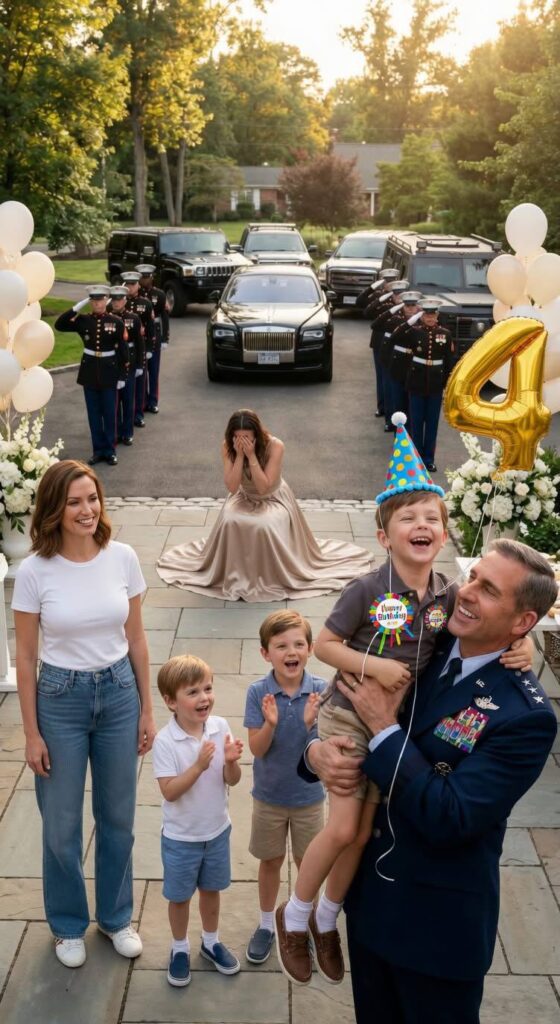
A fleet of five blacked-out SUVs, their suspensions riding low and heavy with military-grade armor, rounded the corner of our quiet cul-de-sac in perfect, aggressive formation. Leading the pack was a pristine, silver Rolls-Royce Phantom, its grille gleaming like a bared row of teeth in the midday sun.
“What on earth?” Brenda gasped, stepping forward, her snobbery momentarily replaced by utter confusion. She squinted through the glaring sunlight. “Who would be lost in this neighborhood with a Maybach?”
I didn’t answer her. I stepped away from the grill, wiping my hands on a towel. I stood tall on the patio, my chin raised. I didn’t look surprised. I looked like a queen whose exiled army had finally returned to the gates.
The lead armored SUV broke formation, gliding smoothly up our driveway. It didn’t park politely. It stopped exactly three inches from the bumper of Brenda’s parked Lexus, pinning it in place.
The driver’s side door opened. A man built like a concrete bunker, wearing a tailored charcoal suit and a dark earpiece, stepped out. He didn’t look at Brenda. He didn’t head for the front door. He walked straight to the rear passenger door of the Rolls-Royce, planted his feet, and snapped to a razor-sharp military salute.
The air in the cul-de-sac seemed to crystallize. Neighbors began to peek out from behind their drawn blinds.
The heavy rear door of the Rolls-Royce swung open. Out stepped General Silas Thorne, the four-star commander of the Joint Chiefs of Staff. He was a towering monument of a man, his chest adorned with rows of ribbons that told a terrifying history of global conflict. Behind him, emerging from the leather interior like a shadow, was Elias Vance, the notoriously reclusive billionaire tech mogul whose aerospace company essentially owned the sky.
Brenda’s wine glass actually rattled against her teeth. These were men she had spent the last five years desperately trying to get a ten-minute meeting with to secure her husband’s political and financial future.
“General Thorne?” Brenda stammered. Her voice pitched upward into a frantic, desperate squeak. She frantically smoothed the wrinkles from her silk blouse and rushed forward, completely abandoning her glass on the porch railing. “General! I’m Brenda Sterling. We—I believe we were supposed to meet at the gala I organized last—”
Thorne didn’t even break his stride. He walked past Brenda as if she were made of glass, his eyes locked entirely on me. He stopped precisely three feet from where I stood, removed his stiff, peaked cap, and bowed his head in a gesture of profound, undeniable respect.
“Major Miller,” the General said. His voice was a gravelly boom that seemed to echo off the siding of the houses. “We heard the young man was turning seven today. The Company couldn’t let a milestone like that pass without paying our respects to the woman who saved all our lives in the Black Sea.”
Behind him, Brenda’s forgotten wine glass rolled off the porch railing and shattered on the patio stones.
“Major… Miller?” Brenda whispered, the color draining entirely from her face, leaving her looking like a wax figure melting in the sun.
The armored SUVs emptied. Dozens of men and women in sharp suits poured onto the lawn, carrying gifts that made the plastic toys at the store look like garbage. They didn’t bring action figures. Elias Vance motioned to his security detail, who carried a massive, glass-encased, meticulously restored vintage model of an F-22 Raptor. General Thorne handed Leo a heavy, gold-plated challenge coin and a leather folder containing a fully funded, lifetime scholarship endowment in his name.
My son, wide-eyed and suddenly surrounded by giants who looked at him like he was royalty, reached out and took the coin.
As the backyard rapidly filled with the most powerful people in the state, Elias Vance stepped up beside me. He didn’t bother to lower his voice. He leaned in and spoke with the clear, crisp projection of a man who owned the room.
“We also found out why the school invitations never went out, Sarah,” Vance said, his eyes drifting lazily over to where Brenda stood frozen. “It wasn’t a postal error. We tracked the IP address that deleted the digital RSVPs from the school’s server.”
The backyard, now teeming with the elite architects of global security and commerce, went dead silent. The only sound was the wind rustling through the cheap birthday banners.
I turned slowly. I walked toward Brenda, my bare feet making absolutely no sound on the freshly cut grass. I didn’t walk like a mother hosting a barbecue. I walked like an apex predator cornering its prey. General Thorne and Elias Vance fell into step right behind me, flanking me like twin pillars of impending doom.
Brenda took a step back, her heel catching in the dirt. Her eyes darted wildly from the General, to the billionaire, and finally, terrifyingly, to me.
“You told me I lacked pedigree, Brenda,” I said. My voice was no longer a submissive hum. It was a low, dangerous silk, the tone of an interrogator who already has the confession. “You told me a ‘nobody’ raises a ‘nobody.’ You looked at my silence and mistook it for weakness. But while you were busy trying to buy your way into ‘high society’ with charity brunches, I was busy ensuring that society still existed.”
I stopped right in front of her, invading her personal space, forcing her to look up into my eyes.
“And then,” I whispered, the temperature of my words dropping below freezing, “you touched my son’s heart.”
I held out my hand. Elias Vance placed a slim, encrypted titanium tablet into my palm. I tapped the screen and held it up to Brenda’s face. It displayed a meticulously logged history of her private emails to the Wellington Academy school board. Paragraph after paragraph of Brenda demanding the school block the party invitations, calling me a “security risk,” an “unfit mother,” and a “stain on the Sterling family name.”
“You didn’t just mock me, Brenda,” I said, letting the tablet drop back to my side. “You weaponized a private school’s server. You sabotaged a seven-year-old’s birthday just to feed your own pathetic, starving ego.”
I turned my head slightly, looking over my shoulder. “General Thorne. I believe Brenda’s husband, Richard, is currently in the final bidding stages for that massive Department of Defense logistics contract, is he not?”
Thorne smiled. It was not a kind expression. It was the smile of a wolf smelling blood.
“Not anymore, Major,” Thorne rumbled, crossing his massive arms over his chest. “We don’t do business with families that harbor… internal threats. I’ll have his firm blacklisted from federal contracting by Monday morning.”
Brenda let out a choked, wet gasp. The foundation of her entire identity—her wealth, her status, her husband’s career—was being systematically vaporized before her eyes.
“Sarah, please,” Brenda began to beg, her voice cracking, her hands reaching out in a pathetic gesture of pleading. “I didn’t—I just wanted—”
She was violently interrupted by the deafening, rhythmic chopping of rotor blades. A heavy, unmarked tactical helicopter descended from the clouds, hovering directly over our house. The immense downwash tore the cheap birthday streamers from the walls and flattened the grass. A thick black rope ladder dropped from the open side door.
A man clad in full tactical gear, an assault rifle slung across his chest, descended the ladder with fluid, practiced speed. He hit the ground, unclipped his harness, and pulled off his helmet.
It was my husband, Mark. The man who was supposed to be at a dull “business conference” in Washington D.C.
Mark didn’t look at his sister. He walked straight through the crowd of dignitaries, who parted for him respectfully. He wrapped his arms around me, kissing the top of my head, smelling of aviation fuel and ozone.
“Sorry I’m late,” Mark said, grinning down at Leo, who was now staring at his father in absolute awe. “Traffic out of the airspace was a nightmare.”
I looked back at Brenda. She was shaking violently, clutching her arms around herself as if trying to hold her shattering reality together. She finally understood. Mark hadn’t married a “nobody” to spite his family. Mark, an intelligence contractor himself, had married the only woman who could speak his language.
“Get off my property, Brenda,” I said quietly.
I didn’t have to call the police. Elias Vance simply snapped his fingers. Two of his massive, suited private security operators stepped forward, flanked Brenda by her elbows, and physically escorted her toward her blocked Lexus. Her social standing, her wealth, her entire world, had evaporated in a single afternoon.
An hour later, the atmosphere in the backyard had completely transformed. It was a scene of surreal, impossible joy.
The heavy tension was gone, replaced by the smell of expensive meats General Thorne had brought and was now personally grilling. Leo was sitting on the General’s massive shoulders, shrieking with laughter as Thorne “flew” him around the yard. Under the shade of the oak tree, Elias Vance was sitting cross-legged in the grass, using a prototype holographic tablet to teach Leo and the two neighborhood kids, Tommy and Maya, the basics of quantum coding. The “empty”, pathetic party had spontaneously become the most exclusive, heavily guarded event in the country.
I stood by the patio table, watching my son smile. The deep, aching fear of failing him was gone.
Mark came up behind me, wrapping his arms around my waist, resting his chin on my shoulder.
“I tried to keep it quiet, Mark,” I whispered, leaning back into his solid warmth. “I really did. I just wanted him to have a normal life. A normal birthday.”
Mark chuckled, a deep, rumbling sound. “Sarah, you are the least normal person I’ve ever met in my entire life. And that’s exactly why we love you. You didn’t raise a ‘nobody.’ You raised a Sterling-Miller. He was never going to have a quiet life with a mother like you. And he shouldn’t have to.”
Out in the driveway, visible through the wooden slats of the fence, Brenda sat trapped in her Lexus, waiting for the security detail to move the Rolls-Royce. I could see her through her windshield, sobbing uncontrollably as she watched the “nobodies” she despised celebrate a victory she couldn’t even afford to buy. Through the open window of her car, I heard the faint, frantic ringing of her phone. She answered it, and even from a distance, I could hear her husband, Richard, screaming through the receiver that all their offshore bank accounts had just been flagged and frozen for “suspicious activity.”
Karma was a sniper, and she never missed her mark.
As the afternoon bled into evening and the sun began to set, casting long, golden shadows across the lawn, General Thorne wiped his hands on a towel and walked over to me. His grandfatherly demeanor faded, replaced by the hardened commander I used to report to.
He pulled me aside, out of earshot of Mark and the kids.
“The party was a good cover to mobilize the team, Sarah,” Thorne murmured, his eyes scanning the perimeter. “But we didn’t just come for the cake and the theatrics.” He handed me a heavily encrypted flash drive. “Something’s happened in the Levant. An asset went dark. We need the ‘Ghost’ back. Just one more time.”
One month later.
The morning air was crisp as I pulled my SUV up to the drop-off lane at the Wellington Academy. Leo unbuckled his seatbelt, his heavy backpack slung over one shoulder.
His life at school had drastically changed. He was no longer the quiet kid sitting alone at lunch. He was now the most respected kid in his grade—not just because rumors had spread about a billionaire and a four-star general attending his party, but because of the quiet, unshakable confidence I had finally allowed myself to instill in him. He walked taller. He knew his worth.
“Have a good day, buddy,” I said, smiling as he opened the door.
“Bye, Mom! Love you!” he called out, running to join Tommy and Maya, who were waiting for him by the gates.
I watched him go, a profound sense of peace settling over me. I drove back to our quiet house in Oak Creek. The streamers and the superhero banner were long gone, but the atmosphere of the home had fundamentally shifted. I was no longer hiding from my own shadow.
I walked upstairs to our bedroom, pushed back the heavy Persian rug, and popped open the hidden floorboard compartment. I began packing a small, discreet tactical bag. Kevlar inserts. Ceramic blades. An encrypted satellite uplink.
Before closing the bag, I walked down the hall to Leo’s room. It was empty, but his bed was unmade. On his nightstand, framed in simple black wood, was a printed photograph from the party: Leo, wearing his paper crown, sitting on General Thorne’s shoulders, while I stood beside them, laughing.
The “nobody” from the motor pool had proven her point. Pedigree isn’t found in a dusty family tree, a trust fund, or a country club membership. It’s forged in the brutal fire of service, the blood of sacrifice, and the unyielding, terrifying softness of a mother’s love.
I walked downstairs to the kitchen, where my secure “work” phone lay on the marble counter. I picked it up, opened the messaging app, and sent a single, heavily encrypted text to General Thorne:
“I’m in. But the extraction has to be flawless. I need to be back in Virginia by Thursday for school drop-off.”
I hit send. I looked out the kitchen window at the quiet, perfectly manicured backyard. The neighborhood was exactly the same, but the woman looking at it had been resurrected.
“You were right about one thing, Brenda,” I whispered to the empty room, a cold, satisfied smile touching my lips. “I didn’t raise him to be like you. I raised him to be like me. And that’s the most dangerous thing you ever overlooked.”
I grabbed my keys and stepped out onto the front porch, the morning sun warming my face.
But as I locked the door, my eyes caught a reflection in the glass. I paused. I looked down the street. Parked in the shadows of the large oak trees at the end of the cul-de-sac was a sleek, black sedan. It wasn’t the General’s detail. It wasn’t Vance’s security.
As I stared at it, the high beams flashed twice in rapid succession—a very specific, very old signal from a rival intelligence agency I thought I had completely dismantled and buried in the ashes of Bogotá five years ago.
The quiet life was officially over. But this time, as I felt the familiar adrenaline spike in my veins, I knew I was ready for the noise.
If you want more stories like this, or if you’d like to share your thoughts about what you would have done in my situation, I’d love to hear from you. Your perspective helps these stories reach more people, so don’t be shy about commenting or sharing.