
Chapter 1: The Splintered Throne
The cheap pine snapped beneath me at the exact second I raised my crystal flute.
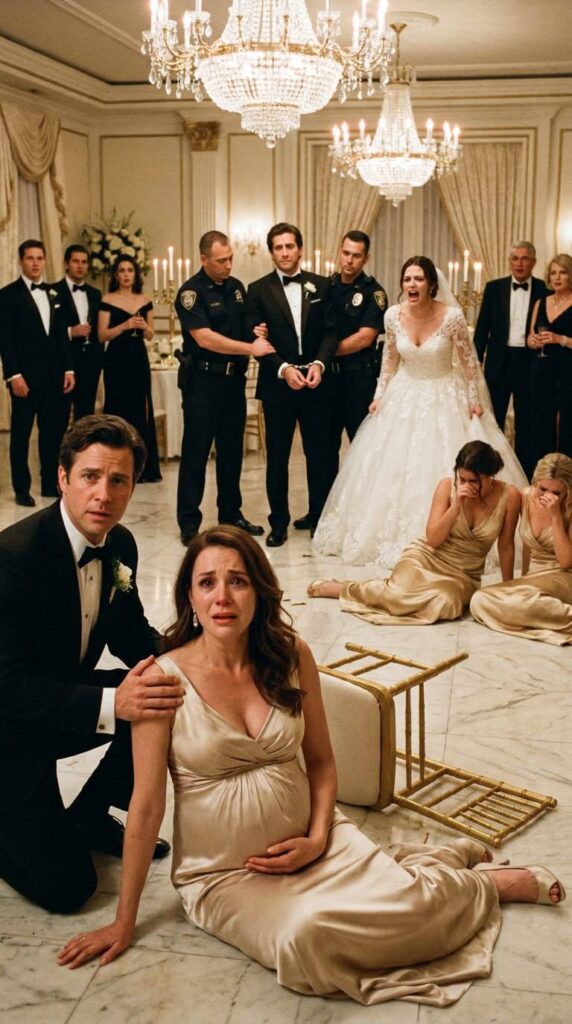
One breath, I was standing awkwardly beside the sweetheart table in a suffocating navy maternity gown, forcing a polite toast through gritted teeth about my sister’s “radiant and magical day.” The very next fraction of a second, the back right leg of the chair simply surrendered. My center of gravity violently shifted, twisting my spine, and I crashed onto the polished hardwood of the ballroom floor with enough blunt force to completely empty my lungs.
My water goblet shattered beside my hip, showering my calves in ice and jagged glass.
A sharp, electric jolt of pain radiated through my pelvis. My hands instantly flew to guard my swollen abdomen.
“God—my baby,” I choked out, desperately trying to pull oxygen past my paralyzed diaphragm.
For one agonizing heartbeat, the opulent grand ballroom at The Magnolia House in downtown Atlanta plunged into absolute, suffocating silence.
Then, somebody chuckled.
It wasn’t a sympathetic sound. It was a short, guttural cough of amusement. A second later, a woman’s giggle bubbled up to join it. Then another. By the time I managed to brace my trembling arm against the sticky, champagne-soaked floorboards to push myself upright, half the venue was openly staring. They were smiling, whispering behind manicured hands, as if my public humiliation was the evening’s premier cabaret act.
I blinked through the dizzying haze and found my sister, Brooke, towering over me. She was wrapped in fifty thousand dollars of imported white silk, her hand delicately pressed over her mouth to mask her amusement. Her bare shoulders were visibly shaking.
“Claire,” she murmured, her tone dripping with a breathless, theatrical brand of fake concern. “Are you alright down there?”
Her maid of honor, Tiffany, didn’t even possess the decency to manufacture empathy.
“Oh, my God,” Tiffany snorted, adjusting her tight bridesmaid dress. “The whale actually tipped over.”
Across the dance floor, two guests in the VIP section already had their smartphones raised, the camera lenses locked onto my sprawling, helpless form. I closed my eyes, praying for a localized earthquake to fracture the foundation and swallow me into the earth.
This was the climax of a nightmare that had officially begun exactly fourteen days prior.
Two weeks ago, I had dragged my exhausted, heavily pregnant body home after a grueling double shift at Rosie’s Diner. My ankles were swollen to the size of grapefruits. I had unlocked the front door, kicked off my orthopedic sneakers, and walked into our master bedroom to find my husband, Dean, buried beneath the duvet with Brooke.
The audio of that night still plays on an endless, agonizing loop in my skull.
“Brooke?” I had whimpered into the darkness, my brain utterly failing to compute the visual data. “Dean?”
Brooke hadn’t screamed. She hadn’t scrambled for her clothes. She casually pulled my Egyptian cotton sheet up to her collarbone and met my gaze with terrifying, reptilian calm. “You really weren’t supposed to find out this way, Claire.”
Dean hadn’t even offered a pathetic denial. He just sat on the edge of the mattress, staring blankly at the carpet as if trying to memorize the thread count.
I was thirty-two weeks pregnant with his child.
Seventy-two hours later, he packed his golf clubs and moved into the guesthouse situated on Brooke’s sprawling suburban estate, allegedly “until the dust settled.”
And yet, despite the absolute annihilation of my reality, my mother, Eleanor, had the supreme audacity to call me on Thursday evening. “You must attend the reception, Claire. People will talk if you are absent. Do not make this tragedy messier than it already is.”
So, I submitted. I arrived unaccompanied. I arrived hollowed out and humiliated. I arrived wearing pumps that pinched my blisters and a fabricated smile that made my jaw ache.
And my reward was lying in a puddle of water while my sister’s inner circle mocked my physical collapse.
“I explicitly warned you to avoid that seat,” Tiffany slurred, casually tilting her champagne flute so the liquor caught the chandelier light. “The joinery looked incredibly cheap.”
“I asked the catering staff for a sturdy replacement,” I stammered, my vocal cords trembling with a volatile cocktail of adrenaline and shame.
Tiffany offered a dismissive shoulder roll. “You were being highly dramatic, per usual.”
I planted my palms against the floor, attempting to hoist myself up, but the massive, uneven weight of my belly threw me entirely off balance. The crystal chandeliers overhead began to streak and blur.
That was the precise moment a deep, authoritative baritone sliced cleanly through the ambient noise of the ballroom.
“Do not move a muscle.”
A pair of impeccably polished, charcoal-gray oxfords stepped into my blurred field of vision. A man knelt beside me. He didn’t hover awkwardly like a bystander; he dropped to one knee with the calm, grounded stability of a first responder. The mocking whispers, the flashing cameras, the suffocating presence of my sister—it all instantly evaporated, leaving only him in focus.
“I have you,” he murmured, his voice a low, steady rumble. “Can you brace your hand against my forearm?”
I swallowed the lump in my throat and nodded.
He gripped my elbow and hoisted me to my feet. His strength was effortless, calculated, and entirely secure. The moment I was safely upright and balancing my weight, he didn’t step back. He deliberately shifted his broad shoulders, inserting himself as a physical barricade between me and the crowd.
“My name is Reid Dalton,” he announced to the room.
Directly across the sweetheart table, the groom’s complexion mutated from a healthy, sun-kissed tan to the color of wet cement.
Mason Reed—Brooke’s endlessly grinning, trust-fund country-club prince—looked as though the Grim Reaper had just RSVP’d to his reception.
Chapter 2: The Audit of Vipers
“Mr. Dalton,” Mason stammered, his voice cracking violently on the second syllable. “I… I was entirely unaware you were on the guest list.”
“No,” Reid replied, his tone as smooth and cold as polished marble. “You weren’t. The element of surprise was a tactical necessity.”
The ballroom, previously humming with a hundred overlapping conversations, went deathly still. You could hear the ice melting in the cocktail buckets.
Brooke blinked her heavy, false eyelashes, completely disoriented. “Mason, darling, who is this man?”
Reid didn’t wait for the groom to fabricate an introduction. He pivoted slightly, ensuring his voice carried to the cheap seats in the back.
“I am the founder and CEO of Dalton Capital,” he declared. “And until approximately twenty minutes ago, your new husband was employed as one of my senior portfolio managers.”
A collective gasp swept across the room, rustling the silk dresses and stiff tuxedo jackets.
Mason let out a high-pitched, panicked chuckle, wiping a bead of sweat from his temple. “Sir, I truly believe this is neither the time nor the venue for a performance review—”
“It became the venue,” Reid interrupted, his voice slicing through the air with lethal precision, “the exact moment my forensic compliance team verified that you embezzled client escrow funds to finance this opulent circus. Furthermore, you utilized stolen capital to secure the lease on your Buckhead penthouse, and to purchase that matte-black Aston Martin currently blocking the valet.”
Brooke’s jaw unhinged. The sprawling bouquet of white peonies slipped through her fingers, hitting the floor with a soft, pathetic thud.
“What?” she breathed.
Mason’s eyes darted wildly toward the exits. “He… he is severely misinformed, Brooke. It’s a clerical error.”
Reid reached inside the breast pocket of his bespoke jacket and withdrew a slender, heavily tabbed manila folder. He tossed it onto the sweetheart table. It landed directly beside Mason’s untouched wedding cake.
“It is documented fact,” Reid stated. “The local precinct dispatched two squad cars. They are currently waiting in the lobby. I simply believed you deserved the courtesy of ruining your own wedding reception before the authorities applied the handcuffs.”
The ballroom detonated.
Brooke lunged, digging her acrylic nails into Mason’s tuxedo sleeve. “Tell me to my face he is lying, Mason!”
Mason violently jerked his arm away, his facade crumbling. “Lower your damn voice, Brooke!”
“My voice?!” she shrieked, her neck flushing a violent, mottled red. “You swore to my mother you were pulling seven figures! You said the cars were company perks!”
Tiffany, desperate to insert herself into the drama, marched forward and pointed a shaking, manicured finger at Reid. “Listen here, you arrogant prick. You cannot just crash a private event and start hurling wild accusations—”
Reid slowly turned his head to look at her. The sheer, freezing intensity of his gaze stopped her mid-sentence.
“Security footage from the venue lobby explicitly captures you repeatedly kicking the leg of a chair occupied by a visibly pregnant woman, immediately after she politely asked you to stop,” Reid said smoothly. “I strongly suggest you take a seat, Ms. Mercer. You are already flirting with a civil lawsuit for reckless endangerment.”
Tiffany’s mouth snapped shut. She physically recoiled, melting back into the crowd of terrified bridesmaids.
My lungs were burning. My pulse hammered against my ribs like a trapped bird. The sheer, overwhelming scale of the karma unfolding before my eyes was impossible to process.
But Reid Dalton wasn’t finished.
He reached back into his suit jacket. “Oh,” he added, his tone conversational, almost wistful. “And Brooke? Before you fracture your vocal cords screaming at your fraudulent groom, you should probably be aware that Mason is not the only man in this room lying to you.”
He produced a secondary envelope, sliding a stack of high-gloss, eight-by-ten photographs across the white linen tablecloth.
Mason snatched the top image.
Even from my position five feet away, my eyes locked onto the subjects instantly. It was Dean. He was pressed aggressively against the side of the guesthouse, locking lips with a blonde woman in a silk robe. The digital timestamp glowing in the bottom right corner confirmed the photos were taken at 11:45 PM. Last night.
Mason emitted a guttural, choked sound that I had never heard a human being produce. It was the sound of a fragile ego shattering into dust.
“You told me he was the landscaping contractor!” Mason roared, waving the photograph in Brooke’s face.
Brooke’s complexion turned the color of chalk. “Mason, sweetheart, please let me explain—”
“He was living in the guesthouse! With my sister-in-law!”
“And you were sleeping with my husband,” I interjected.
My voice was a razor blade. I didn’t know I possessed that volume, that unshakeable, icy authority.
Every single head in the Magnolia House snapped toward me. The murmuring ceased entirely. For the first time since my arrival, absolutely no one was laughing.
Brooke stared at me, her eyes manic, her chest heaving. She looked as though she wanted to physically rip the skin from my skull. “You think you’ve won a prize tonight, Claire? You think this makes you a victor?”
Bile rose in the back of my throat, but I swallowed it down. “No, Brooke. I think you finally lost.”
Right on cue, the heavy double doors of the ballroom swung open. Two uniformed Atlanta police officers marched down the center aisle, their radios crackling in the suffocating silence.
The guests scattered like cockroaches under a sudden light. Cell phones were immediately hoisted into the air again, but the lenses were no longer aimed at me. They were recording Brooke collapsing onto the floor in hysterics. They were recording Mason shouting obscenities. They were recording Tiffany trying to hide behind a floral arrangement, and Dean—my cowardly, pathetic husband—attempting to slink out the service exit like a rat abandoning a burning ship.
Reid wrapped a warm, solid hand around my elbow. “Claire, you need to sit down immediately. You are trembling violently.”
“I’m perfectly fine,” I whispered, though my knees felt like wet paper.
He studied my face, his dark eyes analyzing my dilated pupils. “No, you are in shock. Come with me. My private driver is waiting in the alley. He will transport you to the emergency room for an obstetric check, and then straight home.”
I planted my feet, staring up at this towering, immaculate stranger. “Why? Why would a billionaire CEO orchestrate this elaborate rescue mission for a pregnant waitress he has never met?”
His stoic expression fractured. It softened into something profoundly melancholic, something deeply sad.
“Because,” Reid murmured quietly, “your father pulled me out of the fire when I had nothing. He saved my life. And before he passed, he extracted a promise from me: find you, and protect you, if your mother ever allowed Brooke to destroy you.”
A cold bucket of ice water washed over my brain.
“My father died of a heart attack when I was twelve,” I stated defensively.
Reid held my gaze, unblinking. “That is not the entire narrative, Claire.”
Behind us, Brooke unleashed a blood-curdling shriek as the heavy steel handcuffs ratcheted shut around Mason’s wrists.
In front of me, Reid signaled toward a side exit, simultaneously pulling a sealed, cream-colored envelope from his inner pocket. My name was scrawled across the front.
I recognized the looping, architectural handwriting instantly.
Suddenly, the chair, the shattered glass, and the implosion of my sister’s pathetic wedding were entirely irrelevant. The worst night of my life had mutated into an archeological dig. It was no longer about Dean’s infidelity. It was about the radioactive secret my mother had buried fifteen years ago.
It was about why my father knew this exact nightmare was inevitable.
Chapter 3: The Ghost’s Handwriting
The armored door of Reid’s black Maybach clicked shut, sealing us inside a cocoon of soundproofed, climate-controlled silence. It felt infinitely louder than the screaming match we had just left behind in the ballroom.
I sat frozen against the pristine leather upholstery.
My palms were clamped over my abdomen, my fingertips pressing into the taut, restrictive fabric of my ruined maternity dress. I was subconsciously attempting to stabilize the chaotic trembling of my own body while shielding the fragile life swimming inside me. As if sensing the adrenaline spike, the baby executed a slow, rolling kick against my ribs. I closed my eyes and released a shuddering breath I felt I had been holding for twenty minutes.
Reid settled into the leather seat opposite me. The driver seamlessly merged the luxury sedan into the downtown traffic, leaving the flashing police sirens and the magnificent ruin of the Magnolia House shrinking in the rearview mirror.
We didn’t speak.
We remained in complete silence until the glaring neon of the city center bled into the quiet, tree-lined avenues of the suburbs. I needed the world to recede before my lungs could function properly.
“You should break the seal,” Reid finally suggested, his voice a low, comforting rumble.
The envelope felt impossibly heavy in my lap. It was slightly yellowed at the corners, the texture of the thick cardstock worn from years of handling. My name was written on the front.
I traced the faded blue ink with my thumbnail.
“Claire,” I whispered to the empty air, the sound hollow. “He has been in the ground for a decade and a half.”
Reid didn’t offer a platitude. He didn’t rush my processing. He simply sat there, a silent sentinel, allowing me the space to grieve an impossibility. And somehow, his lack of pressure gave me the strength to act.
My shaking fingers slipped beneath the adhesive flap.
I hesitated for a fraction of a second. Ripping this paper meant permanently destroying the foundational truths of my childhood. It meant the grief I had carried since I was twelve was built on a fallacy.
I pulled the folded parchment free.
My dearest Claire, If these words are in your hands, then I failed to be standing beside you when the walls closed in. That reality is a torment I never successfully learned how to shoulder. I cannot fathom how old you are as you read this. I cannot picture the woman you have grown to be. But I know this as absolute fact: if Reid Dalton has stepped out of the shadows to find you, it means the perimeter has been breached. Something has gone catastrophically wrong.
And it means the time for fairy tales is over.
Your mother sat you down and told you my heart failed. That I died. It was a masterful half-truth. But it was not the reality. Fifteen years ago, I vanished because remaining meant putting a target on your back. I was an auditor. I looked too closely at the wrong ledgers. There was a syndicate of incredibly powerful, ruthless men who operated in the dark. I uncovered their machinery—offshore accounts, laundered capital, lives quietly and efficiently dismantled behind closed boardroom doors. When I attempted to resign and walk away, they illuminated the reality of my situation: there were no exits. So, I engineered my own death. I became a ghost. Not because I ceased to love you. I left because loving you meant I could not stay and bring that violence into our home. I orchestrated the extraction through Reid. He was a hungry, brilliant kid I pulled out of a bad situation, and the only soul I trusted. He funded my disappearance, and in exchange, I demanded a singular vow: Watch the tree line. Not from a distance. But if the day ever arrived when your spirit was at risk of being crushed by the exact same breed of monsters I fled from, he was to intervene.
Claire… your sister possessed a darkness that thrived in that world. You never saw it. And your mother, Eleanor… she made her bed. You were a creature of light. You were never designed to survive in their cynical, transactional ecosystem. If Reid handed you this letter, it means they finally bared their teeth at you. I do not know what traumas you have endured to reach this seat. But the fact that you are breathing means you survived them. It means your spine is made of stronger steel than they could ever forge. Reid holds the remaining puzzle pieces. About my life in the shadows. About the monsters in your house. About the legacy that rightfully belongs to you. Regardless of what horrors you uncover today, memorize this: You were the absolute triumph of my existence. And if the universe had offered me a singular path to stay by your side—I would have taken it without hesitation. — Dad
The cursive letters blurred into a chaotic, watery smear.
I hadn’t registered the tears until a hot drop of saltwater splashed onto the parchment, blooming a dark circle over his signature.
“He didn’t die,” I choked out, the realization tearing through my throat like broken glass.
Reid’s jaw tightened. The stoicism in his eyes cracked, revealing a profound, weary sadness.
“He did, Claire,” Reid replied softly. “Five years ago. Pancreatic cancer.”
My head snapped up, my neck aching from the whiplash. “What?”
Reid nodded slowly. “He was relocated under a fabricated identity. A tiny logging town in Oregon. He lived a highly insulated, quiet existence. He monitored your milestones when it was safe to do so… but always through a proxy.”
My chest contracted violently, starving my lungs of air.
“He was breathing,” I whispered, my voice escalating into a frantic, desperate pitch. “For ten years after my mother buried an empty casket, he was walking the earth, and he never once came to retrieve me?”
“He was chained to the shadows,” Reid defended him. “If he made contact, he would have dragged their crosshairs directly onto you.”
I shook my head, a fierce, burning anger suddenly illuminating the grief. “No! That is cowardice! He could have smuggled us out! He could have—”
“He attempted it.”
Those three words paralyzed me.
Reid leaned forward, resting his elbows on his knees, his massive frame shrinking the cabin space.
“The autumn you turned sixteen,” Reid said, his eyes locking onto mine. “He drove a rusted pickup truck three thousand miles to Atlanta. He parked three blocks from your high school. For three consecutive days, he sat behind the steering wheel, watching you walk through those double doors. He watched you eat lunch on the grass. He watched you laugh with your friends.”
My breath hitched. The memory of being sixteen, feeling utterly alone in a house that hated me, flashed behind my eyes.
“He had a bag packed for you,” Reid continued, his voice thick with emotion. “He was going to approach you on a Thursday afternoon. But that Wednesday night, a lieutenant from the syndicate he fled was spotted dining at the country club your mother frequented. The network was still actively monitoring the family. If he grabbed you, they would have hunted you both down. He drove back to Oregon that night, and he never forgave himself.”
The interior of the Maybach fell silent once more.
But the silence had transformed. It was no longer empty. It was suffocatingly heavy, laden with the weight of a father’s invisible, agonizing sacrifice.
“What did he mean,” I asked, my voice raw and exhausted, “when he wrote about my sister?”
Chapter 4: The Syndicate’s Shadow
Reid exhaled a long, measured breath, staring out the tinted window at the passing streetlights.
“Your father was a brilliant forensic accountant,” Reid began, assuming the clinical tone of a CEO delivering a quarterly report. “He stumbled onto a localized, highly sophisticated financial network. We are talking layered shell corporations, aggressive real estate laundering, and private equity funds designed to clean dirty money for very dangerous clients.”
“Mason,” I breathed, the puzzle pieces clicking together with terrifying speed.
“Correct. Mason was a mid-level operator. An arrogant kid who thought he was smarter than the algorithm.”
“And Brooke?” My voice cracked slightly on my sister’s name.
Reid hesitated. He looked at me with a profound, terrifying pity.
“Your mother remarried eighteen months after your father’s ‘funeral,’” Reid said cautiously.
I stared at him. “To Arthur. A commercial real estate developer.”
“Arthur was a regional director for the syndicate,” Reid corrected bluntly. “He wasn’t building strip malls, Claire. He was washing cartel money through concrete and steel.”
The plush leather seat felt like it was spinning.
“No,” I stammered, shaking my head aggressively. “No, that is a Hollywood script. That doesn’t make logical sense. My mother… my mother was a vice-principal at a private middle school. She baked casseroles.”
“She married ironclad financial stability,” Reid stated coldly. “She craved the country club elite status, and she didn’t care how the sausage was made to secure it.”
I pressed my palms against my temples, desperately trying to construct a timeline that didn’t end in horror. “Brooke… Brooke knew about this?”
“Arthur is Brooke’s biological father,” Reid said. “Brooke was bred for that ecosystem. She knew where the money came from, and she enthusiastically spent it.”
“And me?” I asked, my voice dropping to a hollow, pathetic whisper. “I lived in that house until I was eighteen. I never saw the blood on the money.”
“No,” Reid said, his expression softening. “You didn’t. You were the anomaly. You were the empathetic, soft-hearted girl who worked shifts at a diner because you refused to ask Arthur for an allowance. You were completely blind to it.”
A bitter, cynical laugh tore out of my throat, echoing harshly in the luxury car. “Of course I was blind. I was the naive idiot. I didn’t even notice my husband was sleeping with my sister.”
Suddenly, the narrative of my entire existence felt as though it had been drafted by a malicious stranger. Every memory, every holiday dinner, every cruel comment from my mother—it was all built on a foundation of rotting corpses.
The Maybach gently rolled to a halt.
“We have arrived,” Reid announced.
I looked through the tinted glass. We were parked beneath the glaring, sterile awning of an emergency room entrance. Atlanta General Hospital. Safe. Guarded.
“I explicitly stated I was fine,” I protested weakly, shrinking into the seat.
“You hit a hardwood floor with the blunt force of a car crash,” he replied, already reaching for the door handle. “And you are carrying an eight-month-old fetus. We are verifying your safety.”
I didn’t possess the energy to mount a defense. My adrenaline reserves were entirely depleted.
The triage room smelled violently of industrial bleach and sharp antiseptic.
An attending nurse efficiently strapped a fetal monitor around my swollen belly, her movements brisk but gentle. The cold ultrasound gel made me shiver. Another nurse wrapped a blood pressure cuff around my arm, the velcro tearing loudly in the quiet room.
And then, the sound filled the space.
Thump-thump. Thump-thump. Thump-thump. The rhythmic, galloping heartbeat of my unborn child echoed through the small speakers of the machine. It was strong. It was incredibly fast. It was aggressively, defiantly alive.
It was mine.
I squeezed my eyes shut as a massive, tidal wave of relief washed over my bruised body, carrying away the remnants of the ballroom trauma.
“You and the baby are perfectly stable,” the attending obstetrician smiled thirty minutes later, reviewing the charts. “You sustained some superficial contusions on your right hip, but the placenta is intact. No signs of abruption. We will keep you in observation for two hours purely as a precaution, then discharge you.”
“Thank you,” I whispered, my voice thick with tears.
When the medical staff cleared the room, I opened my eyes to find Reid standing in the corner. He hadn’t left. He had stood vigil the entire time, his arms crossed over his chest, guarding the door.
“There is one final piece of business,” he murmured, stepping into the harsh fluorescent light.
I let my head loll back against the crinkling paper of the exam table. “Of course there is. Bring out the dragons.”
The corner of his mouth twitched upward in a ghost of a smile.
He reached into his jacket pocket for the third time that evening. But he didn’t extract a photograph or a letter.
He held out his palm. Resting in the center was a small, intricately cut brass key.
“What does that unlock?” I asked, staring at the metal.
“Your father left a contingency plan,” Reid explained. “A private safety deposit box in a highly secure offshore branch. I have maintained custody of the key for fifteen years.”
I stared at the brass, terrified to touch it. “What did he put inside?”
“Everything he lacked the time to write in that envelope.”
Chapter 5: The Vault of Redemption
Three days later, I stood deep in the subterranean belly of a private financial institution.
My hip throbbed with a dull, persistent ache. The dark circles under my eyes looked like permanent tattoos. But my hands, resting against the cold steel counter, were entirely steady. The terror had burned off, leaving behind a cold, hardened resolve.
Reid stood a respectful pace behind me as the bank manager simultaneously turned his master key alongside mine. The heavy, metallic clank echoed in the vault. The manager withdrew the long, rectangular metal box, set it on the table, bowed his head, and exited the room, sealing the reinforced door behind him.
I pulled the hinged lid back.
The box smelled of stale paper and old dust. Inside lay a meticulously organized stack of documents, a heavy velvet pouch, and a small stack of physical photographs.
I reached for the photos first.
The top image was polaroid. It was me, roughly six years old, missing a front tooth, perched triumphantly atop my father’s broad shoulders. We were at a county fair, both of our faces split into identical, ecstatic grins.
Beneath it was a photograph I had never seen.
It was him. He looked significantly older. The dark hair I remembered was heavily salted with gray. His face was weathered, his frame noticeably thinner. He was standing on a rugged, pine-covered coastline, wearing a heavy flannel jacket. But his eyes were crinkling at the corners. He was smiling. He was alive.
My throat constricted, a jagged sob catching in my windpipe. I pressed the photograph against my chest, closing my eyes.
I carefully set the images aside and extracted the heavy stack of manila folders.
Legal filings. Offshore trust deeds. Property titles. Anonymized asset transfers.
Page after page, my legal name was listed as the sole, uncontested beneficiary.
“What am I looking at, Reid?” I asked, my voice barely a whisper in the silent vault.
Reid stepped forward, his eyes scanning the documents he had helped safeguard. “Your father didn’t simply vanish into the night, Claire. He systematically drained hidden, untraceable accounts from the syndicate before he burned his bridges. He weaponized their own laundering algorithms against them, siphoning a fraction of the capital and locking it into blind trusts.”
“How much capital?” I breathed, terrified of the answer.
Reid met my eyes. His expression was fiercely protective.
“Enough capital that you will never, for the rest of your natural life, be forced to depend on a human being who does not respect you.”
That evening, I sat on the thrift-store sofa in my tiny, cramped apartment.
It was the same bleak, depressing unit I had hurriedly leased the morning after I caught Dean and Brooke. For two weeks, these walls had felt like a tomb—a monument to my ultimate failure.
Tonight, the cramped walls felt like the launchpad of an empire.
The letter from my father rested on the cheap laminate coffee table. The brass key sat beside it.
My cell phone, plugged into the wall charger, violently buzzed. The screen illuminated the dark room.
Unknown Number. Claire, I am begging you. We need to formulate a legal strategy. Please call me. — Mom
The screen went dark. Ten seconds later, it buzzed again.
You have no idea what you have done. The feds are tearing the house apart. — Brooke
And finally, a third message. No contact name saved.
I am so sorry, Claire. I ruined my life. — Dean
I stared at the glowing pixels. A month ago, a text from Dean would have shattered me. A text from my mother would have triggered a panic attack.
I picked up the device, navigated to the settings, and executed a factory reset. The screen flashed bright white, erasing the contacts, the messages, the history. Some doors in the human heart do not require closure; they simply need to be permanently bricked over.
Chapter 6: The Free Woman
The passage of time is the ultimate executioner of secrets.
Within six weeks, the fallout was absolute. Mason Reed was formally indicted on fourteen counts of wire fraud and grand larceny. Tiffany, having aided in document forgery, accepted a brutal plea deal that permanently stripped her of her brokerage license.
Dean evaporated from the city limits. He became a ghost, slipping away as quietly and cowardly as he had lived.
And Brooke—the golden child, the syndicate princess—was stripped of her frozen assets. She lost the guesthouse, the country club memberships, and the designer gowns. She lost everything she foolishly believed constituted a personality.
For the first time in thirty years, I woke up in the morning and realized I hadn’t lost a single thing of value.
On a remarkably crisp, sunlit morning, exactly fourteen days before my scheduled due date, I stood by the edge of a serene, quiet lake in a private botanical garden.
The air was soft, carrying the scent of blooming jasmine.
Reid stood comfortably beside me, wearing a casual sweater, his hands shoved into his pockets. He had transitioned from a corporate savior into a steady, undeniable fixture in my daily life.
“You are under no moral obligation to forgive them, you know,” Reid murmured, watching a swan glide across the glass-like water.
“I am acutely aware of that,” I replied, pulling my cardigan tighter around my shoulders.
“And you don’t have to force yourself to forget the trauma, either.”
“I have no intention of forgetting a single second of it.”
He nodded slowly, a small, approving smile touching his lips. “That is a healthy perspective.”
I looked down at the massive, beautiful swell of my stomach. As if on cue, the baby shifted, a strong, rolling stretch that distorted my sweater. It was a new life. Entirely unburdened by the sins of her grandmother, untainted by the cowardice of her father.
“What is the protocol now?” I asked, turning to look up at his profile.
Reid smiled fully this time. “You execute whatever protocol you desire, Claire. That was the entire objective of your father’s sacrifice.”
Two weeks later, in a quiet, private birthing suite funded by a ghost’s offshore trust, I held my daughter against my chest for the very first time.
She possessed ten perfect fingers and ten microscopic, perfect toes. She smelled of warm milk and absolute innocence.
I named her Evelyn.
It was not a family name. It was not an homage to a grandmother or an aunt. It was a blank slate. A name that belonged exclusively to her, untethered from the rotting family tree I had successfully chopped down.
On the afternoon I brought Evelyn home to our newly purchased, sun-drenched townhouse, I took a hammer and a nail and hung a simple oak frame in the center of the nursery wall.
Inside the glass rested a cream-colored, slightly smudged letter written in looping, architectural handwriting.
I didn’t mount it on the wall to serve as a morbid reminder of the family I had violently lost. I mounted it as undeniable, historical proof of the absolute hellfire I had survived.
Because in the final accounting of my life, the monsters in my bloodline attempted to break my spirit with a cheap, splintered chair.
But what they inadvertently handed me was the unvarnished truth.
And the truth did not shatter me.
It forged me into a weapon, and it set me completely free.