
The scratch of the ballpoint pen against the heavy legal parchment sounded like a match being struck in a quiet room. I can still hear it. That was the sound of thirty years of memories—my late husband’s calloused hands building the porch, the pencil marks on the doorframe measuring my daughter’s growth—being traded for a cashier’s check. I sold my modest, three-bedroom home in Ohio, the only shelter I had in this world, to fund a fantasy. A million-dollar wedding at the St. Regis Aspen Resort.
I had stepped out of the shuttle into the biting, crisp Colorado air earlier that morning, my heart fluttering against my ribs like a trapped bird. I wore a modest but elegant navy-blue dress I had saved for six months to buy, carefully carrying a corsage of white orchids. I was Sarah Miller, the Mother of the Bride, ready to give away my only child.
The bridal suite was a cavernous, icy expanse of white leather and chrome, smelling sharply of hairspray, expensive lilies, and nervous sweat. I navigated through a swarm of makeup artists and stylists, my eyes searching for her.
Then, I saw her. Tiffany stood on a pedestal in the center of the room, draped in a twenty-thousand-dollar silk gown that flowed around her like liquid pearl. The dress I had sold my soul to buy.
I walked into the center of the suite, my eyes misty with a profound, aching pride. “You look like an angel, Tiffany,” I whispered, reaching out a trembling hand to touch the delicate French lace of her sleeve.
Tiffany snapped her arm back, recoiling as if my hands were coated in motor oil. The stylists around us went dead silent.
“Don’t touch the fabric, Sarah,” she hissed, her voice a low, venomous scrape that I barely recognized. Her eyes, painted to perfection, raked over me with absolute disgust. “And why are you wearing that? You look like a librarian from a flyover state.”
A cold dread coiled in my gut. “I’m your mother, honey,” I said, my voice faltering. “I’m supposed to walk you down the aisle. We practiced…”
Tiffany let out a laugh—a sharp, metallic sound that seemed to shatter the frosty air in the room. She stepped down from the pedestal, her silk train hissing against the marble floor, and grabbed my arm, dragging me into the adjacent powder room.
“The Harrington family thinks my mother is a Duchess currently in a private sanitarium in Switzerland,” she spat, her manicured nails digging into my flesh. “Julian’s parents are European old money. They think we lost our ancestral estate in a tragic fire. They can’t see this.”
She pointed a vicious, trembling finger at my calloused hands—hands that had scrubbed floors and kneaded bread to pay for her college—and the deep lines of worry etched around my eyes.
“But the house…” I stammered, the room suddenly spinning. “I gave you everything. I don’t have a home to go back to, Tiffany.”
“Which is why you are going to do exactly as I say,” she replied, her face a mask of terrifying, calculated ambition. She reached into a hidden, black vinyl garment bag hanging behind the door, pulled out a wad of fabric, and threw it hard against my chest. It fell to my feet.
It was a cheap, black-and-white polyester maid’s uniform.
“Put this on,” she commanded, stepping back out of the bathroom. “You’re not the Mother of the Bride. You’re the ‘temporary staff’ I hired to handle my personal needs today.”
The bathroom door clicked shut, locking me in with the blinding vanity lights and the stark, awful truth. I stood there, staring at my reflection in the vast mirror. My chest felt hollow, excavated by the sheer magnitude of the betrayal. I slowly stripped off the navy dress I had been so proud of. The cheap polyester of the maid’s uniform scratched against my skin like sandpaper, a physical manifestation of the humiliation settling into my bones. I pinned the ridiculous white apron around my waist, feeling utterly, horrifyingly invisible.
When I finally pushed the door open, the atmosphere in the suite had shifted. Eleanor Harrington, the groom’s mother, had arrived. She was a vision of inherited wealth, dripping in emeralds, inspecting Tiffany with the critical eye of a jeweler appraising a diamond.
The moment Eleanor turned, Tiffany’s entire posture transformed. The sociopathic sneer dissolved, replaced instantly by the radiant, demure smile of a perfect, refined bride.
“Oh, Tiffany dear,” Eleanor remarked, her voice dripping with aristocratic drawl as her eyes landed on me. She looked at me not as a human being, but as a piece of misplaced furniture. “Your ‘maid’ looks quite somber. Is she feeling unwell?”
Tiffany sighed dramatically, placing a delicate, comforting hand on her future mother-in-law’s arm. “She’s a charity case, Eleanor. Poor thing lost everything in a terrible housing eviction. I thought I’d give her a job for the day so she could see how the other half lives, try to lift her spirits. She’s a bit… slow. But one must do their part for the less fortunate, mustn’t one?”
My heart didn’t just break; it calcified. It turned to ash as I stood against the wall, my hands clasped in front of me, watching the child I had birthed smile effortlessly at the destruction of my humanity.
When Eleanor turned away to examine a floral arrangement, Tiffany glided over to me, pretending to adjust my collar. Her breath was hot against my ear.
“Play along,” she whispered, her teeth clenched. “If you ruin this for me, Sarah, I swear to God you will never see your future grandchildren. You’ll die alone on the streets. I’ll make sure of it.”
The threat wasn’t empty. She knew I had nowhere to go. She had weaponized my unconditional love, turning my sacrifice into a leash.
An hour later, the orchestral music began to swell from the outdoor terrace. The ceremony was starting. As Tiffany prepared to take her place at the grand double doors, she paused, leaning in to deliver her final decree.
“If you speak a single word to anyone today,” she whispered, her eyes devoid of anything resembling a soul, “I’ll make sure the police are called for ‘stolen jewelry’ found in your bag. Now, go serve the champagne.”
The reception was a suffocating sea of extreme wealth. Five hundred billionaires, tech moguls, and trust-fund socialites milled about the grand ballroom of the St. Regis, the air thick with the scent of roasted duck, white truffles, and expensive perfume. I moved through the crowd like a ghost, a silver tray of crystal flutes balanced on my palm.
My polyester collar chafed my neck, but the physical discomfort was nothing compared to the agony of the million-dollar lie echoing around me.
“Oh, her pedigree is just fascinating,” I heard a woman in a Chanel suit say as I poured her a glass of Dom Pérignon. “Oxford educated, you know. And she runs a non-profit for displaced orphans in Geneva.”
Oxford. She had dropped out of a state college in Ohio to work at a tanning salon.
A few tables over, Julian, the handsome, oblivious groom, was boasting to his groomsmen. “Her family trust liquidated some minor assets to help pay for the resort. A small gift from her Swiss estate, she called it. She’s so humble about her wealth.”
My house. The porch. The memories. A “minor asset liquidated by a trust.”
I felt the bile rising in my throat. I kept my head down, circling the tables, until I reached a cluster of older guests near the ice sculpture. As I offered a napkin to a man in a tailored tuxedo, he paused, his brow furrowing as he looked at my face.
“Wait…” the man said, leaning in closer. “Do I know you? Didn’t you used to run the bakery on Elm Street back in Dayton? Sarah, right?”
My breath hitched. It was Mr. Henderson, a former regular who used to buy two cinnamon rolls every Sunday. Before I could even open my mouth, Tiffany materialized out of thin air, a glass of red wine in her hand. Her face was ashen, her eyes wide with sheer panic.
She purposefully tripped over her own gown, violently sloshing the dark red wine directly onto Mr. Henderson’s tuxedo shoes, screaming in manufactured horror.
“Oh my goodness, I am so sorry!” she cried, immediately turning her fury onto me. “Guard! This maid is being clumsy! She bumped into me! Take her to the kitchen immediately! She is ruining the reception!”
Two broad-shouldered security guards quickly escorted me out of the ballroom, pushing me through the swinging metal doors into the chaotic, steaming underbelly of the catering kitchen.
“Stay out of sight,” one of them barked before leaving me near a prep station.
I leaned against a stainless-steel counter, my hands trembling violently. Next to the sink was Tiffany’s discarded bridal clutch, tossed aside before her grand entrance. The clasp had popped open. Inside, tucked between a compact mirror and a tube of lipstick, was a folded legal document.
I shouldn’t have looked, but my hands moved on their own. I pulled the thick, cream-colored paper out. It was a prenuptial agreement.
I scanned the heavy legal jargon, my eyes stopping dead on a specific clause near the back. Tiffany was claiming she had “no living relatives or heirs with claims to her estate.” And there, at the bottom, was a witness signature. Sarah Miller.
She had forged my signature. She had legally declared me dead to secure her position in the Harrington family.
I stared at the forged ink. The fear that had kept me silent evaporated, replaced by a cold, searing clarity. I wasn’t just a victim of a spoiled child anymore. I was an accessory to a massive, legal fraud.
I looked down the counter. There, resting on a silver service tray, was the DJ’s printed setlist and an unattended, wireless backup microphone. I reached into the deep pocket of my cheap apron and pulled out the small, crumpled piece of cardboard I had kept for three days. It was the “Sold” sign from my front yard. The only thing I had left in the world.
My thumb traced the raised red letters. I made my decision.
The ballroom was bathed in a warm, golden glow as the waiters cleared the dinner plates. It was time for the “Grand Toast.” I stood just outside the swinging kitchen doors, watching from the shadows as the Harrington patriarch, a terrifyingly imposing man named Arthur, clinked his knife against his crystal glass.
The room of five hundred elite guests fell into a respectful, expectant hush.
“To Tiffany,” Arthur began, his booming voice echoing through the massive speakers. “A woman of impeccable grace. A woman whose noble bloodline and European heritage have brought a new level of sophistication to the Harrington family name. We welcome you, our radiant Duchess.”
The crowd erupted into polite, restrained applause. Tiffany sat at the head table, beaming, her hand resting delicately over Julian’s.
I stepped out of the shadows.
My heavy, rubber-soled maid shoes squeaked slightly against the polished parquet floor. I didn’t care. I marched straight through the center of the room, past the tables of bewildered billionaires, my eyes locked onto the stage. The confusion in the room was palpable. Whispers broke out. Why was a member of the temporary staff approaching the head table during the toast?
I bypassed the head table entirely and walked straight to the DJ booth. The DJ, a kid in his twenties, looked up in shock, but I had already flicked the switch on the wireless microphone in my hand.
I tapped the grill. A massive, ear-splitting screech of feedback tore through the ballroom, drowning out the string quartet and silencing the whispers instantly. Five hundred faces turned to me in horror.
Tiffany stood up so fast her chair crashed to the floor. Her face was no longer a mask of perfection; it was a contorted visage of absolute fury and terror.
“Get down from there, you crazy—” she shrieked, hitching up her twenty-thousand-dollar silk gown to rush the stage.
I didn’t flinch. I looked her dead in the eye, raised the microphone, and let my voice boom through the speakers, shattering the million-dollar lie into a million irreversible pieces.
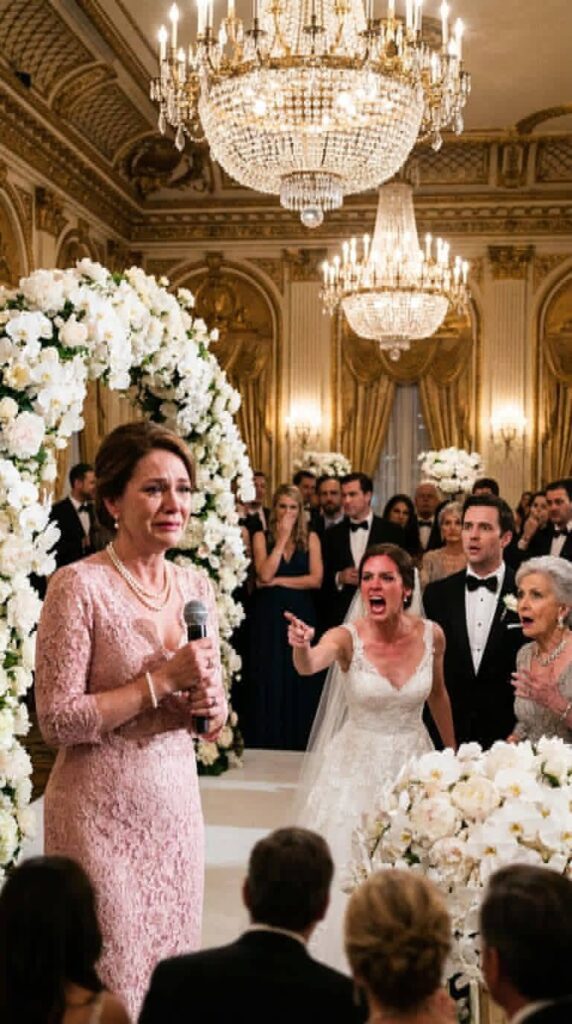
“I’m not a maid,” I said, my voice steady, ringing with a cold authority I didn’t know I possessed. “I’m not a Duchess. And I am certainly not a charity case.”
I turned away from her and faced the sea of wide-eyed guests, locking eyes with Eleanor and Arthur Harrington, who were staring at me as if I were a ghost.
“My name is Sarah Miller,” I continued, the words pouring out of me like a dam breaking. “I am the woman who sold her only home—the house my late husband built with his bare hands—to pay for this resort. I now sleep in a $40-a-night motel off the interstate, just so this ‘Princess’ could afford the dress she is currently wearing to lie to every single one of you.”
The silence that followed was absolute. It was the heavy, suffocating silence of a vacuum.
I reached into my apron, pulled out the crumpled “Sold” sign, and dropped it onto the pristine white tablecloth of the head table. Then, I pulled the prenuptial agreement from my pocket and dropped it right next to Arthur Harrington’s plate.
“She forged my signature on your legal documents,” I said, looking directly at the patriarch. “She legally declared me dead so you wouldn’t find out she comes from a bakery in Dayton, Ohio.”
Arthur Harrington didn’t yell. He didn’t gasp. He slowly picked up the document, his face turning a deep, dangerous, mottled shade of purple. He read the signature, looked at Tiffany, and then looked at his son, who was staring at his new bride as if she were a monster.
Arthur stood up, his massive frame casting a long shadow over the table.
“Julian,” Arthur commanded, his voice deadly quiet but carrying across the dead-silent room. “Call the lawyers. The marriage isn’t even an hour old, and it’s already built on a felony.”
The implosion was instantaneous and utterly chaotic.
The Harrington family moved as a single, furious unit. Eleanor didn’t even look back as she grabbed her sable coat. Julian stood up, his face pale and sickened. He didn’t yell. He simply slid the platinum wedding band off his finger, dropped it onto the “Sold” sign I had left on the table, and walked out the side doors without uttering a single syllable to the woman he had just married.
The elite guests, smelling the blood in the water, began a rapid, murmuring exodus, scrambling for the valet stand to distance themselves from the radioactive fallout of the social disaster of the decade.
Within twenty minutes, the grand ballroom was a graveyard of half-eaten truffles and abandoned champagne glasses.
Tiffany was on her knees in the center of the empty dance floor, the white silk of her dress pooling around her like spilled milk. The caterers, realizing the check was going to bounce, were already mercilessly packing up the silver chafing dishes.
“You ruined it!” Tiffany screamed at me, her voice cracking, her makeup running down her face in ugly, black streaks. “I was almost one of them! You ruined my life!”
I stood over her. I didn’t feel anger anymore. I didn’t feel the crushing weight of betrayal. I just felt an overwhelming, profound pity for the hollow shell of a person sobbing on the floor.
“No, Tiffany,” I said quietly, the echoes of my voice bouncing off the high ceilings. “You were never one of them. You were just a girl pretending to be a queen while your mother was a slave. You built a castle on quicksand, and you’re angry at me because I refused to drown in it with you.”
I reached behind my back, untied the strings of the cheap polyester apron, and let it flutter to the floor next to her.
“I’m retiring from the job today,” I whispered.
I turned around and walked out the grand front doors of the St. Regis. I didn’t look back. As I stepped out into the freezing, biting Aspen night, I realized I had absolutely nothing. No house, no savings, no family. But as the icy wind hit my face, I took a deep, shuddering breath, and for the first time in three years, the air tasted sweet. I was finally, completely free.
I walked down the long, winding driveway toward the main road to wait at the public bus stop. My feet ached in the clunky maid shoes, but my posture was straight.
As I stood shivering under the dim streetlamp, a sleek, black town car pulled up to the curb. The tinted window rolled down. It wasn’t the Harringtons.
It was Mr. Henderson, the guest from the bakery. He looked at me for a long moment, a sad, understanding smile on his face. He reached out and handed me a thick, embossed card.
“My firm develops commercial real estate in Denver,” he said softly. “We’re always looking for people who know the value of hard work and honest hospitality. When you’re ready, Sarah. Give me a call.”
Time doesn’t just heal wounds; it builds new foundations over the scars.
A year later, the biting cold of Aspen was a lifetime away. I was standing in the warm, yeasty air of my own kitchen in Denver. It wasn’t a mansion, and it wasn’t the house my husband built. It was a small, cozy apartment above Sarah’s Hearth, the boutique catering business I had launched with a small business loan and a glowing character reference from a prominent real estate developer named Henderson.
I was wiping down the stainless-steel counters, the smell of cinnamon and roasting thyme clinging to my clothes—not as a maid, but as an owner.
The sharp ring of the wall phone broke the quiet hum of the evening. I picked up the receiver, wiping flour off my cheek.
“You have a collect call from an inmate at the Arapahoe County Detention Center,” the automated, sterile voice announced. “To accept, press one.”
Then, I heard her voice. Faint, panicked, and stripped of all its manufactured aristocracy.
“Mom? Mom, please, it’s Tiffany. The Harringtons pushed the fraud charges. I need bail money, please, I have nowhere else to go…”
I stood there in the warm light of my bakery. My hand hovered over the keypad. A year ago, I would have burned the world down to save her. I would have found a way to bleed myself dry again.
I looked up at the wall above the register. There was a framed photograph hanging there. It wasn’t a picture from a million-dollar wedding. It was an old, faded Polaroid of me as a young woman, twenty-two years old, standing on a porch with dirt on my jeans, proudly holding up the keys to my very first house.
I took a slow, steady breath. With a calm hand, I pressed the button to disconnect the call.
“I paid for your wedding, Tiffany,” I whispered into the quiet hum of the empty room, the dial tone buzzing softly in my ear. “But I’m keeping my life.”
I hung up the phone, locked the front door of the bakery, and stepped out onto the bustling Denver street. The evening air was cool, but it held the promise of spring. As I walked the two blocks toward my apartment, I passed a small neighborhood park. A young girl was chasing her mother through the grass, both of them breathless with genuine, unbought laughter.
I smiled, my hand instinctively slipping into the pocket of my coat. My fingers brushed against a small, worn piece of cardboard I still carried—the “Sold” sign. It was no longer a symbol of my defeat; it was the ticket that had bought my freedom.
I didn’t need a twenty-thousand-dollar silk gown. I didn’t need to be royalty to be a queen of my own domain. I turned the corner, heading toward my new life, where the sun was finally rising on a truth I no longer had to hide.
If you want more stories like this, or if you’d like to share your thoughts about what you would have done in my situation, I’d love to hear from you. Your perspective helps these stories reach more people, so don’t be shy about commenting or sharing.