
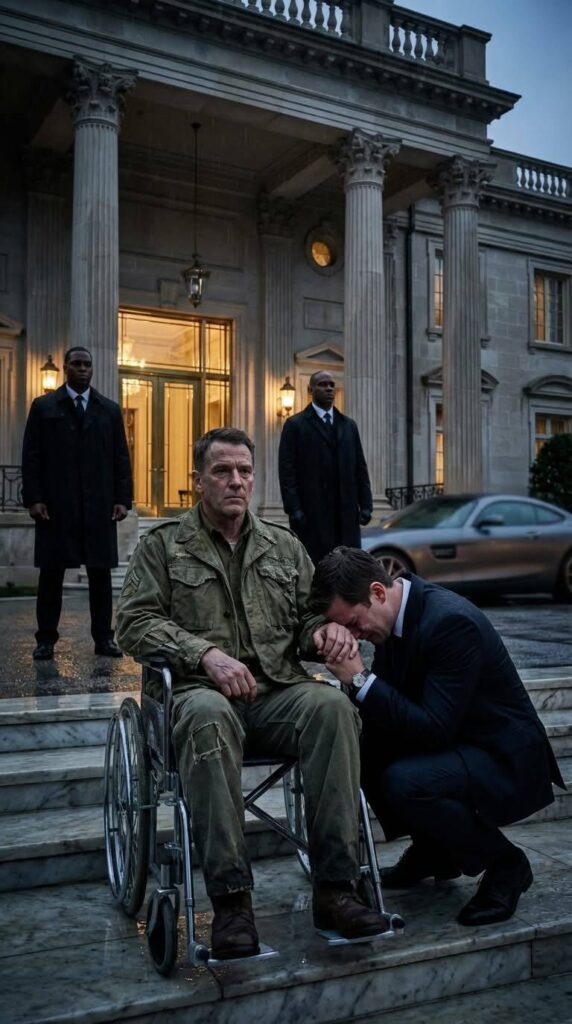
The scent of aviation fuel and stale coffee had seeped so deeply into my skin that I thought I’d never wash it out. It was a familiar smell, the aroma of transit, of leaving one violent corner of the world for another. But this time, the transit was supposed to end. I stood at the edge of the winding, rain-slicked road in the hills of Seattle, the straps of my canvas sea bag biting into my shoulder. Inside that olive-drab cylinder was everything I owned after ten years of continuous deployments with Special Operations. Outside of it was a world that had kept spinning without me.
My boots, scarred by the unforgiving gravel of Kandahar and stained with the stubborn mud of Eastern Europe, crunched against the pristine, crushed-pearl driveway of the Sterling Estate. It wasn’t just a house; it was a fortress of glass, steel, and hyper-modern arrogance. This was what my brother, Bradley, had built while I was gone. While I was burying men I loved and missing the funerals of our own parents, Bradley was coding his way to the top of the defense tech food chain. I wasn’t here for a handout. I was here because the house we grew up in was gone, our parents were in the ground, and he was the only blood I had left.
Promoted Content
I approached the obsidian gates. They towered over me, sleek and featureless, save for a glowing intercom panel. I pressed the silver button, my heart thumping with a strange, uncomfortable vulnerability. I’d breached compounds under heavy fire with a steadier pulse.
“Bradley, it’s Jax. I’m home.”
There was a long, suffocating silence. The only sound was the low, electric hum of the perimeter fence and the drizzle hitting the shoulders of my faded uniform. My jacket wasn’t worn out from neglect; it was a map of my history. The frayed edges of the cuffs, the faded combat patches, the microscopic dust of distant lands woven into the fabric—it was the attire of a ghost trying to rejoin the living.
Finally, a cold, synthesized voice crackled through the speaker. “The CEO is in a board meeting. Deliveries go to the side entrance, Sergeant.”
I closed my eyes for a fraction of a second, swallowing the bile that rose in my throat. “It’s not a delivery, Bradley. It’s your brother,” I replied, keeping my voice level, though the ache in my chest was suddenly sharper than shrapnel.
The heavy gates groaned, then slid open with a hydraulic hiss. It wasn’t a gesture of welcome. It felt more like the jaws of a predator unhinging. I walked up the sweeping driveway, the rain intensifying. As I reached the sweeping marble porch, the massive oak front door swung wide.
Bradley stepped out. He was flanked by two security guards whose tailored charcoal suits likely cost more than a soldier’s annual hazard pay. My brother looked completely foreign to me. He was immaculately groomed, his skin carrying the expensive, artificial tan of someone who vacationed in private villas. He didn’t rush down the steps. He didn’t smile. He didn’t open his arms to the brother who had just spent a decade in the dark.
Instead, he casually lifted his wrist, checking the face of a heavy rose-gold Patek Philippe, and sighed. It was a sigh of profound inconvenience, as if I were nothing more than a lingering, unsightly stain on his immaculate property. I took a step up the stairs, a tentative smile finally breaking across my tired face, ready to close the distance.
Bradley’s hand shot up, palm out, stopping me dead in my tracks. A look of genuine, visceral revulsion twisted his features as his eyes locked onto a thick streak of black helicopter grease smudged across the canvas of my rucksack.
“Look at you,” Bradley sneered, the words slipping from his mouth like poison. He didn’t even look me in the eye; he was too busy inspecting the scuffs on my boots. “Ten years. You spent a decade playing soldier in the dirt while I built an empire. You’re a loser, Jax.”
The rain drummed a steady, cold rhythm against the glass awning above us. I shifted my weight, letting the heavy sea bag slide off my shoulder and hit the marble with a dull, heavy thud. Playing soldier. The phrase echoed in my skull, bringing with it the phantom sounds of rotor wash and the metallic snap of incoming fire.
“You wasted the best years of your life for a government paycheck that couldn’t even buy the laces on my shoes,” he continued, stepping closer to the edge of the porch, looking down at me from his elevated position.
I didn’t flinch. I let the insult wash over me, relying on the internal discipline that had kept me alive. Observe. Orient. Decide. Act. My OODA loop spun silently in the background. I observed the arrogance in his posture, the tension in the guards’ shoulders, the absolute absence of brotherly affection. I oriented myself to the reality that the boy I grew up with was dead, replaced by a sociopath in a bespoke suit.
“I wasn’t playing, Bradley,” I said, my voice barely above a whisper, yet carrying enough weight to cut through the sound of the rain. “I was ensuring guys like you could sleep safely enough to build those empires.”
Bradley laughed. It wasn’t a sound of amusement; it was sharp, metallic, and entirely devoid of warmth. He reached into the breast pocket of his jacket and withdrew a slender Italian leather wallet. With practiced, deliberate slowness, he pulled out a crisp, uncirculated twenty-dollar bill. He pinched it between his index and middle finger, holding it out over the stairs.
Then, he flicked his wrist.
The bill caught the damp breeze. It fluttered through the cold air, a slow, humiliating descent, until it landed face down in a small puddle of muddy water near the toe of my combat boot.
“Here,” Bradley said, his voice dripping with absolute contempt. “For your service. Go find a shelter or a dive bar downtown. Just stay away from my gates. You’re bad for the brand.”
I stared at the bill. The water was slowly seeping into the paper, darkening the green ink. A profound, icy calm settled over me. It was the same terrifyingly still clarity that descends right before a breach, that quiet pocket of time where fear evaporates and only the objective remains. Bradley thought he was untouchable. He looked at my faded uniform and saw a beggar. He couldn’t see the invisible stars resting on my shoulders.
I bent down slowly, my joints popping in protest, and pinched the corner of the wet twenty. I stood up back up, to my full height, and smoothed the bill flat against my palm. I looked up at him, my expression entirely void of anger, which seemed to unnerve one of the guards who subtly shifted his hand toward his waistband.
“You shouldn’t have done that, Bradley,” I said, my tone clinically detached. I pulled my encrypted satellite phone from my breast pocket. “I was going to let you keep the contract.”
The smirk on Bradley’s face faltered for a fraction of a second before roaring back to life. “Contract? What are you talking about, you psycho? The landscaping?”
I didn’t answer him. I didn’t need to. The man standing on the porch thought I was just a washed-out sergeant dragging my knuckles back into civilian life. He had no idea that my last four years weren’t spent kicking down doors in the sandbox. They were spent in the subterranean, windowless rooms of the Pentagon. I was the senior liaison for the Department of Defense’s Future Combat Systems initiative. I was the bridge between the operators who bled in the field and the technology that kept them alive.
I bypassed the commercial network entirely, hitting a three-digit speed-dial code that routed through a secure satellite link. The line clicked twice before a gruff voice answered.
“Vance.”
“General Vance, this is Sterling,” I said, keeping my eyes locked on my brother.
“Jaxson. Good to hear your voice, son. You at the site?”
“I am, sir. Regarding the five-hundred-million-dollar Aegis-X defense contract for Sterling Tech…” I paused, letting the silence stretch just long enough for Bradley’s brow to furrow in confusion. “…cancel it.”
Through the phone, I heard the scratch of a pen stopping. “Excuse me, Jax? We’re finalizing the ink tomorrow.”
“Re-route the tender to Northrup or Lockheed, sir. Whichever can spool up faster.”
“Give me a reason, Sterling.”
“It’s a matter of national security, General. I’ve just conducted my final on-site evaluation of the CEO. He lacks the character, the stability, and the fundamental respect required for a top-secret partnership with the Department of Defense. He’s a liability to our men. Terminate the agreement immediately. Full revocation.”
There was a heavy sigh on the other end, followed by the sound of a file snapping shut. “Consider it dead. Good work, Jaxson. Come home.”
I ended the call and slipped the phone back into my pocket.
For three seconds, nothing happened. The rain continued to fall. Bradley stared at me, opening his mouth to speak, to mock me for what he assumed was a pathetic, theatrical bluff.
Then, the invisible storm made landfall.
Inside the cavernous, glass-walled foyer behind Bradley, a phone began to ring. Then another. Suddenly, the entire mansion seemed to vibrate. Bradley’s own smartwatch lit up like a distress beacon, vibrating furiously against his wrist. One of the security guards touched his earpiece, his eyes widening in sudden, naked panic.
The heavy mahogany doors behind them burst open, and a frantic man in a tailored suit—presumably Bradley’s Chief Operating Officer—sprinted out onto the porch, clutching a tablet as if it were a live grenade.
“Sir!” the man screamed, his voice cracking with hysteria, completely ignoring my presence. “The Pentagon just pulled the Aegis contract! They triggered the morality clause! The system is locking us out of the DoD servers!”
Bradley blinked, the color draining from his face so fast he looked as if he were going into shock. “What? No, that’s impossible. Call them back!”
“I can’t!” the COO yelled, shoving the tablet toward Bradley. “The news just hit the Bloomberg terminal. Our stock is in free-fall! We’re down thirty percent in ninety seconds! The primary investors are on line one, two, and three, and they are demanding an emergency exit!”
Bradley stood frozen on his multi-million dollar porch. The empire he had built, the fortress of wealth he believed made him a god, had just been vaporized by a single voice command. He slowly turned his head, his panicked eyes finally meeting mine. I was still standing in the rain, perfectly still, holding his wet twenty-dollar bill.
“What…” Bradley stammers, his voice a hollow, terrified rasp. “What did you just do?”
“I did my job,” I replied, my voice slicing through the chaotic shouting of the COO and the incessant buzzing of electronics.
The realization hit Bradley like a physical blow. The delusion of his invincibility shattered. With a guttural roar that sounded more like a wounded animal than a tech mogul, he lunged forward, bounding down the marble steps toward me, his hands curled into fists.
“You ruined me!” he screamed, his face twisted into a mask of pure, unadulterated fury. “That was five years of development! Five years of my life! You can’t do this to me!”
He didn’t make it to the bottom step.
The two security guards, the men Bradley paid to protect him from the world, moved with the sudden, violent efficiency of men who knew exactly how to handle a threat. They intercepted Bradley, grabbing him by the shoulders and slamming him back against the stone balustrade.
“Hey! Get your hands off me! I pay you!” Bradley shrieked, struggling futilely against their grip.
The guard on the left, a man with a thick neck and a faded tattoo peaking out from his collar, didn’t look at Bradley. He was looking at me. More specifically, he was looking at the small, dull metal badge pinned above the left breast pocket of my faded uniform—the Combat Infantryman Badge with a star in the wreath. He recognized it. He recognized what it cost to earn it.
“Stand down, Mr. Sterling,” the guard growled at Bradley, his tone shifting from subservient to authoritative. They had chosen a side without a single order being given.
I didn’t move an inch. I stood like a statue of granite in the driveway, letting Bradley exhaust himself against the hold of his own men.
“I didn’t ruin you, Bradley,” I said, walking up the remaining steps until I was eye-to-eye with him. “Your arrogance did.”
“It’s just code!” he pleaded, the anger suddenly collapsing into desperate bargaining. “It’s the best code in the world! What does it matter how I treat you? It’s business!”
“You told me my paycheck couldn’t buy your shoes,” I said softly, looking down at his expensive Italian loafers. “Well, your shoes just cost you half a billion dollars.”
I leaned in closer, dropping my voice so only he could hear. “You see, the Department of Defense doesn’t just buy code. They buy trust. They buy ‘vetted leadership’. If a man doesn’t respect the uniform, if he views the people bleeding for this country as ‘losers’ beneath his notice… he cannot be trusted to build the digital armor that protects them. I just gave you a failing grade, little brother.”
Bradley sagged against the stone, his breath coming in ragged, shallow gasps. The fight had completely left him. The billionaire was gone; in his place was just a terrified boy who realized he had bullied the wrong ghost.
Through the pouring rain, the heavy roar of a high-performance engine cut through the tension. A black, up-armored government SUV screeched to a halt at the gates. The heavy doors swung open, and two men in dark tactical gear stepped out into the weather.
Bradley’s eyes darted toward them, a flicker of desperate hope crossing his pale face. He thought they were there for me. He thought the authorities had arrived to arrest the crazy veteran trespassing on his property.
The two operators jogged up the driveway, ignoring Bradley entirely. They stopped three feet from me, snapped their heels together, and delivered a razor-sharp salute.
“Sir,” the lead operator said, his voice ringing with absolute respect. “The General is waiting at the airfield for your final debrief. Wheels up in thirty.”
Six months later, the Seattle rain had finally given way to a crisp, biting winter chill. I sat in the back of a government SUV, the tinted windows shielding me from the grey overcast sky. I looked out at the city skyline—a city I had sworn to protect, filled with people who would never know my name.
“Pull over here,” I told the driver.
The heavy vehicle glided to a stop against the curb across from the downtown Greyhound station. It was a bleak, concrete structure, a magnet for the lost, the broke, and the desperate.
I rolled down the window, letting the cold air flood the leather interior. Through the throngs of tired travelers and idling buses, I spotted him.
He was sitting on a rusted metal bench, his shoulders hunched, his head resting heavily in his hands. He was wearing a plain, slightly worn jacket. Beside him sat a single, scuffed rolling suitcase. It was Bradley.
The fallout had been biblical. When the Aegis contract was pulled, the house of cards collapsed. The investors fled, the board ousted him in a desperate attempt to save the company, and the creditors swooped in to pick the bones clean. The glass mansion in the hills was gone, seized by the banks. The cars, the watches, the friends who only valued him for his net worth—evaporated. The ’empire’ was now nothing more than a cautionary case study in corporate hubris taught in business schools.
I watched him for a long time. I didn’t feel a surge of vindictive joy. There was no triumphant smirk on my face. Looking at my brother, stripped of his armor of wealth, I only felt a profound, heavy sadness for what could have been. For the family we should have been.
After leaving Bradley’s house that day, I was offered seven-figure consulting gigs from every rival tech firm that scooped up the Aegis crumbs. I turned them all down. I chose to remain in public service, taking a role that allowed me to route federal funding toward veteran-owned startups and rehabilitation programs. I didn’t want a payday. I wanted to build something real.
I opened the door of the SUV and stepped out onto the sidewalk. I walked across the street, the collar of my dark wool peacoat turned up against the wind. I stopped right in front of him.
Bradley slowly raised his head. His eyes were bloodshot, the artificial tan long gone, replaced by the pallor of a man who hadn’t slept a full night in months. He looked up at me, blinking as if I were a mirage. He didn’t speak. He didn’t have the energy left for anger.
I reached into my pocket and pulled out the crisp, green paper. I had dried it out and kept it folded in my wallet for half a year. I held the twenty-dollar bill out toward him.
“You’re going to need this for the bus, Bradley,” I said quietly.
He stared at the money, his hands trembling slightly as he reached out and took it.
“Keep the change,” I added, my voice devoid of malice. “It’s more than you gave me. It’s a second chance. Use it to learn what respect actually looks like.”
I turned my back on him and began walking back across the street toward the waiting SUV. I didn’t look back. But as I reached for the door handle, I knew what was happening behind me. As the diesel engine of his bus roared to life, Bradley would flip that twenty-dollar bill over.
On the back, written in thick black marker, was a phone number for a veteran-run heavy construction company down in Oregon that I had personally vetted. Next to the number, I had written: “Call them when you’re ready to actually work.” But more importantly, securely taped to the center of the bill with a square of black Gaffers tape, was a small, encrypted micro-flash drive containing the core architectural framework of his Aegis code—the only copy that hadn’t been seized or destroyed. It was his life’s work.
The grass at Arlington was damp beneath my polished dress shoes. The cemetery was vast, a rolling sea of white marble markers standing in silent, perfect formation. It was a place of ghosts, of history, and of profound peace.
I stood before my father’s grave, the wind gently rustling the bare branches of the oak trees above. I wasn’t wearing my faded uniform today. I was wearing a new suit—not an arrogant, bespoke Italian cut meant to intimidate, but a simple, dignified, dark navy suit befitting a man who had finally found his footing in the civilian world.
I knelt down, the dampness seeping into the knee of my trousers, and placed a small, vibrant American flag into the earth beside the headstone. I brushed a stray leaf from the carved letters of his name.
“I’m back, Dad,” I whispered, the words catching slightly in my throat. “I kept the name clean.”
I stood up, taking a deep breath of the cold, crisp air. For the first time in a decade, my shoulders didn’t ache with the phantom weight of a rucksack or a rifle plate. I realized then that Bradley, in his cruelest moment, had been right about one thing: the uniform was worn out. It had served its purpose. But the man inside it was stronger, sharper, and more resolved than he had ever been.
My phone buzzed in my inside pocket. I pulled it out. It was a text message from a young private I had mentored years ago, a kid who had lost a leg in Helmand and thought his life was over. Just got the acceptance letter to engineering school, Jax. Thanks for the recommendation. I owe you my life.
I smiled, a genuine, warm smile that reached my eyes. I typed back a quick congratulations and pocketed the phone. Wealth wasn’t a number on a digital bank screen. It wasn’t a glass mansion or a Patek watch. Wealth was the lives you managed to pull from the wreckage. Honor was the only currency that never devalued.
As I turned away from the grave and began the long walk back toward the parking lot, the late afternoon sun broke through the clouds, casting long shadows across the stones. I approached my unmarked government sedan and reached for the door handle.
For a split second, I caught my reflection in the tinted glass of the window. But it wasn’t the man in the suit looking back at me. It was a shadow of my younger self, standing there in that first, dust-covered, blood-stained uniform, his eyes fierce and unyielding.
I blinked, and the ghost was gone, replaced by the man I am now. The past was finally at rest. The twenty-dollar lesson had been taught and paid for. I opened the door and slid into the driver’s seat, ready to go home to a quiet apartment and a civilian life.
But as I put the key in the ignition, the encrypted satellite phone deep in my breast pocket—a phone that had been silent for six months—suddenly began to vibrate. I pulled it out, staring at the flashing red light indicating a Priority One secure channel. I hit the button and raised it to my ear.
“Sterling,” General Vance’s voice echoed through the earpiece, devoid of pleasantries, heavy with a grim urgency. “I know you’re out. But we have a situation. A breach in the new grid. We need a ghost, Jaxson. One last time.”
I stared out the windshield at the endless rows of white marble, the engine of the car humming softly beneath me.
If you want more stories like this, or if you’d like to share your thoughts about what you would have done in my situation, I’d love to hear from you. Your perspective helps these stories reach more people, so don’t be shy about commenting or sharing.