
The sound that woke me at 5:12 a.m. was not a knock—it was the kind of pounding that makes your heart drop before your mind can catch up.
For a second, I couldn’t breathe.
My daughter, Lila, stirred behind me, still wrapped in sleep, her voice soft and uncertain as she whispered, “Mom… what’s happening?”
I didn’t answer.
Because my mind had already gone somewhere dark.
Lila is everything I have.
I had her when I was eighteen, at a time when my own parents believed I had destroyed my future. They cared about reputation, about appearances, about what people would say—and when I refused to give up my child, they chose distance over love.
That was the night I left their house for good.
Since then, life had been anything but easy. Cheap apartments, long shifts, exhaustion that never quite left. I worked wherever I could—serving food in the mornings, cleaning offices at night—doing whatever it took to keep us afloat.
But somehow, through all of that, Lila grew into someone softer than the world we lived in.
She noticed things most people ignored.
She remembered people others had already forgotten.
And last weekend, she came home with an idea that sounded impossible.
“I want to bake,” she said.
“That’s not new,” I told her.
“A lot,” she added.
“How much is a lot?”
She looked at me seriously.
“Forty pies.”
I laughed at first.
She didn’t.

She told me about the nursing home.
About a woman who hadn’t tasted homemade dessert in years.
About a man who used to eat apple pie every Sunday when his wife was still alive.
And then she said something that stopped me.
“It makes people feel remembered.”
I should have said no.
We didn’t have the money, the space, or the time for something like that.
But she had already thought it through—prices, ingredients, even borrowing pie tins from a neighbor.
And in the end, I gave in.
Not because it made sense.
But because she meant it.
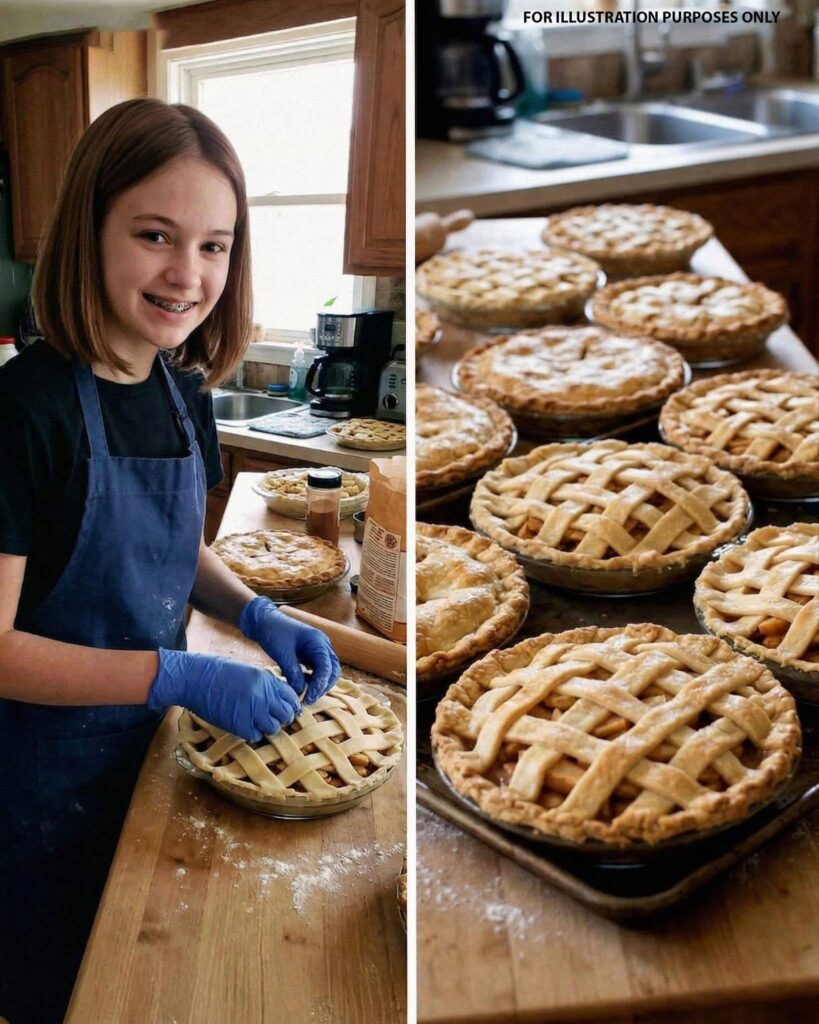
That Saturday, our kitchen turned into chaos.
Flour covered every surface. Apples piled up faster than we could slice them. Cinnamon lingered in the air so strongly it felt like we were breathing it.
At one point, I told her, “Next time, write a card instead.”
She laughed and kept working.
Then, for a moment, she grew quiet.
“Do you think people feel invisible?” she asked.
I paused.
“What do you mean?”
She shrugged slightly.
“Everyone talks about kids needing attention. But older people do too. Sometimes I think people stop seeing them like they still matter.”
I didn’t have an easy answer.
So I just said the truth.
“Yeah… I think that happens.”
Promoted Conten
She nodded, then went back to rolling dough.
“I don’t want that to happen around me.”
When we arrived at the nursing home with trays of pies, the reaction was immediate.
Not just surprise.
Something deeper.
People turned when they smelled it. Faces lifted. Conversations paused.
And then Lila did something that mattered more than the pies.
She stayed.
She asked names.
She listened.
She treated each person like they were still fully there—not just present, but important.
One man took a bite of apple pie, closed his eyes, and said quietly that he hadn’t tasted anything like it since his wife passed away.
Lila didn’t rush him.
She just held his hand.
And in that moment, I realized this was never about baking.
It was about being seen.

The next morning, the pounding on our door pulled me out of sleep.
Two police officers stood outside.
Armed.
My body went cold instantly.
Every worst-case scenario ran through my mind at once.
Had someone gotten sick?
Had we done something wrong?
Had kindness somehow turned into trouble?
I opened the door carefully, my voice tight.
“Yes?”
The officer asked for my name. Then she asked if Lila was home.
My heart dropped.
And then she said the words that nearly broke me:
“We need to talk about what your daughter did yesterday.”
For a moment, I couldn’t think.
I looked back at Lila, who stood behind me, terrified.
I invited them in, bracing for whatever was coming.
But the officer’s expression softened almost immediately.
“No one is in trouble,” she said.
I blinked.
“What?”
She repeated it, slower this time.
“No one is in trouble.”
The tension didn’t leave right away.
It shifted.
Confusion replaced fear.
Then she explained.
Photos from the nursing home had spread online. Families had shared them. People had called, written, reacted in ways no one expected.
One man had called his granddaughter in tears.
A local organization had seen the story.
The mayor’s office had heard.
And suddenly, something small had become something much bigger.
“They want to honor her,” the officer said.
Lila stared.
“Because of pie?”
The officer smiled.
“Because of what those pies meant.”
Then she added something that stayed with me.
“The man you spoke to… Arthur? He said your daughter didn’t just bring dessert. She gave people a piece of themselves back.”
That’s when I broke.
Not quietly.
Not gracefully.
But completely.
Because all that fear—the kind I had learned to carry for years—had nowhere left to go.
That evening, we stood in a crowded room filled with people I didn’t know.
Lila squeezed my hand, nervous.
“Come with me if I get scared,” she whispered.
So I did.
When they called her name, she hesitated.
Then she walked forward anyway.
Arthur spoke first.
He talked about what it feels like to grow older and slowly become invisible. About how people begin to treat you efficiently, kindly even, but without truly seeing who you are anymore.
Then he looked at Lila.
“This girl,” he said, “reminded us we still matter.”
The room went silent.
And then it filled with something heavier than applause.
Recognition.
That’s when I saw them.
My parents.
Standing in the back.
Watching.
They came forward afterward, careful, polite, choosing their words.
“We’re proud,” my father said.
Lila looked at him calmly.
“You don’t get to be proud only when it’s easy,” she replied.
No anger.
Just truth.
And for the first time, I realized something.
She wasn’t just kind.
She was strong.
In a way I had spent years trying to become.

That night, back in our small apartment, the scent of cinnamon still lingered in the air.
Lila dropped into a chair and laughed softly.
“It was just pie,” she said.
I looked at her.
“No,” I replied.
“It was love.”
She smiled, thinking for a moment, then asked:
“So… next weekend? Fifty pies?”
I stared at her.
Then I shook my head, smiling.
“Let’s start with twenty.”
Because sometimes, the smallest acts don’t stay small.
Sometimes, they travel farther than we expect, reach deeper than we intend, and remind people of something they thought they had already lost.
And sometimes—the thing you fear the most when someone knocks on your door…
turns out to be the moment you realize you raised someone who makes the world a little less invisible.