
Chapter 1: The Architecture of a Storm
My name is Hannah Carter, and the exact moment my life fractured into two irreconcilable timelines occurred on the shoulder of a flooded interstate. There is the before: the timeline where I was the obedient, bleeding daughter who foolishly believed a shared bloodline guaranteed a sanctuary. And then there is the after: the timeline where I learned, through the harsh tutelage of torn skin and freezing rain, that the people who gave you life can become your executioners faster than strangers on a street.
Even now, years removed from the wreckage, the visceral memory of that drive home from St. Jude’s Maternity Ward plays in my mind with terrifying, high-definition clarity. Trauma, I have learned, is a meticulous archivist. It preserves the worst moments of your life in amber.
The afternoon had begun with a deceptive, misting drizzle as we navigated out of the hospital parking deck. By the time my sister, Vanessa, steered her pristine, leather-scented Range Rover onto the highway, the sky had bruised into a violent, bruised purple. It felt as though a heavy, theatrical curtain had been violently yanked across the sun. Sheets of water battered the windshield, reducing the world outside to a smeared watercolor of brake lights and gray asphalt.
Vanessa’s knuckles were bone-white as she strangled the steering wheel. Every few seconds, she leaned forward, her chest almost touching the dashboard, as if squinting aggressively enough might somehow bully the storm into submission.
I was wedged in the back seat, pinned between the two rear-facing infant carriers holding my three-day-old twins, Emma and Lucas. They were entirely oblivious to the atmospheric violence outside the glass, and blissfully ignorant of the far more dangerous pressure system building inside the cabin. Every pothole we hit sent a jagged, white-hot spike of agony radiating through my lower abdomen. My body was still a fragile, healing ruin from the emergency C-section, the surgical staples pulling with sickening tension every time the chassis swayed. But the physical pain was a distant, muted static compared to the overwhelming, fierce relief of simply having my babies close enough to touch.
My mother sat rigidly in the passenger seat. She had not directed a single syllable my way since I signed the final divorce decree two weeks prior, right before my water broke.
Beside me, pressed so firmly against the rear door he looked like he was trying to merge with the upholstery, was my father. He kept his face angled toward the blurring trees, maintaining a deliberate physical quarantine from me, as if the profound embarrassment he believed I had dragged into our aristocratic family was an airborne contagion.
The silence inside that luxury SUV was a physical weight. It was suffocating. I tried to anchor my sanity to my children. I stared at Emma’s translucent, fluttering eyelids. I listened to the microscopic, rhythmic hitch of Lucas’s breathing. The miraculous, undeniable fact was that despite the hellscape of the preceding twelve months, they had survived. They were breathing.
Extracting myself from my marriage to Kenneth had been the most terrifying excavation of my life. But it was the only way I was going to survive to see thirty.
Kenneth’s explosive temper had steadily escalated from a simmer to a boil over our three-year marriage. The deterioration was insidious. It began with sharp, belittling critiques about my career as a graphic designer, which eventually mutated into shattered dinner plates, and finally escalated into something profoundly dark. Something physical. I had become a master of wearing long-sleeved silk blouses in July and whispering quiet, practiced apologies for walking into doorframes.
When I finally orchestrated my escape, I naively assumed my parents would become my fortress. I laid the evidence bare on their antique dining table. I presented the sterile, irrefutable medical records. I showed them the stark, high-resolution photographs of the purple and yellow fingerprints blooming across my biceps. I believed, stupidly, that empirical evidence would matter to them.
I was catastrophically wrong.
In the manicured, country-club ecosystem my parents inhabited, optics were the only religion. A fractured marriage was a cardinal sin. A daughter who opted for the perceived vulgarity of a divorce court over suffering in dignified silence was a spectacular, unforgivable disgrace.
“Mom,” I whispered into the heavy air, desperate to puncture the suffocating vacuum of the car. We had been driving in absolute silence for ten miles. “Thank you for coming to get us. I know the weather is awful.”
The syllables had barely cleared my teeth before she verbally decapitated me.
“Don’t.” Her voice sliced through the humid air of the car like a scalpel. “Don’t you dare sit there and thank me for cleaning up your pathetic mess.”
From the driver’s seat, Vanessa let out a low, derisive snort. Vanessa had been the anointed golden child since birth. She possessed the flawless collegiate record, the appropriately wealthy corporate lawyer husband, and the sprawling suburban estate that looked practically plagiarized from Architectural Digest. For nine months of my pregnancy, she had treated my existence like a foul odor she was forced to endure.
“It wasn’t a mess, Mom,” I replied, my voice trembling but finding its footing. “Kenneth was a monster. You know exactly what he did. You saw the emergency room reports.”
My father finally spoke, his voice drifting from the window, sounding hollow and utterly detached. “Every union experiences marital friction, Hannah. You simply threw in the towel. You refused to put in the necessary work.”
A hot, stinging pressure built behind my eyes, but I blinked furiously, staring at the ceiling to force the tears back. Marital friction. Putting in the “work” would not have magically paralyzed Kenneth’s closed fists. Leaning in and trying harder would not have unlocked the master bedroom door on the nights he trapped me inside, screaming slurs through the drywall. But my parents had already selected their preferred narrative, and reality was not invited to the table.
The storm outside intensified, the rain now sounding like buckets of gravel being emptied onto the roof. Emma shifted in her padded seat, letting out a thin, distressed mewl. I reached out, threading my index finger into her tiny palm until her grip tightened and she settled.
“So, where exactly are you planning to squat now?” Vanessa inquired, her tone masquerading as casual conversation, though the venom beneath it was palpable. “Crawling back to that depressing little concrete box Kenneth let you keep?”
“I’ll figure the logistics out,” I answered defensively. “I always manage.”
“You have single-handedly brought shame down upon this entire lineage,” my mother snapped, twisting her torso to glare at me over the console. Her eyes were devoid of any maternal warmth; they looked like two flat, frozen stones. “Do you comprehend the magnitude of this? The entire congregation knows. The neighborhood association knows. Your father’s equity partners are whispering about it. They all know my daughter lacked the basic fortitude to keep a husband satisfied.”
“Our daughter, the quitter,” my father muttered bitterly. “Couldn’t weather a few rough patches.”
Rough patches. That was his sanitized terminology for three years of suffocating terror.
Vanessa caught my eye in the rearview mirror, her lips curling into a triumphant smirk. “At the very least, Kenneth had the class to express his profound embarrassment over your behavior.”
My stomach performed a sickening, violent drop. The blood rushed from my face. “What are you talking about?”
“He called Dad on Tuesday,” Vanessa stated, enjoying the kill. “He practically begged for our forgiveness regarding the whole situation.”
My father nodded slowly, a gesture of profound respect for my abuser. “He took it on the chin like a real man. He confessed he tried absolutely every avenue to salvage the marriage, but that you were simply too combative. Too influenced by this modern, toxic independence.”
My vocal cords paralyzed. Kenneth had played them like a cheap piano. The man who had fractured my collarbone had flawlessly manipulated my own flesh and blood into viewing him as a tragic, longsuffering martyr.
The rain was now a deafening roar, matching the frantic, hammering rhythm of my pulse against my throat.
“Stop the car,” my mother commanded abruptly.
Vanessa blinked, confused. “What? Here? Mom, there’s no shoulder—”
“I said pull this damn car over right now.” Her voice had dropped an octave, achieving a terrifying, glacial calm. “I refuse to endure this a second longer.”
Vanessa hit the brakes. The heavy tires hydroplaned slightly before grabbing the gravel of the emergency shoulder. The SUV shuddered and came to a halt, the hazard lights blinking a frantic orange rhythm into the gray abyss.
My heart climbed into my throat. “Mom,” I stammered, gripping the edges of the infant carriers. “What is happening? What are you doing?”
She turned entirely around. “Get out.”
My brain short-circuited. The words processed as a foreign language. “What?”
“Unbuckle your seatbelt and get out of my sight. Now.”
I stared at her, waiting for the punchline of a sick, twisted joke. “Mom, look outside. It’s a torrential downpour. We are miles from an exit. The babies are seventy-two hours old.”
“You should have calculated the collateral damage before you humiliated this family,” she replied, her face a mask of aristocratic disgust.
“Mom, please, I’m begging you. Do whatever you want to me, but they’re just infants—”
My father suddenly leaned across the seat, his breath hot against my ear. “You made your bed when you dragged our name through the mud,” he hissed. “Now, you can drown in it.”
Before my eyes could even register the movement, his hand shot out. His thick fingers tangled violently in the roots of my hair. A sickening burst of pain exploded across my scalp as he ruthlessly yanked my head backward.
The heavy door beside him clicked and swung open, letting in the roaring wind and the freezing rain.
The engine revved. The car actually began to inch forward. Vanessa was pulling back onto the slick asphalt.
“Dad, stop! Please!” I shrieked, clawing frantically at his wrist. “My babies!”
With a guttural grunt, he shoved me with both hands.
The world violently tilted on its axis. For one horrific, suspended second, I was airborne, hovering between the luxurious leather interior of my past and the violent storm of my future.
Then, the wet pavement rushed up to meet me.
Chapter 2: The Mud and the Mercy
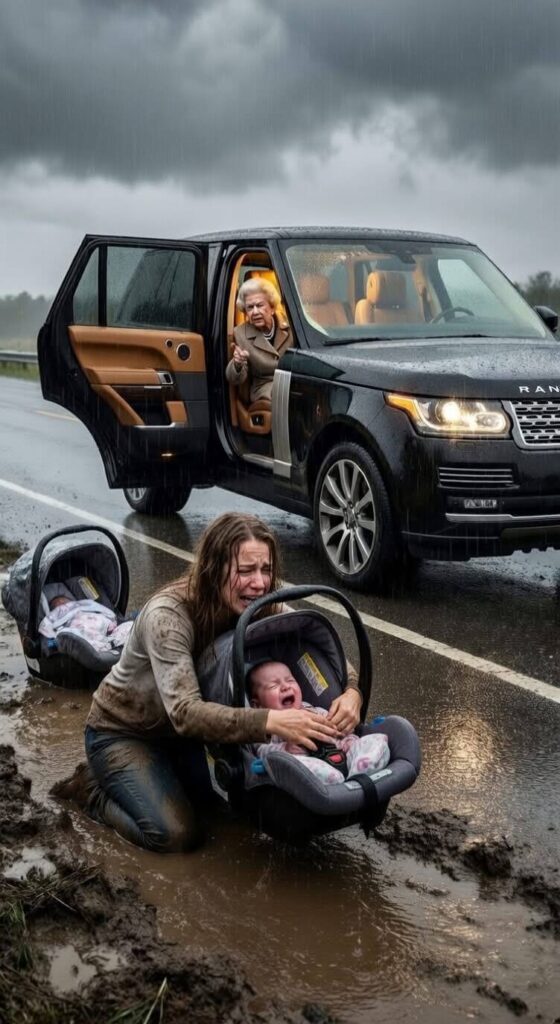
The impact was catastrophic. The asphalt knocked the oxygen entirely from my lungs, and a sharp, blinding crack echoed in my ears as my right shoulder took the brunt of the fall. The rough gravel chewed through my sweatpants, shredding the skin of my knees and thighs. The freezing rain instantly penetrated my clothes, plastering my hair to my face as I lay there in the mud, gasping like a landed fish, trying to force air back into my paralyzed diaphragm.
And then, cutting through the thunder and the roaring wind, I heard it.
Emma. She was screaming.
That high-pitched, terrified wail hit my nervous system like a defibrillator. Ignoring the searing fire in my torn abdomen and the throbbing in my shoulder, I scrambled onto my hands and knees in the muddy ditch.
The Range Rover had braked to a halt fifty feet ahead.
Through the blur of the rain, I saw my mother’s torso leaning out of the passenger window. Her manicured hands were gripping the handle of Emma’s heavy plastic car seat.
“No!” I screamed, the sound tearing my throat raw. “Don’t you dare touch her!”
My mother’s face contorted into a snarl of pure malice. “Divorced women do not deserve the privilege of motherhood!” she shrieked over the storm.
She hoisted the carrier.
Time dilated into a sickening crawl. I watched the black plastic shell, containing my three-day-old daughter, arc through the gray air. It hit the muddy embankment with a sickening, heavy thud, sliding down into the tall, wet grass. Emma’s cries escalated into sheer, breathless terror.
Before I could even push myself to my feet, the second carrier emerged from the window. Lucas’s seat followed the exact same parabolic trajectory, landing with a splash mere feet from his sister.
I threw myself forward, my feet slipping wildly on the slick gravel, pain radiating through every nerve ending in my body. I crashed to my knees beside the carriers. I frantically ripped the rain-covers back. Emma was red-faced and hyperventilating, but the reinforced shell of the seat had protected her from the impact. Lucas had startled awake and was joining his sister in a frantic chorus of panic.
I looked up, a stupid, naive ember of hope flaring in my chest as I heard a car door slam. Maybe they realized they had crossed an unforgivable line. Maybe they were coming back.
Vanessa stepped out of the driver’s side. The rain instantly ruined her expensive silk blouse, but she didn’t seem to care. She marched slowly down the shoulder toward me. For a fleeting second, looking at the sister I had shared secrets and childhood bedrooms with, I thought she was going to help me carry them.
She stopped three feet away. She looked down at me—kneeling in the mud, bleeding, shielding two screaming infants with my broken body.
She pursed her lips, gathered the saliva in her mouth, and spat directly into my face.
“You are a disgusting footnote to this family,” she whispered, her voice colder than the rain.
She pivoted on her heel, marched back to the SUV, and slammed the door. The tires squealed against the wet pavement, kicking a spray of dirty water over me as the red taillights faded into the impenetrable gray wall of the storm.
I was alone.
For an eternity, my brain simply rejected the data it was receiving. It was a cognitive impossibility. My protectors, the architects of my childhood, had literally thrown my flesh and blood into a ditch like bags of spoiled trash.
A sharp gust of wind ripped through my soaked clothes, making my teeth chatter violently, and the cold snapped me back to reality. I could not afford the luxury of shock. My newborns were exposed to a life-threatening drop in temperature.
My right shoulder was screaming in agony, distinctly out of its socket, but I forced my left arm to loop through both handles of the heavy carriers. I hoisted them up, pressing them tightly against my chest to share whatever residual body heat I had left. I began to walk.
The highway was a desolate, terrifying tunnel of water and wind. Every step I took felt like tearing a muscle in half. The surgical staples in my stomach felt like they were ripping through my flesh.
“I’ve got you,” I croaked to the plastic carriers, my voice barely a whisper against the wind. “Mommy is right here. We’re going to survive this. I promise you.”
I don’t know if I walked for forty minutes or four hours. The world narrowed down to the yellow line on the shoulder and the agonizing necessity of putting one foot in front of the other. Cars blew past me, massive semi-trucks kicking up tidal waves of dirty water that nearly knocked me off balance. Dozens of headlights illuminated me—a bleeding, drenched woman carrying two babies—and dozens of drivers accelerated, averting their eyes, refusing to make my nightmare their inconvenience.
My vision was tunneling, dark spots dancing at the edges of my sight, when the neon glow finally bled through the storm.
A Sunoco gas station.
I practically dragged myself across the cracked concrete of the forecourt. The automatic glass doors slid open, and the blast of warm air hit me so hard my knees buckled. I stumbled into the bright, blinding fluorescent light of the convenience store, leaving a trail of muddy water and blood on the linoleum.
The clerk behind the counter—a woman in her late fifties with tired eyes and a name tag that read Barbara—dropped the magazine she was holding.
“Please,” I gasped, the word tasting like copper. I collapsed against an endcap of chips, sliding down the display until I hit the floor, the car seats resting safely beside me. “Help us. Please.”
Barbara didn’t hesitate or ask stupid questions. She vaulted over the counter with surprising speed. “Oh my god, honey,” she breathed, dropping to her knees. She immediately unbuckled the carriers, her hands moving with practiced, clinical efficiency.
“They threw us out,” I sobbed, the adrenaline finally crashing, leaving behind pure, unadulterated terror. “My family… they threw my babies into the mud. I need a phone. I need to…”
“Shh. Don’t speak. Save your energy,” Barbara commanded gently. She yelled over her shoulder to the only other customer in the store, an older man staring in shock near the coffee machines. “Hey! Call 911! Tell them we need an ambulance and a squad car right now!”
She stripped off her uniform fleece and wrapped it around the infants. “I spent twenty years as a neonatal nurse before my back gave out,” she murmured, quickly checking their vitals, feeling their tiny chests. “They’re cold, and they’re angry, but their color is good. They’re going to be perfectly fine, mama. But you,” she lightly touched my mangled shoulder, making me wince, “you need a hospital.”
Twenty minutes later, the flashing red and blue lights of a police cruiser illuminated the storefront. Officer Martinez, a broad-shouldered man with deep laugh lines, took my statement as the paramedics strapped me to a gurney. Barbara sat in the back of the ambulance, refusing to leave the twins’ side.
Martinez listened to my fractured, sobbing recount of the last three hours. His expression morphed from professional detachment to profound, furious disgust.
“Ma’am,” Martinez said quietly, closing his notepad. “I have to ask. Are you willing to press formal charges? I know it’s your parents, and your sister, but…”
I looked past him. I looked at Emma and Lucas, now swaddled in warm, dry hospital blankets, safe in Barbara’s arms. I thought about the trajectory of those car seats flying through the air. Something soft and forgiving inside my chest permanently hardened into obsidian.
“They tried to murder my children,” I said, my voice dead and flat. “I want to press every single charge on the books.”
Martinez nodded grimly. “We’ll send units to their residence immediately. But ma’am, it’s going to be a tough case. It’s your word against three highly respectable people in your community. Without independent proof, defense attorneys will tear this apart.”
I closed my eyes, a wave of despair washing over me. He was right. My parents had millions to spend on legal defense. I was a broke, single mother.
But as the paramedics began to lift my stretcher, the older man from the coffee machine—the customer who had called 911—stepped forward, holding a styrofoam cup.
“Excuse me, officer,” the man said, his voice a gravelly baritone. “My name is George. I was driving two car lengths behind that white Range Rover. I pulled over to the shoulder to make a call right when they stopped.”
I stopped breathing. The entire convenience store went dead silent.
George looked directly into my eyes, and gave a slow, solemn nod. “I saw the man rip her out of the back seat by her hair. And I saw the older woman throw those babies out the window. I saw the whole damn thing, and I’ll testify to every second of it.”
Chapter 3: The Anatomy of a Trial
The criminal justice system moves with the agonizing speed of a glacier, but when it finally arrives, it crushes everything in its path.
Within forty-eight hours of my admission to the hospital—where they reset my dislocated shoulder and repaired the ripped surgical staples—Barbara had called in a favor to a social worker named Gretchen Reynolds. Gretchen was a bulldog wrapped in a cardigan, specializing in high-risk domestic violence escapes. She bypassed the standard bureaucratic red tape, securing me emergency state housing and an introduction to Vincent Marshall, a high-powered litigator who took one look at George’s sworn witness statement and took my civil and criminal case entirely pro bono.
Eight agonizing months later, I found myself sitting at the plaintiff’s table in the Mercer County Superior Courthouse.
The courtroom smelled of lemon polish and nervous sweat. Across the aisle sat my family. It was a surreal out-of-body experience. My mother was draped in conservative navy wool and her signature pearls, projecting the aura of a grieving matriarch. My father wore a bespoke charcoal suit. Vanessa sat beside them, dabbing her eyes with a monogrammed tissue, playing the victim with Oscar-worthy dedication. They had hired a boutique defense firm that specialized in making wealthy people’s problems vanish.
Their entire strategy rested on character assassination. They intended to paint me as a deeply unstable, hysterical woman suffering from postpartum psychosis who had violently thrown herself and her children from a moving vehicle in a suicidal frenzy, while they were merely trying to transport me to a psychiatric facility.
The prosecutor, an absolute shark named Angela Winters, guided me through my direct testimony. I walked the jury through the horror of my marriage to Kenneth, laying the foundation for why my family’s betrayal was so profound.
“And when you presented photographic evidence of your husband’s physical abuse to your mother, what was her exact response?” Angela asked, her voice echoing in the cavernous room.
I looked directly at my mother in the gallery. “She told me that marriage requires sacrifice. She said I needed to be more submissive, and that a bruised arm was better than a bruised reputation.”
Several jurors physically recoiled.
But the defense’s fatal error was their arrogance. Believing they needed to conclusively prove my “hysteria,” the defense attorney, a slick man named Gerald Hartford, called Kenneth to the stand as a character witness.
Kenneth swaggered to the witness box, looking every inch the handsome, successful tech executive. Under oath, he spun a magnificent fable. He claimed I was prone to violent outbursts, that I fabricated the abuse for attention, and that I had been threatening to harm the babies since they were conceived.
When it was Vincent’s turn to cross-examine, he didn’t raise his voice. He simply approached the podium holding a thick manila folder.
“Mr. Kenneth,” Vincent began smoothly. “You claim your ex-wife has a history of fabricating abuse. Do you happen to recall a woman named Patricia Dunn?”
The color instantly drained from Kenneth’s perfectly tanned face. He gripped the edges of the witness stand. “I… that was a misunderstanding years ago.”
“A misunderstanding,” Vincent repeated flatly. He pulled a sheet of paper from the file. “I hold in my hand a police report filed in Connecticut, eight years prior to your marriage to Hannah. Ms. Dunn alleged you fractured her jaw in three places. The charges were only dropped because she fled the state in terror and refused to testify.”
“Objection! Irrelevant and highly prejudicial!” Gerald Hartford shouted, leaping out of his chair.
“Goes directly to the witness’s credibility and pattern of behavior, Your Honor,” Vincent shot back without missing a beat.
The judge overruled. Over the next twenty minutes, Vincent surgically dismantled Kenneth’s life. He produced three separate restraining orders filed by three different women in two different states. He produced emergency room records matching my exact injuries from my marriage. Kenneth visibly sweated, stammering out pathetic denials as the jury watched his charming facade crumble into the dust of a serial abuser.
My parents’ defense strategy evaporated in real-time.
But it was George who drove the final nail into the coffin. When the retired postal worker took the stand, he spoke with the quiet, unshakable authority of a man who had absolutely nothing to gain.
“I was two car lengths back,” George testified, pointing a weathered finger directly at my mother. “I watched that woman—right there in the navy dress—dangle a car seat out the window. I watched her throw an infant into a drainage ditch like she was tossing a cigarette butt. The weather was bad, yes. But my headlights were bright, and my conscience is clear. I know exactly what I saw.”
The jury deliberated for a mere six hours.
When the foreperson stood up to read the verdict, the silence in the room was absolute.
“On the charge of Felony Reckless Endangerment of a Child… we find the defendant, Eleanor Carter… Guilty.”
My mother let out a strangled, breathless gasp and collapsed back into her heavy wooden chair.
“On the charge of Felony Assault… Guilty. On the charge of Attempted Manslaughter… Guilty.”
They read the verdicts for my father. Guilty on all counts. For Vanessa. Guilty on all counts.
When the judge finally struck her gavel to deliver the sentencing two months later, she looked down at my family with an expression of profound disgust.
“In my twenty years on the bench, I have rarely encountered a display of such callous, calculated cruelty,” the judge stated, her voice ringing out. “You prioritized your country club standing over the lives of three helpless human beings. You will serve every day of your respective sentences.”
Four years for my father. Three years for my mother. Five years for Vanessa, as the driver who facilitated the assault.
Vincent didn’t stop there. With the criminal convictions secured, the civil lawsuit was a massacre. To avoid a drawn-out, highly publicized trial for maximum punitive damages, my parents’ legal team capitulated entirely. Vincent liquidated their empire. Their sprawling estate, the vacation home in Aspen, the stock portfolios, my father’s vintage car collection—it was all stripped, sold, and transferred into a massive, impenetrable trust for me and the twins.
They were left with nothing but their pride, and they had to take that to prison.
As I walked out of the courthouse on the final day, the sun was blindingly bright. I looked at the check in my purse—a sum large enough to ensure my children would never know a day of financial panic in their lives.
But as I stood on the concrete steps, I didn’t feel the euphoric rush of victory. I just felt an exhausting, hollow emptiness. I had legally destroyed the monsters, but I was still a woman without a family.
Chapter 4: Roots in Concrete
If trauma is the fire that burns the forest down, the years that follow are the slow, grueling work of planting roots in the scorched earth.
I didn’t navigate the aftermath alone. Barbara, the nurse from the gas station, refused to let us fall through the cracks. During the darkest weeks of the trial, she had opened her modest home to us. “I lost my own daughter to a man with fists twenty years ago,” she confessed to me one night, bottle-feeding Lucas while I wept on her sofa. “I couldn’t save her. But I can make damn sure you survive.”
And survive we did.
With the settlement money, I bought a beautiful, three-bedroom house in a quiet, tree-lined neighborhood. It had a massive oak tree in the front yard, perfect for the tire swing I built myself. Walking into that empty living room on closing day, carrying Emma and Lucas on my hips, I finally broke down. But they were tears of profound relief. This wasn’t a temporary shelter. This was ours. Concrete and wood that no one could ever throw us out of.
I used the long, quiet nights when the twins were sleeping to reclaim my career. Kenneth had forced me to abandon graphic design, isolating me from my network. But I still possessed the raw talent. I took advanced online courses, upgraded my software, and started hustling for freelance gigs.
A logo design here. A local restaurant menu there. I poured my obsessive, trauma-fueled energy into my art. Within two years, my small freelance hustle exploded into a full-fledged creative agency. I hired my first employee, a brilliant but timid girl named Melissa, mentoring her not just in typography, but in how to demand respect in a boardroom. “Why are you so patient with me?” she asked once. “Because,” I replied, “someone was patient with me when I was drowning.”
My business grew to employ twelve people. We won industry awards. I was featured in local business magazines.
And Emma and Lucas? They thrived in the sunlight of a life entirely untouched by the shadows of their birth. They were joyful, chaotic toddlers, entirely oblivious to the fact that their existence had once hung in the balance on a muddy highway.
They had a family. It just wasn’t forged in blood. Barbara was at every single preschool graduation, every soccer game, every scraped knee. The twins called her “Grandma B” with a fierce, possessive love. Barbara taught them how to bake sugar cookies; she taught them how to be gentle with stray animals. She was the matriarch we had chosen, and she chose us back, every single day.
I even began to date again, though with the hyper-vigilance of a soldier walking through a minefield. I learned to spot the red flags instantly. The man who raised his voice at a waiter? Blocked. The man who suggested my career was “cute”? Deleted. I eventually found peace in casual dating, but my priority was absolute: my children were the center of my universe, and any man who wanted access to it had to earn his place in orbit.
Five years passed. Five years of beautiful, uninterrupted peace. The criminal records of my past felt like a movie I had watched a long time ago.
Until a Tuesday evening in late October.
The twins were upstairs, drawing in their bedroom. I was in the kitchen, pouring a glass of wine, when the heavy brass doorbell chimed.
I wiped my hands on a towel and pulled open the front door.
The wine glass nearly slipped from my fingers.
Standing on my porch, bathed in the yellow light of the carriage lamp, was the ghost of the woman who used to be my mother.
Chapter 5: The Ashes of Obligation
She looked utterly destroyed.
Prison had aggressively accelerated her aging. The perfectly coiffed, dyed-blonde hair was now thin, stringy, and stark white. The aristocratic posture had crumbled, leaving her shoulders rounded and defeated. Her designer clothes had been replaced by a cheap, ill-fitting wool coat.
“Hannah,” she whispered, her voice a frail, trembling rasp.
My nervous system spiked, every alarm bell ringing, but I didn’t step back. I didn’t slam the door. Instead, I stepped out onto the porch, pulling the heavy door firmly shut behind me until it clicked. I would not allow her toxic air to contaminate the sanctuary I had built for my children.
“You are violating a permanent restraining order,” I said, my voice as hard and flat as the pavement she had left me on. “You have exactly sixty seconds to state your business before I call the police and send you back to a cell.”
Tears immediately spilled over her wrinkled cheeks. “I know. I’m sorry. I’m so, so sorry, Hannah. I know the words are useless. But prison… it strips you of all your delusions. I see what I did. I destroyed my own blood because of my ego.”
“Your ego didn’t just break a dish, Eleanor,” I replied, refusing to use the word ‘Mom’. “Your ego attempted to assassinate two infants.”
She flinched violently at the truth. “I want to try to make amends. Please. I just want to know my grandchildren. And… your father.” She swallowed hard, wiping her nose with the back of her hand. “He has stage-four pancreatic cancer. The doctors gave him three months, maybe less. He’s begging to see you. He wants to apologize before he dies.”
I stared at her. I searched my soul for a flicker of pity, a spark of the daughter who used to seek their approval.
There was nothing but cold ash.
I let out a harsh, abrasive laugh. “He wants absolution on his deathbed? Tell him to pray to whatever god he believes in, because he won’t get it from me.”
“Hannah, please! He’s dying! Can’t you find a shred of mercy in your heart?”
I took a step forward, invading her space, forcing her to look into my eyes. “Where was your mercy when I was bleeding in the dirt? Where was your compassion when you threw my daughter into a ditch like garbage? Where was your heart when Vanessa spat in my face?”
She had no counter-argument. She just stood there, weeping pathetically into the cold autumn air.
“You taught me the most profound lesson of my life that night,” I continued, my voice dropping to a lethal whisper. “You taught me that biology is just a biological accident. It doesn’t mean a damn thing. Love is an action. Family is a choice. You failed the most basic, primal test of humanity.”
“I know,” she sobbed, burying her face in her hands. “I’ll regret it until they put me in the ground.”
“Good,” I said smoothly. “You absolutely should. Now, get off my property. If you ever come within a mile of my children again, I will not call the police. I will handle you myself.”
“Wait!” she cried out as I turned the doorknob. “Your father… his life insurance. The remnants of his pension. He changed his will. He wants everything to go to Emma and Lucas.”
I paused, looking back over my shoulder. “Keep it. Burn it. Give it to Vanessa. We don’t want a single dime of his guilt money. My children are provided for. By me.”
I walked inside, locked the deadbolt, and watched through the peephole as she stood shivering on the porch for five long minutes before finally turning and shuffling away into the dark.
My father died three months later. I did not attend the funeral. When the estate lawyer aggressively pursued me to accept the trust funds, I legally rerouted every penny into an untouchable charitable trust for survivors of domestic violence.
A year later, a thick envelope arrived at my design agency. The return address was Vanessa’s. She wrote a sprawling, twenty-page letter detailing her intense therapy, her profound remorse, and how prison had shattered her toxic worldview. She begged for a chance to just buy me a cup of coffee.
I took a red Sharpie, wrote RETURN TO SENDER across the envelope in massive letters, and dropped it back in the mail.
Society is obsessed with the concept of forgiveness. People love to peddle the platitude that holding onto anger is like drinking poison and expecting the other person to die. They tell you that you must forgive to find peace.
They are wrong.
Some acts are fundamentally unforgivable, and making peace with that fact is where true freedom lies. I do not spend my days consumed by rage. I simply evict them from my reality. I succeeded in spite of their cruelty, not because I found it in my heart to reconcile with them.
Today, Emma and Lucas are brilliant, fiercely independent teenagers. They know the sanitized, age-appropriate history of their birth, but to them, it’s just an abstract story. It holds no power over them. They cannot fathom being related to people capable of such darkness, because they have only ever known a home saturated in light.
Barbara is eighty-two now. She walks a little slower, but she is still the undisputed matriarch of our clan, holding court at every Thanksgiving dinner, demanding the twins tell her about their crushes and college applications.
Sometimes, when the house is quiet and the rain is lashing against the windows, my mind drifts back to the highway. I remember the paralyzing cold. I remember the absolute certainty that we were going to die in the mud.
But then I look around my beautiful, warm home. I look at the empire I built with my own two hands. And I know the truth.
I didn’t just survive the storm. I became the architect of my own sky.